Conflict Resolution
Conflict Statistics
• 60 – 80% of all workplace difficulties stem from
strained relationships with peers. “Managing
Differences” by Daniel Dana
• 66% of men and women say that workplace conflict
has a huge impact on their overall stress level
(American Psychology Association 2004)
• If an employee misses work because of a stress
related issue it typically lasts 21 days or more –
(U.S. Bureau of Labor)
• 20% of managers time is spent on conflict
management (AMA)
Conflict Defined
• Stonegate Mortgage Definition:
• Academic Definition: Process resulting from tension
between team members impacting performance
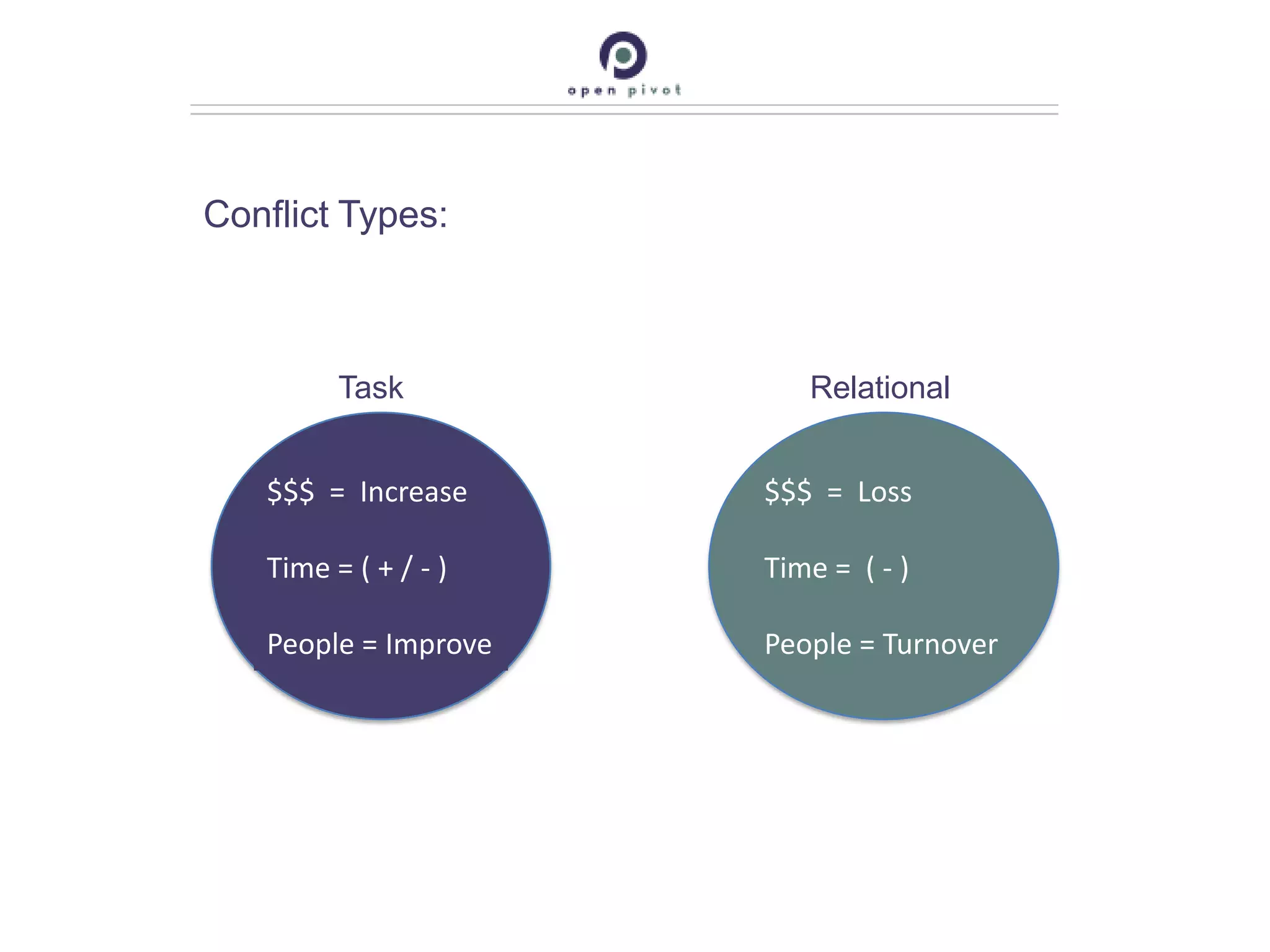
Conflict Types:
Task Relational
$$$ = Increase
Time = ( + / - )
People = Improve
$$$ = Loss
Time = ( - )
People = Turnover
Self-Evaluation: “During Conflict I…”
• Distance Myself By Pulling Away: Avoider
• Come At Others By Attacking: Agitator
• Build Alliances and Pair With Others: Acquiesce
Conflict Continuum: Point Easy and Point
Hard
HIGH
T
I
M
E
LOW HIGH
DIFFICULTY
Point Easy
Point Hard
Situational Leadership Model
LOW SUPPORT
HIGH INSTRUCTION
INSTRUCT THEME
LOW SUPPORT
LOW INSTRUCTION
DELEGATE THEME
HIGH INSTRUCTION
HIGH SUPPORT
COACH THEME
HIGH SUPPORT
LOW INSTRUCTION
RELATE THEME
LOW
S
U
P
P
O
R
T
HIGH
LOW
INSTRUCTION
My Team’s Situational Leadership Model
INSTRUCT OR TRAIN THEME
1.
2.
3.
DELEGATE THEME
1.
2.
3.
COACH THEME (AT-RISK, NEW)
1.
2.
3.
RELATE THEME
1.
2.
3.
LOW
S
U
P
P
O
R
T
HIGH LOW
INSTRUCTION
Fierce Conversation Overview
Adapted from Susan Scott “Fierce Convo”
Defined: One in which we come out from behind ourselves into the
conversation and make it real
“The person who can most accurately describe reality without laying blame
will emerge the leader.” - Susan Scott
“As a leader, if you tolerate the behavior you are saying it is ok.” – Susan
Scott
Evaluate:
1. What are you afraid to address with your boss?
2. What are you not addressing with your direct reports?
3. How often are you just being polite saying things you do not mean?
Fierce Conversation Framework
Adapted from Susan Scott “Fierce Convo”
Step #1: Identify The Issue – “What do we need to resolve today?”
Step #2: Clarify The Issue – “What and for how long has this been going
on?”
Step #3: Determine The Impact – “How does this impact you / me and
others?”
Step #4: Future Implications – “How does this issue threaten our future?”
Step #5: Personal Contribution – “What have I done to contribute?”
Step #6: Ideal Outcome- “When this is resolved what will be different?”
Step #7 Commit To Action- “What is the most potent step I can take?”
Fierce Conversation – Preparation
Step #1: Identify The Issue – ___________________________________
Step #2: Clarify The Issue – ____________________________________
Step #3: Determine The Impact – $_____ People______ Company_____
Step #4: Future Implications – __________________________________
Step #5: Personal Contribution – ________________________________
Step #6: Ideal Outcome- _______________________________________
Step #7 Commit To Action- _____________________________________

Conflict handouts

  • 1.
  • 2.
    Conflict Statistics • 60– 80% of all workplace difficulties stem from strained relationships with peers. “Managing Differences” by Daniel Dana • 66% of men and women say that workplace conflict has a huge impact on their overall stress level (American Psychology Association 2004) • If an employee misses work because of a stress related issue it typically lasts 21 days or more – (U.S. Bureau of Labor) • 20% of managers time is spent on conflict management (AMA)
  • 3.
    Conflict Defined • StonegateMortgage Definition: • Academic Definition: Process resulting from tension between team members impacting performance
  • 4.
    Conflict Types: Task Relational $$$= Increase Time = ( + / - ) People = Improve $$$ = Loss Time = ( - ) People = Turnover
  • 5.
    Self-Evaluation: “During ConflictI…” • Distance Myself By Pulling Away: Avoider • Come At Others By Attacking: Agitator • Build Alliances and Pair With Others: Acquiesce
  • 6.
    Conflict Continuum: PointEasy and Point Hard HIGH T I M E LOW HIGH DIFFICULTY Point Easy Point Hard
  • 7.
    Situational Leadership Model LOWSUPPORT HIGH INSTRUCTION INSTRUCT THEME LOW SUPPORT LOW INSTRUCTION DELEGATE THEME HIGH INSTRUCTION HIGH SUPPORT COACH THEME HIGH SUPPORT LOW INSTRUCTION RELATE THEME LOW S U P P O R T HIGH LOW INSTRUCTION
  • 8.
    My Team’s SituationalLeadership Model INSTRUCT OR TRAIN THEME 1. 2. 3. DELEGATE THEME 1. 2. 3. COACH THEME (AT-RISK, NEW) 1. 2. 3. RELATE THEME 1. 2. 3. LOW S U P P O R T HIGH LOW INSTRUCTION
  • 9.
    Fierce Conversation Overview Adaptedfrom Susan Scott “Fierce Convo” Defined: One in which we come out from behind ourselves into the conversation and make it real “The person who can most accurately describe reality without laying blame will emerge the leader.” - Susan Scott “As a leader, if you tolerate the behavior you are saying it is ok.” – Susan Scott Evaluate: 1. What are you afraid to address with your boss? 2. What are you not addressing with your direct reports? 3. How often are you just being polite saying things you do not mean?
  • 10.
    Fierce Conversation Framework Adaptedfrom Susan Scott “Fierce Convo” Step #1: Identify The Issue – “What do we need to resolve today?” Step #2: Clarify The Issue – “What and for how long has this been going on?” Step #3: Determine The Impact – “How does this impact you / me and others?” Step #4: Future Implications – “How does this issue threaten our future?” Step #5: Personal Contribution – “What have I done to contribute?” Step #6: Ideal Outcome- “When this is resolved what will be different?” Step #7 Commit To Action- “What is the most potent step I can take?”
  • 11.
    Fierce Conversation –Preparation Step #1: Identify The Issue – ___________________________________ Step #2: Clarify The Issue – ____________________________________ Step #3: Determine The Impact – $_____ People______ Company_____ Step #4: Future Implications – __________________________________ Step #5: Personal Contribution – ________________________________ Step #6: Ideal Outcome- _______________________________________ Step #7 Commit To Action- _____________________________________