2
• It is concerned with converting
materials and labor into goods and
services as efficiently as possible to
maximize the profit of an
organization.
• It is a transformation process of
converting inputs into outputs.
3
• Operations Management concern with
the conversion of inputs into outputs,
using physical resources, so as to
provide the desired utilities to the
customer while meeting the other
organizational objectives of
effectiveness, efficiency and
adoptability.
4
• Following are the activities, which are
listed under Production and Operations
Management functions:
1. Location of facilities.
2. Plant layouts and Material Handling.
3. Product Design.
4. Process Design.
5
5. Production Planning and Control.
6. Quality Control.
7. Materials Management.
8. Maintenance Management.
6
• The technique of foreseeing every
step in a long series of separate
operations, each step to be taken at
the right time and in the right place
and each operation to be performed
in maximum efficiency.
7
• It helps entrepreneur to work out the
quantity of material, manpower,
machine and money requires for
producing predetermined level of
output in given period of time.
• Production planning starts with
planning and ends with loading.
8
PLANNING
ROUTING
SCHEDULING
LOADING
9
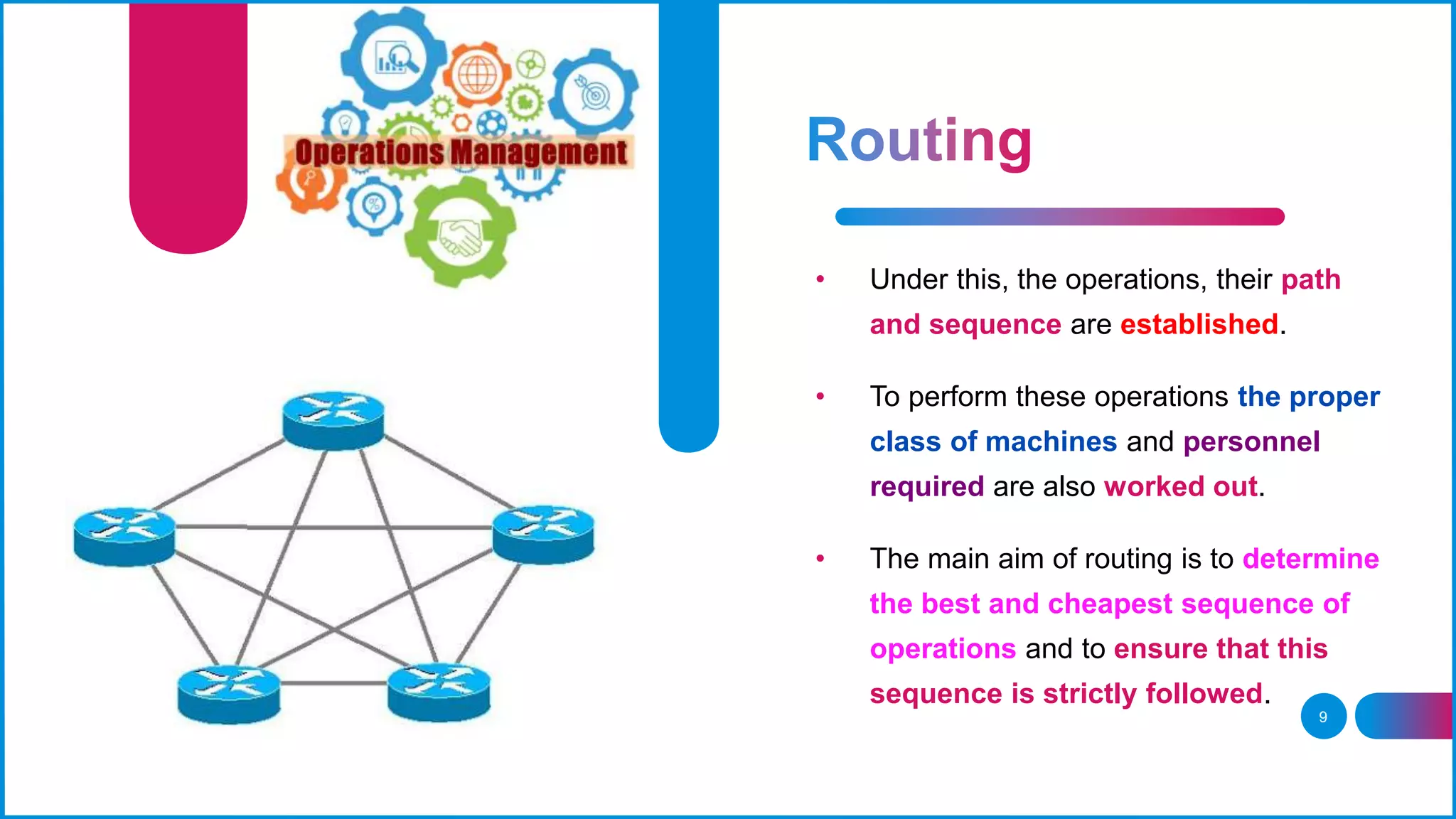
• Under this, the operations, their path
and sequence are established.
• To perform these operations the proper
class of machines and personnel
required are also worked out.
• The main aim of routing is to determine
the best and cheapest sequence of
operations and to ensure that this
sequence is strictly followed.
10
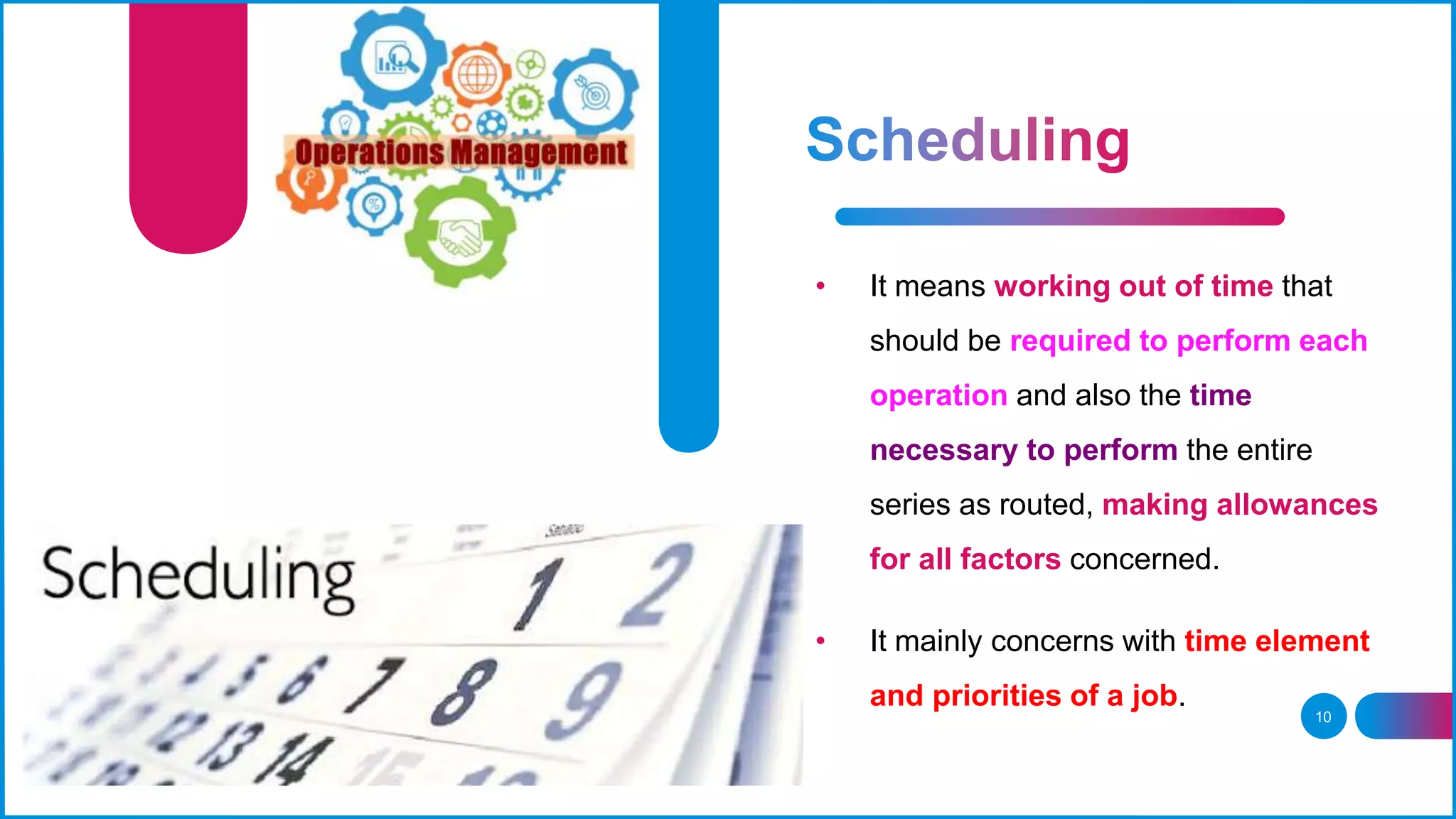
• It means working out of time that
should be required to perform each
operation and also the time
necessary to perform the entire
series as routed, making allowances
for all factors concerned.
• It mainly concerns with time element
and priorities of a job.
11
• Production schedule: The main aim is to schedule
that amount of work, which can easily be handled
by plant and equipment without interference.
• Master Schedule: Scheduling usually starts with
preparation of master schedule which is weekly
or monthly break-down of the production
requirement for each product for a definite time
period, by having this as a running record of total
production requirements the entrepreneur is in
better position to shift the production from one
product to another as per the changed
production requirements.
12
• Manufacturing schedule: It is prepared
on the basis of type of manufacturing
process involved. It is very useful where
single or few products are
manufactured repeatedly at regular
intervals. Thus it would show the
required quality of each product and
sequence in which the same to be
operated.
13
• The next step is the execution of the
schedule plan as per the route chalked
out it includes the assignment of the
work to the operators at their machines
or work places.
• So loading determines who will do the
work as routing determines where and
scheduling determines when it shall
be done.
14
• Production control is the process of
planning production in advance of
operations, establishing the extract route
of each individual item part or assembly,
setting, starting and finishing for each
important item, assembly or the finishing
production and releasing the necessary
orders as well as initiating the necessary
follow-up to have the smooth function of
the enterprise.
15
DISPATCHING
FOLLOWING UP
INSPECTION
CORRECVTIVE
MEASURES
16
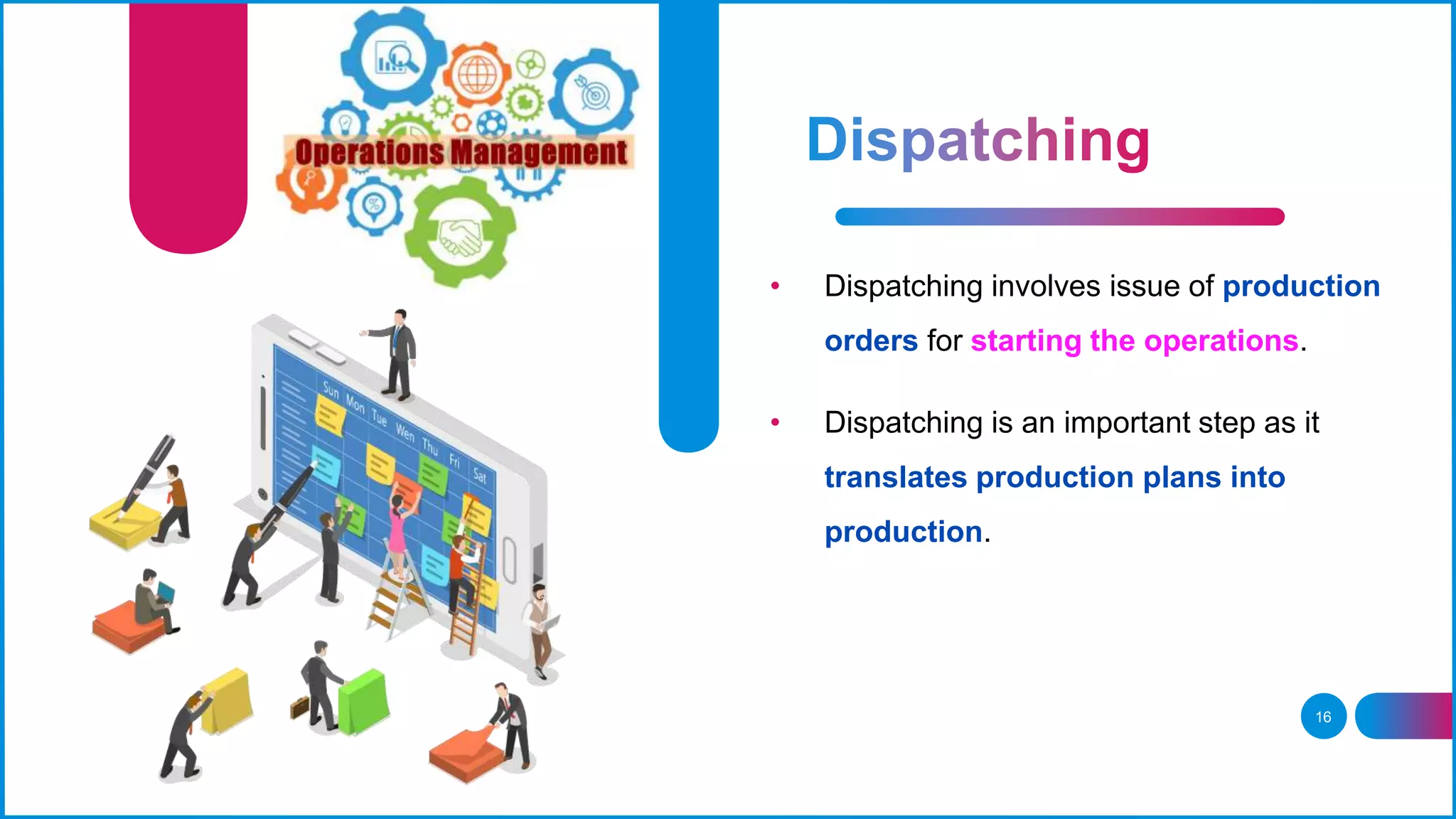
• Dispatching involves issue of production
orders for starting the operations.
• Dispatching is an important step as it
translates production plans into
production.
17
• Every production programme involves
determination of the progress of work,
removing bottlenecks in the flow of work
and ensuring that the productive
operations are taking place in accordance
with the plans.
• All problems or deviations are
investigated and remedial measurer are
undertaken to ensure the completion of
work by the planned date.
18
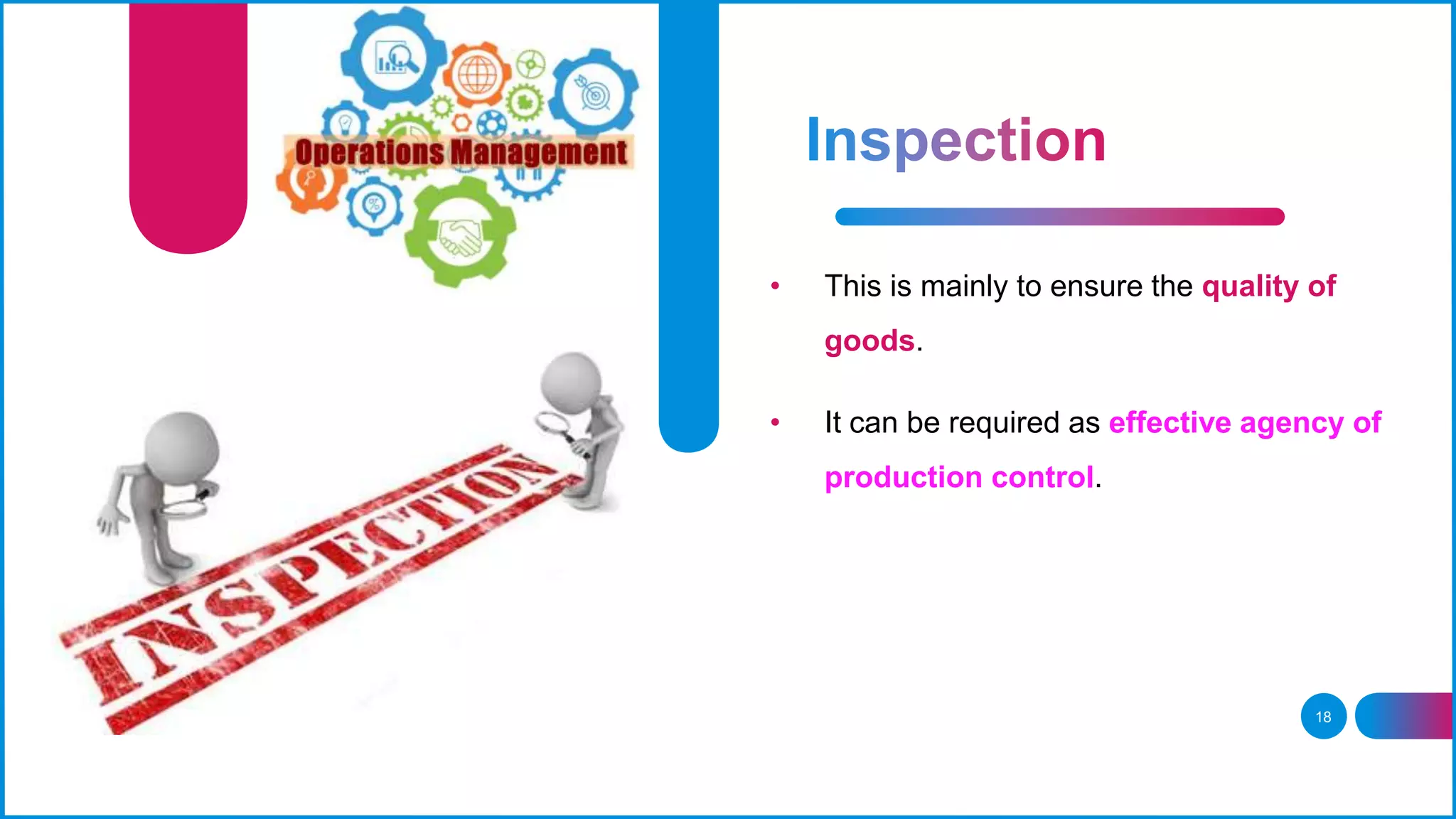
• This is mainly to ensure the quality of
goods.
• It can be required as effective agency of
production control.
19
• Corrective action may involve any of
those activities of adjusting the route,
rescheduling of work changing the
workloads, repairs and maintenance of
machinery or equipment, control over
inventories of the cause of deviation is
the poor performance of the
employees.
20
• Chase Strategy
• Level Strategy
• Pure / Mixed Strategy
• Sub Contracting
21
• Match the production rate to the order
rate by hiring and laying off employees
as the order rate varies.
22
• Maintain a stable workforce working at a
constant output rate.
• Fluctuating inventory levels absorbs
shortages and surpluses.
• Order backlogs and lost sales.
• Employee’s benefit from stable work hours
at the costs of potentially decreased
customer service levels and increased
inventory costs.
23
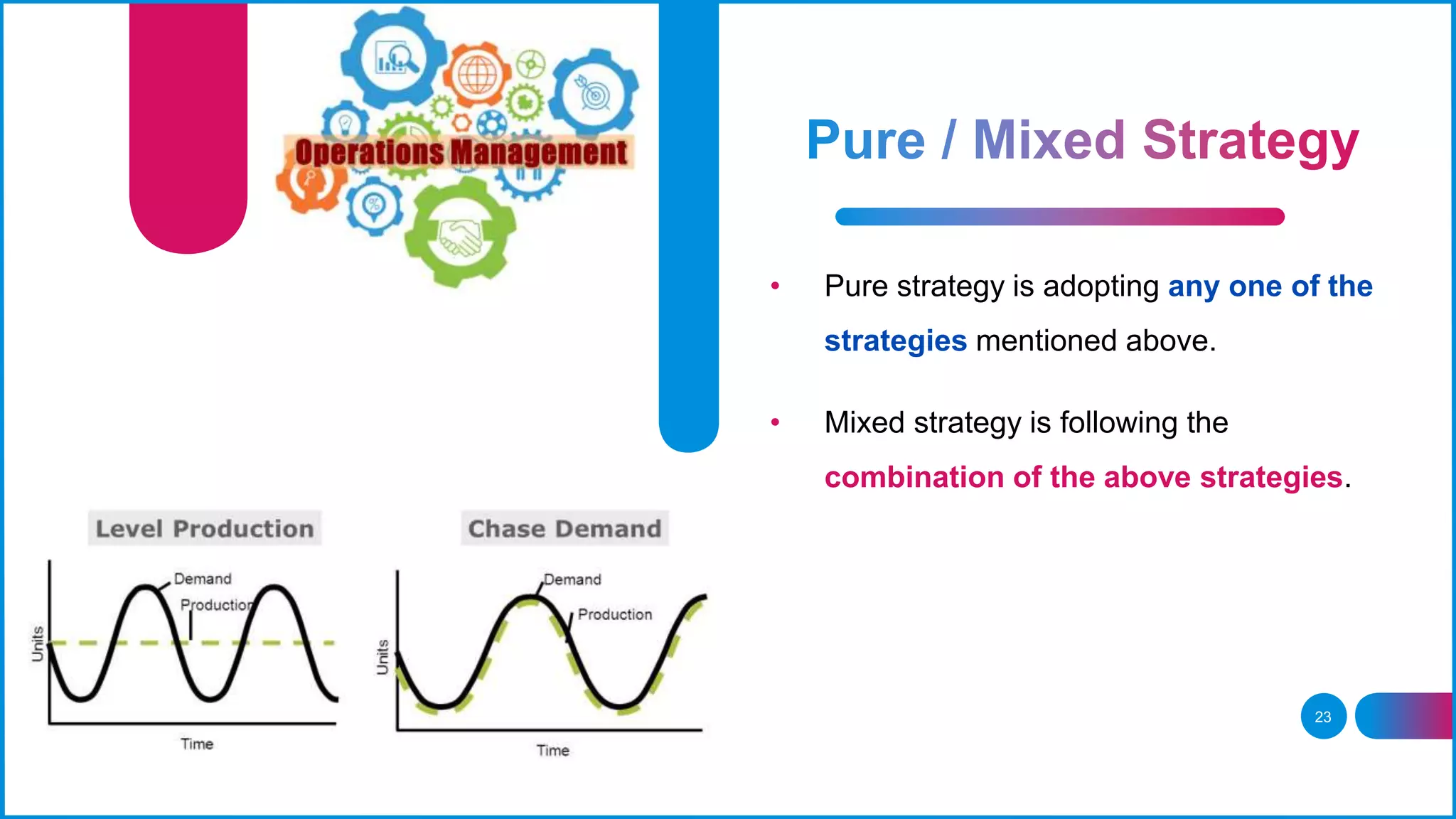
• Pure strategy is adopting any one of the
strategies mentioned above.
• Mixed strategy is following the
combination of the above strategies.
24
• This strategy is similar to chase strategy as the
managers may choose to subcontract some portion of
production.
• Hiring and laying off is translated to sub contracting.
• Some level of subcontracting can be desirable to
accommodate demand fluctuations.
• The manufacturer can loose some control over schedule
and quality if the relationship with the supplier is not
strong.
• Extensive subcontracting is viewed as a high-risk
strategy.
25
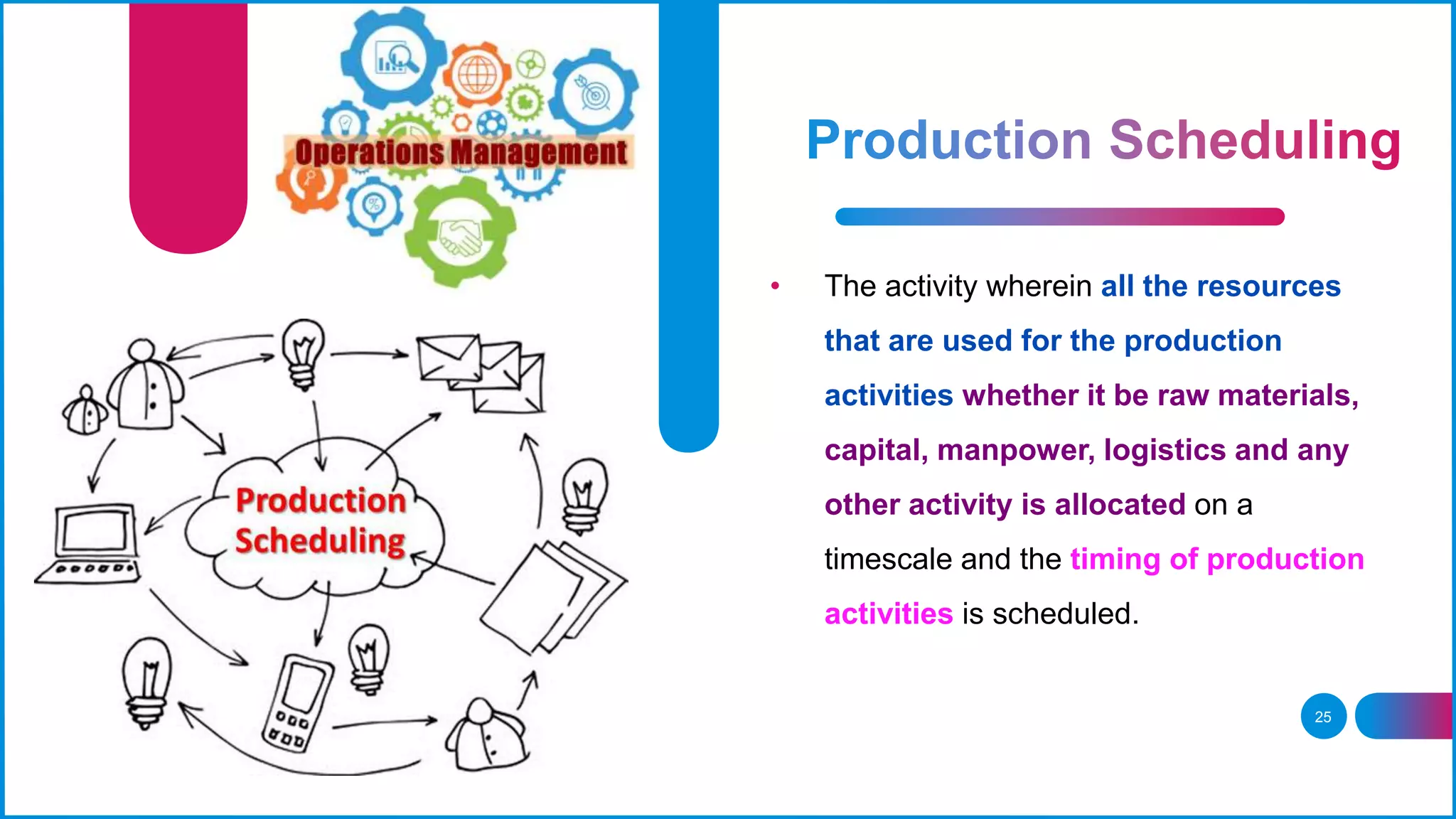
• The activity wherein all the resources
that are used for the production
activities whether it be raw materials,
capital, manpower, logistics and any
other activity is allocated on a
timescale and the timing of production
activities is scheduled.
26
• Forward Scheduling
• Backward scheduling
27
• Forward scheduling is a scheduling
method in which actual production
activities start when a job order is
received.
• Using forward scheduling, the operations
manager determines the start and finish
times for jobs to be done by assigning
them to the earliest available time slots
at the work center.
28
• As the jobs start at the earliest
possible time, they are completed
before they are required at subsequent
work centers.
• Therefore, the work-in-process
inventory levels are high in the forward
scheduling method.
29
• The backward scheduling method
schedules order according to their due
dates.
• Backwards scheduling requires a delivery
date from the customer because the
system schedules backwards from the
delivery date to arrive at a start date.
• Backward scheduling is commonly used
when making arrangements for special
events and occasions such as marriages
30
• Routing
• Loading
• Dispatching
31
• Firms that follow this rule prioritize their
jobs according to their earliest due date.
• A firm lists the earliest due dates of all
the jobs and dispatching is done in
such a way that the one with the earliest
due date is dispatched first, the next
earliest job second, and so on.
32
• Jobs that have the longest processing
time are loaded first onto the work
center in this method.
• These types of jobs are given priority they
are considered more valuable to
organizations.
33
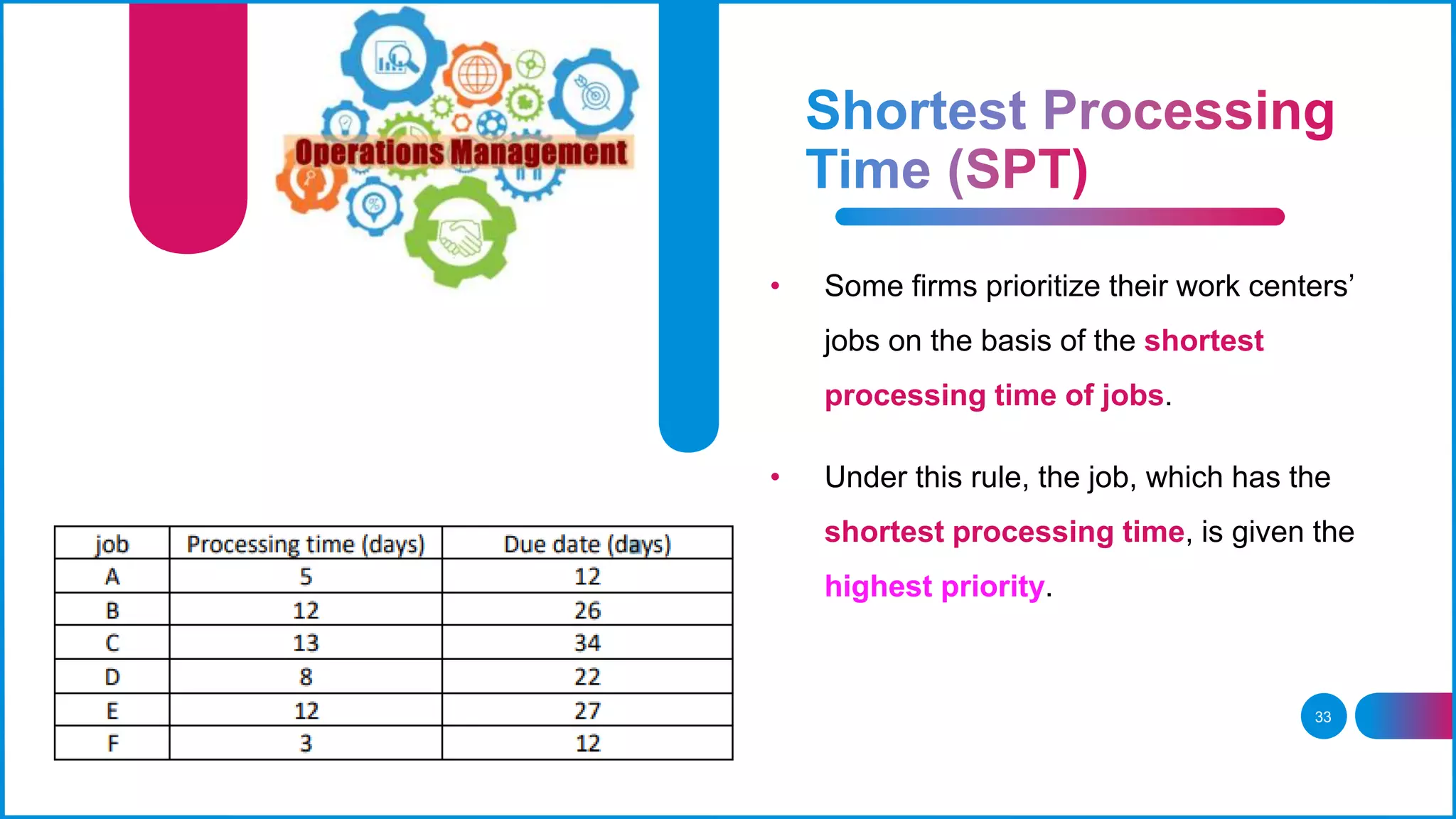
• Some firms prioritize their work centers’
jobs on the basis of the shortest
processing time of jobs.
• Under this rule, the job, which has the
shortest processing time, is given the
highest priority.
34
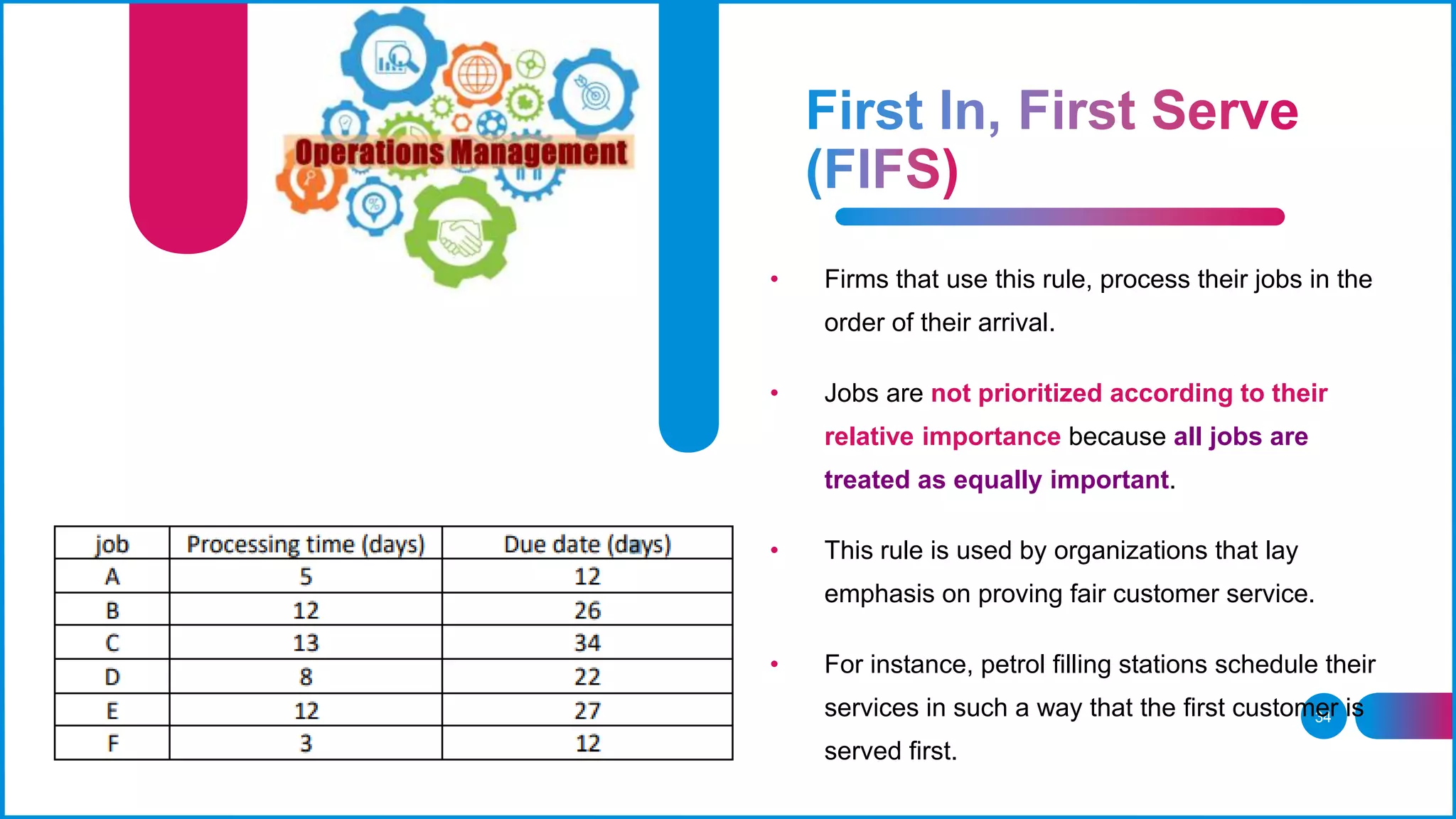
• Firms that use this rule, process their jobs in the
order of their arrival.
• Jobs are not prioritized according to their
relative importance because all jobs are
treated as equally important.
• This rule is used by organizations that lay
emphasis on proving fair customer service.
• For instance, petrol filling stations schedule their
services in such a way that the first customer is
served first.
35
• The operations manager calculates the
slack time of each job, i.e. the
difference between the time remaining
in the due date and the processing
time required.
• Jobs with the shortest slack time are
dispatched first.
Operations management

Operations management

  • 2.
    2 • It isconcerned with converting materials and labor into goods and services as efficiently as possible to maximize the profit of an organization. • It is a transformation process of converting inputs into outputs.
  • 3.
    3 • Operations Managementconcern with the conversion of inputs into outputs, using physical resources, so as to provide the desired utilities to the customer while meeting the other organizational objectives of effectiveness, efficiency and adoptability.
  • 4.
    4 • Following arethe activities, which are listed under Production and Operations Management functions: 1. Location of facilities. 2. Plant layouts and Material Handling. 3. Product Design. 4. Process Design.
  • 5.
    5 5. Production Planningand Control. 6. Quality Control. 7. Materials Management. 8. Maintenance Management.
  • 6.
    6 • The techniqueof foreseeing every step in a long series of separate operations, each step to be taken at the right time and in the right place and each operation to be performed in maximum efficiency.
  • 7.
    7 • It helpsentrepreneur to work out the quantity of material, manpower, machine and money requires for producing predetermined level of output in given period of time. • Production planning starts with planning and ends with loading.
  • 8.
  • 9.
    9 • Under this,the operations, their path and sequence are established. • To perform these operations the proper class of machines and personnel required are also worked out. • The main aim of routing is to determine the best and cheapest sequence of operations and to ensure that this sequence is strictly followed.
  • 10.
    10 • It meansworking out of time that should be required to perform each operation and also the time necessary to perform the entire series as routed, making allowances for all factors concerned. • It mainly concerns with time element and priorities of a job.
  • 11.
    11 • Production schedule:The main aim is to schedule that amount of work, which can easily be handled by plant and equipment without interference. • Master Schedule: Scheduling usually starts with preparation of master schedule which is weekly or monthly break-down of the production requirement for each product for a definite time period, by having this as a running record of total production requirements the entrepreneur is in better position to shift the production from one product to another as per the changed production requirements.
  • 12.
    12 • Manufacturing schedule:It is prepared on the basis of type of manufacturing process involved. It is very useful where single or few products are manufactured repeatedly at regular intervals. Thus it would show the required quality of each product and sequence in which the same to be operated.
  • 13.
    13 • The nextstep is the execution of the schedule plan as per the route chalked out it includes the assignment of the work to the operators at their machines or work places. • So loading determines who will do the work as routing determines where and scheduling determines when it shall be done.
  • 14.
    14 • Production controlis the process of planning production in advance of operations, establishing the extract route of each individual item part or assembly, setting, starting and finishing for each important item, assembly or the finishing production and releasing the necessary orders as well as initiating the necessary follow-up to have the smooth function of the enterprise.
  • 15.
  • 16.
    16 • Dispatching involvesissue of production orders for starting the operations. • Dispatching is an important step as it translates production plans into production.
  • 17.
    17 • Every productionprogramme involves determination of the progress of work, removing bottlenecks in the flow of work and ensuring that the productive operations are taking place in accordance with the plans. • All problems or deviations are investigated and remedial measurer are undertaken to ensure the completion of work by the planned date.
  • 18.
    18 • This ismainly to ensure the quality of goods. • It can be required as effective agency of production control.
  • 19.
    19 • Corrective actionmay involve any of those activities of adjusting the route, rescheduling of work changing the workloads, repairs and maintenance of machinery or equipment, control over inventories of the cause of deviation is the poor performance of the employees.
  • 20.
    20 • Chase Strategy •Level Strategy • Pure / Mixed Strategy • Sub Contracting
  • 21.
    21 • Match theproduction rate to the order rate by hiring and laying off employees as the order rate varies.
  • 22.
    22 • Maintain astable workforce working at a constant output rate. • Fluctuating inventory levels absorbs shortages and surpluses. • Order backlogs and lost sales. • Employee’s benefit from stable work hours at the costs of potentially decreased customer service levels and increased inventory costs.
  • 23.
    23 • Pure strategyis adopting any one of the strategies mentioned above. • Mixed strategy is following the combination of the above strategies.
  • 24.
    24 • This strategyis similar to chase strategy as the managers may choose to subcontract some portion of production. • Hiring and laying off is translated to sub contracting. • Some level of subcontracting can be desirable to accommodate demand fluctuations. • The manufacturer can loose some control over schedule and quality if the relationship with the supplier is not strong. • Extensive subcontracting is viewed as a high-risk strategy.
  • 25.
    25 • The activitywherein all the resources that are used for the production activities whether it be raw materials, capital, manpower, logistics and any other activity is allocated on a timescale and the timing of production activities is scheduled.
  • 26.
    26 • Forward Scheduling •Backward scheduling
  • 27.
    27 • Forward schedulingis a scheduling method in which actual production activities start when a job order is received. • Using forward scheduling, the operations manager determines the start and finish times for jobs to be done by assigning them to the earliest available time slots at the work center.
  • 28.
    28 • As thejobs start at the earliest possible time, they are completed before they are required at subsequent work centers. • Therefore, the work-in-process inventory levels are high in the forward scheduling method.
  • 29.
    29 • The backwardscheduling method schedules order according to their due dates. • Backwards scheduling requires a delivery date from the customer because the system schedules backwards from the delivery date to arrive at a start date. • Backward scheduling is commonly used when making arrangements for special events and occasions such as marriages
  • 30.
  • 31.
    31 • Firms thatfollow this rule prioritize their jobs according to their earliest due date. • A firm lists the earliest due dates of all the jobs and dispatching is done in such a way that the one with the earliest due date is dispatched first, the next earliest job second, and so on.
  • 32.
    32 • Jobs thathave the longest processing time are loaded first onto the work center in this method. • These types of jobs are given priority they are considered more valuable to organizations.
  • 33.
    33 • Some firmsprioritize their work centers’ jobs on the basis of the shortest processing time of jobs. • Under this rule, the job, which has the shortest processing time, is given the highest priority.
  • 34.
    34 • Firms thatuse this rule, process their jobs in the order of their arrival. • Jobs are not prioritized according to their relative importance because all jobs are treated as equally important. • This rule is used by organizations that lay emphasis on proving fair customer service. • For instance, petrol filling stations schedule their services in such a way that the first customer is served first.
  • 35.
    35 • The operationsmanager calculates the slack time of each job, i.e. the difference between the time remaining in the due date and the processing time required. • Jobs with the shortest slack time are dispatched first.