Dear Sir/Madam
For more
Please visit my YouTube Channel to learn computer
https://www.youtube.com/yka39
For class IX & X Computer Class visit-:
www.it402.com
AGENTS OF GRADATION
AGENTS OF GRADATION
• The earth surface is very uneven.
• There are various landforms found on the
earth surface.
• Would you name some of the landforms
which you see on the earth surface ?
• …………………
These features are the result
of
various endogenic and exogenic
forces
Exogenic forces include :
Weathering
• Rocks are weaken by
the process of
Weathering.
Erosion
• Such weak rocks are
easily eroded and
transported by the
agents of gradation.
Agents of gradation
try to level the ground which is
made uneven by endogenic forces.
There are five agents of gradation :
• Running water
• Ground water
• Moving snow
• Wind &
• Sea waves
Today we would be looking into the work of
Moving snow / ice.
Gl and
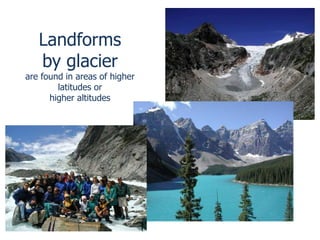
Landforms
by glacier
are found in areas of higher
latitudes or
higher altitudes
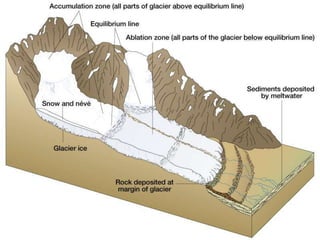
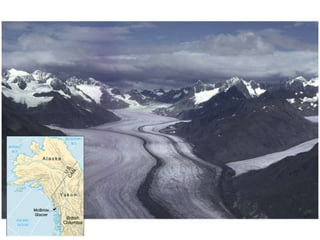
What is a glacier?
• A glacier is simply the existence of year-
round ice on the landscape.
• There are two broad types: continental and
alpine.
How do glaciers form?
• Glaciers form whenever snowfall exceeds
snowmelt year after year. The snow
accumulates incrementally, pressure increases,
and it is changed into névé and then ice by
this pressure.
Why is a glacier the only thing that is
ever comiEROSIONAL
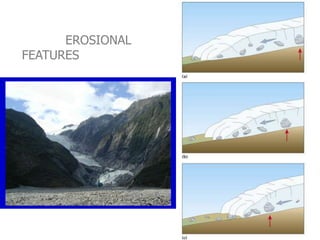
FEATURESgoing at the same
time?
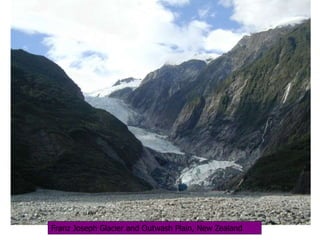
Franz Joseph Glacier and Outwash Plain, New Zealand
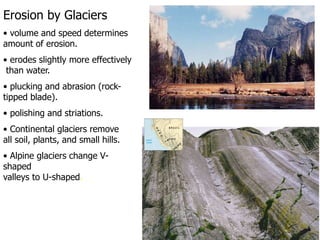
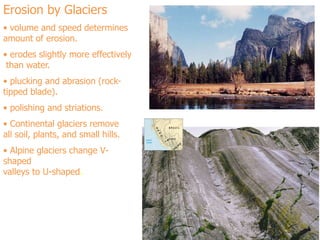
Erosion by Glaciers
• volume and speed determines
amount of erosion.
• erodes slightly more effectively
than water.
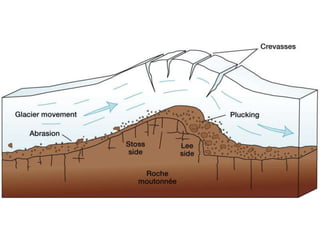
• plucking and abrasion (rock-
tipped blade).
• polishing and striations.
• Continental glaciers remove
all soil, plants, and small hills.
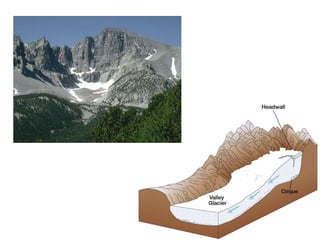
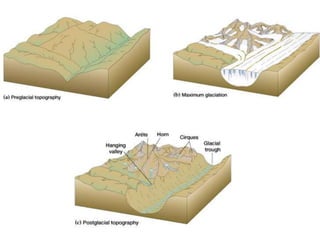
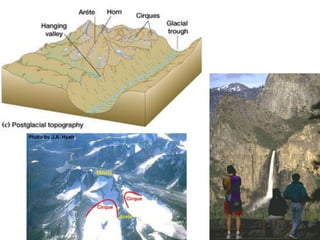
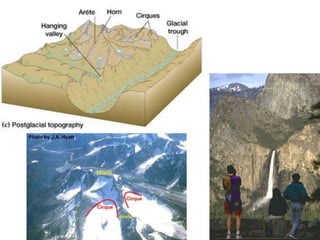
• Alpine glaciers change V-
shaped
valleys to U-shaped.
DdepoDsition by GDlaciers
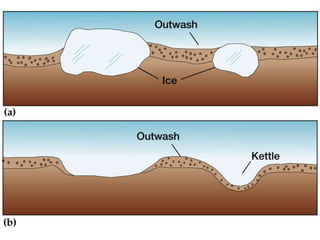
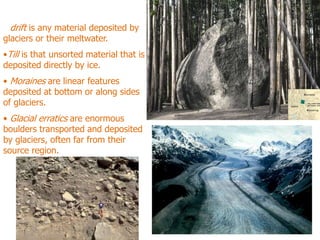
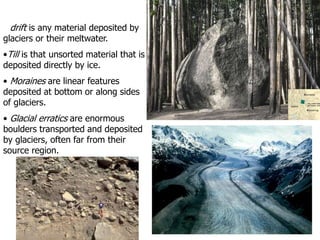
• drift is any material deposited by
glaciers or their meltwater.
•Till is that unsorted material that is
deposited directly by ice.
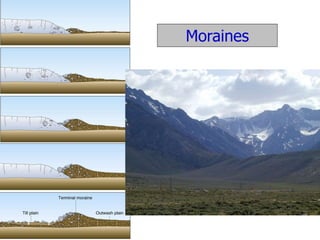
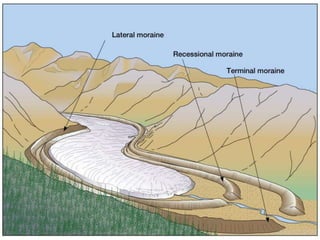
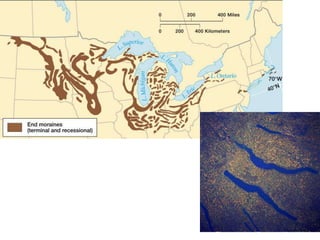
• Moraines are linear features
deposited at bottom or along sides
of glaciers.
• Glacial erratics are enormous
boulders transported and deposited
by glaciers, often far from their
source region.
Deposition by Glaciers
• drift is any material deposited by
glaciers or their meltwater.
•Till is that unsorted material that is
deposited directly by ice.
• Moraines are linear features
deposited at bottom or along sides
of glaciers.
• Glacial erratics are enormous
boulders transported and deposited
by glaciers, often far from their
source region.
Moraines
Finger Lakes Region, New York
Erosion by Glaciers
• volume and speed determines
amount of erosion.
• erodes slightly more effectively
than water.
• plucking and abrasion (rock-
tipped blade).
• polishing and striations.
• Continental glaciers remove
all soil, plants, and small hills.
• Alpine glaciers change V-
shaped
valleys to U-shaped.
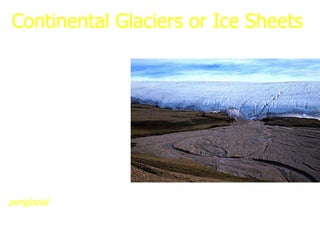
Continental Glaciers or Ice Sheets
• only two true ice sheets exist
today: Greenland and
Antarctica
• where they meet the sea
they can form ice sheets.
• vary in thickness from
hundreds of feet to two miles
deep
• scour away all soil and
vegetation and dramatically
reshape the landscape and
ecology of large regions.
• much change occurs in the
periglacial environment.
Ellesmere Island, Canada
Dear Sir/Madam
For more
Please visit my YouTube Channel to learn computer
https://www.youtube.com/yka39
For class IX & X Computer Class visit-:
www.it402.com

Agents of gradation

  • 1.
    Dear Sir/Madam For more Pleasevisit my YouTube Channel to learn computer https://www.youtube.com/yka39 For class IX & X Computer Class visit-: www.it402.com
  • 2.
  • 3.
    AGENTS OF GRADATION •The earth surface is very uneven. • There are various landforms found on the earth surface. • Would you name some of the landforms which you see on the earth surface ? • …………………
  • 4.
    These features arethe result of various endogenic and exogenic forces
  • 5.
    Exogenic forces include: Weathering • Rocks are weaken by the process of Weathering. Erosion • Such weak rocks are easily eroded and transported by the agents of gradation.
  • 6.
    Agents of gradation tryto level the ground which is made uneven by endogenic forces.
  • 7.
    There are fiveagents of gradation : • Running water • Ground water • Moving snow • Wind & • Sea waves Today we would be looking into the work of Moving snow / ice.
  • 8.
    Gl and Landforms by glacier arefound in areas of higher latitudes or higher altitudes
  • 9.
    What is aglacier? • A glacier is simply the existence of year- round ice on the landscape. • There are two broad types: continental and alpine. How do glaciers form? • Glaciers form whenever snowfall exceeds snowmelt year after year. The snow accumulates incrementally, pressure increases, and it is changed into névé and then ice by this pressure.
  • 10.
    Why is aglacier the only thing that is ever comiEROSIONAL FEATURESgoing at the same time?
  • 13.
    Franz Joseph Glacierand Outwash Plain, New Zealand
  • 15.
    Erosion by Glaciers •volume and speed determines amount of erosion. • erodes slightly more effectively than water. • plucking and abrasion (rock- tipped blade). • polishing and striations. • Continental glaciers remove all soil, plants, and small hills. • Alpine glaciers change V- shaped valleys to U-shaped.
  • 16.
    DdepoDsition by GDlaciers •drift is any material deposited by glaciers or their meltwater. •Till is that unsorted material that is deposited directly by ice. • Moraines are linear features deposited at bottom or along sides of glaciers. • Glacial erratics are enormous boulders transported and deposited by glaciers, often far from their source region.
  • 18.
    Deposition by Glaciers •drift is any material deposited by glaciers or their meltwater. •Till is that unsorted material that is deposited directly by ice. • Moraines are linear features deposited at bottom or along sides of glaciers. • Glacial erratics are enormous boulders transported and deposited by glaciers, often far from their source region.
  • 20.
  • 23.
  • 24.
    Erosion by Glaciers •volume and speed determines amount of erosion. • erodes slightly more effectively than water. • plucking and abrasion (rock- tipped blade). • polishing and striations. • Continental glaciers remove all soil, plants, and small hills. • Alpine glaciers change V- shaped valleys to U-shaped.
  • 27.
    Continental Glaciers orIce Sheets • only two true ice sheets exist today: Greenland and Antarctica • where they meet the sea they can form ice sheets. • vary in thickness from hundreds of feet to two miles deep • scour away all soil and vegetation and dramatically reshape the landscape and ecology of large regions. • much change occurs in the periglacial environment. Ellesmere Island, Canada
  • 28.
    Dear Sir/Madam For more Pleasevisit my YouTube Channel to learn computer https://www.youtube.com/yka39 For class IX & X Computer Class visit-: www.it402.com