Chapter 1: HUMAN
DEVELOPMENT
Meaning, Concepts and Approaches
Preliminary Activity:
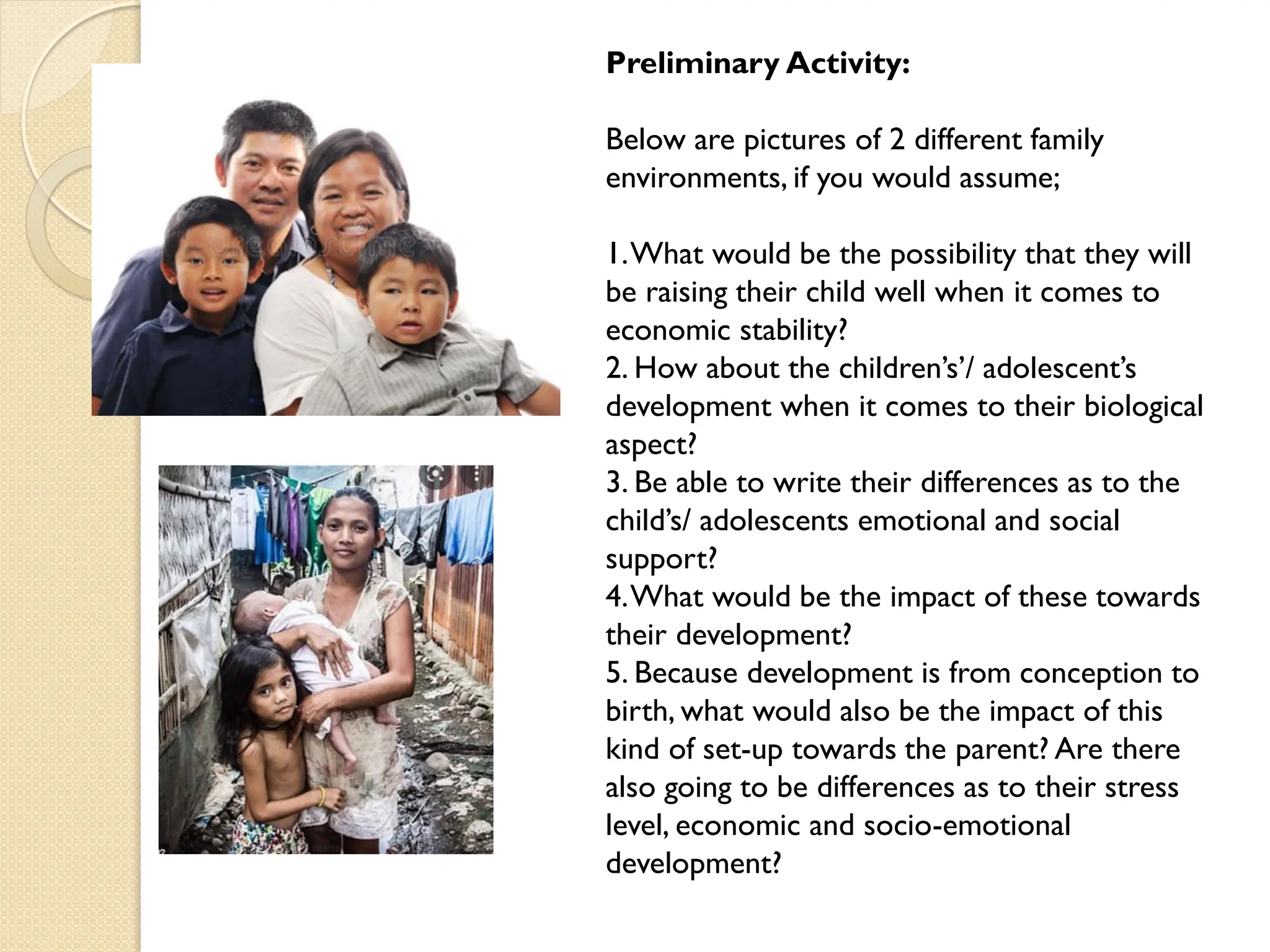
Below are pictures of 2 different family
environments, if you would assume;
1.What would be the possibility that they will
be raising their child well when it comes to
economic stability?
2. How about the children‟s‟/ adolescent‟s
development when it comes to their biological
aspect?
3. Be able to write their differences as to the
child‟s/ adolescents emotional and social
support?
4.What would be the impact of these towards
their development?
5. Because development is from conception to
birth, what would also be the impact of this
kind of set-up towards the parent? Are there
also going to be differences as to their stress
level, economic and socio-emotional
development?
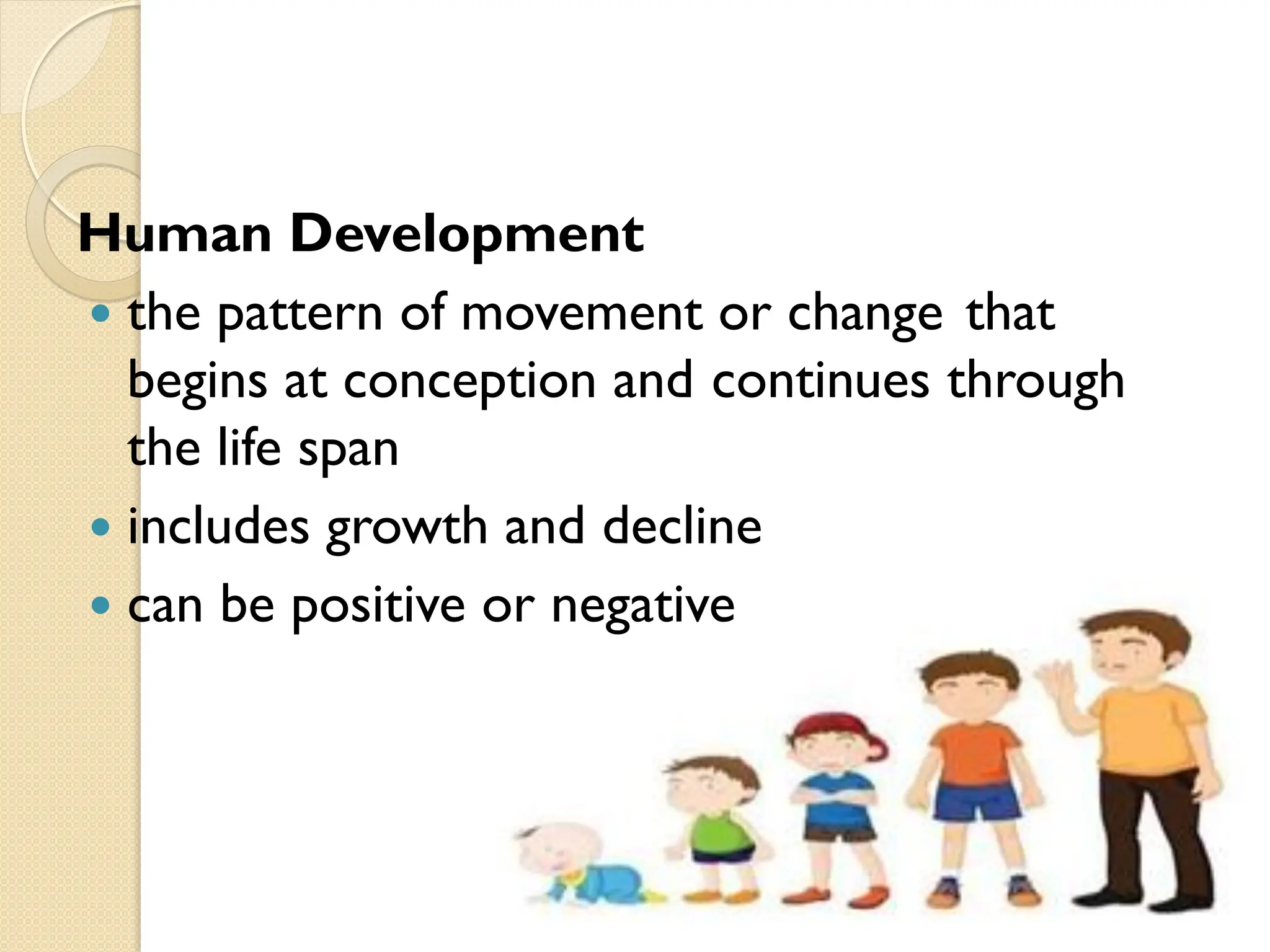
Human Development
 the pattern of movement or change that
begins at conception and continues through
the life span
 includes growth and decline
 can be positive or negative
Major Principles of Human Development:
1. Development is
relatively
orderlya.)
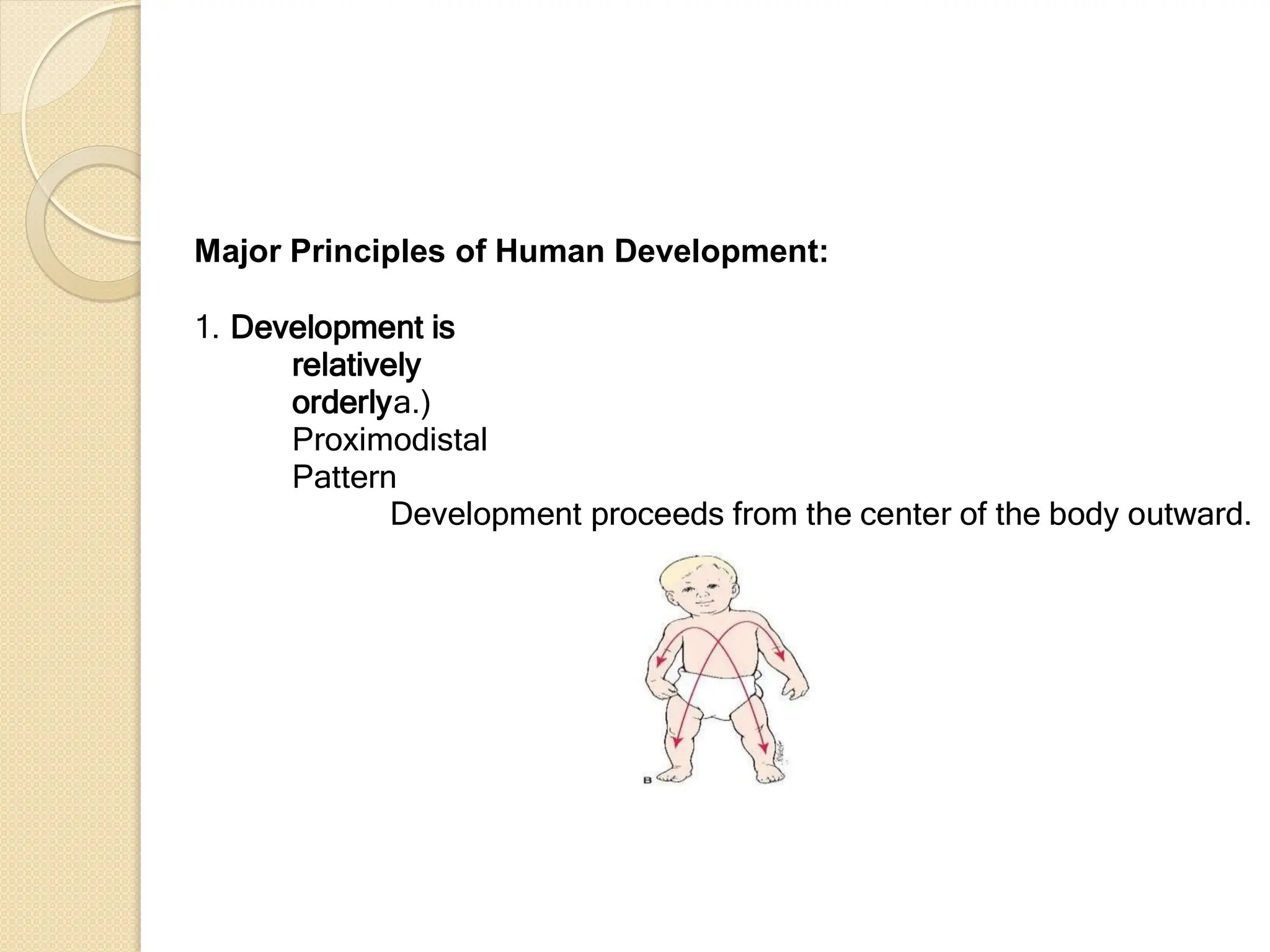
Proximodistal
Pattern
Development proceeds from the center of the body outward.
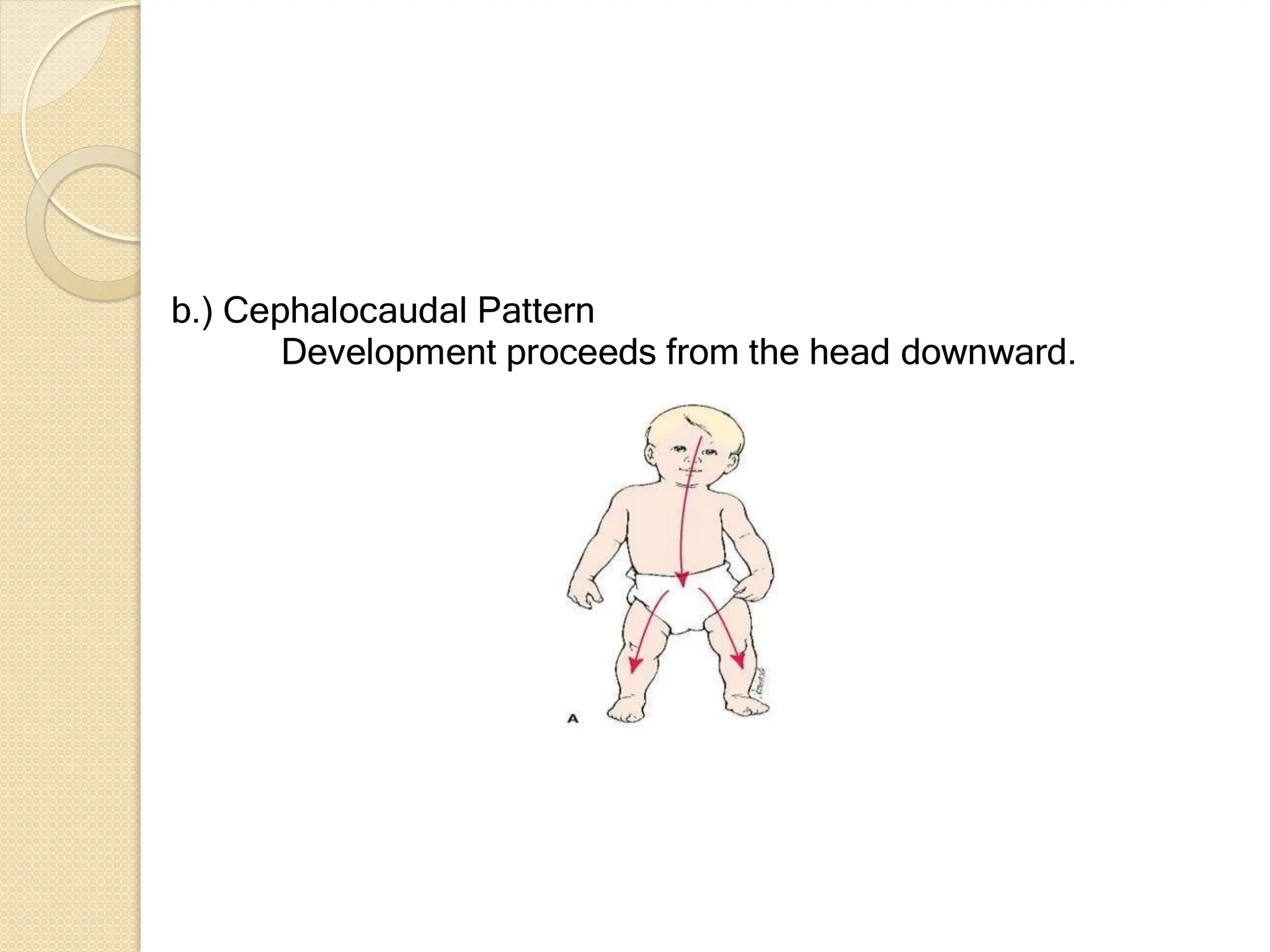
b.) Cephalocaudal Pattern
Development proceeds from the head downward.
 2. Development depends on maturation and
learning – Human growth and development are influenced
by both maturation and learning.
 3. Development proceeds from the simple to
complex- Children perform simple tasks before doing
complex ones. For example, children learn letters before
words.
 4. Development is a continuous process – As a child
develops, he or she adds to the skills already acquired and
the new skills become the basis for further achievement
and mastery of skills. Most children follow a similar pattern.
Also, one stage of development lays the foundation for the
next stage of development.
 4. Development is a continuous process – As a child
develops, he or she adds to the skills already acquired and the new
skills become the basis for further achievement and mastery of
skills. Most children follow a similar pattern. Also, one stage of
development lays the foundation for the next stage of development.
 5. Development proceeds from the general to specific –
development occurs from large muscle movements to more refined
(smaller) muscle movements. For example, in motor development,
the infant will be able to grasp an object with the whole hand
before using only the thumb and forefinger. There are different
individual rates of development. Each child is different and the rates
at which individual children develops is different. Although the
patterns and sequences for development are usually the same for
all children, the rates at which individual children reach
developmental stages will be different. For instance, some children
walk at ten months while others walk a few months older at
eighteen months of age.
Aspects of Human Development
 The aspects of development could be many but
the most important development aspects are
physical development, cognitive development,
language development, social development,
emotional development, moral development, and
gender development.
1. • Physical development – refers to changes
in the bodily structures and functions of different
body parts.
2. • Cognitive development – refers to
intellectual development; it deals with abilities, such
as processing information that includes thinking,
imagination, memorizing, learning,
3• Language development – refers to
changes in the use of speech
4• Social development – refers to changes
in forming relationships/interaction with others.
5• Emotional development – refers to
changes in feelings; causes, and expressions of
emotions/ feelings.
6. Moral development – refers to changes in
reasoning about “Right” or “Wrong”.
7. Gender development – refers to changes in
understanding the roles played by males and
females.
Approaches to Human Development
 1.)Traditional Perspective
 Believes that individuals will show extensive
change from birth to adolescence, little or no
change in adulthood and decline in late old
age.
2.) Life-span Approach
 • Believes that even in adulthood, developmental change
takes place as it does during childhood.
 Characteristics of a Life- Span Perspective
 a.) Development is LIFELONG- It does not end in
adulthood. No developmental stage dominates development.
 b.) Development is MULTIDIMENSIONAL- Development
consists of biological, cognitive and socio-emotional
dimensions.
 c.) Development is PLASTIC- Development is possible
throughout the lifespan.
 d.) Development is CONTEXTUAL- Individuals are changing
beings in a changing world.
 e.) Development involves GROWTH, MAINTENANCE and
REGULATION- Growth, maintenance and regulation are 3
goals of human development. The goals of individuals vary
among developmental stages.
Principles of Child Development and
Learning that Inform Practice
 All areas of development and learning are
important.
 Learning and development follow sequences.
 Development and learning proceed at varying
rates
 Development and learning result from an
interaction of maturation and experience.
 Early experiences have profound effects on
development and learning.
 Development proceeds toward greater complexity,
self- regulation, and symbolic capacities.
 Children develop best when they have secure
relationships.
 Development and learning occur in and are influenced
by multiple social and cultural contexts.
 Children learn in a variety of ways.
 Play is an important vehicle for developing self-
regulation and promoting language, cognition, and
social competence.
 Development and learning advance when children are
challenged.
 Children„s experiences shape their motivation and
approaches to learning.
 Be able to watch this video about childhood trauma and answer the
following questions with utmost honesty and effort.
 https://www.youtube.com/watch?v=Hj1d8xJdPvU
 Questions:
 1.When neglect is present, what do you think would be the impact
of this situation towards the child‟s cognitive, physical and emotional
aspect? Be able to mention at least 1 or more changes that neglect
may bring towards the child.
 2. Have you had any experience with neglect when you were still
young? How do you think this affected you in your life? ( If none,
think of someone who has experienced neglect and reflect on how
this situation influenced their thinking or socio-emotional upbringing.

Chapter-1-Human-Development.pdf. sige na baya

  • 1.
  • 2.
    Preliminary Activity: Below arepictures of 2 different family environments, if you would assume; 1.What would be the possibility that they will be raising their child well when it comes to economic stability? 2. How about the children‟s‟/ adolescent‟s development when it comes to their biological aspect? 3. Be able to write their differences as to the child‟s/ adolescents emotional and social support? 4.What would be the impact of these towards their development? 5. Because development is from conception to birth, what would also be the impact of this kind of set-up towards the parent? Are there also going to be differences as to their stress level, economic and socio-emotional development?
  • 3.
    Human Development  thepattern of movement or change that begins at conception and continues through the life span  includes growth and decline  can be positive or negative
  • 4.
    Major Principles ofHuman Development: 1. Development is relatively orderlya.) Proximodistal Pattern Development proceeds from the center of the body outward.
  • 5.
    b.) Cephalocaudal Pattern Developmentproceeds from the head downward.
  • 6.
     2. Developmentdepends on maturation and learning – Human growth and development are influenced by both maturation and learning.  3. Development proceeds from the simple to complex- Children perform simple tasks before doing complex ones. For example, children learn letters before words.  4. Development is a continuous process – As a child develops, he or she adds to the skills already acquired and the new skills become the basis for further achievement and mastery of skills. Most children follow a similar pattern. Also, one stage of development lays the foundation for the next stage of development.
  • 7.
     4. Developmentis a continuous process – As a child develops, he or she adds to the skills already acquired and the new skills become the basis for further achievement and mastery of skills. Most children follow a similar pattern. Also, one stage of development lays the foundation for the next stage of development.  5. Development proceeds from the general to specific – development occurs from large muscle movements to more refined (smaller) muscle movements. For example, in motor development, the infant will be able to grasp an object with the whole hand before using only the thumb and forefinger. There are different individual rates of development. Each child is different and the rates at which individual children develops is different. Although the patterns and sequences for development are usually the same for all children, the rates at which individual children reach developmental stages will be different. For instance, some children walk at ten months while others walk a few months older at eighteen months of age.
  • 8.
    Aspects of HumanDevelopment  The aspects of development could be many but the most important development aspects are physical development, cognitive development, language development, social development, emotional development, moral development, and gender development. 1. • Physical development – refers to changes in the bodily structures and functions of different body parts. 2. • Cognitive development – refers to intellectual development; it deals with abilities, such as processing information that includes thinking, imagination, memorizing, learning,
  • 9.
    3• Language development– refers to changes in the use of speech 4• Social development – refers to changes in forming relationships/interaction with others. 5• Emotional development – refers to changes in feelings; causes, and expressions of emotions/ feelings. 6. Moral development – refers to changes in reasoning about “Right” or “Wrong”. 7. Gender development – refers to changes in understanding the roles played by males and females.
  • 10.
    Approaches to HumanDevelopment  1.)Traditional Perspective  Believes that individuals will show extensive change from birth to adolescence, little or no change in adulthood and decline in late old age.
  • 11.
    2.) Life-span Approach • Believes that even in adulthood, developmental change takes place as it does during childhood.  Characteristics of a Life- Span Perspective  a.) Development is LIFELONG- It does not end in adulthood. No developmental stage dominates development.  b.) Development is MULTIDIMENSIONAL- Development consists of biological, cognitive and socio-emotional dimensions.  c.) Development is PLASTIC- Development is possible throughout the lifespan.  d.) Development is CONTEXTUAL- Individuals are changing beings in a changing world.  e.) Development involves GROWTH, MAINTENANCE and REGULATION- Growth, maintenance and regulation are 3 goals of human development. The goals of individuals vary among developmental stages.
  • 12.
    Principles of ChildDevelopment and Learning that Inform Practice  All areas of development and learning are important.  Learning and development follow sequences.  Development and learning proceed at varying rates  Development and learning result from an interaction of maturation and experience.  Early experiences have profound effects on development and learning.
  • 13.
     Development proceedstoward greater complexity, self- regulation, and symbolic capacities.  Children develop best when they have secure relationships.  Development and learning occur in and are influenced by multiple social and cultural contexts.  Children learn in a variety of ways.  Play is an important vehicle for developing self- regulation and promoting language, cognition, and social competence.  Development and learning advance when children are challenged.  Children„s experiences shape their motivation and approaches to learning.
  • 14.
     Be ableto watch this video about childhood trauma and answer the following questions with utmost honesty and effort.  https://www.youtube.com/watch?v=Hj1d8xJdPvU  Questions:  1.When neglect is present, what do you think would be the impact of this situation towards the child‟s cognitive, physical and emotional aspect? Be able to mention at least 1 or more changes that neglect may bring towards the child.  2. Have you had any experience with neglect when you were still young? How do you think this affected you in your life? ( If none, think of someone who has experienced neglect and reflect on how this situation influenced their thinking or socio-emotional upbringing.