Human Development:
Meaning, Concepts, and
Approaches
mddecio@cpu.edu.ph
Corpus, B. et al., (2018).
Child and Adolescent Learners
and Learning Principles. OBE-PPST-Based.
Metro Manila. Lorimar Publishing.
Educ 1101
Human
Development
The scientific study of the ways in which people change as well as
remain the same from conception to death.- Portland State University pdx Pressbook
It encompasses physical, cognitive, and psychosocial changes that
occur throughout a lifetime.- britannica.com
Two Approaches to
Human Development:
TRADITIONAL and
LIFE-SPAN
TRADITIONAL Approach to
Human Development
Primarily focuses on the changes that occur from birth
through adolescence, emphasizing stability during adulthood
and a decline in old age.
This perspective often views development as a series of
predictable stages that individuals pass through in a linear
fashion.
Heimduo.org
Key points ofTraditional Approach to Human Development:
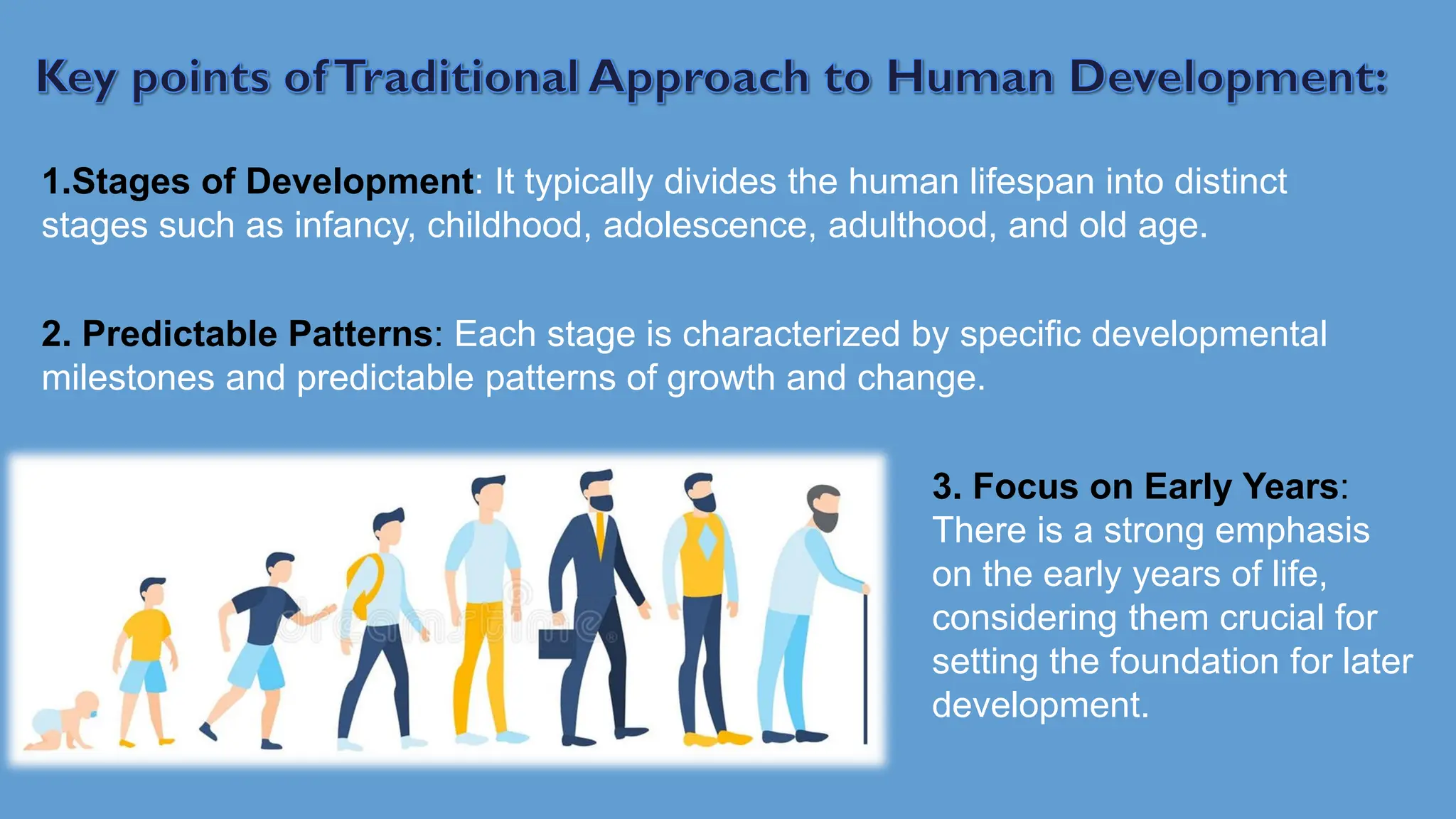
1.Stages of Development: It typically divides the human lifespan into distinct
stages such as infancy, childhood, adolescence, adulthood, and old age.
3. Focus on Early Years:
There is a strong emphasis
on the early years of life,
considering them crucial for
setting the foundation for later
development.
2. Predictable Patterns: Each stage is characterized by specific developmental
milestones and predictable patterns of growth and change.
4. Stability in Adulthood: Adulthood is often seen as a period of stability where
significant changes are less frequent.
5. Decline in Old Age:
The later years are viewed as a time of decline in physical and cognitive abilities.
This approach contrasts with the lifespan
perspective, which views development as a
continuous process that occurs throughout
life, influenced by multiple factors and
contexts
sagepub.com
LIFESPAN Approach to Human Development
Humans continue to change in predictable ways throughout
their lifetime, even into old age (lifetime patterns of change).
sage.com (2022)
Even in adulthood, developmental changes take place as it
does during childhood.
Paul Baltes (Santrock, 2002), an expert in Life-
span Development, gives the following
characteristics:
1. Development is lifelong.
Development does not end in adulthood.
2. Development is plastic.
Plasticity refers to the potential for change.
Development is possible throughout the
lifespan. No one is too old to learn.
3. Development is multidimensional.
Development consists of biological,
cognitive, and socio-emotional
dimensions.
Development as a process is complex
because it is the product of biological,
cognitive, and socio-emotional process
(Santrock, 2002).
A. Development is relatively orderly.
Humans will first learn how to sit, crawl
then walk before they can run.
The muscular control of the trunk and the
arms comes earlier as compared to the
hands and the fingers. Proximodistal Pattern
During infancy, the greatest growth always
occurs at the top (the head)- with physical
growth in size, weight, and future
differentiation gradually working its way
down from top to bottom.
Cephalo-caudal Pattern
B. Development takes place gradually.
Development is a gradual process and
unfolds over time.
Cognitive processes involves changes in
the individual’s thought, intelligence, and
language.
Socio-emotional processes include
changes in the individual’s relationship with
other people, changes in emotions, and
changes in personality.
4. Development is contextual.
Individuals act on contexts that include
the individual’s biological makeup,
physical environment, cognitive
processes, and historical, social, and
cultural contexts (Santrock, 2002).
Children’s biological makeup, social
and cultural contexts vary and therefore
make them develop differently from
each other.
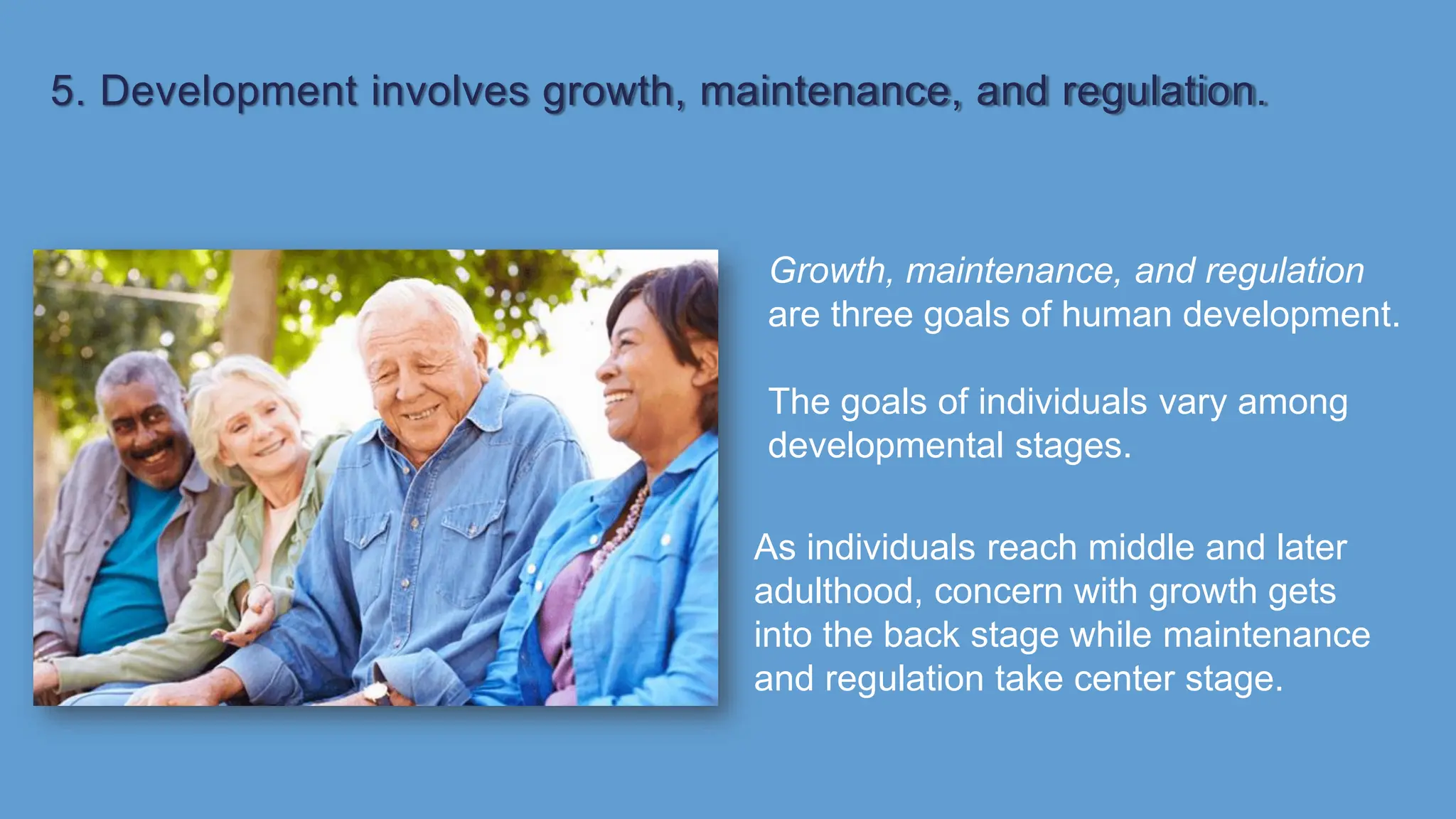
5. Development involves growth, maintenance, and regulation.
Growth, maintenance, and regulation
are three goals of human development.
The goals of individuals vary among
developmental stages.
As individuals reach middle and later
adulthood, concern with growth gets
into the back stage while maintenance
and regulation take center stage.
NAEYC (2009) affirms the characteristics of the
life-span development approach
A. All the domains of development and
learning – physical, social and
emotional, and cognitive – are
important, and they are closely
interrelated.
Children’s development and learning in
one domain influence and are
influenced by what takes place in other
domains.
Characteristics of Human Development
from a Life-Span Perspective:
Development is multidimensional
B. Many aspects of children’s learning and development follow well-documented
sequences, with later abilities, skills, and knowledge building on those already
acquired.
C. Development and learning
proceed at varying rates from child
to child, as well as at uneven rates
across different areas of a child’s
individual functioning.
Development takes place gradually.
D. Development and learning result from a dynamic and continuous interaction of
biological maturation and experience.
E. Early experiences have profound
effects, both cumulative and
delayed, on a child's development
and learning; and optimal periods
exist for certain types of
development and learning to occur.
Development is contextual.
Development is lifelong.
F. Development proceeds toward
greater complexity, self-regulation, and
symbolic representational capacities.
G. Children develop best when they
have secure, consistent relationships
with responsive adults and
opportunities for positive relationships
with peers.
Development takes place gradually.
Development is contextual.
Development is lifelong.
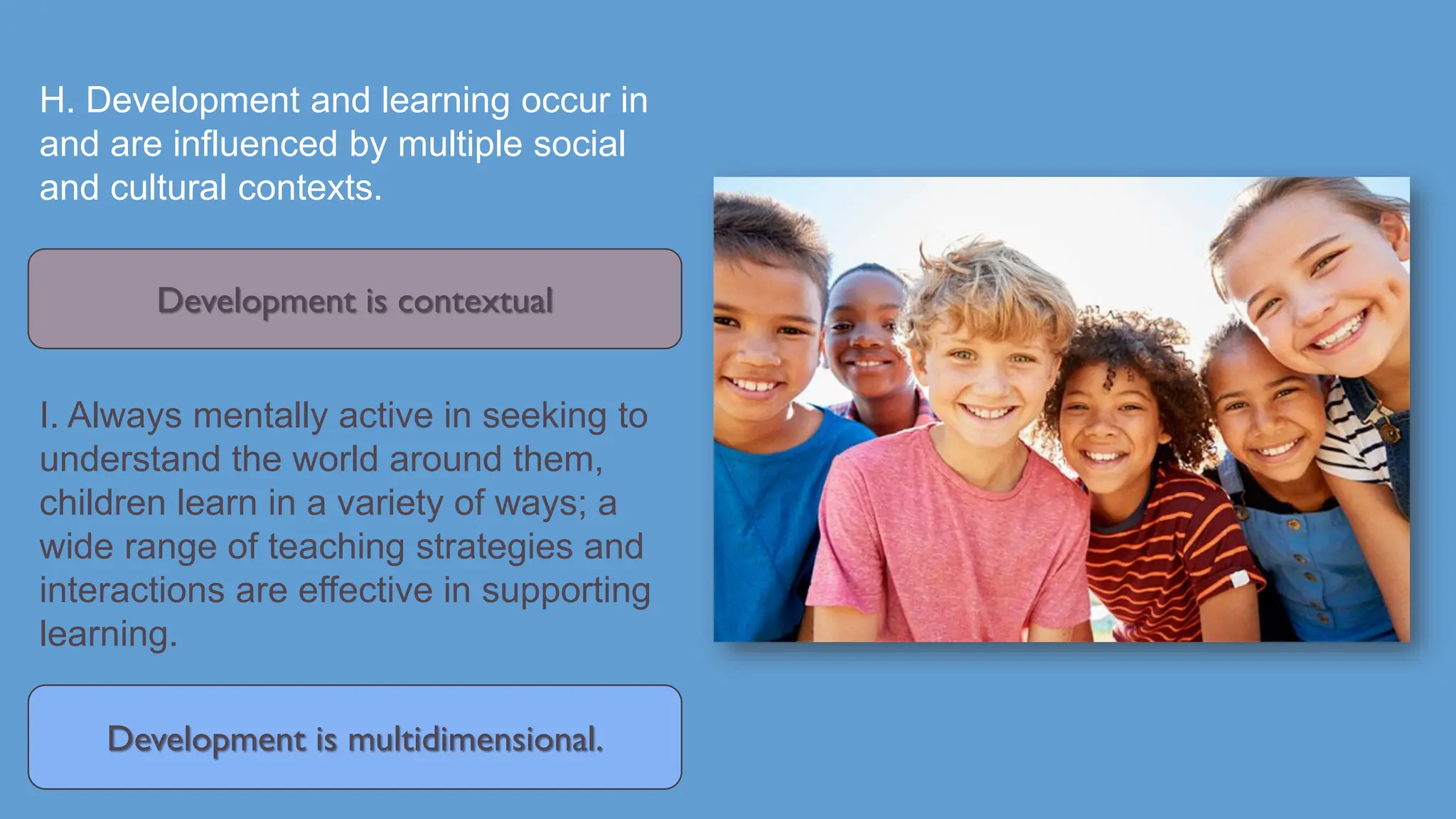
H. Development and learning occur in
and are influenced by multiple social
and cultural contexts.
I. Always mentally active in seeking to
understand the world around them,
children learn in a variety of ways; a
wide range of teaching strategies and
interactions are effective in supporting
learning.
Development is contextual
Development is multidimensional.
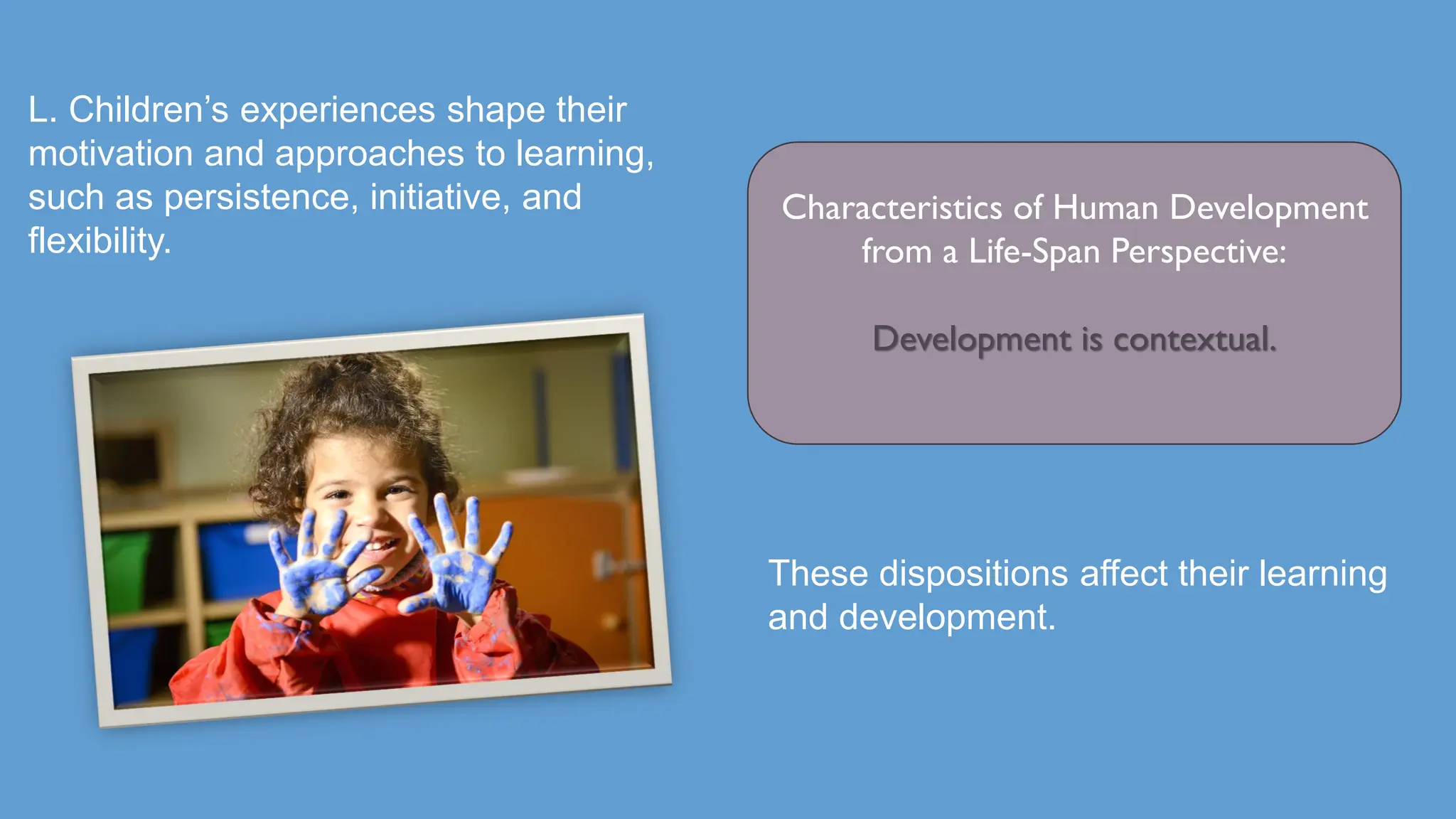
L. Children’s experiences shape their
motivation and approaches to learning,
such as persistence, initiative, and
flexibility.
Characteristics of Human Development
from a Life-Span Perspective:
Development is contextual.
These dispositions affect their learning
and development.
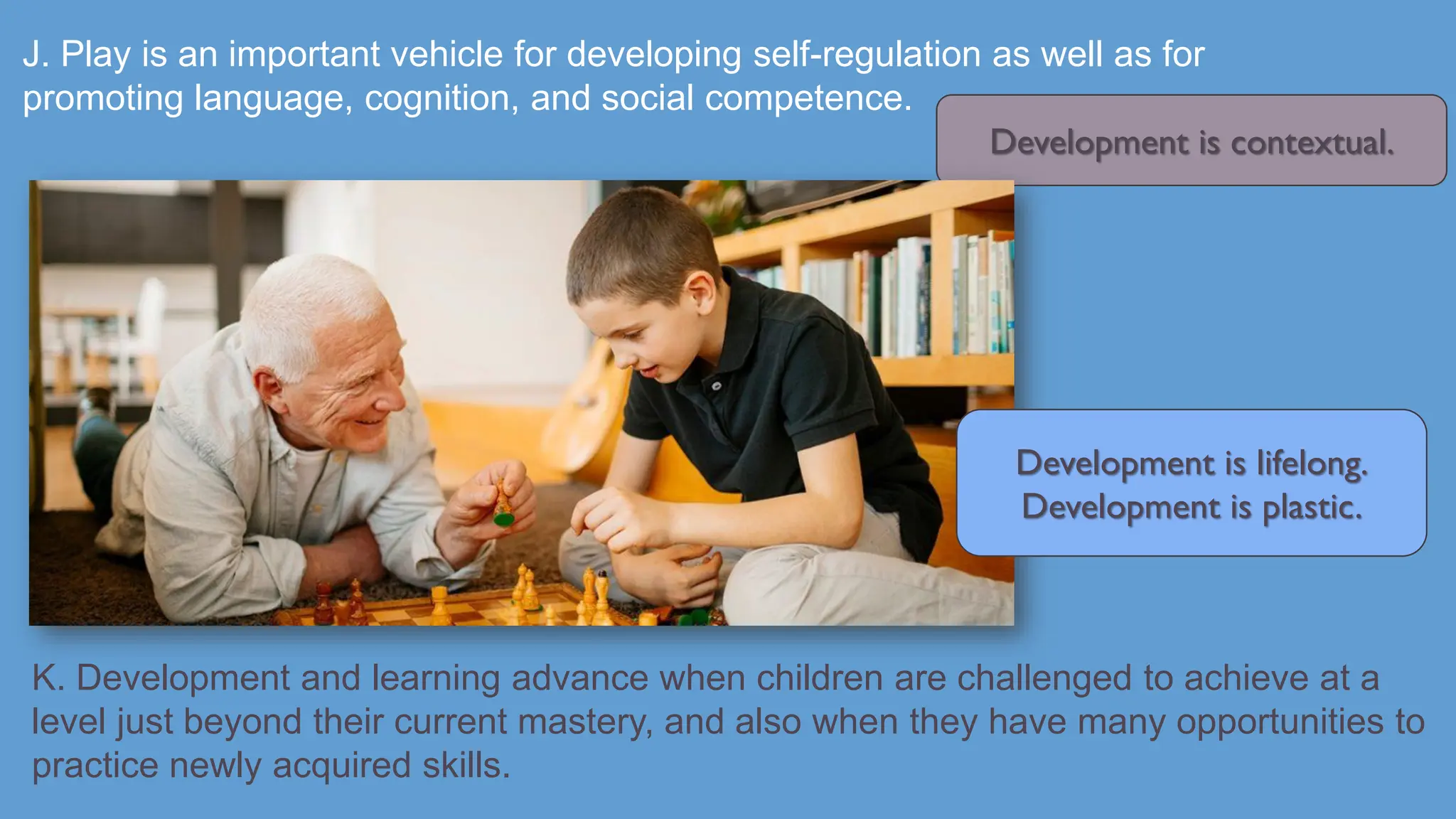
J. Play is an important vehicle for developing self-regulation as well as for
promoting language, cognition, and social competence.
K. Development and learning advance when children are challenged to achieve at a
level just beyond their current mastery, and also when they have many opportunities to
practice newly acquired skills.
Development is contextual.
Development is lifelong.
Development is plastic.

2_Human Development. early childhood education

  • 1.
    Human Development: Meaning, Concepts,and Approaches mddecio@cpu.edu.ph Corpus, B. et al., (2018). Child and Adolescent Learners and Learning Principles. OBE-PPST-Based. Metro Manila. Lorimar Publishing. Educ 1101
  • 2.
    Human Development The scientific studyof the ways in which people change as well as remain the same from conception to death.- Portland State University pdx Pressbook It encompasses physical, cognitive, and psychosocial changes that occur throughout a lifetime.- britannica.com
  • 3.
    Two Approaches to HumanDevelopment: TRADITIONAL and LIFE-SPAN
  • 4.
    TRADITIONAL Approach to HumanDevelopment Primarily focuses on the changes that occur from birth through adolescence, emphasizing stability during adulthood and a decline in old age. This perspective often views development as a series of predictable stages that individuals pass through in a linear fashion. Heimduo.org
  • 5.
    Key points ofTraditionalApproach to Human Development: 1.Stages of Development: It typically divides the human lifespan into distinct stages such as infancy, childhood, adolescence, adulthood, and old age. 3. Focus on Early Years: There is a strong emphasis on the early years of life, considering them crucial for setting the foundation for later development. 2. Predictable Patterns: Each stage is characterized by specific developmental milestones and predictable patterns of growth and change.
  • 6.
    4. Stability inAdulthood: Adulthood is often seen as a period of stability where significant changes are less frequent. 5. Decline in Old Age: The later years are viewed as a time of decline in physical and cognitive abilities. This approach contrasts with the lifespan perspective, which views development as a continuous process that occurs throughout life, influenced by multiple factors and contexts sagepub.com
  • 8.
    LIFESPAN Approach toHuman Development Humans continue to change in predictable ways throughout their lifetime, even into old age (lifetime patterns of change). sage.com (2022) Even in adulthood, developmental changes take place as it does during childhood.
  • 9.
    Paul Baltes (Santrock,2002), an expert in Life- span Development, gives the following characteristics: 1. Development is lifelong. Development does not end in adulthood. 2. Development is plastic. Plasticity refers to the potential for change. Development is possible throughout the lifespan. No one is too old to learn.
  • 10.
    3. Development ismultidimensional. Development consists of biological, cognitive, and socio-emotional dimensions. Development as a process is complex because it is the product of biological, cognitive, and socio-emotional process (Santrock, 2002).
  • 11.
    A. Development isrelatively orderly. Humans will first learn how to sit, crawl then walk before they can run. The muscular control of the trunk and the arms comes earlier as compared to the hands and the fingers. Proximodistal Pattern During infancy, the greatest growth always occurs at the top (the head)- with physical growth in size, weight, and future differentiation gradually working its way down from top to bottom. Cephalo-caudal Pattern
  • 12.
    B. Development takesplace gradually. Development is a gradual process and unfolds over time. Cognitive processes involves changes in the individual’s thought, intelligence, and language. Socio-emotional processes include changes in the individual’s relationship with other people, changes in emotions, and changes in personality.
  • 13.
    4. Development iscontextual. Individuals act on contexts that include the individual’s biological makeup, physical environment, cognitive processes, and historical, social, and cultural contexts (Santrock, 2002). Children’s biological makeup, social and cultural contexts vary and therefore make them develop differently from each other.
  • 14.
    5. Development involvesgrowth, maintenance, and regulation. Growth, maintenance, and regulation are three goals of human development. The goals of individuals vary among developmental stages. As individuals reach middle and later adulthood, concern with growth gets into the back stage while maintenance and regulation take center stage.
  • 17.
    NAEYC (2009) affirmsthe characteristics of the life-span development approach A. All the domains of development and learning – physical, social and emotional, and cognitive – are important, and they are closely interrelated. Children’s development and learning in one domain influence and are influenced by what takes place in other domains. Characteristics of Human Development from a Life-Span Perspective: Development is multidimensional
  • 18.
    B. Many aspectsof children’s learning and development follow well-documented sequences, with later abilities, skills, and knowledge building on those already acquired. C. Development and learning proceed at varying rates from child to child, as well as at uneven rates across different areas of a child’s individual functioning. Development takes place gradually.
  • 19.
    D. Development andlearning result from a dynamic and continuous interaction of biological maturation and experience. E. Early experiences have profound effects, both cumulative and delayed, on a child's development and learning; and optimal periods exist for certain types of development and learning to occur. Development is contextual. Development is contextual. Development is lifelong.
  • 20.
    F. Development proceedstoward greater complexity, self-regulation, and symbolic representational capacities. G. Children develop best when they have secure, consistent relationships with responsive adults and opportunities for positive relationships with peers. Development takes place gradually. Development is contextual. Development is lifelong.
  • 21.
    H. Development andlearning occur in and are influenced by multiple social and cultural contexts. I. Always mentally active in seeking to understand the world around them, children learn in a variety of ways; a wide range of teaching strategies and interactions are effective in supporting learning. Development is contextual Development is multidimensional.
  • 22.
    L. Children’s experiencesshape their motivation and approaches to learning, such as persistence, initiative, and flexibility. Characteristics of Human Development from a Life-Span Perspective: Development is contextual. These dispositions affect their learning and development.
  • 23.
    J. Play isan important vehicle for developing self-regulation as well as for promoting language, cognition, and social competence. K. Development and learning advance when children are challenged to achieve at a level just beyond their current mastery, and also when they have many opportunities to practice newly acquired skills. Development is contextual. Development is lifelong. Development is plastic.