Clean energy update no.2:
windenergy
wind energy –
generating serious power
visit cleanenergycouncil.org.au
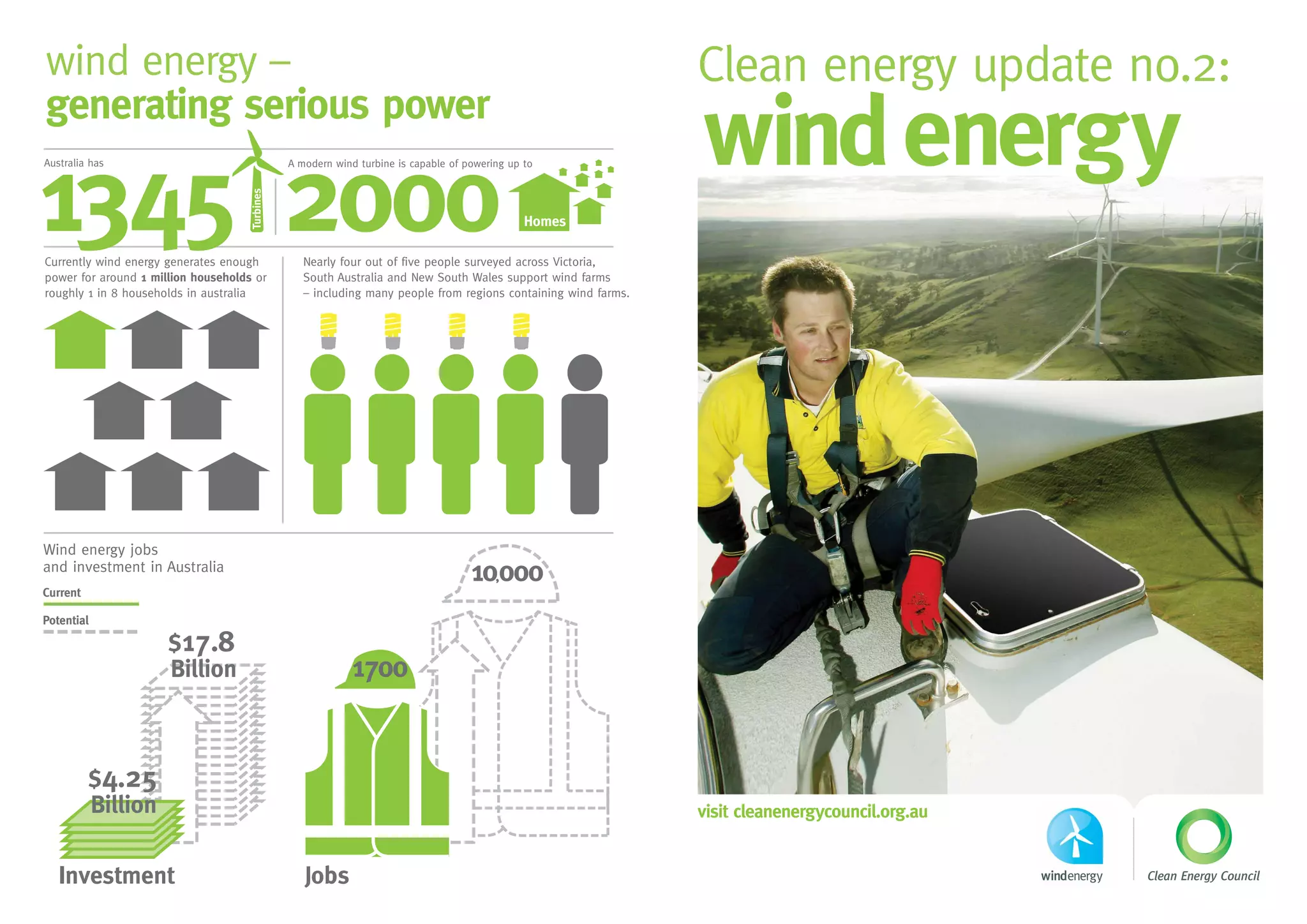
Currently wind energy generates enough
power for around 1 million households or
roughly 1 in 8 households in australia
Nearly four out of five people surveyed across Victoria,
South Australia and New South Wales support wind farms
– including many people from regions containing wind farms.
Wind energy jobs
and investment in Australia
Current
Potential
Investment Jobs
1345 2000
Australia has A modern wind turbine is capable of powering up to
Turbines
Homes
$17.8
Billion
10,000
$4.25
Billion
1700
CEC_WIND_FACTSv11 27/8/12 11:47 AM Page 1
Investment
and jobs
A recent study found a typical 50 megawatt wind farm
(capable of powering up to 21,000 homes) is constructed
by workers who spend up to $1.2 million locally, and
contributes up to $80,000 annually to community projects.
The study found such a wind farm creates up to 48 direct
jobs during construction, and then employs around five
ongoing permanent staff.
Further, it found wind farms generate significant extra
funds for local suppliers, contractors, shopkeepers,
community facilities and more, with up to seven extra
ongoing jobs created locally as a flow-on effect of having
a 50 megawatt wind farm nearby.
A total of $4.25 billion has been invested in Australia as a
result of wind power projects. Based on current planned
projects, the potential for another $17.8 billion investment
exists.
Benefits
for farmers
Wind farming can help farmers generate vital extra
income, make better use of marginal farming land, and
insure against market downturns. In some cases, this can
mean the difference between staying on the land and
having to sell up.
Strong community
support
A recent survey by independent researcher QDos showed
nearly 80 per cent of those surveyed across Victoria,
New South Wales and South Australia (including regional
areas containing wind farms) supported the development
of wind farms.
Large-scale renewable energy like wind power is the
lowest-cost way to meet Australia’s target of sourcing 20
per cent of our energy from renewable sources by 2020.
Contrary to some recent claims, wind and other large-scale
renewable energy sources contribute only a tiny amount to
the average power bill – just two per cent compared to
the massive 40 per cent that goes towards upgrading the
power network.
Wind turbine noise Australian wind farms face some of the toughest guidelines in
the world in relation to their permissible noise levels.
A study by independent noise consultant Sonus shows that
one of the biggest sources of infrasound is the ocean – yet
there are no reports of the hundreds of thousands of coast-
dwelling Australians suffering ill health from infrasound.
Health There are nearly 200,000 wind turbines across sites all
over the world – many of them close to people’s houses.
More than a dozen peer-reviewed expert studies have
been completed on wind farms and none has shown a
direct link between them and ill health.
Back up generation Energy created by wind turbines is just one of a range of
energy types feeding into our power system to provide us
with electricity. Demand and supply of energy fluctuates all
the time and the energy network is designed to cope with
this. It needs back-up power for a range of reasons including
demand spikes and power station failure. No back-up power
station has been built just to support wind.
Real estate prices Many locations near wind farms have seen property prices
increase significantly over the last few years, such as Cape
Bridgewater and Port Fairy in south-west Victoria.
A study by the NSW Department of Lands in the second
half of 2009 looked at properties near eight wind farms
and found no evidence that wind turbines caused property
values to drop.
visit cleanenergycouncil.org.au
The lowest-cost
way to meet
Australia’s
Renewable
Energy Target
CEC_WIND_FACTSv11 27/8/12 11:48 AM Page 2

Wind Energy in Australia

  • 1.
    Clean energy updateno.2: windenergy wind energy – generating serious power visit cleanenergycouncil.org.au Currently wind energy generates enough power for around 1 million households or roughly 1 in 8 households in australia Nearly four out of five people surveyed across Victoria, South Australia and New South Wales support wind farms – including many people from regions containing wind farms. Wind energy jobs and investment in Australia Current Potential Investment Jobs 1345 2000 Australia has A modern wind turbine is capable of powering up to Turbines Homes $17.8 Billion 10,000 $4.25 Billion 1700 CEC_WIND_FACTSv11 27/8/12 11:47 AM Page 1
  • 2.
    Investment and jobs A recentstudy found a typical 50 megawatt wind farm (capable of powering up to 21,000 homes) is constructed by workers who spend up to $1.2 million locally, and contributes up to $80,000 annually to community projects. The study found such a wind farm creates up to 48 direct jobs during construction, and then employs around five ongoing permanent staff. Further, it found wind farms generate significant extra funds for local suppliers, contractors, shopkeepers, community facilities and more, with up to seven extra ongoing jobs created locally as a flow-on effect of having a 50 megawatt wind farm nearby. A total of $4.25 billion has been invested in Australia as a result of wind power projects. Based on current planned projects, the potential for another $17.8 billion investment exists. Benefits for farmers Wind farming can help farmers generate vital extra income, make better use of marginal farming land, and insure against market downturns. In some cases, this can mean the difference between staying on the land and having to sell up. Strong community support A recent survey by independent researcher QDos showed nearly 80 per cent of those surveyed across Victoria, New South Wales and South Australia (including regional areas containing wind farms) supported the development of wind farms. Large-scale renewable energy like wind power is the lowest-cost way to meet Australia’s target of sourcing 20 per cent of our energy from renewable sources by 2020. Contrary to some recent claims, wind and other large-scale renewable energy sources contribute only a tiny amount to the average power bill – just two per cent compared to the massive 40 per cent that goes towards upgrading the power network. Wind turbine noise Australian wind farms face some of the toughest guidelines in the world in relation to their permissible noise levels. A study by independent noise consultant Sonus shows that one of the biggest sources of infrasound is the ocean – yet there are no reports of the hundreds of thousands of coast- dwelling Australians suffering ill health from infrasound. Health There are nearly 200,000 wind turbines across sites all over the world – many of them close to people’s houses. More than a dozen peer-reviewed expert studies have been completed on wind farms and none has shown a direct link between them and ill health. Back up generation Energy created by wind turbines is just one of a range of energy types feeding into our power system to provide us with electricity. Demand and supply of energy fluctuates all the time and the energy network is designed to cope with this. It needs back-up power for a range of reasons including demand spikes and power station failure. No back-up power station has been built just to support wind. Real estate prices Many locations near wind farms have seen property prices increase significantly over the last few years, such as Cape Bridgewater and Port Fairy in south-west Victoria. A study by the NSW Department of Lands in the second half of 2009 looked at properties near eight wind farms and found no evidence that wind turbines caused property values to drop. visit cleanenergycouncil.org.au The lowest-cost way to meet Australia’s Renewable Energy Target CEC_WIND_FACTSv11 27/8/12 11:48 AM Page 2