AGATHIS
ARAUCARIACEAE
MORPHOLOGY
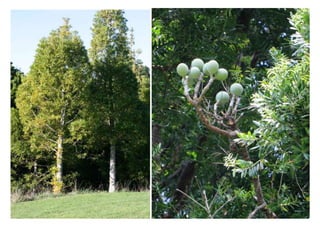
• Tall trees – 40 metres
• Evergreen, columnar trunk with whorled horrizontal branches.
• Leaves spirally arranged on main stem & opposite on lateral
shoots.
• Reddish when young & dark green when old.
• Long, petiolate, thick glabrous, broad, ovate-lanceolate with
parallel venation.
• Cushion like scars left on leaf fall.
• Leaves remain for 15 to 20 years.
• Root – typical tap root with developed branches.
ANATOMY
Root – Epidermis – single layered.
Cortex – parenchymatous, 6-7 layered.
Endodermis – single layered – tanniferous.
Pericycle – 5 to 7 layered, has resin ducts in rings.
Stele – diarch condition.
Sec. Growth as usual with uniseriate rings.
Stem – Thin cuticle & epidermis.
Many layered parenchymatous cortex – 2 zones.
Outer zone – 3 to 4 layers small tanniferous cells.
Inner zone – large cells, some with tannin.
2 rings of resin ducts – one below eidermis.
Other associated with vas. bndls. – outside phloem.
Vas.bndls. Collateral & open.
Leaf traces in pairs.
Sec. thickening – bordered pits & uniseriate rays & sclerids
Leaf – dorsiventral.
Upper epidermis – rectangular cells, highly
cuticularised.
Hypodermis – stone cells seen.
Sub-epidermal layer – with tannin cells.
Palisade – elongated, compactly arranged.
Inner to spongy another layer of palisade
seen.
Through out mesophyll - sclerids present.
Stomata on both upper & lower epidermis.
Vas.bndls numerous, alternate with resin ducts.
Bundle sheath – sclerenchymatous fibres.
Xylem & phloem as usual.
REPRODUCTION
Plants are dioecious.
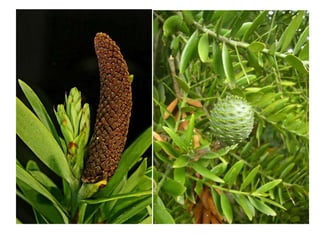
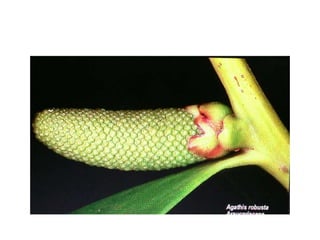
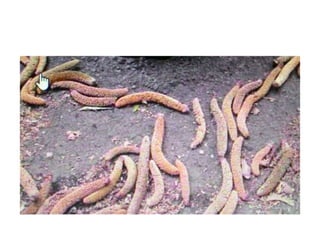
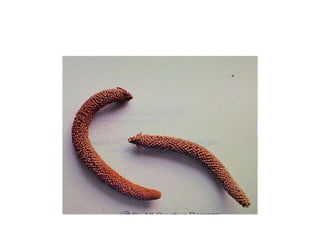
Male cones cylindrical, solitary or in clusters on the
lower branches of trees.
Cones – erect, subsessile & axillary.
Microsporophylls – spirally arranged around axis.
Each with small stalk, peltate head & 5 to 15
microsporangia in 2 rows.
Long cone axis elongates when sporangia mature.
By a longitudinal slit – sporangia dehise in April- March.
Microsprorogenesis same as in others – innermost wall
layer forms tapetum.
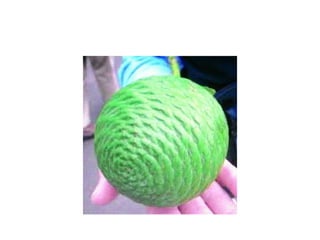
• Female cones large, solitary, stalked, sub-
globose – upper part of trees. Central axis –
megasporophylls spirally arranged – each
broader than long – thick in the centre with 2
membraneous lateral extensions & a short
upturned tip – a single ovule develops on the
adaxial surface of megasporophyll & is fused
to sporophyll only at its base – ovuliferous
scale & bract scale completely fused.
• Ovule development same as in others –
unitegmic, orthotropus – group of archesporial
cells – one of them as megaspore mother cell –
R/D – triad of megaspores – lowermost one
functional.
• Functional Megaspore
• Nuclear division
• Upto 500 nuclei
• Cellularization occurs
• Archegonial initial – large central cell & small neck
initial
• Neck initial – 12 wedge shaped cells in one tier
• Central nucleus – Egg nucleus & ventral canal nucleus
• Egg nucleus surrounds cytoplasm – Egg cell
• POLLINATION – by wind
• FERTILIZATION – as usual.
• EMBRYOGENY
• Zygote nucleus
• Nuclear divisions
• 64 proembryonal nuclei
• Free nuclear proembryo
• Nuclei arranged in 3 groups
• Upper – single row of large radially elongated nuclei
• Middle – few round nuclei of 2 rows
• Lower – elongated nuclei - fewer in number
• Wall formation
• Suspensor develops – pushes embryo deep inside
• Only simple polyembryony
• Cotyledons – 2 to 4 in number
• Seed coat – thick – outer 4 to 5 layers & inner 5 to 6 layers
• Seed germination epigeal
•
AGATHIS
AGATHIS..............................pptx

AGATHIS..............................pptx

  • 1.
    AGATHIS ARAUCARIACEAE MORPHOLOGY • Tall trees– 40 metres • Evergreen, columnar trunk with whorled horrizontal branches. • Leaves spirally arranged on main stem & opposite on lateral shoots. • Reddish when young & dark green when old. • Long, petiolate, thick glabrous, broad, ovate-lanceolate with parallel venation. • Cushion like scars left on leaf fall. • Leaves remain for 15 to 20 years. • Root – typical tap root with developed branches.
  • 3.
    ANATOMY Root – Epidermis– single layered. Cortex – parenchymatous, 6-7 layered. Endodermis – single layered – tanniferous. Pericycle – 5 to 7 layered, has resin ducts in rings. Stele – diarch condition. Sec. Growth as usual with uniseriate rings. Stem – Thin cuticle & epidermis. Many layered parenchymatous cortex – 2 zones. Outer zone – 3 to 4 layers small tanniferous cells. Inner zone – large cells, some with tannin. 2 rings of resin ducts – one below eidermis. Other associated with vas. bndls. – outside phloem. Vas.bndls. Collateral & open. Leaf traces in pairs. Sec. thickening – bordered pits & uniseriate rays & sclerids
  • 4.
    Leaf – dorsiventral. Upperepidermis – rectangular cells, highly cuticularised. Hypodermis – stone cells seen. Sub-epidermal layer – with tannin cells. Palisade – elongated, compactly arranged. Inner to spongy another layer of palisade seen. Through out mesophyll - sclerids present. Stomata on both upper & lower epidermis. Vas.bndls numerous, alternate with resin ducts. Bundle sheath – sclerenchymatous fibres. Xylem & phloem as usual.
  • 5.
    REPRODUCTION Plants are dioecious. Malecones cylindrical, solitary or in clusters on the lower branches of trees. Cones – erect, subsessile & axillary. Microsporophylls – spirally arranged around axis. Each with small stalk, peltate head & 5 to 15 microsporangia in 2 rows. Long cone axis elongates when sporangia mature. By a longitudinal slit – sporangia dehise in April- March. Microsprorogenesis same as in others – innermost wall layer forms tapetum.
  • 7.
    • Female coneslarge, solitary, stalked, sub- globose – upper part of trees. Central axis – megasporophylls spirally arranged – each broader than long – thick in the centre with 2 membraneous lateral extensions & a short upturned tip – a single ovule develops on the adaxial surface of megasporophyll & is fused to sporophyll only at its base – ovuliferous scale & bract scale completely fused.
  • 8.
    • Ovule developmentsame as in others – unitegmic, orthotropus – group of archesporial cells – one of them as megaspore mother cell – R/D – triad of megaspores – lowermost one functional.
  • 9.
    • Functional Megaspore •Nuclear division • Upto 500 nuclei • Cellularization occurs • Archegonial initial – large central cell & small neck initial • Neck initial – 12 wedge shaped cells in one tier • Central nucleus – Egg nucleus & ventral canal nucleus • Egg nucleus surrounds cytoplasm – Egg cell
  • 10.
    • POLLINATION –by wind • FERTILIZATION – as usual. • EMBRYOGENY • Zygote nucleus • Nuclear divisions • 64 proembryonal nuclei • Free nuclear proembryo • Nuclei arranged in 3 groups • Upper – single row of large radially elongated nuclei • Middle – few round nuclei of 2 rows • Lower – elongated nuclei - fewer in number
  • 11.
    • Wall formation •Suspensor develops – pushes embryo deep inside • Only simple polyembryony • Cotyledons – 2 to 4 in number • Seed coat – thick – outer 4 to 5 layers & inner 5 to 6 layers • Seed germination epigeal •
  • 12.