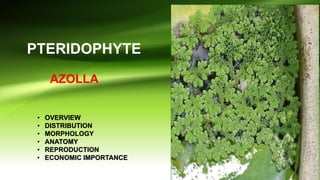
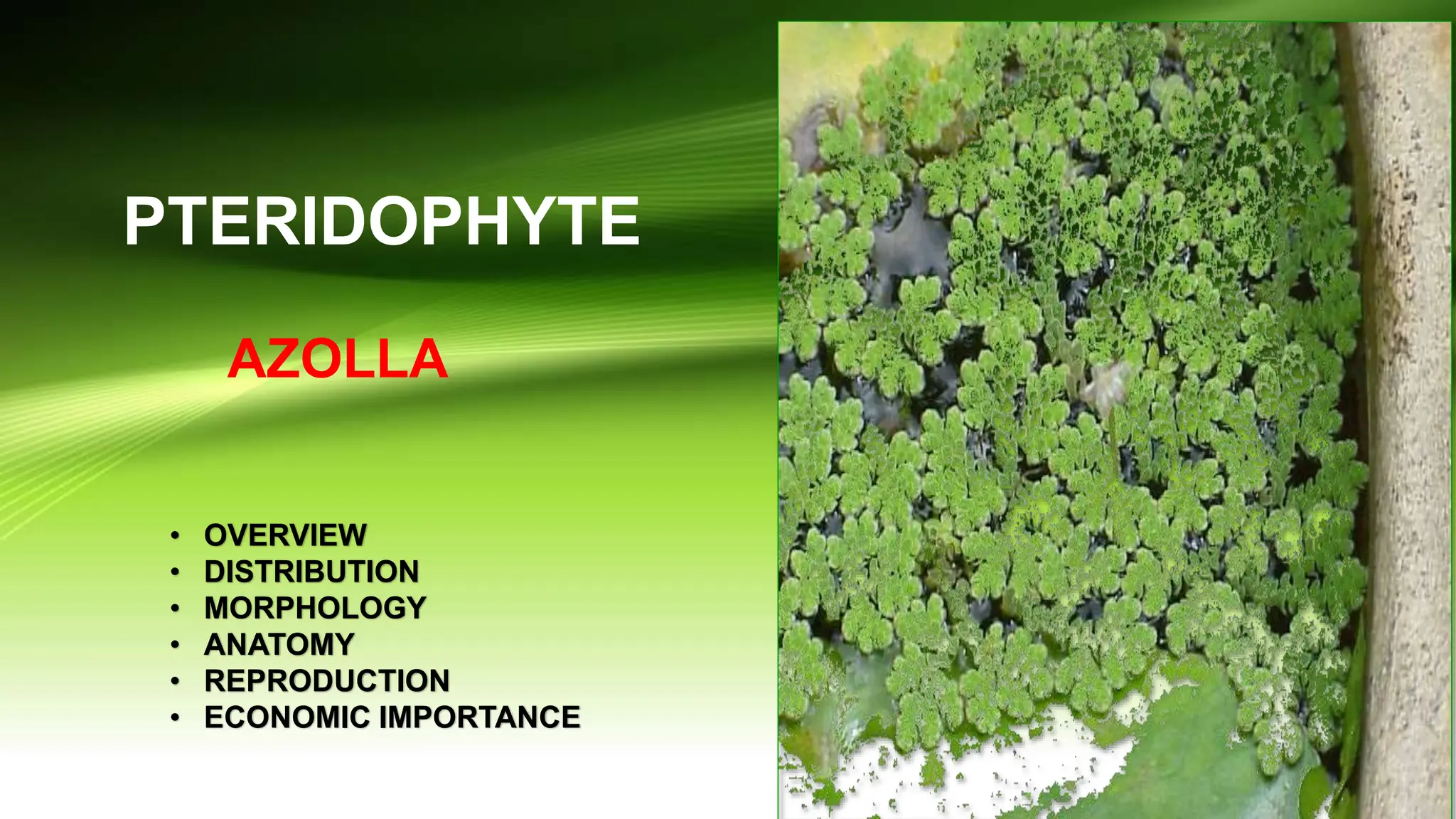
PTERIDOPHYTE
AZOLLA
• OVERVIEW
• DISTRIBUTION
• MORPHOLOGY
• ANATOMY
• REPRODUCTION
• ECONOMIC IMPORTANCE
OVERVIEW :
• DIVISION : POLYPODIOPHYTA
• CLASS : POLYPODIOPSIDA
• ORDER : SALVIANIALES
• FAMILY : SALVINIACEAE
• GENUS : AZOLLA
HABIT : INVASIVE FLOATING WETLAND PLANT
HABITAT : FRESHWATER , LOW CURRENT AREAS , PH 4-7 ,TEMP 20-28°C , OLIGOTROPHIC .
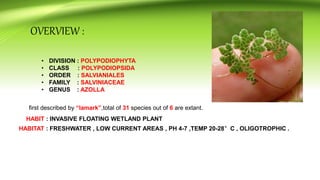
first described by “lamark”,total of 31 species out of 6 are extant.
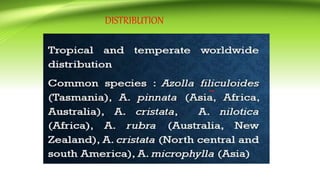
DISTRIBUTION
MORPHOLOGY
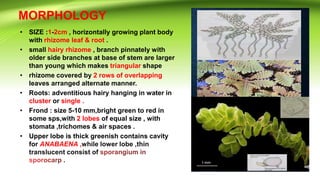
• SIZE :1-2cm , horizontally growing plant body
with rhizome leaf & root .
• small hairy rhizome , branch pinnately with
older side branches at base of stem are larger
than young which makes triangular shape
• rhizome covered by 2 rows of overlapping
leaves arranged alternate manner.
• Roots: adventitious hairy hanging in water in
cluster or single .
• Frond : size 5-10 mm,bright green to red in
some sps,with 2 lobes of equal size , with
stomata ,trichomes & air spaces .
• Upper lobe is thick greenish contains cavity
for ANABAENA ,while lower lobe ,thin
translucent consist of
.
ANATOMY - LEAF
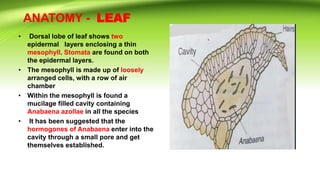
• Dorsal lobe of leaf shows two
epidermal layers enclosing a thin
mesophyll. Stomata are found on both
the epidermal layers.
• The mesophyll is made up of loosely
arranged cells, with a row of air
chamber
• Within the mesophyll is found a
mucilage filled cavity containing
Anabaena azollae in all the species
• It has been suggested that the
hormogones of Anabaena enter into the
cavity through a small pore and get
themselves established.
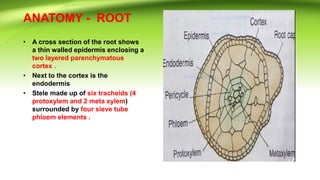
• A cross section of the root shows
a thin walled epidermis enclosing a
two layered parenchymatous
cortex .
• Next to the cortex is the
endodermis
• Stele made up of six tracheids (4
protoxylem and 2 meta xylem)
surrounded by four sieve tube
phloem elements .
ANATOMY - ROOT
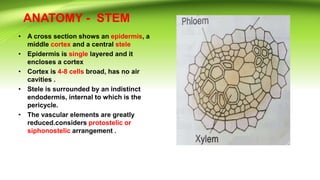
• A cross section shows an epidermis, a
middle cortex and a central stele
• Epidermis is single layered and it
encloses a cortex
• Cortex is 4-8 cells broad, has no air
cavities .
• Stele is surrounded by an indistinct
endodermis, internal to which is the
pericycle.
• The vascular elements are greatly
reduced.considers protostelic or
siphonostelic arrangement .
ANATOMY - STEM
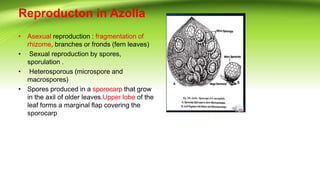
Reproducton in Azolla
• Asexual reproduction : fragmentation of
rhizome, branches or fronds (fern leaves)
• Sexual reproduction by spores,
sporulation .
• Heterosporous (microspore and
macrospores)
• Spores produced in a sporocarp that grow
in the axil of older leaves.Upper lobe of the
leaf forms a marginal flap covering the
sporocarp
Sporangium is leptosporangiate,
A ring of meristematic tissue surrounds the sporangium and forms
the sporocarp wall of two layered thick.
Female sporocarps are much smaller, containing one sporangium
and one functional spore. Since an individual female spore is
considerably larger than a male spore, it is termed a megaspore.
microsporangium all the 32 spores are functional.
Azolla has microscopic male and female gametophytes that develop
inside the male and female spores.
Female gametophyte protrudes from the megaspore and bears a
small number of archegonia, each containing a single egg
Microspore forms a male gametophyte with a single antheridium
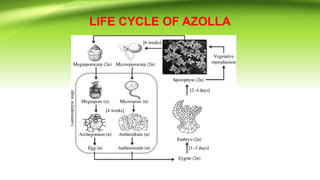
LIFE CYCLE OF AZOLLA
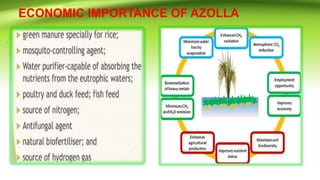
ECONOMIC IMPORTANCE OF AZOLLA
BY
P. SAI CHARAN
1007-23-502-007

azolla. TYPE STUDY ,GENERAL MORPHOLOGY ANOTOMY REPRODUCTION

  • 1.
    PTERIDOPHYTE AZOLLA • OVERVIEW • DISTRIBUTION •MORPHOLOGY • ANATOMY • REPRODUCTION • ECONOMIC IMPORTANCE
  • 2.
    OVERVIEW : • DIVISION: POLYPODIOPHYTA • CLASS : POLYPODIOPSIDA • ORDER : SALVIANIALES • FAMILY : SALVINIACEAE • GENUS : AZOLLA HABIT : INVASIVE FLOATING WETLAND PLANT HABITAT : FRESHWATER , LOW CURRENT AREAS , PH 4-7 ,TEMP 20-28°C , OLIGOTROPHIC . first described by “lamark”,total of 31 species out of 6 are extant.
  • 3.
  • 4.
    MORPHOLOGY • SIZE :1-2cm, horizontally growing plant body with rhizome leaf & root . • small hairy rhizome , branch pinnately with older side branches at base of stem are larger than young which makes triangular shape • rhizome covered by 2 rows of overlapping leaves arranged alternate manner. • Roots: adventitious hairy hanging in water in cluster or single . • Frond : size 5-10 mm,bright green to red in some sps,with 2 lobes of equal size , with stomata ,trichomes & air spaces . • Upper lobe is thick greenish contains cavity for ANABAENA ,while lower lobe ,thin translucent consist of .
  • 5.
    ANATOMY - LEAF •Dorsal lobe of leaf shows two epidermal layers enclosing a thin mesophyll. Stomata are found on both the epidermal layers. • The mesophyll is made up of loosely arranged cells, with a row of air chamber • Within the mesophyll is found a mucilage filled cavity containing Anabaena azollae in all the species • It has been suggested that the hormogones of Anabaena enter into the cavity through a small pore and get themselves established.
  • 6.
    • A crosssection of the root shows a thin walled epidermis enclosing a two layered parenchymatous cortex . • Next to the cortex is the endodermis • Stele made up of six tracheids (4 protoxylem and 2 meta xylem) surrounded by four sieve tube phloem elements . ANATOMY - ROOT
  • 7.
    • A crosssection shows an epidermis, a middle cortex and a central stele • Epidermis is single layered and it encloses a cortex • Cortex is 4-8 cells broad, has no air cavities . • Stele is surrounded by an indistinct endodermis, internal to which is the pericycle. • The vascular elements are greatly reduced.considers protostelic or siphonostelic arrangement . ANATOMY - STEM
  • 8.
    Reproducton in Azolla •Asexual reproduction : fragmentation of rhizome, branches or fronds (fern leaves) • Sexual reproduction by spores, sporulation . • Heterosporous (microspore and macrospores) • Spores produced in a sporocarp that grow in the axil of older leaves.Upper lobe of the leaf forms a marginal flap covering the sporocarp
  • 9.
    Sporangium is leptosporangiate, Aring of meristematic tissue surrounds the sporangium and forms the sporocarp wall of two layered thick. Female sporocarps are much smaller, containing one sporangium and one functional spore. Since an individual female spore is considerably larger than a male spore, it is termed a megaspore. microsporangium all the 32 spores are functional. Azolla has microscopic male and female gametophytes that develop inside the male and female spores. Female gametophyte protrudes from the megaspore and bears a small number of archegonia, each containing a single egg Microspore forms a male gametophyte with a single antheridium
  • 10.
  • 11.
  • 12.