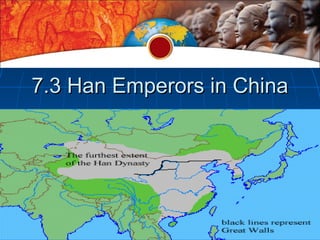
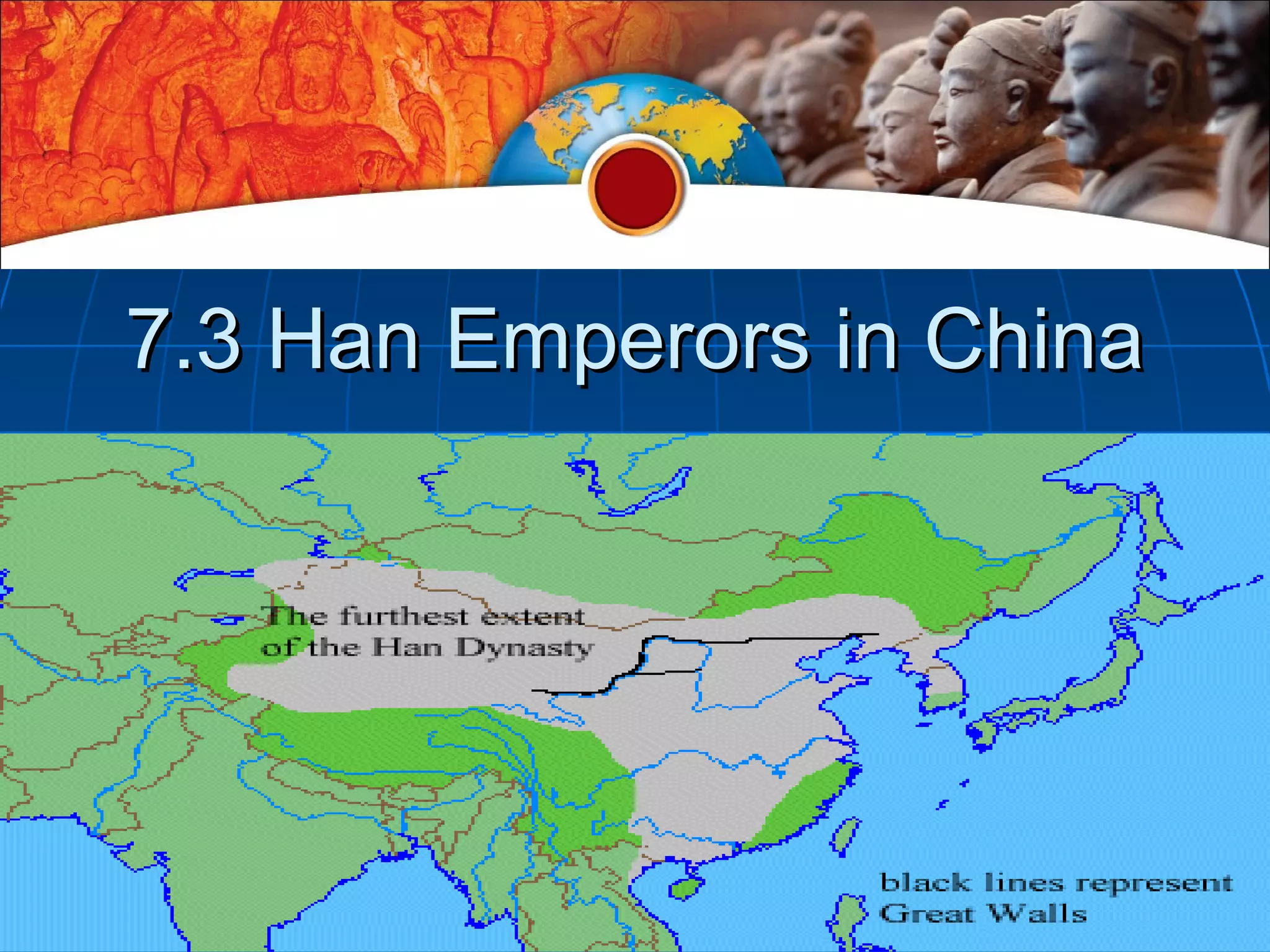
7.3 Han Emperors in China
The Han Restore Unity in China
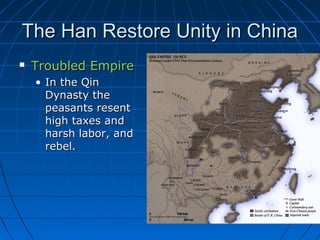
   Troubled Empire
    • In the Qin
      Dynasty the
      peasants resent
      high taxes and
      harsh labor, and
      rebel.
The Han Restore Unity in China
   Liu Bang Founds the Han Dynasty
    • Liu Bang defeats Xiang Yu, a rival for power,
      and founds the Han Dynasty
    • The Han Dynasty begins about 202 B.C. and
      lasts about 400 years.
    • Han Dynasty has great influence on Chinese
      people and culture
    • Liu Bang establishes centralized government—
      a central authority rules.
    • Liu Bang lowers taxes and reduces
      punishments to keep people happy
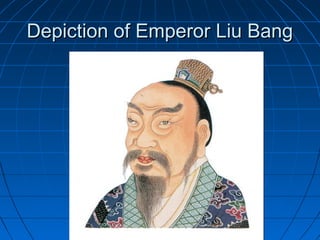
Depiction of Emperor Liu Bang
The Han Restore Unity in China
   The Empress Lü
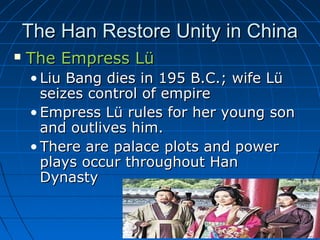
    • Liu Bang dies in 195 B.C.; wife Lü
      seizes control of empire
    • Empress Lü rules for her young son
      and outlives him.
    • There are palace plots and power
      plays occur throughout Han
      Dynasty
The Han Restore Unity in China
   The Martial Emperor
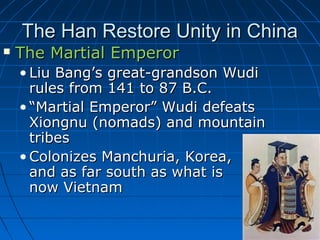
    • Liu Bang’s great-grandson Wudi
      rules from 141 to 87 B.C.
    • “Martial Emperor” Wudi defeats
      Xiongnu (nomads) and mountain
      tribes
    • Colonizes Manchuria, Korea,
      and as far south as what is
      now Vietnam
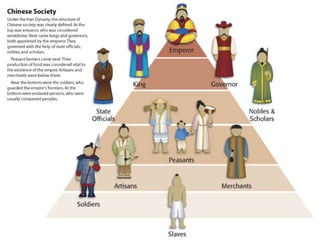
A Highly Structured Society
   Emperor’s Role
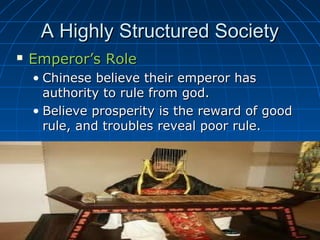
    • Chinese believe their emperor has
      authority to rule from god.
    • Believe prosperity is the reward of good
      rule, and troubles reveal poor rule.
A Highly Structured Society
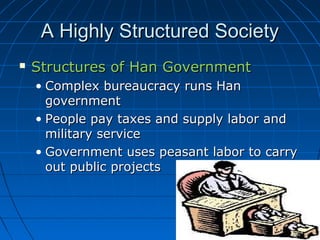
   Structures of Han Government
    • Complex bureaucracy runs Han
      government
    • People pay taxes and supply labor and
      military service
    • Government uses peasant labor to carry
      out public projects
A Highly Structured Society
   Confucianism, the Road to Success
    • Wudi’s government employs 130,000;
      bureaucracy of 18 ranks of jobs
    • Civil service jobs—government jobs obtained
      through examinations.
    • Job applicants begin to be tested on knowledge
      of Confucianism
    • Wudi favors Confucian scholars, builds schools
      to train them
    • Only sons of wealthy can afford expensive
      schooling
    • Civil service system works well, continues unil
      1912
Han Technology Revolutionizes
        Chinese Life
 Technology, Commerce, and
          Culture
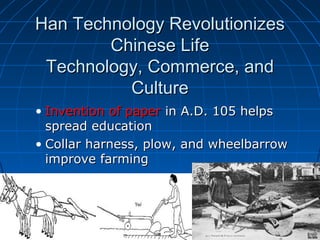
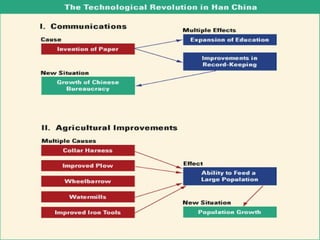
• Invention of paper in A.D. 105 helps
  spread education
• Collar harness, plow, and wheelbarrow
  improve farming
Han Technology, Commerce, & Culture
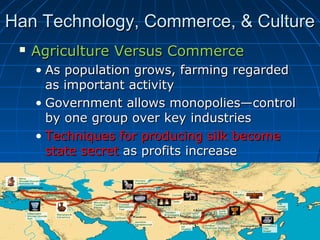
    Agriculture Versus Commerce
     • As population grows, farming regarded
       as important activity
     • Government allows monopolies—control
       by one group over key industries
     • Techniques for producing silk become
       state secret as profits increase
Han Unifies Chinese Culture
   Bringing Different Peoples Under
    Chinese Rule
    • To unify empire, Chinese government
      encourages assimilation
    • Assimilation—integrating conquered
      peoples into Chinese culture
    • Writers encourage unity by recording
      Chinese history
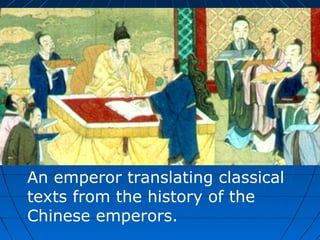
An emperor translating classical
texts from the history of the
Chinese emperors.
Han Unifies Chinese Culture
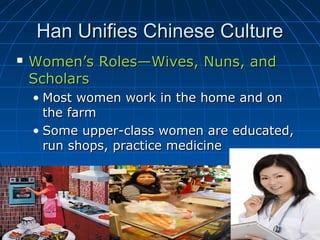
   Women’s Roles—Wives, Nuns, and
    Scholars
    • Most women work in the home and on
      the farm
    • Some upper-class women are educated,
      run shops, practice medicine
The Fall of the Han and Their
                 Return
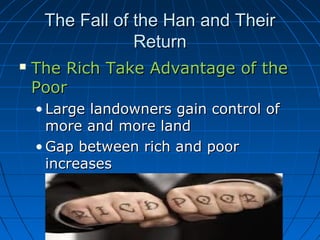
   The Rich Take Advantage of the
    Poor
    • Large landowners gain control of
      more and more land
    • Gap between rich and poor
      increases
The Fall of the Han and Their
                   Return
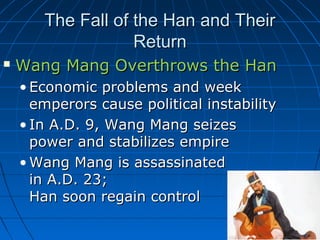
   Wang Mang Overthrows the Han
    • Economic problems and week
      emperors cause political instability
    • In A.D. 9, Wang Mang seizes
      power and stabilizes empire
    • Wang Mang is assassinated
      in A.D. 23;
      Han soon regain control
The Fall of the Han and Their
                 Return
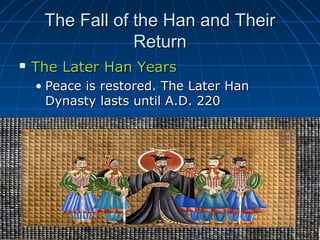
   The Later Han Years
    • Peace is restored. The Later Han
      Dynasty lasts until A.D. 220

7.3 han emperors in china

  • 1.
  • 2.
    The Han RestoreUnity in China  Troubled Empire • In the Qin Dynasty the peasants resent high taxes and harsh labor, and rebel.
  • 3.
    The Han RestoreUnity in China  Liu Bang Founds the Han Dynasty • Liu Bang defeats Xiang Yu, a rival for power, and founds the Han Dynasty • The Han Dynasty begins about 202 B.C. and lasts about 400 years. • Han Dynasty has great influence on Chinese people and culture • Liu Bang establishes centralized government— a central authority rules. • Liu Bang lowers taxes and reduces punishments to keep people happy
  • 4.
  • 5.
    The Han RestoreUnity in China  The Empress Lü • Liu Bang dies in 195 B.C.; wife Lü seizes control of empire • Empress Lü rules for her young son and outlives him. • There are palace plots and power plays occur throughout Han Dynasty
  • 6.
    The Han RestoreUnity in China  The Martial Emperor • Liu Bang’s great-grandson Wudi rules from 141 to 87 B.C. • “Martial Emperor” Wudi defeats Xiongnu (nomads) and mountain tribes • Colonizes Manchuria, Korea, and as far south as what is now Vietnam
  • 7.
    A Highly StructuredSociety  Emperor’s Role • Chinese believe their emperor has authority to rule from god. • Believe prosperity is the reward of good rule, and troubles reveal poor rule.
  • 8.
    A Highly StructuredSociety  Structures of Han Government • Complex bureaucracy runs Han government • People pay taxes and supply labor and military service • Government uses peasant labor to carry out public projects
  • 10.
    A Highly StructuredSociety  Confucianism, the Road to Success • Wudi’s government employs 130,000; bureaucracy of 18 ranks of jobs • Civil service jobs—government jobs obtained through examinations. • Job applicants begin to be tested on knowledge of Confucianism • Wudi favors Confucian scholars, builds schools to train them • Only sons of wealthy can afford expensive schooling • Civil service system works well, continues unil 1912
  • 11.
    Han Technology Revolutionizes Chinese Life Technology, Commerce, and Culture • Invention of paper in A.D. 105 helps spread education • Collar harness, plow, and wheelbarrow improve farming
  • 13.
    Han Technology, Commerce,& Culture  Agriculture Versus Commerce • As population grows, farming regarded as important activity • Government allows monopolies—control by one group over key industries • Techniques for producing silk become state secret as profits increase
  • 14.
    Han Unifies ChineseCulture  Bringing Different Peoples Under Chinese Rule • To unify empire, Chinese government encourages assimilation • Assimilation—integrating conquered peoples into Chinese culture • Writers encourage unity by recording Chinese history
  • 15.
    An emperor translatingclassical texts from the history of the Chinese emperors.
  • 16.
    Han Unifies ChineseCulture  Women’s Roles—Wives, Nuns, and Scholars • Most women work in the home and on the farm • Some upper-class women are educated, run shops, practice medicine
  • 17.
    The Fall ofthe Han and Their Return  The Rich Take Advantage of the Poor • Large landowners gain control of more and more land • Gap between rich and poor increases
  • 18.
    The Fall ofthe Han and Their Return  Wang Mang Overthrows the Han • Economic problems and week emperors cause political instability • In A.D. 9, Wang Mang seizes power and stabilizes empire • Wang Mang is assassinated in A.D. 23; Han soon regain control
  • 19.
    The Fall ofthe Han and Their Return  The Later Han Years • Peace is restored. The Later Han Dynasty lasts until A.D. 220