Ancient India (321-185 B.C.E.) The Mauryan Empire and the Spread of Buddhism
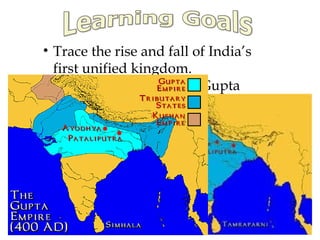
Trace the rise and fall of India’s first unified kingdom. Describe the rise of the Gupta Empire
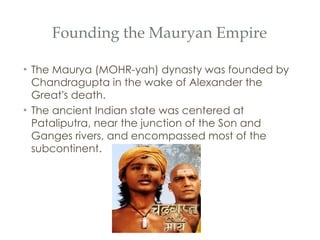
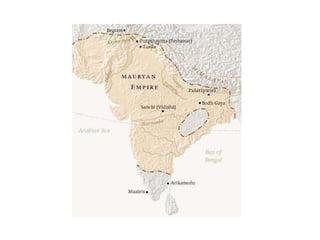
Founding the Mauryan Empire The Maurya (MOHR-yah) dynasty was founded by Chandragupta in the wake of Alexander the Great ’ s death. The ancient Indian state was centered at Pataliputra, near the junction of the Son and Ganges rivers, and encompassed most of the subcontinent.
 
Life in the Mauryan Empire The Mauryan empire was an efficient and highly organized autocracy with a standing army and civil service.  This bureaucracy and its operation were the model for the  Artha-shastra  ( “ Treatise on the Aims of Life ” ), an important Indian manual on the art of politics, attributed to the  chief minister to King Candragupta.
The Life of Emperor Aśoka Aśoka (pronounced ah-SHOH-kah) was born in 302 B.C.E. and died in 232 B.C.E.  He was the grandson of Chandragupta, the founder of the Mauryan empire. Chandragupta stepped down from the throne in 301 B.C.E. to become a Jain, leaving the empire to his son, Bindusara. Aśoka (or  Ashoka ) reigned from either  c.  265–238 BCE or  c.  273–232 BCE.
 
The Reign of Emperor Aśoka Aśoka began his reign as a typical ancient ruler: cruel, proud, and merciless. Tales of his ruthlessness are collectively identified under the tradition of  “ Black Aśoka, ”  referring to the idea that before he became a Buddhist, Aśoka was an evil man. Through prolonged warfare, Aśoka extended his empire until it convered nearly the entire subcontinent of India.
Aśoka ’ s Conversion to Buddhism In 262 B.C.E. his troops conquered Kalinga, capturing 150,000 people and killing many more. Eventually sickened by bloodshed and full of remorse for having caused great suffering, he converted to Buddhism From one of the edicts, we know that  “ Just after the taking of Kalinga, His Sacred Majesty began to follow Righteousness, to love Righteousness, to give instruction in Righteousness. ”
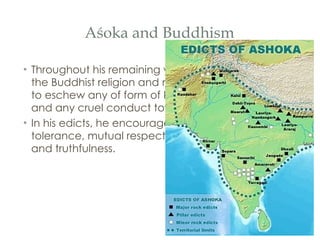
Aśoka and Buddhism Throughout his remaining years, Aśoka promoted the Buddhist religion and morality, encouraging all to eschew any of form of killing, the eating of meat and any cruel conduct toward living things.  In his edicts, he encouraged his subjects to promote tolerance, mutual respect, self-control, kindness, and truthfulness.
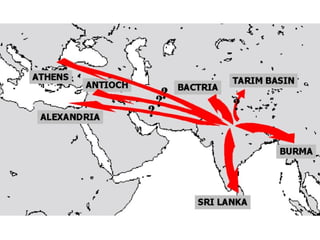
Aśoka Spreads Buddhism Aśoka explains in his edicts that he sent emissaries as far as the Mediterranean, and to the peoples throughout  India  in order to propagate the Buddhist faith.  He claimed that they were all converted to the Dharma as a result, although history shows that only Ceylon converted to Buddhism around this time.
 
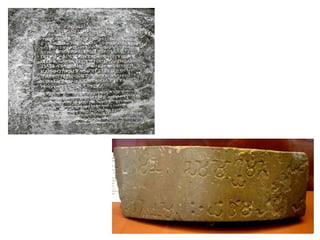
The Edicts of Aśoka The Edicts of Aśoka are a collection of 33 inscriptions on the Pillars of Aśoka, as well as boulders and cave walls. These are some of the oldest deciphered original texts of India.  The inscriptions proclaim Ashoka's beliefs in the Buddhist concept of  dharma  and although Buddhism and the Buddha are mentioned, they tend to focus on social and moral precepts rather than religious practices.
 
The Pillars of Aśoka The pillars of Ashoka are a series of columns dispersed throughout the northern Indian subcontinent. Many of the pillars are carved with the  Edicts of Ashoka .  The most famous of the columns is the one that was erected at  Sarnath , headed by a  capital with four lions .
 
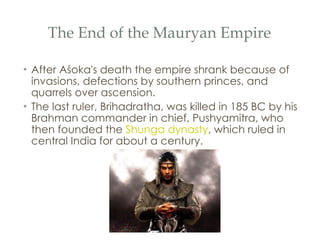
The End of the Mauryan Empire After Aśoka's death the empire shrank because of invasions, defections by southern princes, and quarrels over ascension.  The last ruler, Brihadratha, was killed in 185 BC by his Brahman commander in chief, Pushyamitra, who then founded the  Shunga dynasty , which ruled in central India for about a century.
Describe achievements in Indian literature, Art, science & mathematics Section 2 Summarize Indian trade and its effects on India and other Asian Cultures
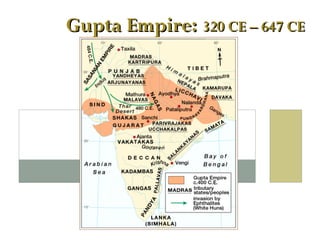
Gupta Empire:   320 CE – 647 CE
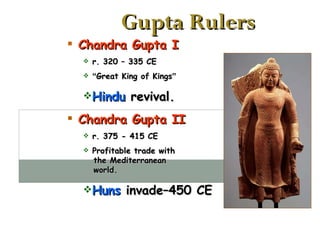
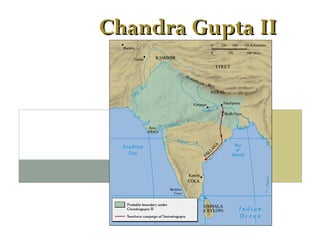
Gupta Rulers Chandra Gupta   I r. 320 – 335 CE “ Great King of Kings ” Hindu  revival. Chandra Gupta II   r. 375 - 415 CE Profitable trade with   the Mediterranean   world. Huns  invade–450 CE
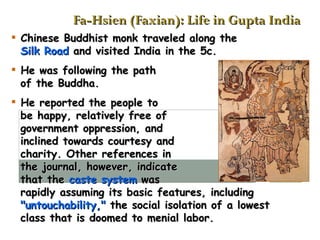
Fa-Hsien (Faxian): Life in Gupta India Chinese Buddhist monk traveled along the    Silk Road  and visited India in the 5c. He was following the path   of the Buddha. He reported the people to    be happy, relatively free of    government oppression, and    inclined towards courtesy and    charity. Other references in    the journal, however, indicate    that the  caste system  was    rapidly assuming its basic features, including   "untouchability,"  the social isolation of a lowest   class that is doomed to menial labor.
Chandra Gupta II
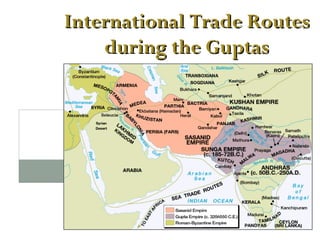
International Trade Routes during the Guptas
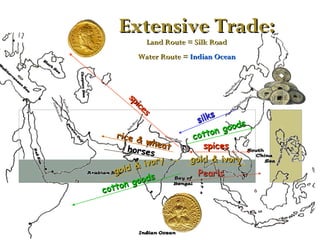
Extensive Trade: Land Route = Silk Road Water Route =  Indian Ocean spices spices gold & ivory gold & ivory rice & wheat horses cotton goods cotton goods silks Pearls
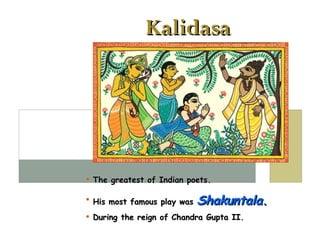
Kalidasa The greatest of Indian poets. His most famous play was  Shakuntala . During the reign of Chandra Gupta II.
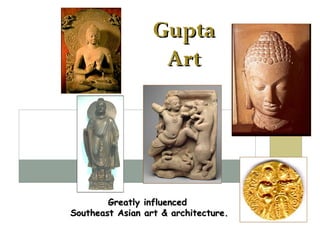
Gupta Art Greatly influenced  Southeast Asian art & architecture.
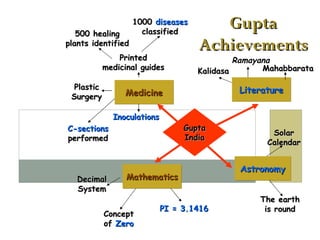
Medicine Literature Mathematics Astronomy Printed medicinal guides 1000  diseases classified Plastic Surgery C-sections performed Inoculations 500 healing plants identified Decimal System Concept of  Zero PI = 3.1416 Kalidasa Solar Calendar The earth is round Gupta India Gupta Achievements Mahabbarata Ramayana
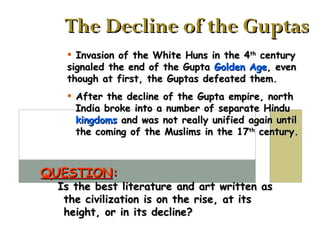
The Decline of the Guptas Invasion of the White Huns in the 4 th  century signaled the end of the Gupta  Golden Age , even though at first, the Guptas defeated them. After the decline of the Gupta empire, north   India broke into a number of separate Hindu   kingdoms  and was not really unified again until   the coming of the Muslims in the 17 th  century. QUESTION :   Is the best literature and art written as   the civilization is on the rise, at its   height, or in its decline?
Bhartrhari 5c India court poet and philosopher. Knowledge is man's crowning mark, A treasure secretly buried, The source of luxury, fame, and bliss, A guru most venerable, A friend on foreign journeys, The pinnacle of divinity. Knowledge is valued by kings    beyond wealth--- When he lacks it, a man is a brute.
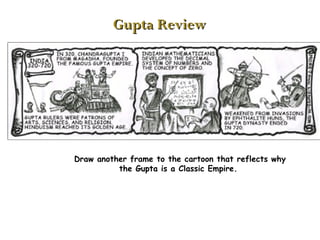
Gupta Review Draw another frame to the cartoon that reflects why the Gupta is a Classic Empire.
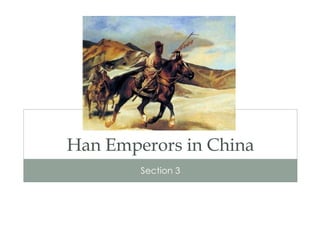
Han Emperors in China Section 3
 
Preview Main Idea / Reading Focus  Han Society Trade and Buddhism The Silk Roads   Han Achievements Chinese Society and Culture
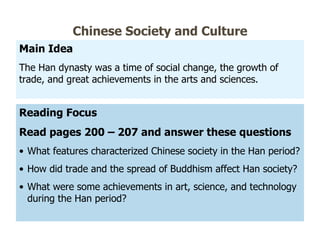
Reading Focus  Read pages 200 – 207 and answer these questions What features characterized Chinese society in the Han period? How did trade and the spread of Buddhism affect Han society? What were some achievements in art, science, and technology during the Han period? Main Idea  The Han dynasty was a time of social change, the growth of trade, and great achievements in the arts and sciences. Chinese Society and Culture
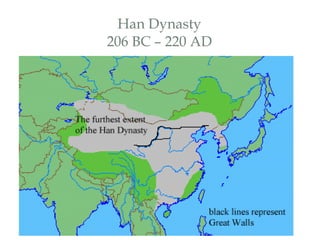
Han Dynasty 206 BC – 220 AD
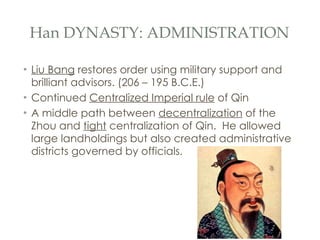
Han DYNASTY: ADMINISTRATION Liu Bang  restores order using military support and brilliant advisors. (206 – 195 B.C.E.) Continued  Centralized Imperial rule  of Qin A middle path between  decentralization  of the Zhou and  tight  centralization of Qin.  He allowed large landholdings but also created administrative districts governed by officials.
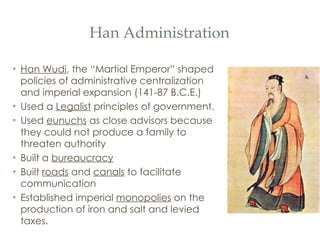
Han Administration Han Wudi , the “Martial Emperor” shaped policies of administrative centralization and imperial expansion (141-87 B.C.E.) Used a  Legalist  principles of government. Used  eunuchs  as close advisors because they could not produce a family to threaten authority Built a  bureaucracy Built  roads  and  canals  to facilitate communication Established imperial  monopolies  on the production of iron and salt and levied taxes.
Administration [continued] Adopts some Confucian ideals! Established civil service system Develops imperial university – used Confucianism as the basis for its curriculum. Needed educated group of men to effectively run centralized bureaucratic government
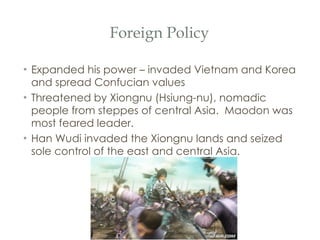
Foreign Policy Expanded his power – invaded Vietnam and Korea and spread Confucian values Threatened by Xiongnu (Hsiung-nu), nomadic people from steppes of central Asia.  Maodon was most feared leader. Han Wudi invaded the Xiongnu lands and seized sole control of the east and central Asia.
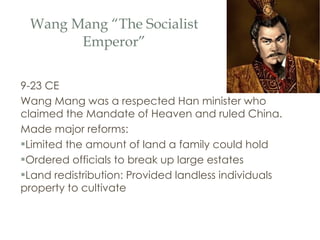
Wang Mang “The Socialist Emperor” 9-23 CE Wang Mang was a respected Han minister who claimed the Mandate of Heaven and ruled China. Made major reforms: Limited the amount of land a family could hold Ordered officials to break up large estates Land redistribution: Provided landless individuals property to cultivate
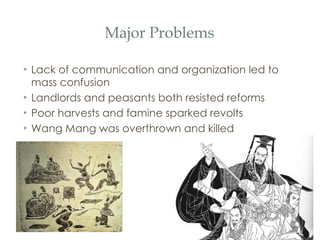
Major Problems Lack of communication and organization led to mass confusion Landlords and peasants both resisted reforms Poor harvests and famine sparked revolts Wang Mang was overthrown and killed
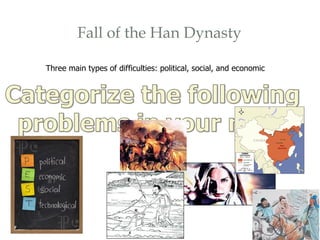
Fall of the Han Dynasty Three main types of difficulties: political, social, and economic
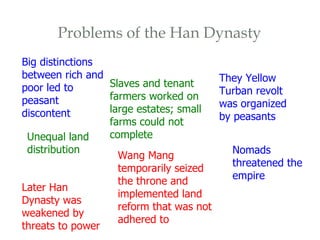
Problems of the Han Dynasty Big distinctions between rich and poor led to peasant discontent Unequal land distribution Later Han Dynasty was weakened by threats to power Slaves and tenant farmers worked on large estates; small farms could not complete Wang Mang temporarily seized the throne and implemented land reform that was not adhered to They Yellow Turban revolt was organized by peasants Nomads threatened the empire
Han Society Extra
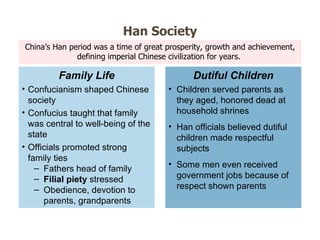
Characterize Han technology, culture and commerce
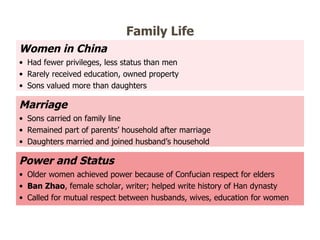
China ’s Han period was a time of great prosperity, growth and achievement, defining imperial Chinese civilization for years.  Han Society Confucianism shaped Chinese society Confucius taught that family was central to well-being of the state Officials promoted strong family ties Fathers head of family Filial piety  stressed Obedience, devotion to parents, grandparents Family Life Children served parents as they aged, honored dead at household shrines Han officials believed dutiful children made respectful subjects Some men even received government jobs because of respect shown parents Dutiful Children
Women in China Had fewer privileges, less status than men Rarely received education, owned property Sons valued more than daughters Power and Status Older women achieved power because of Confucian respect for elders Ban Zhao , female scholar, writer; helped write history of Han dynasty Called for mutual respect between husbands, wives, education for women Marriage Sons carried on family line Remained part of parents ’ household after marriage Daughters married and joined husband ’s household Family Life
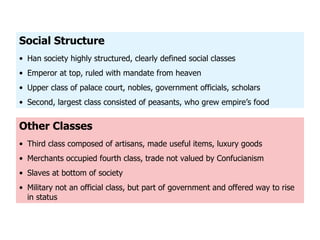
Other Classes Third class composed of artisans, made useful items, luxury goods Merchants occupied fourth class, trade not valued by Confucianism Slaves at bottom of society Military not an official class, but part of government and offered way to rise in status Social Structure Han society highly structured, clearly defined social classes Emperor at top, ruled with mandate from heaven Upper class of palace court, nobles, government officials, scholars Second, largest class consisted of peasants, who grew empire ’s food
Han Society 90 percent of nearly 60 million in China at time were peasants Lived in small villages in simple houses, labored long hours in fields, worked on government projects in winter High taxes, bad weather could force them into debt Many had to sell lands, become laborers for wealthy Peasant Class Social class determined status, but not wealth or power Merchants usually wealthier than peasants, but were lower in status Wealthy in Han China lived well Spacious homes, large estates Hired numerous laborers Rich and Poor
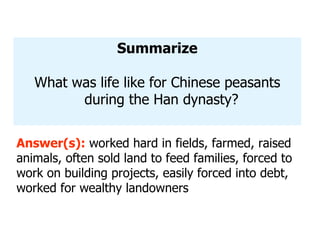
Summarize What was life like for Chinese peasants during the Han dynasty? Answer(s):  worked hard in fields, farmed, raised animals, often sold land to feed families, forced to work on building projects, easily forced into debt, worked for wealthy landowners
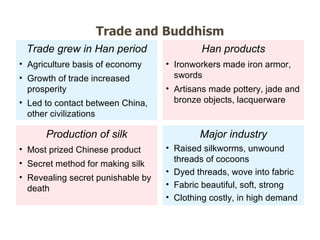
Trade grew in Han period Agriculture basis of economy Growth of trade increased prosperity Led to contact between China, other civilizations Production of silk Most prized Chinese product  Secret method for making silk Revealing secret punishable by death  Han products Ironworkers made iron armor, swords Artisans made pottery, jade and bronze objects, lacquerware Major industry Raised silkworms, unwound threads of cocoons  Dyed threads, wove into fabric Fabric beautiful, soft, strong Clothing costly, in high demand  Trade and Buddhism
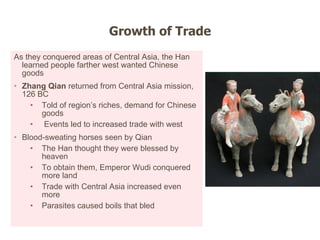
As they conquered areas of Central Asia, the Han learned people farther west wanted Chinese goods Zhang Qian  returned from Central Asia mission, 126 BC   Told of region ’s riches, demand for Chinese goods Events led to increased trade with west Blood-sweating horses seen by Qian  The Han thought they were blessed by heaven To obtain them, Emperor Wudi conquered more land Trade with Central Asia increased even more Parasites caused boils that bled Growth of Trade
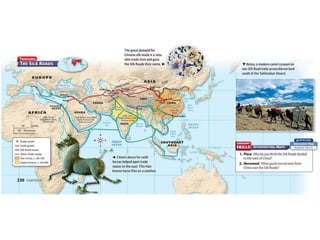
Merchants traveling between China, Central Asia used overland routes. The most famous were called the  Silk Roads . This network of routes eventually stretched from China over 4,000 miles to Mediterranean Sea, and linked China to India, the Middle East, and the Roman Empire. The Silk Roads Travelers on Silk Roads crossed rugged, barren terrain Faced attacks by bandits For protection, traveled in huge camel caravans Stopped at stations along way Travel Most merchants traveled only part of way Traded goods with merchants from distant lands Most goods traded were luxury items Small, valuable, highly profitable Trade
 
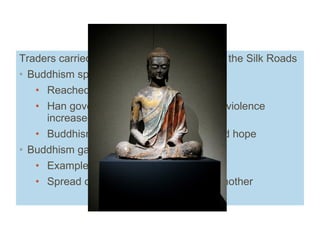
Traders carried ideas as well as goods over the Silk Roads Buddhism spread to China from India Reached China in first century AD Han government became less stable, violence increased Buddhism ’s message of rebirth offered hope Buddhism gained popularity by AD 200  Example of cultural diffusion Spread of ideas from one culture to another Trade and Buddhism
Draw Conclusions How did trade over the Silk Roads affect China ’s culture? Answer(s):  profitable trade in luxury items, connections to Central Asia, introduction of Buddhism
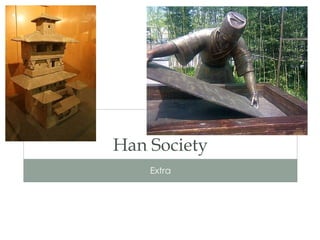
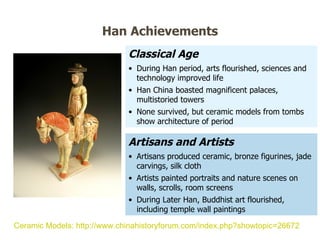
Classical Age During Han period, arts flourished, sciences and technology improved life Han China boasted magnificent palaces, multistoried towers None survived, but ceramic models from tombs show architecture of period Artisans and Artists Artisans produced ceramic, bronze figurines, jade carvings, silk cloth Artists painted portraits and nature scenes on walls, scrolls, room screens During Later Han, Buddhist art flourished, including temple wall paintings Han Achievements Ceramic Models: http://www.chinahistoryforum.com/index.php?showtopic=26672
Han writers produced important works of history Sima Qian Wrote  Records of the Grand Historian  or  Shiji This early history became model for Chinese historical writing Han Achievements
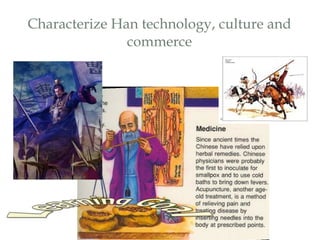
Technology One of most important Han inventions - paper  Made by grinding plant fibers into paste, paste dried in sheets Created  “books” by connecting several sheets of paper into long scroll Science  Created seismograph to measure earthquake tremors Made advances in  acupuncture , use of needles to cure disease, relieve pain Invented compass, sundial, water mill, ship ’s rudder Farming  Inventions included iron plow, wheelbarrow With iron plow, farmer could till more land With wheelbarrow, farmer could haul more Han Achievements
Summarize What were some technological advances of the Han dynasty? Answer(s):  paper, iron plow, wheelbarrow, acupuncture, compass, sundial, water mill, rudder

Ch.7.india&china establish empires

  • 1.
    Ancient India (321-185B.C.E.) The Mauryan Empire and the Spread of Buddhism
  • 2.
    Trace the riseand fall of India’s first unified kingdom. Describe the rise of the Gupta Empire
  • 3.
    Founding the MauryanEmpire The Maurya (MOHR-yah) dynasty was founded by Chandragupta in the wake of Alexander the Great ’ s death. The ancient Indian state was centered at Pataliputra, near the junction of the Son and Ganges rivers, and encompassed most of the subcontinent.
  • 4.
  • 5.
    Life in theMauryan Empire The Mauryan empire was an efficient and highly organized autocracy with a standing army and civil service. This bureaucracy and its operation were the model for the Artha-shastra ( “ Treatise on the Aims of Life ” ), an important Indian manual on the art of politics, attributed to the chief minister to King Candragupta.
  • 6.
    The Life ofEmperor Aśoka Aśoka (pronounced ah-SHOH-kah) was born in 302 B.C.E. and died in 232 B.C.E. He was the grandson of Chandragupta, the founder of the Mauryan empire. Chandragupta stepped down from the throne in 301 B.C.E. to become a Jain, leaving the empire to his son, Bindusara. Aśoka (or Ashoka ) reigned from either c. 265–238 BCE or c. 273–232 BCE.
  • 7.
  • 8.
    The Reign ofEmperor Aśoka Aśoka began his reign as a typical ancient ruler: cruel, proud, and merciless. Tales of his ruthlessness are collectively identified under the tradition of “ Black Aśoka, ” referring to the idea that before he became a Buddhist, Aśoka was an evil man. Through prolonged warfare, Aśoka extended his empire until it convered nearly the entire subcontinent of India.
  • 9.
    Aśoka ’ sConversion to Buddhism In 262 B.C.E. his troops conquered Kalinga, capturing 150,000 people and killing many more. Eventually sickened by bloodshed and full of remorse for having caused great suffering, he converted to Buddhism From one of the edicts, we know that “ Just after the taking of Kalinga, His Sacred Majesty began to follow Righteousness, to love Righteousness, to give instruction in Righteousness. ”
  • 10.
    Aśoka and BuddhismThroughout his remaining years, Aśoka promoted the Buddhist religion and morality, encouraging all to eschew any of form of killing, the eating of meat and any cruel conduct toward living things. In his edicts, he encouraged his subjects to promote tolerance, mutual respect, self-control, kindness, and truthfulness.
  • 11.
    Aśoka Spreads BuddhismAśoka explains in his edicts that he sent emissaries as far as the Mediterranean, and to the peoples throughout India in order to propagate the Buddhist faith. He claimed that they were all converted to the Dharma as a result, although history shows that only Ceylon converted to Buddhism around this time.
  • 12.
  • 13.
    The Edicts ofAśoka The Edicts of Aśoka are a collection of 33 inscriptions on the Pillars of Aśoka, as well as boulders and cave walls. These are some of the oldest deciphered original texts of India. The inscriptions proclaim Ashoka's beliefs in the Buddhist concept of dharma and although Buddhism and the Buddha are mentioned, they tend to focus on social and moral precepts rather than religious practices.
  • 14.
  • 15.
    The Pillars ofAśoka The pillars of Ashoka are a series of columns dispersed throughout the northern Indian subcontinent. Many of the pillars are carved with the Edicts of Ashoka . The most famous of the columns is the one that was erected at Sarnath , headed by a capital with four lions .
  • 16.
  • 17.
    The End ofthe Mauryan Empire After Aśoka's death the empire shrank because of invasions, defections by southern princes, and quarrels over ascension. The last ruler, Brihadratha, was killed in 185 BC by his Brahman commander in chief, Pushyamitra, who then founded the Shunga dynasty , which ruled in central India for about a century.
  • 18.
    Describe achievements inIndian literature, Art, science & mathematics Section 2 Summarize Indian trade and its effects on India and other Asian Cultures
  • 19.
    Gupta Empire: 320 CE – 647 CE
  • 20.
    Gupta Rulers ChandraGupta I r. 320 – 335 CE “ Great King of Kings ” Hindu revival. Chandra Gupta II r. 375 - 415 CE Profitable trade with the Mediterranean world. Huns invade–450 CE
  • 21.
    Fa-Hsien (Faxian): Lifein Gupta India Chinese Buddhist monk traveled along the Silk Road and visited India in the 5c. He was following the path of the Buddha. He reported the people to be happy, relatively free of government oppression, and inclined towards courtesy and charity. Other references in the journal, however, indicate that the caste system was rapidly assuming its basic features, including "untouchability," the social isolation of a lowest class that is doomed to menial labor.
  • 22.
  • 23.
    International Trade Routesduring the Guptas
  • 24.
    Extensive Trade: LandRoute = Silk Road Water Route = Indian Ocean spices spices gold & ivory gold & ivory rice & wheat horses cotton goods cotton goods silks Pearls
  • 25.
    Kalidasa The greatestof Indian poets. His most famous play was Shakuntala . During the reign of Chandra Gupta II.
  • 26.
    Gupta Art Greatlyinfluenced Southeast Asian art & architecture.
  • 27.
    Medicine Literature MathematicsAstronomy Printed medicinal guides 1000 diseases classified Plastic Surgery C-sections performed Inoculations 500 healing plants identified Decimal System Concept of Zero PI = 3.1416 Kalidasa Solar Calendar The earth is round Gupta India Gupta Achievements Mahabbarata Ramayana
  • 28.
    The Decline ofthe Guptas Invasion of the White Huns in the 4 th century signaled the end of the Gupta Golden Age , even though at first, the Guptas defeated them. After the decline of the Gupta empire, north India broke into a number of separate Hindu kingdoms and was not really unified again until the coming of the Muslims in the 17 th century. QUESTION : Is the best literature and art written as the civilization is on the rise, at its height, or in its decline?
  • 29.
    Bhartrhari 5c Indiacourt poet and philosopher. Knowledge is man's crowning mark, A treasure secretly buried, The source of luxury, fame, and bliss, A guru most venerable, A friend on foreign journeys, The pinnacle of divinity. Knowledge is valued by kings beyond wealth--- When he lacks it, a man is a brute.
  • 30.
    Gupta Review Drawanother frame to the cartoon that reflects why the Gupta is a Classic Empire.
  • 31.
    Han Emperors inChina Section 3
  • 32.
  • 33.
    Preview Main Idea/ Reading Focus Han Society Trade and Buddhism The Silk Roads Han Achievements Chinese Society and Culture
  • 34.
    Reading Focus Read pages 200 – 207 and answer these questions What features characterized Chinese society in the Han period? How did trade and the spread of Buddhism affect Han society? What were some achievements in art, science, and technology during the Han period? Main Idea The Han dynasty was a time of social change, the growth of trade, and great achievements in the arts and sciences. Chinese Society and Culture
  • 35.
    Han Dynasty 206BC – 220 AD
  • 36.
    Han DYNASTY: ADMINISTRATIONLiu Bang restores order using military support and brilliant advisors. (206 – 195 B.C.E.) Continued Centralized Imperial rule of Qin A middle path between decentralization of the Zhou and tight centralization of Qin. He allowed large landholdings but also created administrative districts governed by officials.
  • 37.
    Han Administration HanWudi , the “Martial Emperor” shaped policies of administrative centralization and imperial expansion (141-87 B.C.E.) Used a Legalist principles of government. Used eunuchs as close advisors because they could not produce a family to threaten authority Built a bureaucracy Built roads and canals to facilitate communication Established imperial monopolies on the production of iron and salt and levied taxes.
  • 38.
    Administration [continued] Adoptssome Confucian ideals! Established civil service system Develops imperial university – used Confucianism as the basis for its curriculum. Needed educated group of men to effectively run centralized bureaucratic government
  • 39.
    Foreign Policy Expandedhis power – invaded Vietnam and Korea and spread Confucian values Threatened by Xiongnu (Hsiung-nu), nomadic people from steppes of central Asia. Maodon was most feared leader. Han Wudi invaded the Xiongnu lands and seized sole control of the east and central Asia.
  • 40.
    Wang Mang “TheSocialist Emperor” 9-23 CE Wang Mang was a respected Han minister who claimed the Mandate of Heaven and ruled China. Made major reforms: Limited the amount of land a family could hold Ordered officials to break up large estates Land redistribution: Provided landless individuals property to cultivate
  • 41.
    Major Problems Lackof communication and organization led to mass confusion Landlords and peasants both resisted reforms Poor harvests and famine sparked revolts Wang Mang was overthrown and killed
  • 42.
    Fall of theHan Dynasty Three main types of difficulties: political, social, and economic
  • 43.
    Problems of theHan Dynasty Big distinctions between rich and poor led to peasant discontent Unequal land distribution Later Han Dynasty was weakened by threats to power Slaves and tenant farmers worked on large estates; small farms could not complete Wang Mang temporarily seized the throne and implemented land reform that was not adhered to They Yellow Turban revolt was organized by peasants Nomads threatened the empire
  • 44.
  • 45.
    Characterize Han technology,culture and commerce
  • 46.
    China ’s Hanperiod was a time of great prosperity, growth and achievement, defining imperial Chinese civilization for years. Han Society Confucianism shaped Chinese society Confucius taught that family was central to well-being of the state Officials promoted strong family ties Fathers head of family Filial piety stressed Obedience, devotion to parents, grandparents Family Life Children served parents as they aged, honored dead at household shrines Han officials believed dutiful children made respectful subjects Some men even received government jobs because of respect shown parents Dutiful Children
  • 47.
    Women in ChinaHad fewer privileges, less status than men Rarely received education, owned property Sons valued more than daughters Power and Status Older women achieved power because of Confucian respect for elders Ban Zhao , female scholar, writer; helped write history of Han dynasty Called for mutual respect between husbands, wives, education for women Marriage Sons carried on family line Remained part of parents ’ household after marriage Daughters married and joined husband ’s household Family Life
  • 48.
    Other Classes Thirdclass composed of artisans, made useful items, luxury goods Merchants occupied fourth class, trade not valued by Confucianism Slaves at bottom of society Military not an official class, but part of government and offered way to rise in status Social Structure Han society highly structured, clearly defined social classes Emperor at top, ruled with mandate from heaven Upper class of palace court, nobles, government officials, scholars Second, largest class consisted of peasants, who grew empire ’s food
  • 49.
    Han Society 90percent of nearly 60 million in China at time were peasants Lived in small villages in simple houses, labored long hours in fields, worked on government projects in winter High taxes, bad weather could force them into debt Many had to sell lands, become laborers for wealthy Peasant Class Social class determined status, but not wealth or power Merchants usually wealthier than peasants, but were lower in status Wealthy in Han China lived well Spacious homes, large estates Hired numerous laborers Rich and Poor
  • 50.
    Summarize What waslife like for Chinese peasants during the Han dynasty? Answer(s): worked hard in fields, farmed, raised animals, often sold land to feed families, forced to work on building projects, easily forced into debt, worked for wealthy landowners
  • 51.
    Trade grew inHan period Agriculture basis of economy Growth of trade increased prosperity Led to contact between China, other civilizations Production of silk Most prized Chinese product Secret method for making silk Revealing secret punishable by death Han products Ironworkers made iron armor, swords Artisans made pottery, jade and bronze objects, lacquerware Major industry Raised silkworms, unwound threads of cocoons Dyed threads, wove into fabric Fabric beautiful, soft, strong Clothing costly, in high demand Trade and Buddhism
  • 52.
    As they conqueredareas of Central Asia, the Han learned people farther west wanted Chinese goods Zhang Qian returned from Central Asia mission, 126 BC Told of region ’s riches, demand for Chinese goods Events led to increased trade with west Blood-sweating horses seen by Qian The Han thought they were blessed by heaven To obtain them, Emperor Wudi conquered more land Trade with Central Asia increased even more Parasites caused boils that bled Growth of Trade
  • 53.
    Merchants traveling betweenChina, Central Asia used overland routes. The most famous were called the Silk Roads . This network of routes eventually stretched from China over 4,000 miles to Mediterranean Sea, and linked China to India, the Middle East, and the Roman Empire. The Silk Roads Travelers on Silk Roads crossed rugged, barren terrain Faced attacks by bandits For protection, traveled in huge camel caravans Stopped at stations along way Travel Most merchants traveled only part of way Traded goods with merchants from distant lands Most goods traded were luxury items Small, valuable, highly profitable Trade
  • 54.
  • 55.
    Traders carried ideasas well as goods over the Silk Roads Buddhism spread to China from India Reached China in first century AD Han government became less stable, violence increased Buddhism ’s message of rebirth offered hope Buddhism gained popularity by AD 200 Example of cultural diffusion Spread of ideas from one culture to another Trade and Buddhism
  • 56.
    Draw Conclusions Howdid trade over the Silk Roads affect China ’s culture? Answer(s): profitable trade in luxury items, connections to Central Asia, introduction of Buddhism
  • 57.
    Classical Age DuringHan period, arts flourished, sciences and technology improved life Han China boasted magnificent palaces, multistoried towers None survived, but ceramic models from tombs show architecture of period Artisans and Artists Artisans produced ceramic, bronze figurines, jade carvings, silk cloth Artists painted portraits and nature scenes on walls, scrolls, room screens During Later Han, Buddhist art flourished, including temple wall paintings Han Achievements Ceramic Models: http://www.chinahistoryforum.com/index.php?showtopic=26672
  • 58.
    Han writers producedimportant works of history Sima Qian Wrote Records of the Grand Historian or Shiji This early history became model for Chinese historical writing Han Achievements
  • 59.
    Technology One ofmost important Han inventions - paper Made by grinding plant fibers into paste, paste dried in sheets Created “books” by connecting several sheets of paper into long scroll Science Created seismograph to measure earthquake tremors Made advances in acupuncture , use of needles to cure disease, relieve pain Invented compass, sundial, water mill, ship ’s rudder Farming Inventions included iron plow, wheelbarrow With iron plow, farmer could till more land With wheelbarrow, farmer could haul more Han Achievements
  • 60.
    Summarize What weresome technological advances of the Han dynasty? Answer(s): paper, iron plow, wheelbarrow, acupuncture, compass, sundial, water mill, rudder