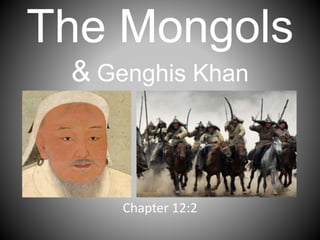

The Mongols
& Genghis Khan
Chapter 12:2
THE
MONGOLS• Main Idea: EMPIRE BUILDING. The Mongols, a
nomadic people from the steppe, conquered
settled societies across much of Asia
• Why it Matters now? The Mongols built the
largest unified land empire in world history
Setting the Stage:
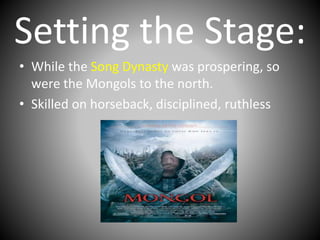
• While the Song Dynasty was prospering, so
were the Mongols to the north.
• Skilled on horseback, disciplined, ruthless
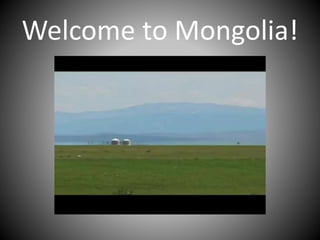
Welcome to Mongolia!
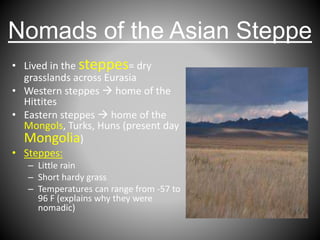
Nomads of the Asian Steppe
• Lived in the steppes= dry
grasslands across Eurasia
• Western steppes  home of the
Hittites
• Eastern steppes  home of the
Mongols, Turks, Huns (present day
Mongolia)
• Steppes:
– Little rain
– Short hardy grass
– Temperatures can range from -57 to
96 F (explains why they were
nomadic)
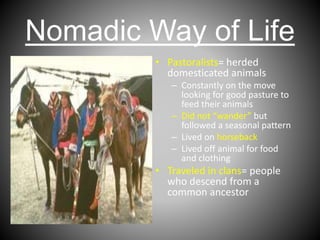
Nomadic Way of Life
• Pastoralists= herded
domesticated animals
– Constantly on the move
looking for good pasture to
feed their animals
– Did not “wander” but
followed a seasonal pattern
– Lived on horseback
– Lived off animal for food
and clothing
• Traveled in clans= people
who descend from a
common ancestor
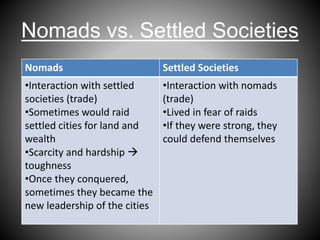
Nomads vs. Settled Societies
Nomads Settled Societies
•Interaction with settled
societies (trade)
•Sometimes would raid
settled cities for land and
wealth
•Scarcity and hardship 
toughness
•Once they conquered,
sometimes they became the
new leadership of the cities
•Interaction with nomads
(trade)
•Lived in fear of raids
•If they were strong, they
could defend themselves
Nomad Way of Life
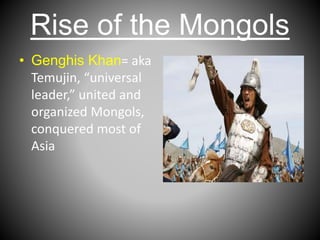
Rise of the Mongols
• Genghis Khan= aka
Temujin, “universal
leader,” united and
organized Mongols,
conquered most of
Asia
The Mongols Trailer
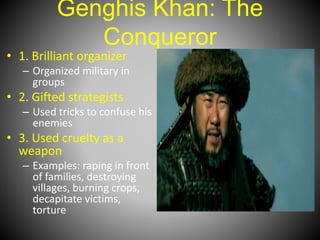
Genghis Khan: The
Conqueror
• 1. Brilliant organizer
– Organized military in
groups
• 2. Gifted strategists
– Used tricks to confuse his
enemies
• 3. Used cruelty as a
weapon
– Examples: raping in front
of families, destroying
villages, burning crops,
decapitate victims,
torture
Genghis Khan Song
The Mongol Empire
• Genghis died from
illness
• Continued to expand
after his death 
created the largest
unified land empire in
history
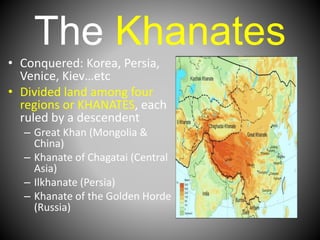
The Khanates
• Conquered: Korea, Persia,
Venice, Kiev…etc
• Divided land among four
regions or KHANATES, each
ruled by a descendent
– Great Khan (Mongolia &
China)
– Khanate of Chagatai (Central
Asia)
– Ilkhanate (Persia)
– Khanate of the Golden Horde
(Russia)
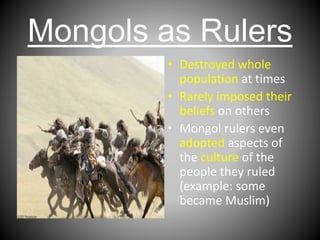
Mongols as Rulers
• Destroyed whole
population at times
• Rarely imposed their
beliefs on others
• Mongol rulers even
adopted aspects of
the culture of the
people they ruled
(example: some
became Muslim)
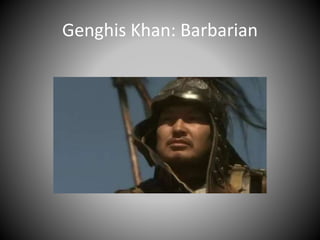
Genghis Khan: Barbarian
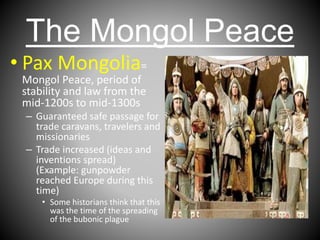
The Mongol Peace
• Pax Mongolia=
Mongol Peace, period of
stability and law from the
mid-1200s to mid-1300s
– Guaranteed safe passage for
trade caravans, travelers and
missionaries
– Trade increased (ideas and
inventions spread)
(Example: gunpowder
reached Europe during this
time)
• Some historians think that this
was the time of the spreading
of the bubonic plague
The Mongol Empire
Chapter 12:3
• H/W: Chapter 12:
Section 3 -The Mongol
Empire-
• Finish your notes by
reading in your
textbook and
answering the
questions in the note
guide
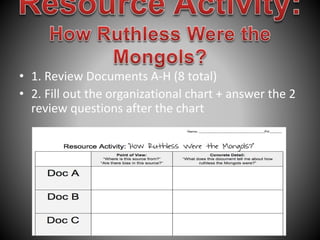
• 1. Review Documents A-H (8 total)
• 2. Fill out the organizational chart + answer the 2
review questions after the chart
Document A
Document B
Document C
Document D
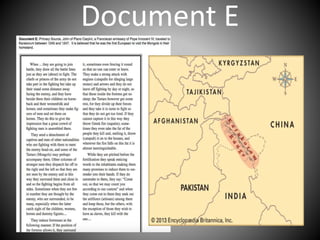
Document E
Document F
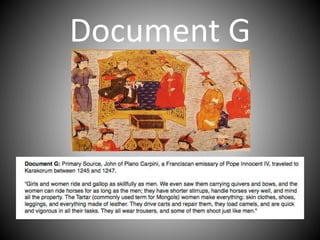
Document G
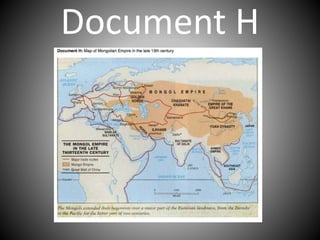
Document H
The Mongol Empire
Chapter 12:3
• H/W: Chapter 12:
Section 3 -The Mongol
Empire-
• Finish your notes by
reading in your
textbook and
answering the
questions in the note
guide

AP World: Mongols (12:2) + Mongol Reading Resources

  • 2.
    The Mongols & GenghisKhan Chapter 12:2
  • 3.
    THE MONGOLS• Main Idea:EMPIRE BUILDING. The Mongols, a nomadic people from the steppe, conquered settled societies across much of Asia • Why it Matters now? The Mongols built the largest unified land empire in world history
  • 4.
    Setting the Stage: •While the Song Dynasty was prospering, so were the Mongols to the north. • Skilled on horseback, disciplined, ruthless
  • 5.
  • 6.
    Nomads of theAsian Steppe • Lived in the steppes= dry grasslands across Eurasia • Western steppes  home of the Hittites • Eastern steppes  home of the Mongols, Turks, Huns (present day Mongolia) • Steppes: – Little rain – Short hardy grass – Temperatures can range from -57 to 96 F (explains why they were nomadic)
  • 7.
    Nomadic Way ofLife • Pastoralists= herded domesticated animals – Constantly on the move looking for good pasture to feed their animals – Did not “wander” but followed a seasonal pattern – Lived on horseback – Lived off animal for food and clothing • Traveled in clans= people who descend from a common ancestor
  • 8.
    Nomads vs. SettledSocieties Nomads Settled Societies •Interaction with settled societies (trade) •Sometimes would raid settled cities for land and wealth •Scarcity and hardship  toughness •Once they conquered, sometimes they became the new leadership of the cities •Interaction with nomads (trade) •Lived in fear of raids •If they were strong, they could defend themselves
  • 9.
  • 10.
    Rise of theMongols • Genghis Khan= aka Temujin, “universal leader,” united and organized Mongols, conquered most of Asia
  • 11.
  • 12.
    Genghis Khan: The Conqueror •1. Brilliant organizer – Organized military in groups • 2. Gifted strategists – Used tricks to confuse his enemies • 3. Used cruelty as a weapon – Examples: raping in front of families, destroying villages, burning crops, decapitate victims, torture
  • 13.
  • 14.
    The Mongol Empire •Genghis died from illness • Continued to expand after his death  created the largest unified land empire in history
  • 17.
    The Khanates • Conquered:Korea, Persia, Venice, Kiev…etc • Divided land among four regions or KHANATES, each ruled by a descendent – Great Khan (Mongolia & China) – Khanate of Chagatai (Central Asia) – Ilkhanate (Persia) – Khanate of the Golden Horde (Russia)
  • 18.
    Mongols as Rulers •Destroyed whole population at times • Rarely imposed their beliefs on others • Mongol rulers even adopted aspects of the culture of the people they ruled (example: some became Muslim)
  • 19.
  • 20.
    The Mongol Peace •Pax Mongolia= Mongol Peace, period of stability and law from the mid-1200s to mid-1300s – Guaranteed safe passage for trade caravans, travelers and missionaries – Trade increased (ideas and inventions spread) (Example: gunpowder reached Europe during this time) • Some historians think that this was the time of the spreading of the bubonic plague
  • 21.
    The Mongol Empire Chapter12:3 • H/W: Chapter 12: Section 3 -The Mongol Empire- • Finish your notes by reading in your textbook and answering the questions in the note guide
  • 22.
    • 1. ReviewDocuments A-H (8 total) • 2. Fill out the organizational chart + answer the 2 review questions after the chart
  • 23.
  • 24.
  • 25.
  • 26.
  • 27.
  • 28.
  • 29.
  • 30.
  • 31.
    The Mongol Empire Chapter12:3 • H/W: Chapter 12: Section 3 -The Mongol Empire- • Finish your notes by reading in your textbook and answering the questions in the note guide

Editor's Notes

  • #3 Notes: https://docs.google.com/document/d/1gqmErVSk_wb-a-eQwbyW8USoOksAHZzgoDpnj6OT8w8/edit?usp=sharing
  • #8 Each Mongol traveled with 3 extra horses, switched saddles and mounts, so they could stay on the horse for up to 10 days. If food was scarce, they would make a small gash in the horses neck and drink horse’s blood