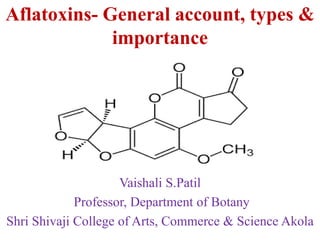
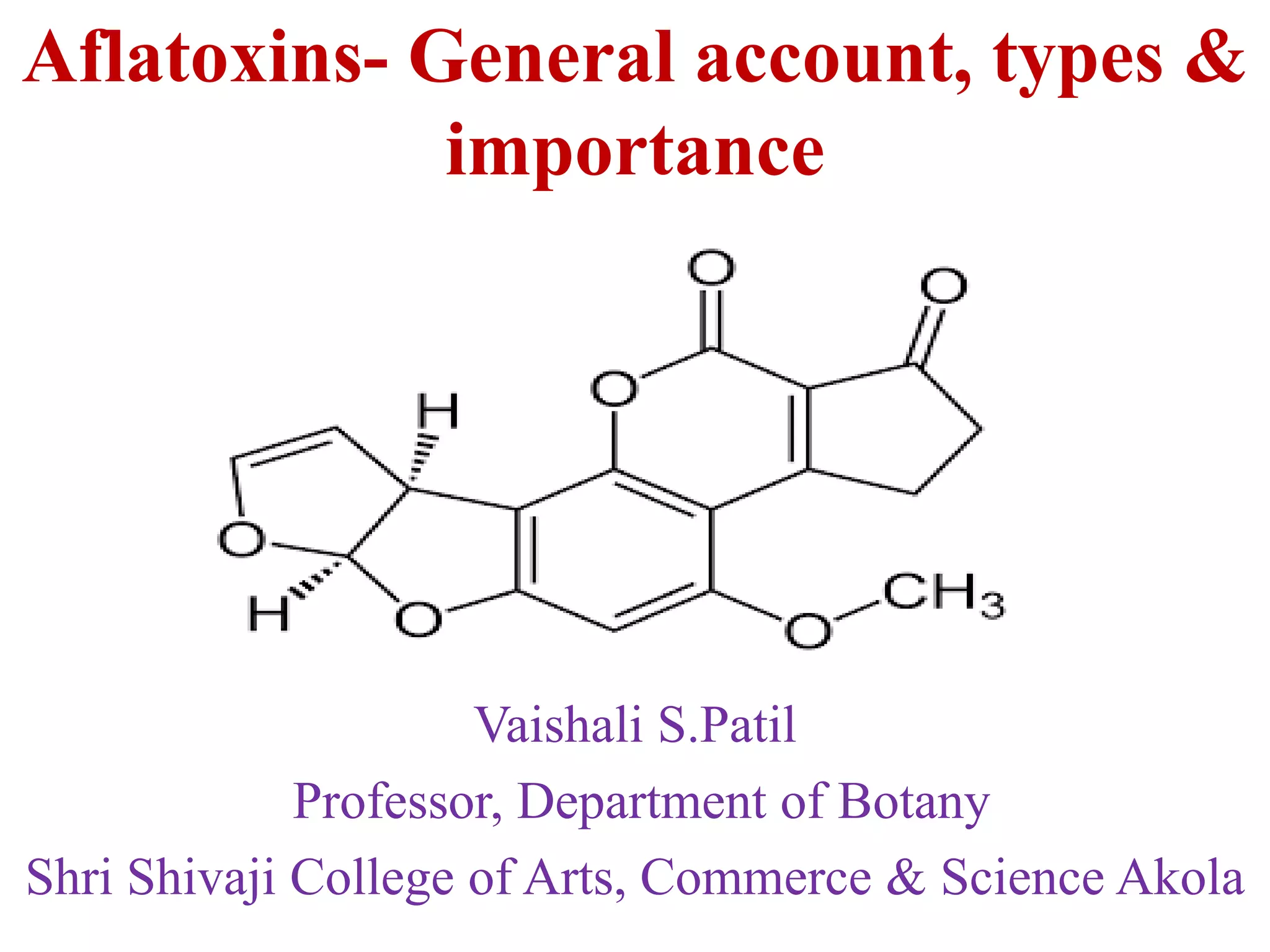
Aflatoxins- General account, types &
importance
Vaishali S.Patil
Professor, Department of Botany
Shri Shivaji College of Arts, Commerce & Science Akola
Introduction
• Aflatoxins are poisonous carcinogens and mutagens that are produced
by 20 related fungal metabolites of certain molds (Aspergillus
flavus and Aspergillus parasiticus) which grow in soil, decaying
vegetation, hay, and grains.
• The molds can colonize and contaminate food before harvest or
during storage, especially following prolonged exposure to a high-
humidity environment, or to stressful conditions such as drought.
• They are regularly found in improperly stored staple
commodities such as cassava, chili
peppers, cottonseed, millet, peanuts, rice, sesame
seeds, sorghum, sunflower seeds, sweetcorn, tree nuts, wheat, and a
variety of spices.
• Aflatoxin transformation products are sometimes found in eggs, milk
products, and meat when animals are fed contaminated grains.
• They have been found in both pet and human foods, as well as in
feedstocks for agricultural animals.
•The aflatoxins were initially isolated and identified as the causative
agent in Turkey X disease that caused necrosis of the liver in 1960 and
over 100,000 turkeys died in England and USA and the death was
attributed to the consumption of a mould-contaminated peanut meal.
•.Aflatoxins are highly liposoluble compounds and are readily absorbed
from the site of exposure usually through the gastrointestinal tract and
respiratory tract into blood stream.
•Human and animals get exposed to aflatoxins by two major routes (a)
direct ingestion of aflatoxin-contaminated foods or ingestion of
aflatoxins carried over from feed into milk and milk products like cheese
and powdered milk as well as other animal tissues mainly as AFM1(b) by
inhalation of dust particles of aflatoxins especially AFB1 in contaminated
foods in industries and factories.
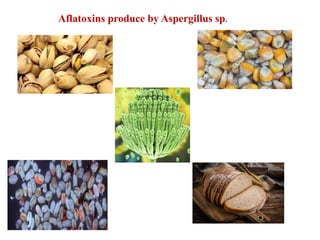
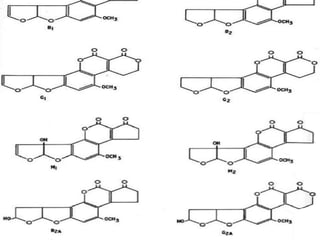
Aflatoxins produce by Aspergillus sp.
Types
1.Aflatoxin B1 and B2 (AFB), produced by Aspergillus flavus and A.
parasiticus
2.Aflatoxin G1 and G2 (AFG), produced by some Group II A.
flavus and Aspergillus parasiticus.
3.Aflatoxin M1 (AFM1), metabolite of aflatoxin B1 in humans and
animals (exposure in ng levels may come from a mother's milk)
4.Aflatoxin M2, metabolite of aflatoxin B2 in milk of cattle fed on
contaminated foods.
5. Aflatoxicol (AFL): metabolite produced by breaking down the
lactone ring
6. Aflatoxin Q1 (AFQ1), major metabolite of AFB1 in in vitro liver
preparations of other higher vertebrates.
1.Aflatoxin B1 Chemical formula: C17H12O6 is an aflatoxin produced
by Aspergillus flavus and A. parasiticus.
•It is a very potent carcinogen with a TD50 3.2 μg/kg/day in rats.
Aflatoxin B1 is a common contaminant in a variety of foods including
peanuts, cottonseed meal, corn, and other grains; as well as animal feeds.
•It is considered the most toxic aflatoxin and it is highly implicated
in hepatocellular carcinoma (HCC) in humans.
• In animals, aflatoxin B1 has also been shown to
be mutagenic, teratogenic, and to cause immunosuppression.
•Several sampling and analytical methods including thin-layer
chromatography (TLC), high-performance liquId
chromatography (HPLC), mass spectrometry, and enzyme-linked
immunosorbent assay (ELISA), among others, have been used to test for
aflatoxin B1 contamination in foods.
Sources - found in contaminated food and humans are exposed to
aflatoxin B1 almost entirely through their diet in swine and poultry
production.
Pathology
Reduction in weight of liver, vacuolation of hepatocytes, and
hepatic carcinoma. Other liver lesions include enlargement of hepatic
cells, fatty infiltration, necrosis, hemorrhage, fibrosis, regeneration of
nodules, and bile duct proliferation/hyperplasia.
Toxicity
1.Acute toxicity symptoms include anorexia, malaise, and low-grade
fever.
2.Subacute toxicity showed moderate to severe liver damage.
3. Chronic toxicity showed decreased hepatic microsomal cytochrome
P-450 concentration, reduction in feed consumption and decreased
weight gain.
4.Subchronic toxicity in fish showed fish to present with preneoplastic
lesions, concurrently with changes in gill, pancreas, intestine and spleen.
5.Genotoxicity DNA adducts, 8-hydroxyguanine lesions and DNA
damage.
6. Carcinogenicity the development of liver cell carcinoma.
7. Embryotoxicity development of the bursa of Fabricius.
8.Teratogenicity reduced fetal weights, wrist drop, enlarged eye
socket, agenesis of caudal vertebrae, micropthalmia, cardiac defects, and
lenticular degeneration.
9. Immunotoxicity reduced serum total globulin and
reduced bactericidal activities.
2.Aflatoxin B2: Molecular Formula: C17H14O6
Moderately potent hepatotoxic, hepatocarcinogenic, mutagenic and
teratogenic mycotoxins produced by Aspergillus
flavus and parasiticus. Dihydroxy derivatives of aflatoxin B1. Formed
during growth on the same commodities as aflatoxin B1 (including
peanuts, corn and other cereals, and oilseeds), but in smaller amounts.
Metabolized to aflatoxin M2, and excreted in milk in this form.
3.Aflatoxin G1- Molecular Formula:C17H12O7 - Aflatoxin G1 is a
toxic metabolite of the fungi Aspergillus flavus and A. Parasiticus.
Aflatoxin G1 belongs to the class of organic compounds known as
difurocoumarolactones. Aflatoxin g is formally rated as a carcinogen (by
IARC 1) and is also a potentially toxic compound. Aflatoxins are
complex ring compounds that are fatal in large doses; in small doses they
induce tumors of the liver.
•Carcinogens, Mutagens, Teratogens. Skin, Eye, and Respiratory
Irritations.
4.Aflatoxin G2 Molecular Formula:C17H14O7 .
Aflatoxin g2 is a very light and fluffy crystalline solid. Exhibits green-
blue fluorescence. Aflatoxin G2 ... /is/ the 9,10-dihydro derivative
of aflatoxin G1.
5.Aflatoxin M1.-It is a chemical compound of the aflatoxin class, a
group of mycotoxins produced by three species of Aspergillus -
Aspergillus flavus, Aspergillus parasiticus, and the rare Aspergillus
nomius - which contaminate plant and plant products.
•Aspergillus flavus produces only B-type aflatoxins. Aflatoxin M1 is the
hydroxylated metabolite of aflatoxin B1 and can be found in milk or milk
products obtained from livestock that have ingested contaminated feed.
•Aflatoxin M1 is usually considered to be a detoxication by-product of
aflatoxin B1.
•The main sources of aflatoxins in feeds are peanut, meal, maize
and cottonseed meal.
•The chemical structure of aflatoxin M1. Aflatoxin M1 is the 4-hydroxy
derivative of aflatoxin B1 and is secreted in the milk of mammals that
consume aflatoxin B1. Aflatoxin M1 has a relative molecular mass of
328 Da and has the molecular formula C17H12O7.
•Aflatoxin M1 is found in milk, like human milk. Cows, sheep, goats and
buffaloes that have consumed feeds contaminated with aflatoxin B1,
aflatoxin M1 will be formed as a result of the metabolic process in the
livers of ruminants and excreted in milk.
•In other words, human beings can be exposed to the toxins through
consumption of contaminated milk and other foods.
Pathology
The effect of aflatoxin M1 was much weaker than aflatoxin B1 in
producing liver cancer.
6.Aflatoxin M2 Chemical FormulaC17H14O7 produced by many
species of Aspergillus, a fungus, most notably Aspergillus flavus and
Aspergillus parasiticus.
•Aflatoxins are toxic and among the most carcinogenic substances
known. Aflatoxin M2 is a metabolite of aflatoxin B2 in milk of cattle fed.
.
on contaminated foods.
• Aflatoxin M2 belongs to the family of Difurocoumarocyclopentenone
Series. These are polycyclic aromatic compounds containing a
cyclopenten-2-one ring fused to the coumarin moiety of the
difurocoumarin skeleton. Difurocoumarocyclopentenones are a subgroup
of the aflatoxins and related compounds.
7.Aflatoxicol (AFL):Molecular Formula:C17H14O6
•Increase the risk of NEOPLASMS in humans or animals. Both
genotoxic chemicals, which affect DNA directly, and nongenotoxic
chemicals, which induce neoplasms by other mechanism.
8. Aflatoxin Q1- Molecular Formula:C17H12O7
Aflatoxin Q1 is a member of the class of aflatoxins that is aflatoxin B1 in
which the hydrogen at the pro-3S position is replaced by
a hydroxy group. It has a role as a human xenobiotic metabolite and a
carcinogenic agent. It is an aflatoxin, an aromatic ether and an aromatic
ketone. It derives from an aflatoxin B1.
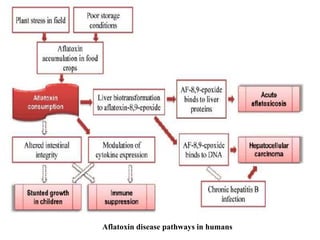
Aflatoxin disease pathways in humans
Importance
1.High-level aflatoxin exposure produces an
acute hepatic necrosis (acute aflatoxicosis), resulting later
in cirrhosis or carcinoma of the liver. Acute liver failure is made manifest
by bleeding, edema, alteration in digestion, changes to the absorption
and/or metabolism of nutrients, and mental changes and/or coma.
2.Children are particularly affected by aflatoxin exposure, which is
associated with stunted growth, delayed development, liver damage, and
liver cancer.
3.After entering the body, aflatoxins may be metabolized by the liver to a
reactive epoxide intermediate or hydroxylated to become the less
harmful aflatoxin M1.
4. Aflatoxin metabolites may intercalate into DNA and alkylate the bases
through epoxide moiety. This is thought to cause mutations in
the p53 gene, an important gene in preventing cell cycle progression
when there are DNA mutations, or signaling apoptosis (programmed cell
death).
5.Effect of aflatoxins on mitochondrial DNA- damage the mitochondria
can lead to mitochondrial diseases and may be responsible for aging
mechanisms. The damage to mitDNA is caused by adduction and
mutations of mitochondrial membranes leading to increased cell death
(apoptosis) as well as disruption of energy production (production of
ATP) .
6. Effect of aflatoxins on mitochondrial structure- AFB causes
ultrastuctural changes in mitochondria and also induces mitochondrial
directed apoptosis thus reducing their function.
7. Effect of aflatoxins on protein synthesis- reduction in protein content
in body tissues like in skeletal muscle, heart, liver and kidney could be
due to increased liver and kidney necrosis.
8.Aflatoxin B1 can cause immune suppression, and exposure to it is
associated with an increased viral load in HIV positive individuals.
Prevention-A regular diet including apiaceous vegetables, such
as carrots, parsnips, celery, and parsley may reduce
the carcinogenic effects of aflatoxin.
Aflatoxins  general account, types & importance

Aflatoxins general account, types & importance

  • 1.
    Aflatoxins- General account,types & importance Vaishali S.Patil Professor, Department of Botany Shri Shivaji College of Arts, Commerce & Science Akola
  • 2.
    Introduction • Aflatoxins arepoisonous carcinogens and mutagens that are produced by 20 related fungal metabolites of certain molds (Aspergillus flavus and Aspergillus parasiticus) which grow in soil, decaying vegetation, hay, and grains. • The molds can colonize and contaminate food before harvest or during storage, especially following prolonged exposure to a high- humidity environment, or to stressful conditions such as drought. • They are regularly found in improperly stored staple commodities such as cassava, chili peppers, cottonseed, millet, peanuts, rice, sesame seeds, sorghum, sunflower seeds, sweetcorn, tree nuts, wheat, and a variety of spices. • Aflatoxin transformation products are sometimes found in eggs, milk products, and meat when animals are fed contaminated grains. • They have been found in both pet and human foods, as well as in feedstocks for agricultural animals.
  • 3.
    •The aflatoxins wereinitially isolated and identified as the causative agent in Turkey X disease that caused necrosis of the liver in 1960 and over 100,000 turkeys died in England and USA and the death was attributed to the consumption of a mould-contaminated peanut meal. •.Aflatoxins are highly liposoluble compounds and are readily absorbed from the site of exposure usually through the gastrointestinal tract and respiratory tract into blood stream. •Human and animals get exposed to aflatoxins by two major routes (a) direct ingestion of aflatoxin-contaminated foods or ingestion of aflatoxins carried over from feed into milk and milk products like cheese and powdered milk as well as other animal tissues mainly as AFM1(b) by inhalation of dust particles of aflatoxins especially AFB1 in contaminated foods in industries and factories.
  • 4.
    Aflatoxins produce byAspergillus sp.
  • 5.
    Types 1.Aflatoxin B1 andB2 (AFB), produced by Aspergillus flavus and A. parasiticus 2.Aflatoxin G1 and G2 (AFG), produced by some Group II A. flavus and Aspergillus parasiticus. 3.Aflatoxin M1 (AFM1), metabolite of aflatoxin B1 in humans and animals (exposure in ng levels may come from a mother's milk) 4.Aflatoxin M2, metabolite of aflatoxin B2 in milk of cattle fed on contaminated foods. 5. Aflatoxicol (AFL): metabolite produced by breaking down the lactone ring 6. Aflatoxin Q1 (AFQ1), major metabolite of AFB1 in in vitro liver preparations of other higher vertebrates.
  • 6.
    1.Aflatoxin B1 Chemicalformula: C17H12O6 is an aflatoxin produced by Aspergillus flavus and A. parasiticus. •It is a very potent carcinogen with a TD50 3.2 μg/kg/day in rats. Aflatoxin B1 is a common contaminant in a variety of foods including peanuts, cottonseed meal, corn, and other grains; as well as animal feeds. •It is considered the most toxic aflatoxin and it is highly implicated in hepatocellular carcinoma (HCC) in humans. • In animals, aflatoxin B1 has also been shown to be mutagenic, teratogenic, and to cause immunosuppression. •Several sampling and analytical methods including thin-layer chromatography (TLC), high-performance liquId chromatography (HPLC), mass spectrometry, and enzyme-linked immunosorbent assay (ELISA), among others, have been used to test for aflatoxin B1 contamination in foods. Sources - found in contaminated food and humans are exposed to aflatoxin B1 almost entirely through their diet in swine and poultry production.
  • 7.
    Pathology Reduction in weightof liver, vacuolation of hepatocytes, and hepatic carcinoma. Other liver lesions include enlargement of hepatic cells, fatty infiltration, necrosis, hemorrhage, fibrosis, regeneration of nodules, and bile duct proliferation/hyperplasia. Toxicity 1.Acute toxicity symptoms include anorexia, malaise, and low-grade fever. 2.Subacute toxicity showed moderate to severe liver damage. 3. Chronic toxicity showed decreased hepatic microsomal cytochrome P-450 concentration, reduction in feed consumption and decreased weight gain. 4.Subchronic toxicity in fish showed fish to present with preneoplastic lesions, concurrently with changes in gill, pancreas, intestine and spleen. 5.Genotoxicity DNA adducts, 8-hydroxyguanine lesions and DNA damage. 6. Carcinogenicity the development of liver cell carcinoma. 7. Embryotoxicity development of the bursa of Fabricius.
  • 8.
    8.Teratogenicity reduced fetalweights, wrist drop, enlarged eye socket, agenesis of caudal vertebrae, micropthalmia, cardiac defects, and lenticular degeneration. 9. Immunotoxicity reduced serum total globulin and reduced bactericidal activities. 2.Aflatoxin B2: Molecular Formula: C17H14O6 Moderately potent hepatotoxic, hepatocarcinogenic, mutagenic and teratogenic mycotoxins produced by Aspergillus flavus and parasiticus. Dihydroxy derivatives of aflatoxin B1. Formed during growth on the same commodities as aflatoxin B1 (including peanuts, corn and other cereals, and oilseeds), but in smaller amounts. Metabolized to aflatoxin M2, and excreted in milk in this form. 3.Aflatoxin G1- Molecular Formula:C17H12O7 - Aflatoxin G1 is a toxic metabolite of the fungi Aspergillus flavus and A. Parasiticus. Aflatoxin G1 belongs to the class of organic compounds known as difurocoumarolactones. Aflatoxin g is formally rated as a carcinogen (by IARC 1) and is also a potentially toxic compound. Aflatoxins are complex ring compounds that are fatal in large doses; in small doses they
  • 9.
    induce tumors ofthe liver. •Carcinogens, Mutagens, Teratogens. Skin, Eye, and Respiratory Irritations. 4.Aflatoxin G2 Molecular Formula:C17H14O7 . Aflatoxin g2 is a very light and fluffy crystalline solid. Exhibits green- blue fluorescence. Aflatoxin G2 ... /is/ the 9,10-dihydro derivative of aflatoxin G1. 5.Aflatoxin M1.-It is a chemical compound of the aflatoxin class, a group of mycotoxins produced by three species of Aspergillus - Aspergillus flavus, Aspergillus parasiticus, and the rare Aspergillus nomius - which contaminate plant and plant products. •Aspergillus flavus produces only B-type aflatoxins. Aflatoxin M1 is the hydroxylated metabolite of aflatoxin B1 and can be found in milk or milk products obtained from livestock that have ingested contaminated feed. •Aflatoxin M1 is usually considered to be a detoxication by-product of aflatoxin B1. •The main sources of aflatoxins in feeds are peanut, meal, maize and cottonseed meal.
  • 10.
    •The chemical structureof aflatoxin M1. Aflatoxin M1 is the 4-hydroxy derivative of aflatoxin B1 and is secreted in the milk of mammals that consume aflatoxin B1. Aflatoxin M1 has a relative molecular mass of 328 Da and has the molecular formula C17H12O7. •Aflatoxin M1 is found in milk, like human milk. Cows, sheep, goats and buffaloes that have consumed feeds contaminated with aflatoxin B1, aflatoxin M1 will be formed as a result of the metabolic process in the livers of ruminants and excreted in milk. •In other words, human beings can be exposed to the toxins through consumption of contaminated milk and other foods. Pathology The effect of aflatoxin M1 was much weaker than aflatoxin B1 in producing liver cancer. 6.Aflatoxin M2 Chemical FormulaC17H14O7 produced by many species of Aspergillus, a fungus, most notably Aspergillus flavus and Aspergillus parasiticus. •Aflatoxins are toxic and among the most carcinogenic substances known. Aflatoxin M2 is a metabolite of aflatoxin B2 in milk of cattle fed.
  • 11.
    . on contaminated foods. •Aflatoxin M2 belongs to the family of Difurocoumarocyclopentenone Series. These are polycyclic aromatic compounds containing a cyclopenten-2-one ring fused to the coumarin moiety of the difurocoumarin skeleton. Difurocoumarocyclopentenones are a subgroup of the aflatoxins and related compounds. 7.Aflatoxicol (AFL):Molecular Formula:C17H14O6 •Increase the risk of NEOPLASMS in humans or animals. Both genotoxic chemicals, which affect DNA directly, and nongenotoxic chemicals, which induce neoplasms by other mechanism. 8. Aflatoxin Q1- Molecular Formula:C17H12O7 Aflatoxin Q1 is a member of the class of aflatoxins that is aflatoxin B1 in which the hydrogen at the pro-3S position is replaced by a hydroxy group. It has a role as a human xenobiotic metabolite and a carcinogenic agent. It is an aflatoxin, an aromatic ether and an aromatic ketone. It derives from an aflatoxin B1.
  • 13.
  • 14.
    Importance 1.High-level aflatoxin exposureproduces an acute hepatic necrosis (acute aflatoxicosis), resulting later in cirrhosis or carcinoma of the liver. Acute liver failure is made manifest by bleeding, edema, alteration in digestion, changes to the absorption and/or metabolism of nutrients, and mental changes and/or coma. 2.Children are particularly affected by aflatoxin exposure, which is associated with stunted growth, delayed development, liver damage, and liver cancer. 3.After entering the body, aflatoxins may be metabolized by the liver to a reactive epoxide intermediate or hydroxylated to become the less harmful aflatoxin M1. 4. Aflatoxin metabolites may intercalate into DNA and alkylate the bases through epoxide moiety. This is thought to cause mutations in the p53 gene, an important gene in preventing cell cycle progression when there are DNA mutations, or signaling apoptosis (programmed cell death).
  • 15.
    5.Effect of aflatoxinson mitochondrial DNA- damage the mitochondria can lead to mitochondrial diseases and may be responsible for aging mechanisms. The damage to mitDNA is caused by adduction and mutations of mitochondrial membranes leading to increased cell death (apoptosis) as well as disruption of energy production (production of ATP) . 6. Effect of aflatoxins on mitochondrial structure- AFB causes ultrastuctural changes in mitochondria and also induces mitochondrial directed apoptosis thus reducing their function. 7. Effect of aflatoxins on protein synthesis- reduction in protein content in body tissues like in skeletal muscle, heart, liver and kidney could be due to increased liver and kidney necrosis. 8.Aflatoxin B1 can cause immune suppression, and exposure to it is associated with an increased viral load in HIV positive individuals. Prevention-A regular diet including apiaceous vegetables, such as carrots, parsnips, celery, and parsley may reduce the carcinogenic effects of aflatoxin.