Dr. Abdelatty M.Saleh
Assistant Prof. of Biotechnology – KFS University
Aflatoxins
2.
What are aflatoxins?
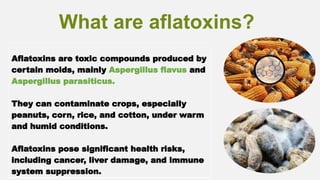
Aflatoxinsare toxic compounds produced by
certain molds, mainly Aspergillus flavus and
Aspergillus parasiticus.
They can contaminate crops, especially
peanuts, corn, rice, and cotton, under warm
and humid conditions.
Aflatoxins pose significant health risks,
including cancer, liver damage, and immune
system suppression.
3.
Types of aflatoxins?
Typesof Aflatoxins
Aflatoxins include B1, B2, G1, and G2.
Aflatoxin B1 is the most toxic and
carcinogenic.
Each type is characterized by different
fluorescent properties, which are useful for
detection.
4.
Sources of aflatoxins?
Producedby molds such as Aspergillus
flavus and Aspergillus parasiticus.
Commonly found in crops like peanuts, corn,
rice, cotton, and tree nuts.
Can develop during the growing season or
during improper storage conditions.
5.
c
Long-term exposure can
leadto liver cancer
(hepatocellular
carcinoma) and immune
suppression.
Title text addition
Title text addition
Health effects
chronic Toxicity
c
Symptoms include
nausea, vomiting,
abdominal pain, and
liver bleeding.
Acute Toxicity
Aflatoxin B1 is a known carcinogen to humans.
6.
Detection Methods
Chromatography: High-performanceliquid
chromatography (HPLC) is commonly used.
Spectroscopy: Methods like UV-Vis and
fluorescence spectroscopy are employed for
quick detection.
Immunoassays: ELISA (Enzyme-Linked
Immunosorbent Assay) is often used in field
testing.
7.
Prevention Measures
Proper Storage
Keepcrops in dry, cool
conditions to reduce mold
growth.
Biological Control
Using beneficial
microorganisms to
outcompete harmful molds.
Chemical Methods
Some substances can
absorb or neutralize
aflatoxins in contaminated
crops
8.
Regulations and Standards
Boththe U.S. FDA and the European
Food Safety Authority have set limits
for aflatoxin levels in food products.
The U.S.Food and Drug Administration
(FDA) has established allowable level of
aflatoxins as follows :
• 20 ppb for food, feeds, Brazil nuts,
peanuts pistachio nuts
• 0.5 ppb for fish.
9.
Control Measures inAnimal Feed
Aflatoxins can also affect livestock. When
animals consume contaminated feed, the
toxins are often transferred to milk, eggs,
and meat.
To prevent this:
1. Regulate Animal Feed: Feed should be
regularly tested for aflatoxin contamination.
2. Detoxification Agents: Some additives can
be included in animal feed to neutralize or
reduce the toxicity of aflatoxins.
10.
Aflatoxin in theDairy Industry
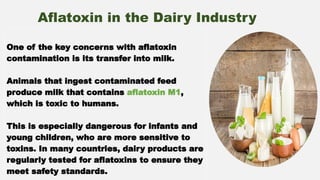
One of the key concerns with aflatoxin
contamination is its transfer into milk.
Animals that ingest contaminated feed
produce milk that contains aflatoxin M1,
which is toxic to humans.
This is especially dangerous for infants and
young children, who are more sensitive to
toxins. In many countries, dairy products are
regularly tested for aflatoxins to ensure they
meet safety standards.
11.
Efforts to preventaflatoxin contamination
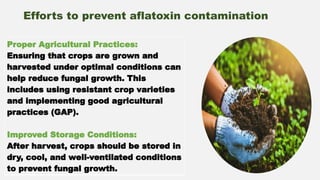
Proper Agricultural Practices:
Ensuring that crops are grown and
harvested under optimal conditions can
help reduce fungal growth. This
includes using resistant crop varieties
and implementing good agricultural
practices (GAP).
Improved Storage Conditions:
After harvest, crops should be stored in
dry, cool, and well-ventilated conditions
to prevent fungal growth.
12.
Efforts to preventaflatoxin contamination
Use of Fungicides: Certain fungicides
can be used to control fungal growth,
but they must be used carefully to
avoid residue contamination.
Good Manufacturing Practices (GMP):
Ensuring that food processing and
handling follow strict guidelines to
minimize the risk of contamination.
Monitoring and Testing:
Regular testing of crops and food
products for aflatoxin contamination