
Vivek kumar
1st MSC-2nd sem
Bangalore university, Bangalore
AFLATOXIN
AND
OCHRATOXIN
MYCOTOXINS
Mycotoxins are the toxins produced by some species of
molds(myco-fungal).These mycotoxin are some of the most toxic
substance in existence.
Mycotoxins are not actually alive like mold spores,so when we
take about ‘killing mycotoxin’ it really means breaking down
mycotoxins and their toxicity so they are no longer dangerous to
human.
• There are several different types of mycotoxins
• Aflatoxin
• Ochratoxin
• Fuminosins
• Trichothecenes
• Zearlonone etc…..
AFLATOXIN
• Aflatoxins are one of the most potent and dangerous groups of mycotoxins
worldwide
• These are poisonous carcinogens that are produced by certain molds
(A.flavus,A.parasiticus) which grows in soil,decaying vegetation, hay and
grains.
• They are regularly found in improperly stored staple commodities such as
cassava,chilli,peppers,corn,cotton,seed,millet,peanut,rice,sesame
seeds,wheat & variety of spices.
• Aflatoxjns are among the most carcinogenic substance known.After entering
into the body,aflatoxin my be metabolized by liver to reactive epoxide
intermediate or hydroxylated to become the less harmful aflatoxin.
• Different types of moulds which produce toxic are
A.ochraceus,A.versicolor,A.fumigatus,A.terreus,A.clavatus.
Types of aflatoxin
• At least 14 different aflatoxins are produced in nature
• There are 4 main types of aflatoxin.
1. Aflatoxin B1 and B2 produced by A.flavus and A.parasiticus.- B1 is
the major toxin produced.
2. Aflatoxin G1 and G2 produced by some group ll A.flavus and
A.parasiticus.
3. Aflatoxin M1,metabolite of aflatoxin B1 in human & animals.
4. Aflatoxin M2, metabolites of aflatoxin B2 in milk of cattle fed on
contaminated foods.
STRUCTURE
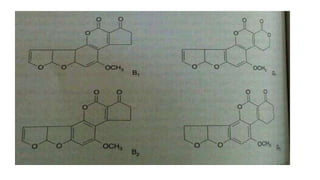
• The two major metabolites of aflatoxin have been designated as B1
and G1 because they fluoresce blue(B1) and green (G1) when
exposed to long wave UV light.
• Aflatoxin B2& G2 are the dihydro derivatives of B1 & G1 other closely
related aflatoxins include B2a,G2a & GM1.
• Aflatoxin M1,M2 & P1 are hydroxylated derivates of B1 & B2 which
are excreted in urine feces,& milk as metabolic products of B1& B2
following their consumption by mammals.
• They are highly oxygenated heterocyclic compounds.
TOXICITY
• Aflatoxin B1 is the most toxic of aflatoxin,toxic to various animals.
• Many of other aflatoxins have been shown to be toxic or
carcinogenic to different species of fish, mammals and poultry.
• When cows eat feed containing aflatoxin, aflatoxin M1 & M2 is
excreted in milk.Although M1&M2 are less toxic than parent
compounds B1 &B2, M1 retains toxic & carcinogenic ability in
many animals.
• M1 has also been detected in the urine of Philippine women who
had consumed peanut butter containing aflatoxin.
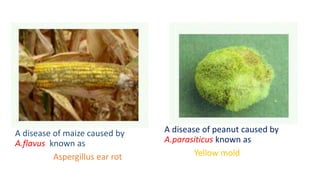
A disease of maize caused by
A.flavus known as
Aspergillus ear rot
A disease of peanut caused by
A.parasiticus known as
Yellow mold
TOXIC DETECTION
By chemical or biological methods.
• In chemical method ,samples are extracted with organic solvent
such as chloroform or methonal in combination with small
amounts of water.
• Extracts are further cleaned up by passage with a silica gel column.
• The extract is then concentrated , usually by evaporation under
nitrogen & separated by TLC or HPLC.
• Visualized under UV light & quantified by visual comparison with
known concentration of standard or flurimetry.
Factors affecting growth and toxic production
• A.falvus and A.parasiticus have similar growth patterns.
• Both require growth temperatures of 32-33C & can grow at 10-42C.
• Aflatoxins are produced at 12-40C. Optimum water activity required
for growth is near 0.99.
• Growth occurs at pH ranging from 2-10.5 but aflatoxin production has
been reported for A.parasiticus between pH 3 & 8.
• Reduction of available oxygen by modified atmosphere packaging of
foods with oxygen scavengers can inhibit aflatoxin formation by both
the species.
OCHRATOXIN
• Schott(1965) isolated about 22 fungi,which were toxic to
ducklings,rats and mice.Subsequently a toxic metabolite of
A.ochraceus was isolated,identified and named as
“ochratocin A”
• Other ochratoxin A producing molds have been noted where
some strains of P.viridicatum & P.palitans produce ‘citrinin’
and ‘ochratoxin A’
• There is some speculation that these two mycotoxins can act
synergistically in animals to result in nephrotoxicity.
STRUCTURE
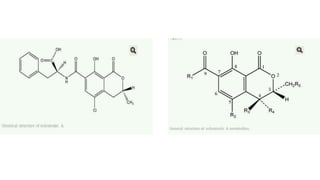
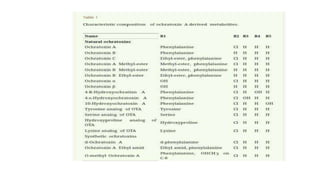
• Ochratoxin A is structurally a chlorinated isocoumarin derivative with
amide bond to phenylalanine.
• A dechloro analog of this compound has also been isolated & named
ochratoxin B.
• In addition,there are other minor components including a methly &
ethly ester of A&B and 4- hydroxy ochratoxin A.
• Ochratoxin A fluoresces green under UV light and ochratoxin B
fluoresces blue.
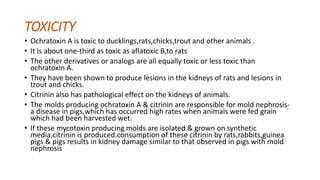
TOXICITY
• Ochratoxin A is toxic to ducklings,rats,chicks,trout and other animals .
• It is about one-third as toxic as aflatoxic B,to rats
• The other derivatives or analogs are all equally toxic or less toxic than
ochratoxin A.
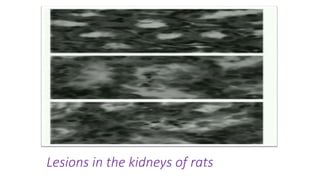
• They have been shown to produce lesions in the kidneys of rats and lesions in
trout and chicks.
• Citrinin also has pathological effect on the kidneys of animals.
• The molds producing ochratoxin A & citrinin are responsible for mold nephrosis-
a disease in pigs,which has occurred high rates when animals were fed grain
which had been harvested wet.
• If these mycotoxin producing molds are isolated & grown on synthetic
media,citrinin is produced.consumption of these citrinin by rats,rabbits,guinea
pigs & pigs results in kidney damage similar to that observed in pigs with mold
nephrosis
Lesions in the kidneys of rats
Factors affecting are:
• It is xerophike,capable of growth down to water activity of 0.79
• It grows at temperature of 8-37C and within a wide pH range of 2.2 to
10.3.
• Ochratoxin A is produced at quite high temperatures between 25 and
30C.
Significance in foods
• In addition to their unknown effect on human beings,the ochratoxins
are of interest in foods for at least three reasons-
1. They are toxic to some animals.
2. Some Are very heat resistant eg: prolonged autoclaving doesn’t
destroy ochratoxin A when heated in oatmeal.
3. Many ochrantoxin and citrinin producing fungi are capable of
growth and mycotoxin producing at temperature below 10C and
ochratoxins have been isolated from numerous foods.
REFERENCE
Text book of-FOOD MICROBIOLOGY
By- K.VIJAYA RAMESH,
MJP PUBLISHERS page no- 506-510
• https://www.apsnet.org/edcenter/topics/mycotoxins/aflatoxins.aspx
• https://www.ncbi.nlm.nih.gov/PMC/articlespmc3135212/
THANK YOU…….

Mycotoxins

  • 1.
    Vivek kumar 1st MSC-2ndsem Bangalore university, Bangalore
  • 2.
  • 3.
    MYCOTOXINS Mycotoxins are thetoxins produced by some species of molds(myco-fungal).These mycotoxin are some of the most toxic substance in existence. Mycotoxins are not actually alive like mold spores,so when we take about ‘killing mycotoxin’ it really means breaking down mycotoxins and their toxicity so they are no longer dangerous to human.
  • 4.
    • There areseveral different types of mycotoxins • Aflatoxin • Ochratoxin • Fuminosins • Trichothecenes • Zearlonone etc…..
  • 5.
    AFLATOXIN • Aflatoxins areone of the most potent and dangerous groups of mycotoxins worldwide • These are poisonous carcinogens that are produced by certain molds (A.flavus,A.parasiticus) which grows in soil,decaying vegetation, hay and grains. • They are regularly found in improperly stored staple commodities such as cassava,chilli,peppers,corn,cotton,seed,millet,peanut,rice,sesame seeds,wheat & variety of spices. • Aflatoxjns are among the most carcinogenic substance known.After entering into the body,aflatoxin my be metabolized by liver to reactive epoxide intermediate or hydroxylated to become the less harmful aflatoxin. • Different types of moulds which produce toxic are A.ochraceus,A.versicolor,A.fumigatus,A.terreus,A.clavatus.
  • 6.
    Types of aflatoxin •At least 14 different aflatoxins are produced in nature • There are 4 main types of aflatoxin. 1. Aflatoxin B1 and B2 produced by A.flavus and A.parasiticus.- B1 is the major toxin produced. 2. Aflatoxin G1 and G2 produced by some group ll A.flavus and A.parasiticus. 3. Aflatoxin M1,metabolite of aflatoxin B1 in human & animals. 4. Aflatoxin M2, metabolites of aflatoxin B2 in milk of cattle fed on contaminated foods.
  • 7.
    STRUCTURE • The twomajor metabolites of aflatoxin have been designated as B1 and G1 because they fluoresce blue(B1) and green (G1) when exposed to long wave UV light. • Aflatoxin B2& G2 are the dihydro derivatives of B1 & G1 other closely related aflatoxins include B2a,G2a & GM1. • Aflatoxin M1,M2 & P1 are hydroxylated derivates of B1 & B2 which are excreted in urine feces,& milk as metabolic products of B1& B2 following their consumption by mammals. • They are highly oxygenated heterocyclic compounds.
  • 9.
    TOXICITY • Aflatoxin B1is the most toxic of aflatoxin,toxic to various animals. • Many of other aflatoxins have been shown to be toxic or carcinogenic to different species of fish, mammals and poultry. • When cows eat feed containing aflatoxin, aflatoxin M1 & M2 is excreted in milk.Although M1&M2 are less toxic than parent compounds B1 &B2, M1 retains toxic & carcinogenic ability in many animals. • M1 has also been detected in the urine of Philippine women who had consumed peanut butter containing aflatoxin.
  • 10.
    A disease ofmaize caused by A.flavus known as Aspergillus ear rot A disease of peanut caused by A.parasiticus known as Yellow mold
  • 11.
    TOXIC DETECTION By chemicalor biological methods. • In chemical method ,samples are extracted with organic solvent such as chloroform or methonal in combination with small amounts of water. • Extracts are further cleaned up by passage with a silica gel column. • The extract is then concentrated , usually by evaporation under nitrogen & separated by TLC or HPLC. • Visualized under UV light & quantified by visual comparison with known concentration of standard or flurimetry.
  • 12.
    Factors affecting growthand toxic production • A.falvus and A.parasiticus have similar growth patterns. • Both require growth temperatures of 32-33C & can grow at 10-42C. • Aflatoxins are produced at 12-40C. Optimum water activity required for growth is near 0.99. • Growth occurs at pH ranging from 2-10.5 but aflatoxin production has been reported for A.parasiticus between pH 3 & 8. • Reduction of available oxygen by modified atmosphere packaging of foods with oxygen scavengers can inhibit aflatoxin formation by both the species.
  • 13.
    OCHRATOXIN • Schott(1965) isolatedabout 22 fungi,which were toxic to ducklings,rats and mice.Subsequently a toxic metabolite of A.ochraceus was isolated,identified and named as “ochratocin A” • Other ochratoxin A producing molds have been noted where some strains of P.viridicatum & P.palitans produce ‘citrinin’ and ‘ochratoxin A’ • There is some speculation that these two mycotoxins can act synergistically in animals to result in nephrotoxicity.
  • 14.
    STRUCTURE • Ochratoxin Ais structurally a chlorinated isocoumarin derivative with amide bond to phenylalanine. • A dechloro analog of this compound has also been isolated & named ochratoxin B. • In addition,there are other minor components including a methly & ethly ester of A&B and 4- hydroxy ochratoxin A. • Ochratoxin A fluoresces green under UV light and ochratoxin B fluoresces blue.
  • 17.
    TOXICITY • Ochratoxin Ais toxic to ducklings,rats,chicks,trout and other animals . • It is about one-third as toxic as aflatoxic B,to rats • The other derivatives or analogs are all equally toxic or less toxic than ochratoxin A. • They have been shown to produce lesions in the kidneys of rats and lesions in trout and chicks. • Citrinin also has pathological effect on the kidneys of animals. • The molds producing ochratoxin A & citrinin are responsible for mold nephrosis- a disease in pigs,which has occurred high rates when animals were fed grain which had been harvested wet. • If these mycotoxin producing molds are isolated & grown on synthetic media,citrinin is produced.consumption of these citrinin by rats,rabbits,guinea pigs & pigs results in kidney damage similar to that observed in pigs with mold nephrosis
  • 18.
    Lesions in thekidneys of rats
  • 19.
    Factors affecting are: •It is xerophike,capable of growth down to water activity of 0.79 • It grows at temperature of 8-37C and within a wide pH range of 2.2 to 10.3. • Ochratoxin A is produced at quite high temperatures between 25 and 30C.
  • 20.
    Significance in foods •In addition to their unknown effect on human beings,the ochratoxins are of interest in foods for at least three reasons- 1. They are toxic to some animals. 2. Some Are very heat resistant eg: prolonged autoclaving doesn’t destroy ochratoxin A when heated in oatmeal. 3. Many ochrantoxin and citrinin producing fungi are capable of growth and mycotoxin producing at temperature below 10C and ochratoxins have been isolated from numerous foods.
  • 21.
    REFERENCE Text book of-FOODMICROBIOLOGY By- K.VIJAYA RAMESH, MJP PUBLISHERS page no- 506-510 • https://www.apsnet.org/edcenter/topics/mycotoxins/aflatoxins.aspx • https://www.ncbi.nlm.nih.gov/PMC/articlespmc3135212/
  • 22.