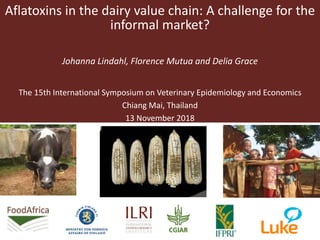
Aflatoxins in the dairy value chain: A challenge for the
informal market?
Johanna Lindahl, Florence Mutua and Delia Grace
The 15th International Symposium on Veterinary Epidemiology and Economics
Chiang Mai, Thailand
13 November 2018
Presentation outline
• Aflatoxins and livestock in low- and middle-
income countries (LMIC)
• Our work in Africa
• What do we do about it?
• Mitigation strategies at different levels in Kenya
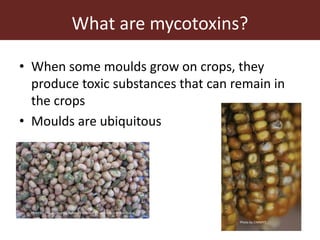
What are mycotoxins?
• When some moulds grow on crops, they
produce toxic substances that can remain in
the crops
• Moulds are ubiquitous
Photo by IITA. Aspergillus naturally infected groundnuts in Mozambique.
Photo by CIMMYT.
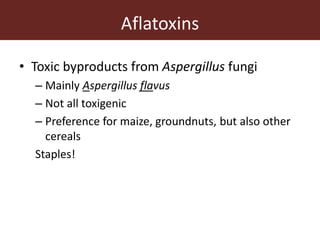
Aflatoxins
• Toxic byproducts from Aspergillus fungi
– Mainly Aspergillus flavus
– Not all toxigenic
– Preference for maize, groundnuts, but also other
cereals
Staples!
Aflatoxins
• Different kinds
– Invisible
– Odourless
– Tasteless
– Heat stable
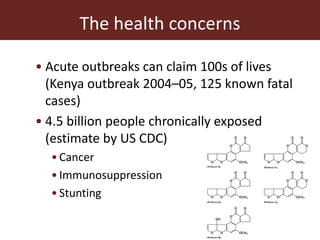
The health concerns
• Acute outbreaks can claim 100s of lives
(Kenya outbreak 2004–05, 125 known fatal
cases)
• 4.5 billion people chronically exposed
(estimate by US CDC)
•Cancer
•Immunosuppression
•Stunting
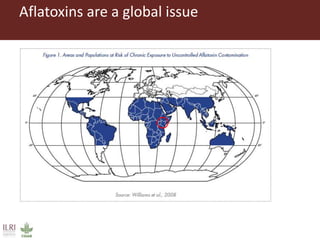
Aflatoxins are a global issue
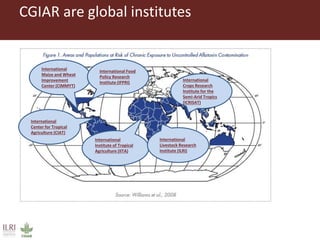
CGIAR are global institutes
International
Center for Tropical
Agriculture (CIAT)
International
Crops Research
Institute for the
Semi-Arid Tropics
(ICRISAT)
International
Institute of Tropical
Agriculture (IITA)
International
Livestock Research
Institute (ILRI)
International
Maize and Wheat
Improvement
Center (CIMMYT)
International Food
Policy Research
Institute (IFPRI)
Why focus on aflatoxins in Kenya?
• Kenya outbreak 2004–05: 125 known fatal
cases
• 884 women sampled in Eastern Province
• All had aflatoxin in the blood
• Exposure levels higher in poor people
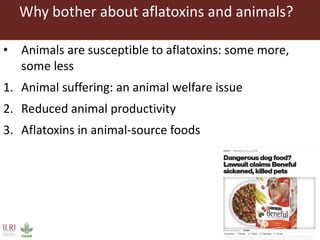
Why bother about aflatoxins and animals?
• Animals are susceptible to aflatoxins: some more,
some less
1. Animal suffering: an animal welfare issue
2. Reduced animal productivity
3. Aflatoxins in animal-source foods
Health effects observed
• Liver damage
• Gastrointestinal dysfunction, decreased appetite
• Immunosuppression
• Decreased reproductive function, decreased
growth and decreased production
• Can we see these effects in low-producing animals?
• Little research in Africa in literature search
• Varying effects in all studies
Safe levels?
• ≤50 in young poultry
• ≤100 in adult poultry
• ≤50 in weaned pigs
• ≤200 in finishing pigs
• <100 in calves
• <300 in cattle
• <100 in Nile tilapia
However depending on other factors!
Animal-source food
• Aflatoxins are transferred to animal products
• 1-7% of aflatoxins in feed is metabolized and
transferred to milk
• Much lower transfer to meat and eggs
• Reduced if feeding is stopped
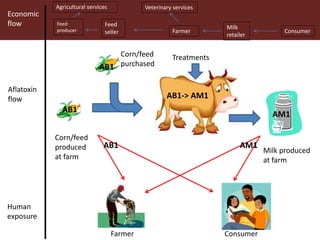
Farmer Consumer
Economic
flow
Aflatoxin
flow
Human
exposure
Feed
producer
AB1
AB1
AB1-> AM1
AM1
Corn/feed
produced
at farm
Corn/feed
purchased
Milk produced
at farm
AB1 AM1
Treatments
Feed
seller Farmer
Veterinary services
Milk
retailer
Agricultural services
Consumer
Aflatoxins in Kenya dairy
Qualitative study- understanding behaviour
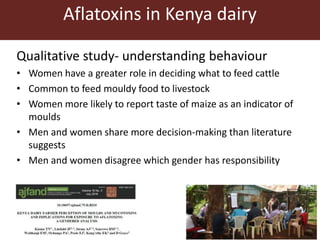
• Women have a greater role in deciding what to feed cattle
• Common to feed mouldy food to livestock
• Women more likely to report taste of maize as an indicator of
moulds
• Men and women share more decision-making than literature
suggests
• Men and women disagree which gender has responsibility
Kenya: Dairy value chain
• Feed collected from five countiesa
– From farmers: 0.02 ppb to 9,661 ppb
– Samples exceeding 5 ppb
• 25–100% of the feed in farms
• 85.7–100% of the feed from feed retailers
• 20–100% of the feeds from feed manufacturers
• Milk samples: Up to 6999 ppt
a Mugangai et al. 2016
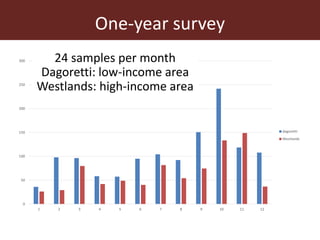
One-year survey
0
50
100
150
200
250
300
1 2 3 4 5 6 7 8 9 10 11 12
dagoretti
Westlands
24 samples per month
Dagoretti: low-income area
Westlands: high-income area
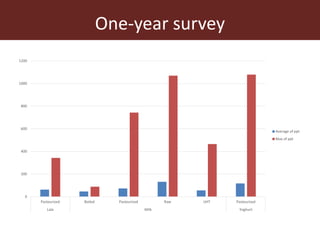
One-year survey
0
200
400
600
800
1000
1200
Pasteurized Boiled Pasteurized Raw UHT Pasteurized
Lala Milk Yoghurt
Average of ppt
Max of ppt
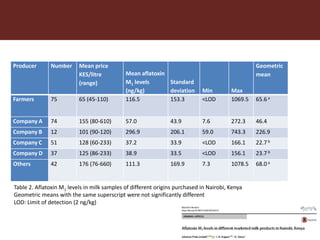
Producer Number Mean price
KES/litre
(range)
Mean aflatoxin
M1 levels
(ng/kg)
Standard
deviation Min Max
Geometric
mean
Farmers 75 65 (45-110) 116.5 153.3 <LOD 1069.5 65.6 a
Company A 74 155 (80-610) 57.0 43.9 7.6 272.3 46.4
Company B 12 101 (90-120) 296.9 206.1 59.0 743.3 226.9
Company C 51 128 (60-233) 37.2 33.9 <LOD 166.1 22.7 b
Company D 37 125 (86-233) 38.9 33.5 <LOD 156.1 23.7 b
Others 42 176 (76-660) 111.3 169.9 7.3 1078.5 68.0 a
Table 2. Aflatoxin M1 levels in milk samples of different origins purchased in Nairobi, Kenya
Geometric means with the same superscript were not significantly different
LOD: Limit of detection (2 ng/kg)
Kenya: Urban milk
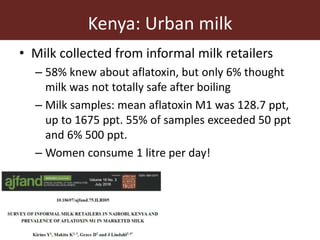
• Milk collected from informal milk retailers
– 58% knew about aflatoxin, but only 6% thought
milk was not totally safe after boiling
– Milk samples: mean aflatoxin M1 was 128.7 ppt,
up to 1675 ppt. 55% of samples exceeded 50 ppt
and 6% 500 ppt.
– Women consume 1 litre per day!
Kiruni et al. 2016, Afr J Food, Nutr Ag Dev
Kenya: Urban milk
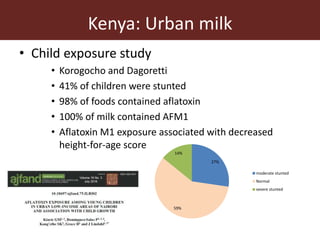
• Child exposure study
• Korogocho and Dagoretti
• 41% of children were stunted
• 98% of foods contained aflatoxin
• 100% of milk contained AFM1
• Aflatoxin M1 exposure associated with decreased
height-for-age score
Kiarie et al. 2016, Afr J Food, Nutr Ag Dev
27%
59%
14%
moderate stunted
Normal
severe stunted
Mitigation options
• Aflatoxins can be mitigated all along the dairy
value chain
o Costs
o Implementation
o Side effects
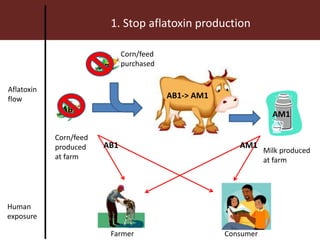
Farmer Consumer
1. Stop aflatoxin production
Aflatoxin
flow
Human
exposure
AB1
AB1
AB1-> AM1
AM1
Corn/feed
produced
at farm
Corn/feed
purchased
Milk produced
at farm
AB1 AM1
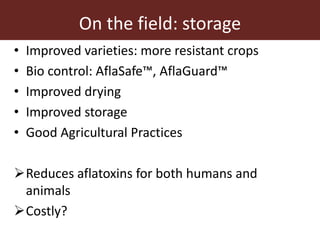
On the field: storage
• Improved varieties: more resistant crops
• Bio control: AflaSafe™, AflaGuard™
• Improved drying
• Improved storage
• Good Agricultural Practices
Reduces aflatoxins for both humans and
animals
Costly?
Farmer Consumer
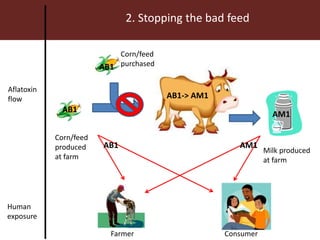
2. Stopping the bad feed
Aflatoxin
flow
Human
exposure
AB1
AB1
AB1-> AM1
AM1
Corn/feed
produced
at farm
Corn/feed
purchased
Milk produced
at farm
AB1 AM1
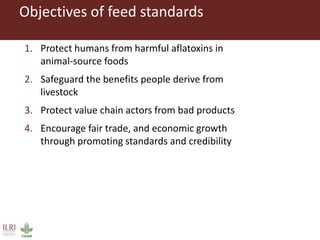
Objectives of feed standards
1. Protect humans from harmful aflatoxins in
animal-source foods
2. Safeguard the benefits people derive from
livestock
3. Protect value chain actors from bad products
4. Encourage fair trade, and economic growth
through promoting standards and credibility
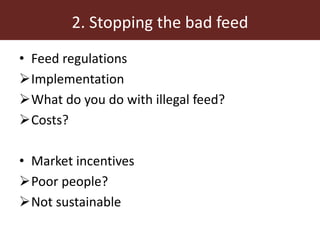
2. Stopping the bad feed
• Feed regulations
Implementation
What do you do with illegal feed?
Costs?
• Market incentives
Poor people?
Not sustainable
Farmer Consumer
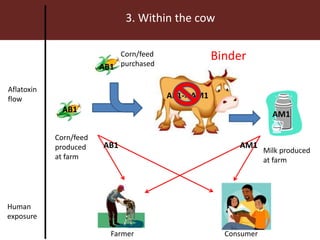
3. Within the cow
Aflatoxin
flow
Human
exposure
AB1
AB1
AB1-> AM1
AM1
Corn/feed
produced
at farm
Corn/feed
purchased
Milk produced
at farm
AB1 AM1
Binder
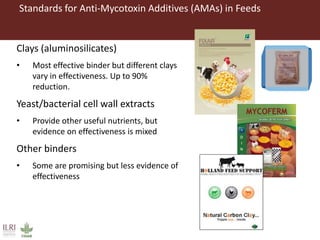
Standards for Anti-Mycotoxin Additives (AMAs) in Feeds
Clays (aluminosilicates)
• Most effective binder but different clays
vary in effectiveness. Up to 90%
reduction.
Yeast/bacterial cell wall extracts
• Provide other useful nutrients, but
evidence on effectiveness is mixed
Other binders
• Some are promising but less evidence of
effectiveness
The case for binders
• Multiple benefits:
1. Increase animal productivity
2. Reduce aflatoxins in animal-source foods
3. Create safe “sink” for aflatoxin
4. Improved animal welfare
• Food safety/security tradeoff  win-win opportunity
• Current trial will provide evidence on effectiveness
Reducing aflatoxins in milk using binders
• Baseline survey to collect data on:
– Levels of aflatoxins in milk
– Feeding practices
– Farmer awareness
– Farmer willingness to use mitigation methods
– Farmer willingness to pay for binders or other
mitigation methods
Study sites
• Urban/peri-urban
– Kasarani
– Kisumu
• 20 trial farms and 10 control farms recruited
in each site
– Given Novasil as a feed additive
Follow up
• Regular follow up and endline survey of farmers
• Compliance?
• Concerns with adulteration
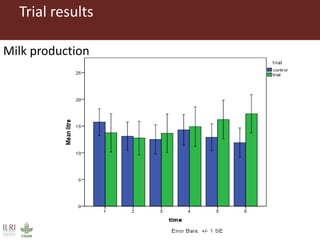
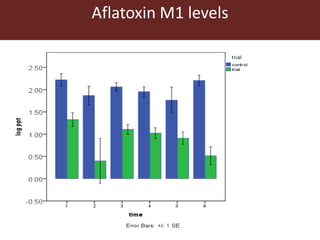
Trial results
Milk production
Aflatoxin M1 levels
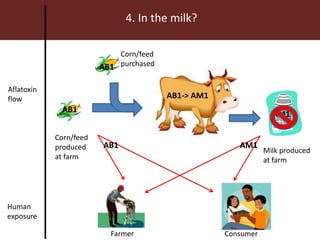
Farmer Consumer
4. In the milk?
Aflatoxin
flow
Human
exposure
AB1
AB1
AB1-> AM1
AM1
Corn/feed
produced
at farm
Corn/feed
purchased
Milk produced
at farm
AB1 AM1
4. In the milk
• Biological control??
Research still ongoing
Pasteurization not working
Farmer Consumer
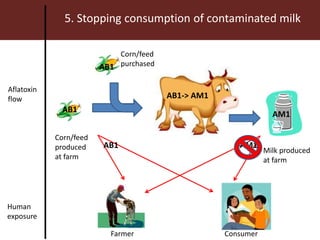
5. Stopping consumption of contaminated milk
Aflatoxin
flow
Human
exposure
AB1
AB1
AB1-> AM1
AM1
Corn/feed
produced
at farm
Corn/feed
purchased
Milk produced
at farm
AB1 AM1
5. Stopping consumption
• Legislation
• Awareness and market incentives
Implementation
What do you do with illegal milk?
Costs?
Poor consumers?
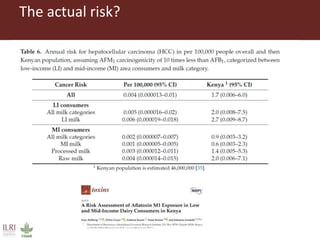
The actual risk?
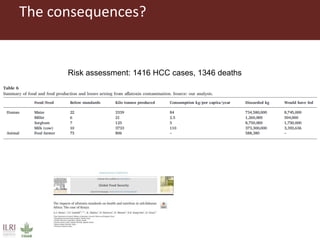
The consequences?
Risk assessment: 1416 HCC cases, 1346 deaths
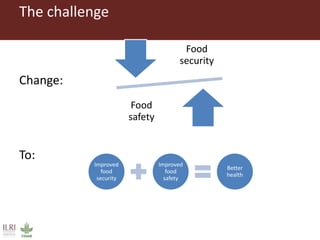
The challenge
Change:
To:
Food
security
Food
safety
Improved
food
security
Improved
food
safety
Better
health
Take-home messages
• Livestock is affected by aflatoxins, and so are animal-
sourced food
• Livestock feed sector + binders can suck
contaminated grain out of human food chain
• Potential for regulation to cause harm (burden on
agricultural sector, concentrating contaminated
among poorest)
• Need to research what works in each country
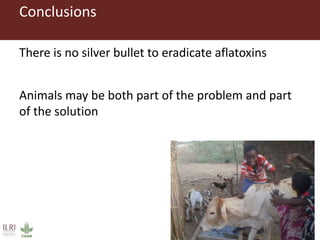
Conclusions
There is no silver bullet to eradicate aflatoxins
Animals may be both part of the problem and part
of the solution
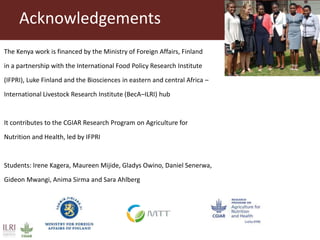
The Kenya work is financed by the Ministry of Foreign Affairs, Finland
in a partnership with the International Food Policy Research Institute
(IFPRI), Luke Finland and the Biosciences in eastern and central Africa –
International Livestock Research Institute (BecA–ILRI) hub
It contributes to the CGIAR Research Program on Agriculture for
Nutrition and Health, led by IFPRI
Students: Irene Kagera, Maureen Mijide, Gladys Owino, Daniel Senerwa,
Gideon Mwangi, Anima Sirma and Sara Ahlberg
Acknowledgements
This presentation is licensed for use under the Creative Commons Attribution 4.0 International Licence.
better lives through livestock
ilri.org
ILRI thanks all donors and organizations who globally supported its work through their contributions
to the CGIAR system

Aflatoxins in the dairy value chain: A challenge for the informal market?

  • 1.
    Aflatoxins in thedairy value chain: A challenge for the informal market? Johanna Lindahl, Florence Mutua and Delia Grace The 15th International Symposium on Veterinary Epidemiology and Economics Chiang Mai, Thailand 13 November 2018
  • 2.
    Presentation outline • Aflatoxinsand livestock in low- and middle- income countries (LMIC) • Our work in Africa • What do we do about it? • Mitigation strategies at different levels in Kenya
  • 3.
    What are mycotoxins? •When some moulds grow on crops, they produce toxic substances that can remain in the crops • Moulds are ubiquitous Photo by IITA. Aspergillus naturally infected groundnuts in Mozambique. Photo by CIMMYT.
  • 4.
    Aflatoxins • Toxic byproductsfrom Aspergillus fungi – Mainly Aspergillus flavus – Not all toxigenic – Preference for maize, groundnuts, but also other cereals Staples!
  • 5.
    Aflatoxins • Different kinds –Invisible – Odourless – Tasteless – Heat stable
  • 6.
    The health concerns •Acute outbreaks can claim 100s of lives (Kenya outbreak 2004–05, 125 known fatal cases) • 4.5 billion people chronically exposed (estimate by US CDC) •Cancer •Immunosuppression •Stunting
  • 7.
    Aflatoxins are aglobal issue
  • 8.
    CGIAR are globalinstitutes International Center for Tropical Agriculture (CIAT) International Crops Research Institute for the Semi-Arid Tropics (ICRISAT) International Institute of Tropical Agriculture (IITA) International Livestock Research Institute (ILRI) International Maize and Wheat Improvement Center (CIMMYT) International Food Policy Research Institute (IFPRI)
  • 9.
    Why focus onaflatoxins in Kenya? • Kenya outbreak 2004–05: 125 known fatal cases • 884 women sampled in Eastern Province • All had aflatoxin in the blood • Exposure levels higher in poor people
  • 10.
    Why bother aboutaflatoxins and animals? • Animals are susceptible to aflatoxins: some more, some less 1. Animal suffering: an animal welfare issue 2. Reduced animal productivity 3. Aflatoxins in animal-source foods
  • 11.
    Health effects observed •Liver damage • Gastrointestinal dysfunction, decreased appetite • Immunosuppression • Decreased reproductive function, decreased growth and decreased production • Can we see these effects in low-producing animals? • Little research in Africa in literature search • Varying effects in all studies
  • 12.
    Safe levels? • ≤50in young poultry • ≤100 in adult poultry • ≤50 in weaned pigs • ≤200 in finishing pigs • <100 in calves • <300 in cattle • <100 in Nile tilapia However depending on other factors!
  • 13.
    Animal-source food • Aflatoxinsare transferred to animal products • 1-7% of aflatoxins in feed is metabolized and transferred to milk • Much lower transfer to meat and eggs • Reduced if feeding is stopped
  • 14.
    Farmer Consumer Economic flow Aflatoxin flow Human exposure Feed producer AB1 AB1 AB1-> AM1 AM1 Corn/feed produced atfarm Corn/feed purchased Milk produced at farm AB1 AM1 Treatments Feed seller Farmer Veterinary services Milk retailer Agricultural services Consumer
  • 15.
    Aflatoxins in Kenyadairy Qualitative study- understanding behaviour • Women have a greater role in deciding what to feed cattle • Common to feed mouldy food to livestock • Women more likely to report taste of maize as an indicator of moulds • Men and women share more decision-making than literature suggests • Men and women disagree which gender has responsibility
  • 16.
    Kenya: Dairy valuechain • Feed collected from five countiesa – From farmers: 0.02 ppb to 9,661 ppb – Samples exceeding 5 ppb • 25–100% of the feed in farms • 85.7–100% of the feed from feed retailers • 20–100% of the feeds from feed manufacturers • Milk samples: Up to 6999 ppt a Mugangai et al. 2016
  • 17.
    One-year survey 0 50 100 150 200 250 300 1 23 4 5 6 7 8 9 10 11 12 dagoretti Westlands 24 samples per month Dagoretti: low-income area Westlands: high-income area
  • 18.
    One-year survey 0 200 400 600 800 1000 1200 Pasteurized BoiledPasteurized Raw UHT Pasteurized Lala Milk Yoghurt Average of ppt Max of ppt
  • 19.
    Producer Number Meanprice KES/litre (range) Mean aflatoxin M1 levels (ng/kg) Standard deviation Min Max Geometric mean Farmers 75 65 (45-110) 116.5 153.3 <LOD 1069.5 65.6 a Company A 74 155 (80-610) 57.0 43.9 7.6 272.3 46.4 Company B 12 101 (90-120) 296.9 206.1 59.0 743.3 226.9 Company C 51 128 (60-233) 37.2 33.9 <LOD 166.1 22.7 b Company D 37 125 (86-233) 38.9 33.5 <LOD 156.1 23.7 b Others 42 176 (76-660) 111.3 169.9 7.3 1078.5 68.0 a Table 2. Aflatoxin M1 levels in milk samples of different origins purchased in Nairobi, Kenya Geometric means with the same superscript were not significantly different LOD: Limit of detection (2 ng/kg)
  • 20.
    Kenya: Urban milk •Milk collected from informal milk retailers – 58% knew about aflatoxin, but only 6% thought milk was not totally safe after boiling – Milk samples: mean aflatoxin M1 was 128.7 ppt, up to 1675 ppt. 55% of samples exceeded 50 ppt and 6% 500 ppt. – Women consume 1 litre per day! Kiruni et al. 2016, Afr J Food, Nutr Ag Dev
  • 21.
    Kenya: Urban milk •Child exposure study • Korogocho and Dagoretti • 41% of children were stunted • 98% of foods contained aflatoxin • 100% of milk contained AFM1 • Aflatoxin M1 exposure associated with decreased height-for-age score Kiarie et al. 2016, Afr J Food, Nutr Ag Dev 27% 59% 14% moderate stunted Normal severe stunted
  • 22.
    Mitigation options • Aflatoxinscan be mitigated all along the dairy value chain o Costs o Implementation o Side effects
  • 23.
    Farmer Consumer 1. Stopaflatoxin production Aflatoxin flow Human exposure AB1 AB1 AB1-> AM1 AM1 Corn/feed produced at farm Corn/feed purchased Milk produced at farm AB1 AM1
  • 24.
    On the field:storage • Improved varieties: more resistant crops • Bio control: AflaSafe™, AflaGuard™ • Improved drying • Improved storage • Good Agricultural Practices Reduces aflatoxins for both humans and animals Costly?
  • 25.
    Farmer Consumer 2. Stoppingthe bad feed Aflatoxin flow Human exposure AB1 AB1 AB1-> AM1 AM1 Corn/feed produced at farm Corn/feed purchased Milk produced at farm AB1 AM1
  • 26.
    Objectives of feedstandards 1. Protect humans from harmful aflatoxins in animal-source foods 2. Safeguard the benefits people derive from livestock 3. Protect value chain actors from bad products 4. Encourage fair trade, and economic growth through promoting standards and credibility
  • 27.
    2. Stopping thebad feed • Feed regulations Implementation What do you do with illegal feed? Costs? • Market incentives Poor people? Not sustainable
  • 28.
    Farmer Consumer 3. Withinthe cow Aflatoxin flow Human exposure AB1 AB1 AB1-> AM1 AM1 Corn/feed produced at farm Corn/feed purchased Milk produced at farm AB1 AM1 Binder
  • 29.
    Standards for Anti-MycotoxinAdditives (AMAs) in Feeds Clays (aluminosilicates) • Most effective binder but different clays vary in effectiveness. Up to 90% reduction. Yeast/bacterial cell wall extracts • Provide other useful nutrients, but evidence on effectiveness is mixed Other binders • Some are promising but less evidence of effectiveness
  • 30.
    The case forbinders • Multiple benefits: 1. Increase animal productivity 2. Reduce aflatoxins in animal-source foods 3. Create safe “sink” for aflatoxin 4. Improved animal welfare • Food safety/security tradeoff  win-win opportunity • Current trial will provide evidence on effectiveness
  • 31.
    Reducing aflatoxins inmilk using binders • Baseline survey to collect data on: – Levels of aflatoxins in milk – Feeding practices – Farmer awareness – Farmer willingness to use mitigation methods – Farmer willingness to pay for binders or other mitigation methods
  • 32.
    Study sites • Urban/peri-urban –Kasarani – Kisumu • 20 trial farms and 10 control farms recruited in each site – Given Novasil as a feed additive
  • 33.
    Follow up • Regularfollow up and endline survey of farmers • Compliance? • Concerns with adulteration
  • 34.
  • 35.
  • 36.
    Farmer Consumer 4. Inthe milk? Aflatoxin flow Human exposure AB1 AB1 AB1-> AM1 AM1 Corn/feed produced at farm Corn/feed purchased Milk produced at farm AB1 AM1
  • 37.
    4. In themilk • Biological control?? Research still ongoing Pasteurization not working
  • 38.
    Farmer Consumer 5. Stoppingconsumption of contaminated milk Aflatoxin flow Human exposure AB1 AB1 AB1-> AM1 AM1 Corn/feed produced at farm Corn/feed purchased Milk produced at farm AB1 AM1
  • 39.
    5. Stopping consumption •Legislation • Awareness and market incentives Implementation What do you do with illegal milk? Costs? Poor consumers?
  • 40.
  • 41.
    The consequences? Risk assessment:1416 HCC cases, 1346 deaths
  • 42.
  • 43.
    Take-home messages • Livestockis affected by aflatoxins, and so are animal- sourced food • Livestock feed sector + binders can suck contaminated grain out of human food chain • Potential for regulation to cause harm (burden on agricultural sector, concentrating contaminated among poorest) • Need to research what works in each country
  • 44.
    Conclusions There is nosilver bullet to eradicate aflatoxins Animals may be both part of the problem and part of the solution
  • 45.
    The Kenya workis financed by the Ministry of Foreign Affairs, Finland in a partnership with the International Food Policy Research Institute (IFPRI), Luke Finland and the Biosciences in eastern and central Africa – International Livestock Research Institute (BecA–ILRI) hub It contributes to the CGIAR Research Program on Agriculture for Nutrition and Health, led by IFPRI Students: Irene Kagera, Maureen Mijide, Gladys Owino, Daniel Senerwa, Gideon Mwangi, Anima Sirma and Sara Ahlberg Acknowledgements
  • 46.
    This presentation islicensed for use under the Creative Commons Attribution 4.0 International Licence. better lives through livestock ilri.org ILRI thanks all donors and organizations who globally supported its work through their contributions to the CGIAR system