Johanna Lindahl Delia Grace
Finnish embassy meeting
Nairobi
November 24 2014
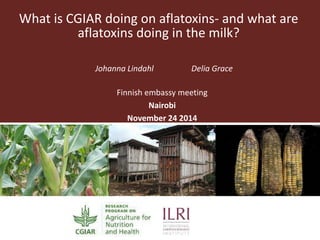
What is CGIAR doing on aflatoxins- and what are
aflatoxins doing in the milk?
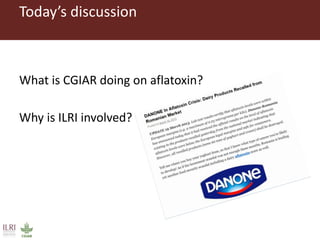
Today’s discussion
What is CGIAR doing on aflatoxin?
Why is ILRI involved?
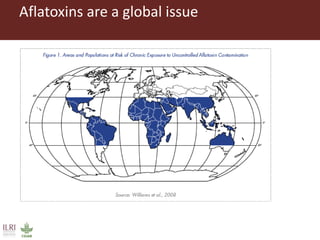
Aflatoxins are a global issue
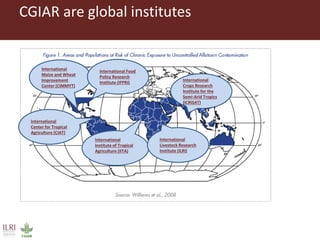
CGIAR are global institutes
International
Center for Tropical
Agriculture (CIAT)
International
Crops Research
Institute for the
Semi-Arid Tropics
(ICRISAT)
International
Institute of Tropical
Agriculture (IITA)
International
Livestock Research
Institute (ILRI)
International
Maize and Wheat
Improvement
Center (CIMMYT)
International Food
Policy Research
Institute (IFPRI)
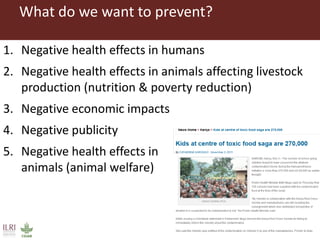
What do we want to prevent?
1. Negative health effects in humans
2. Negative health effects in animals affecting livestock
production (nutrition & poverty reduction)
3. Negative economic impacts
4. Negative publicity
5. Negative health effects in
animals (animal welfare)
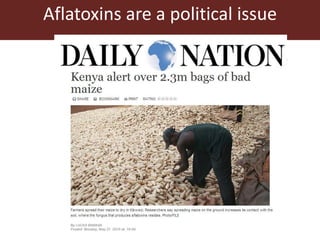
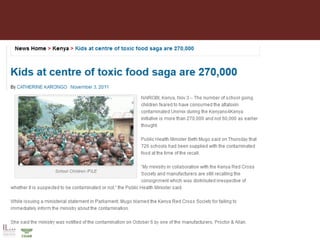
Aflatoxins are a political issue
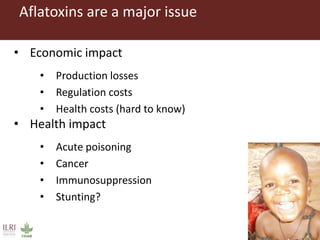
Aflatoxins are a major issue
• Economic impact
• Production losses
• Regulation costs
• Health costs (hard to know)
• Health impact
• Acute poisoning
• Cancer
• Immunosuppression
• Stunting?
Why is it so scary?
• Invisible toxin
• Odourless
• Heat-stable
• And we are feeding it to our children
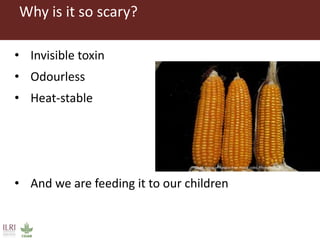
Clean maize or fungus-free maize cobs. Photo by IITA.
But how big is the problem really for you
and me?
• Exposure of aflatoxin
• Levels of aflatoxin
• Consumption of contaminated products
• ILRI is working on risk assessment with FoodAfrica
• Who are the consumers?
• Children
• Pregnant and nursing mothers
• The first 1000 days.
• Where is the problems?
• Risk mapping (FoodAfrica)
Farmer Consumer
Economic
flow
Aflatoxin
flow
Human
exposure
Feed
producer
AB1
AB1
AB1-> AM1
AM1
Corn/feed
produced
at farm
Corn/feed
purchased
Milk produced
at farm
AB1 AM1
Treatments
Feed
seller Farmer
Veterinary services
Milk
retailer
Agricultural services
Consumer
What promotes the fungal growth?
• Pre-harvest: damage by insects, draughts
• Insects cause damage and are mechanical vectors
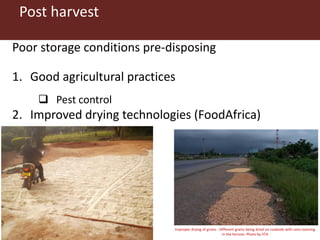
• Post-harvest: Poor storage conditions
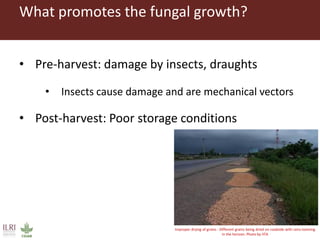
Improper drying of grains - Different grains being dried on roadside with rains looming
in the horizon. Photo by IITA
How is CGIAR approaching this?
1. Bridging the knowledge gap
2. Diagnostics
3. Pre-harvest interventions
4. Post-harvest interventions
5. Handling aflatoxin contaminated products
6. Policies and standards
Pre-harvest
Prevent fungal growth pre-harvest: Insects and
drought predisposes
1. Breeding for resistance
 Drought-tolerant, or insect-resistant maize
2. Good agricultural practices
 Fertilizers, pesticides, irrigation
3. Biological control using atoxigenic strains
 Aflasafe, Afla-guard
Post harvest
Poor storage conditions pre-disposing
1. Good agricultural practices
 Pest control
2. Improved drying technologies (FoodAfrica)
Improper drying of grains - Different grains being dried on roadside with rains looming
in the horizon. Photo by IITA
Preventing consumption
1. Sorting
2. Legislation
 Limits for human and animal consumption
3. Treatment (detoxification)
 Ammoniation
 Ozone treatment
 Nixtamilization
 Fermentation
 Binders
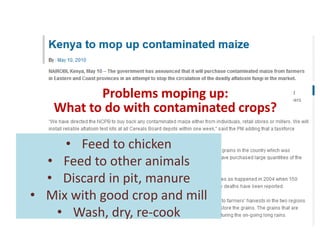
Problems moping up:
What to do with contaminated crops?
• Feed to chicken
• Feed to other animals
• Discard in pit, manure
• Mix with good crop and mill
• Wash, dry, re-cook
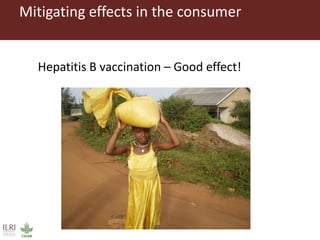
Mitigating effects in the consumer
Hepatitis B vaccination – Good effect!
Public awareness and dietary
considerations
Dietary diversification, switching from high-risk crop
Consumption pattern
Consumer awareness
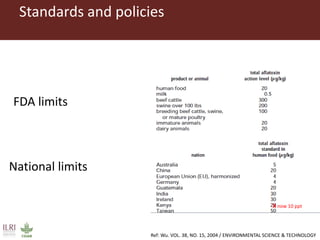
Standards and policies
Ref: Wu. VOL. 38, NO. 15, 2004 / ENVIRONMENTAL SCIENCE & TECHNOLOGY
FDA limits
National limits
X now 10 ppt
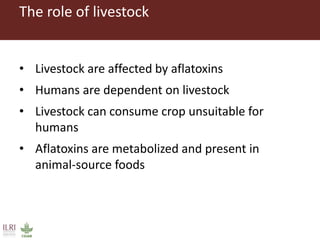
Highly susceptible: oral LD50 (<1 mg per kg body weight)
Rabbits, ducks, cats, swine, rainbow trout
Moderately susceptible: oral LD50 (1-2 mg per kg body weight)
Dogs, horses, calves, turkeys, guinea pigs, sheep, baboon
Relatively resistant: oral LD50 (5-10 mg kg body weight)
Chickens, rats, macaque monkeys, mouse, hamsters
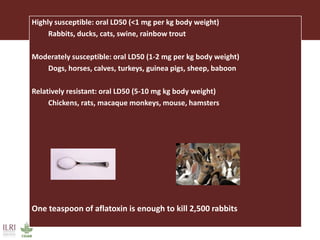
One teaspoon of aflatoxin is enough to kill 2,500 rabbits
The role of livestock
• Livestock are affected by aflatoxins
• Humans are dependent on livestock
• Livestock can consume crop unsuitable for
humans
• Aflatoxins are metabolized and present in
animal-source foods
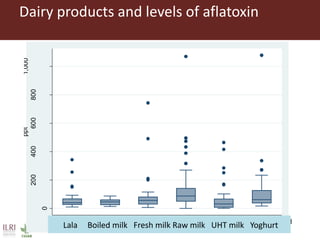
Dairy products and levels of aflatoxin
0
200400600800
1,000ppt
Lala PasteurizedMilk BoiledMilk PasteurizedMilk Raw Milk UHTYoghurt Pasteurized
Lala Boiled milk Fresh milk Raw milk UHT milk Yoghurt
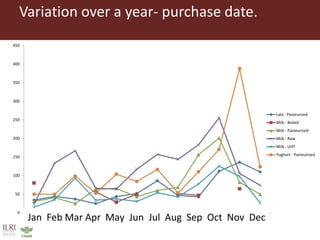
Variation over a year- purchase date.
0
50
100
150
200
250
300
350
400
450
1 2 3 4 5 6 7 8 9 10 11 12
Lala - Pasteurized
Milk - Boiled
Milk - Pasteurized
Milk - Raw
Milk - UHT
Yoghurt - Pasteurized
Jan Feb Mar Apr May Jun Jul Aug Sep Oct Nov Dec
Projects on milk and livestock
• Consumption patterns and risk assessment
• Economic assessment
• Association with stunting
• Reduced growth in chickens and efficacy of
binders
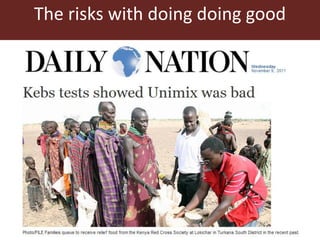
The risks with doing doing good
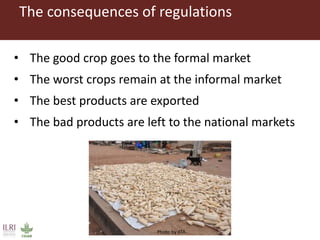
The consequences of regulations
• The good crop goes to the formal market
• The worst crops remain at the informal market
• The best products are exported
• The bad products are left to the national markets
Photo by IITA.
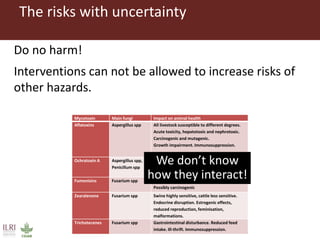
The risks with uncertainty
Do no harm!
Interventions can not be allowed to increase risks of
other hazards.
Mycotoxin Main fungi Impact on animal health
Aflatoxins Aspergillus spp All livestock susceptible to different degrees.
Acute toxicity, hepatotoxic and nephrotoxic.
Carcinogenic and mutagenic.
Growth impairment. Immunosuppression.
Ochratoxin A Aspergillus spp,
Penicillum spp
Nephrotoxic
Immunosuppression
Possibly carcinogenic
Fumonisins Fusarium spp Toxic to liver and central nervous system
Possibly carcinogenic
Zearalenone Fusarium spp Swine highly sensitive, cattle less sensitive.
Endocrine disruption. Estrogenic effects,
reduced reproduction, feminisation,
malformations.
Trichotecenes Fusarium spp Gastrointestinal disturbance. Reduced feed
intake. Ill-thrift. Immunosuppression.
We don’t know
how they interact!
Conclusions- importance of milk
Milk have generally low levels of aflatoxins compared
to other commodities.
Aflatoxin M1 has unknown toxic effects on children
We need to use evidence
We must not forget the other hazards and mycotoxins
We need to cooperate
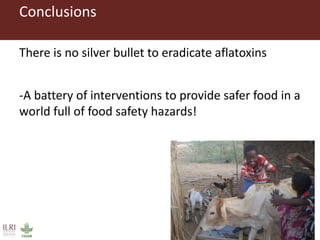
Conclusions
There is no silver bullet to eradicate aflatoxins
-A battery of interventions to provide safer food in a
world full of food safety hazards!
The ILRI work is financed by
Ministry of foreign affairs, Finland, and the CGIAR
Research Program on
Agriculture for nutrition and health (CRP 4)
It is implemented in a partnership with
International food policy research institute (IFPRI), MTT
Finland, Biosciences in eastern and central Africa (BecA)
Acknowledgements
The presentation has a Creative Commons licence. You are free to re-use or distribute this work, provided credit is given to ILRI.
better lives through livestock
ilri.org

What is CGIAR doing on aflatoxins—And what are aflatoxins doing in the milk?

  • 1.
    Johanna Lindahl DeliaGrace Finnish embassy meeting Nairobi November 24 2014 What is CGIAR doing on aflatoxins- and what are aflatoxins doing in the milk?
  • 2.
    Today’s discussion What isCGIAR doing on aflatoxin? Why is ILRI involved?
  • 3.
    Aflatoxins are aglobal issue
  • 4.
    CGIAR are globalinstitutes International Center for Tropical Agriculture (CIAT) International Crops Research Institute for the Semi-Arid Tropics (ICRISAT) International Institute of Tropical Agriculture (IITA) International Livestock Research Institute (ILRI) International Maize and Wheat Improvement Center (CIMMYT) International Food Policy Research Institute (IFPRI)
  • 5.
    What do wewant to prevent? 1. Negative health effects in humans 2. Negative health effects in animals affecting livestock production (nutrition & poverty reduction) 3. Negative economic impacts 4. Negative publicity 5. Negative health effects in animals (animal welfare)
  • 6.
    Aflatoxins are apolitical issue
  • 8.
    Aflatoxins are amajor issue • Economic impact • Production losses • Regulation costs • Health costs (hard to know) • Health impact • Acute poisoning • Cancer • Immunosuppression • Stunting?
  • 9.
    Why is itso scary? • Invisible toxin • Odourless • Heat-stable • And we are feeding it to our children Clean maize or fungus-free maize cobs. Photo by IITA.
  • 10.
    But how bigis the problem really for you and me? • Exposure of aflatoxin • Levels of aflatoxin • Consumption of contaminated products • ILRI is working on risk assessment with FoodAfrica • Who are the consumers? • Children • Pregnant and nursing mothers • The first 1000 days. • Where is the problems? • Risk mapping (FoodAfrica)
  • 11.
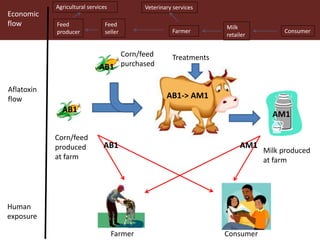
    Farmer Consumer Economic flow Aflatoxin flow Human exposure Feed producer AB1 AB1 AB1-> AM1 AM1 Corn/feed produced atfarm Corn/feed purchased Milk produced at farm AB1 AM1 Treatments Feed seller Farmer Veterinary services Milk retailer Agricultural services Consumer
  • 12.
    What promotes thefungal growth? • Pre-harvest: damage by insects, draughts • Insects cause damage and are mechanical vectors • Post-harvest: Poor storage conditions Improper drying of grains - Different grains being dried on roadside with rains looming in the horizon. Photo by IITA
  • 13.
    How is CGIARapproaching this? 1. Bridging the knowledge gap 2. Diagnostics 3. Pre-harvest interventions 4. Post-harvest interventions 5. Handling aflatoxin contaminated products 6. Policies and standards
  • 14.
    Pre-harvest Prevent fungal growthpre-harvest: Insects and drought predisposes 1. Breeding for resistance  Drought-tolerant, or insect-resistant maize 2. Good agricultural practices  Fertilizers, pesticides, irrigation 3. Biological control using atoxigenic strains  Aflasafe, Afla-guard
  • 15.
    Post harvest Poor storageconditions pre-disposing 1. Good agricultural practices  Pest control 2. Improved drying technologies (FoodAfrica) Improper drying of grains - Different grains being dried on roadside with rains looming in the horizon. Photo by IITA
  • 16.
    Preventing consumption 1. Sorting 2.Legislation  Limits for human and animal consumption 3. Treatment (detoxification)  Ammoniation  Ozone treatment  Nixtamilization  Fermentation  Binders
  • 17.
    Problems moping up: Whatto do with contaminated crops? • Feed to chicken • Feed to other animals • Discard in pit, manure • Mix with good crop and mill • Wash, dry, re-cook
  • 18.
    Mitigating effects inthe consumer Hepatitis B vaccination – Good effect!
  • 19.
    Public awareness anddietary considerations Dietary diversification, switching from high-risk crop Consumption pattern Consumer awareness
  • 20.
    Standards and policies Ref:Wu. VOL. 38, NO. 15, 2004 / ENVIRONMENTAL SCIENCE & TECHNOLOGY FDA limits National limits X now 10 ppt
  • 21.
    Highly susceptible: oralLD50 (<1 mg per kg body weight) Rabbits, ducks, cats, swine, rainbow trout Moderately susceptible: oral LD50 (1-2 mg per kg body weight) Dogs, horses, calves, turkeys, guinea pigs, sheep, baboon Relatively resistant: oral LD50 (5-10 mg kg body weight) Chickens, rats, macaque monkeys, mouse, hamsters One teaspoon of aflatoxin is enough to kill 2,500 rabbits
  • 22.
    The role oflivestock • Livestock are affected by aflatoxins • Humans are dependent on livestock • Livestock can consume crop unsuitable for humans • Aflatoxins are metabolized and present in animal-source foods
  • 23.
    Dairy products andlevels of aflatoxin 0 200400600800 1,000ppt Lala PasteurizedMilk BoiledMilk PasteurizedMilk Raw Milk UHTYoghurt Pasteurized Lala Boiled milk Fresh milk Raw milk UHT milk Yoghurt
  • 24.
    Variation over ayear- purchase date. 0 50 100 150 200 250 300 350 400 450 1 2 3 4 5 6 7 8 9 10 11 12 Lala - Pasteurized Milk - Boiled Milk - Pasteurized Milk - Raw Milk - UHT Yoghurt - Pasteurized Jan Feb Mar Apr May Jun Jul Aug Sep Oct Nov Dec
  • 25.
    Projects on milkand livestock • Consumption patterns and risk assessment • Economic assessment • Association with stunting • Reduced growth in chickens and efficacy of binders
  • 26.
    The risks withdoing doing good
  • 27.
    The consequences ofregulations • The good crop goes to the formal market • The worst crops remain at the informal market • The best products are exported • The bad products are left to the national markets Photo by IITA.
  • 28.
    The risks withuncertainty Do no harm! Interventions can not be allowed to increase risks of other hazards. Mycotoxin Main fungi Impact on animal health Aflatoxins Aspergillus spp All livestock susceptible to different degrees. Acute toxicity, hepatotoxic and nephrotoxic. Carcinogenic and mutagenic. Growth impairment. Immunosuppression. Ochratoxin A Aspergillus spp, Penicillum spp Nephrotoxic Immunosuppression Possibly carcinogenic Fumonisins Fusarium spp Toxic to liver and central nervous system Possibly carcinogenic Zearalenone Fusarium spp Swine highly sensitive, cattle less sensitive. Endocrine disruption. Estrogenic effects, reduced reproduction, feminisation, malformations. Trichotecenes Fusarium spp Gastrointestinal disturbance. Reduced feed intake. Ill-thrift. Immunosuppression. We don’t know how they interact!
  • 29.
    Conclusions- importance ofmilk Milk have generally low levels of aflatoxins compared to other commodities. Aflatoxin M1 has unknown toxic effects on children We need to use evidence We must not forget the other hazards and mycotoxins We need to cooperate
  • 30.
    Conclusions There is nosilver bullet to eradicate aflatoxins -A battery of interventions to provide safer food in a world full of food safety hazards!
  • 31.
    The ILRI workis financed by Ministry of foreign affairs, Finland, and the CGIAR Research Program on Agriculture for nutrition and health (CRP 4) It is implemented in a partnership with International food policy research institute (IFPRI), MTT Finland, Biosciences in eastern and central Africa (BecA) Acknowledgements
  • 32.
    The presentation hasa Creative Commons licence. You are free to re-use or distribute this work, provided credit is given to ILRI. better lives through livestock ilri.org