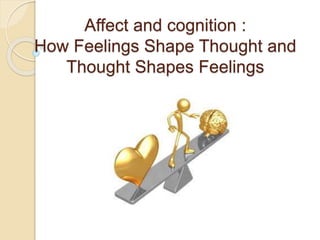
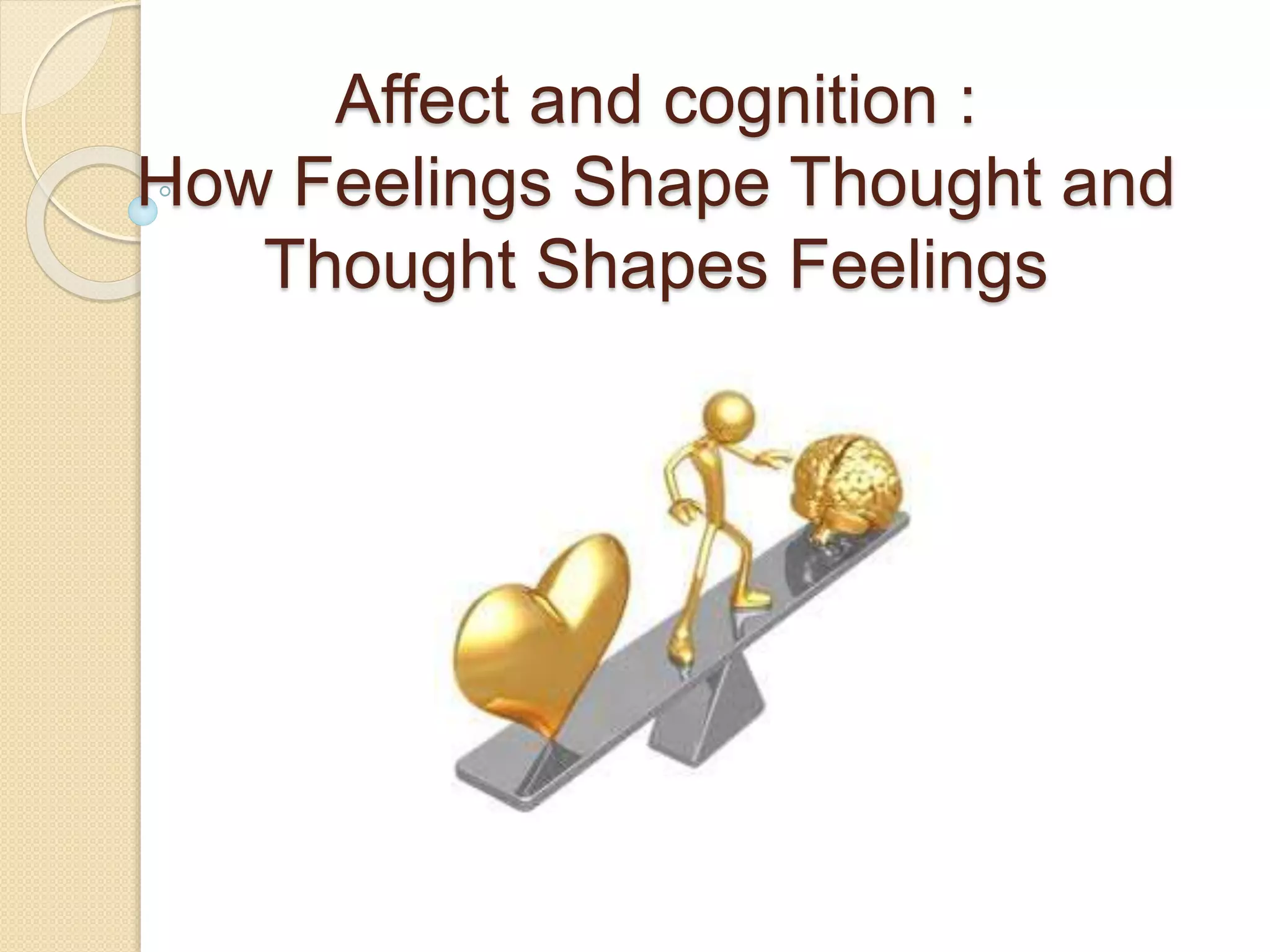
Affect and cognition :
How Feelings Shape Thought and
Thought Shapes Feelings
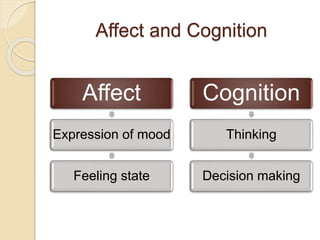
Affect and Cognition
Affect
Expression of mood
Feeling state
Cognition
Thinking
Decision making
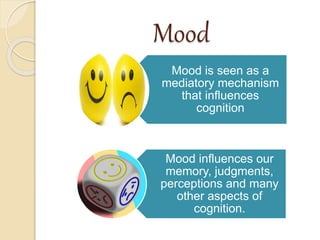
Mood
Mood is seen as a
mediatory mechanism
that influences
cognition
Mood influences our
memory, judgments,
perceptions and many
other aspects of
cognition.
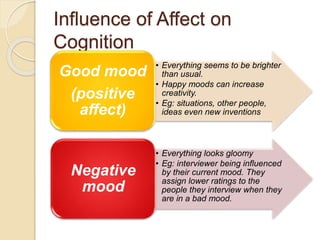
Influence of Affect on
Cognition
• Everything seems to be brighter
than usual.
• Happy moods can increase
creativity.
• Eg: situations, other people,
ideas even new inventions
Good mood
(positive
affect)
• Everything looks gloomy
• Eg: interviewer being influenced
by their current mood. They
assign lower ratings to the
people they interview when they
are in a bad mood.
Negative
mood
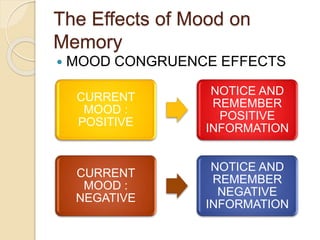
The Effects of Mood on
Memory
 MOOD CONGRUENCE EFFECTS
CURRENT
MOOD :
POSITIVE
NOTICE AND
REMEMBER
POSITIVE
INFORMATION
CURRENT
MOOD :
NEGATIVE
NOTICE AND
REMEMBER
NEGATIVE
INFORMATION
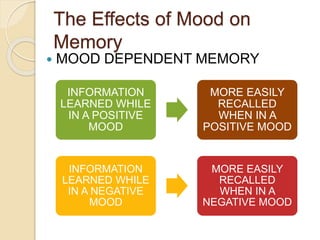
The Effects of Mood on
Memory
 MOOD DEPENDENT MEMORY
INFORMATION
LEARNED WHILE
IN A POSITIVE
MOOD
MORE EASILY
RECALLED
WHEN IN A
POSITIVE MOOD
INFORMATION
LEARNED WHILE
IN A NEGATIVE
MOOD
MORE EASILY
RECALLED
WHEN IN A
NEGATIVE MOOD
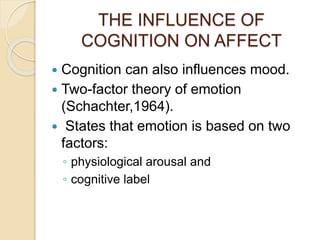
THE INFLUENCE OF
COGNITION ON AFFECT
 Cognition can also influences mood.
 Two-factor theory of emotion
(Schachter,1964).
 States that emotion is based on two
factors:
◦ physiological arousal and
◦ cognitive label
 According to the theory when an
emotion is felt, a physiological arousal
occurs and the person uses the
immediate environment to search for
emotional cues to label the
physiological arousal.
 This can sometimes cause
misinterpretations of emotions based
on the body’s physiological state.
 When the brain does not know why it
feels an emotion it relies on external
stimulation for cues on how to label
the emotion.
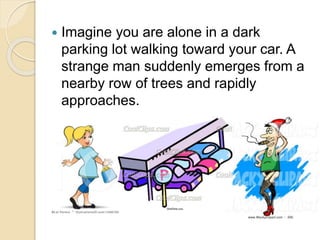
 Imagine you are alone in a dark
parking lot walking toward your car. A
strange man suddenly emerges from a
nearby row of trees and rapidly
approaches.
The sequence that follows,
according to the two-factor
theory, would be much like this:
I. See a strange man walking toward
me.
2. My heart is racing and I am
trembling.
3. My rapid heart rate and trembling
are caused by fear.
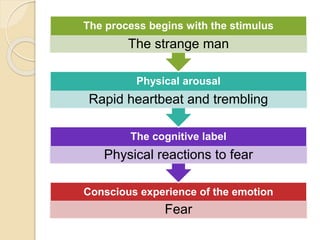
Conscious experience of the emotion
Fear
The cognitive label
Physical reactions to fear
Physical arousal
Rapid heartbeat and trembling
The process begins with the stimulus
The strange man
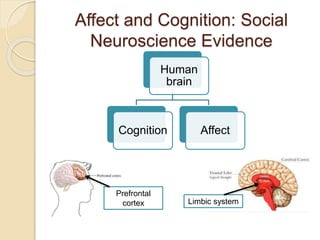
Affect and Cognition: Social
Neuroscience Evidence
Human
brain
Cognition Affect
Prefrontal
cortex Limbic system
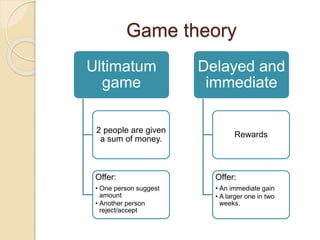
Game theory
Ultimatum
game
2 people are given
a sum of money.
Offer:
• One person suggest
amount
• Another person
reject/accept
Delayed and
immediate
Rewards
Offer:
• An immediate gain
• A larger one in two
weeks.

Affect and cognition

  • 1.
    Affect and cognition: How Feelings Shape Thought and Thought Shapes Feelings
  • 2.
    Affect and Cognition Affect Expressionof mood Feeling state Cognition Thinking Decision making
  • 3.
    Mood Mood is seenas a mediatory mechanism that influences cognition Mood influences our memory, judgments, perceptions and many other aspects of cognition.
  • 4.
    Influence of Affecton Cognition • Everything seems to be brighter than usual. • Happy moods can increase creativity. • Eg: situations, other people, ideas even new inventions Good mood (positive affect) • Everything looks gloomy • Eg: interviewer being influenced by their current mood. They assign lower ratings to the people they interview when they are in a bad mood. Negative mood
  • 5.
    The Effects ofMood on Memory  MOOD CONGRUENCE EFFECTS CURRENT MOOD : POSITIVE NOTICE AND REMEMBER POSITIVE INFORMATION CURRENT MOOD : NEGATIVE NOTICE AND REMEMBER NEGATIVE INFORMATION
  • 6.
    The Effects ofMood on Memory  MOOD DEPENDENT MEMORY INFORMATION LEARNED WHILE IN A POSITIVE MOOD MORE EASILY RECALLED WHEN IN A POSITIVE MOOD INFORMATION LEARNED WHILE IN A NEGATIVE MOOD MORE EASILY RECALLED WHEN IN A NEGATIVE MOOD
  • 7.
    THE INFLUENCE OF COGNITIONON AFFECT  Cognition can also influences mood.  Two-factor theory of emotion (Schachter,1964).  States that emotion is based on two factors: ◦ physiological arousal and ◦ cognitive label
  • 8.
     According tothe theory when an emotion is felt, a physiological arousal occurs and the person uses the immediate environment to search for emotional cues to label the physiological arousal.  This can sometimes cause misinterpretations of emotions based on the body’s physiological state.  When the brain does not know why it feels an emotion it relies on external stimulation for cues on how to label the emotion.
  • 9.
     Imagine youare alone in a dark parking lot walking toward your car. A strange man suddenly emerges from a nearby row of trees and rapidly approaches.
  • 10.
    The sequence thatfollows, according to the two-factor theory, would be much like this: I. See a strange man walking toward me. 2. My heart is racing and I am trembling. 3. My rapid heart rate and trembling are caused by fear.
  • 11.
    Conscious experience ofthe emotion Fear The cognitive label Physical reactions to fear Physical arousal Rapid heartbeat and trembling The process begins with the stimulus The strange man
  • 12.
    Affect and Cognition:Social Neuroscience Evidence Human brain Cognition Affect Prefrontal cortex Limbic system
  • 13.
    Game theory Ultimatum game 2 peopleare given a sum of money. Offer: • One person suggest amount • Another person reject/accept Delayed and immediate Rewards Offer: • An immediate gain • A larger one in two weeks.