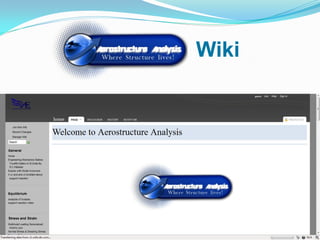
Why wiki ?
 A wiki is a website designed for multiple
 people to collaborate by adding and
 editing content. Aerostructure Analysis
 wiki is an example of a wiki. A wiki farm
 is a collection of individual wikis, usually
 hosted by the same website. Browse
 through a list of wikis by category
Wiki
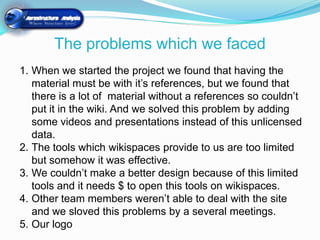
The problems which we faced
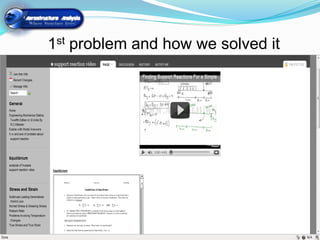
1. When we started the project we found that having the
   material must be with it’s references, but we found that
   there is a lot of material without a references so couldn’t
   put it in the wiki. And we solved this problem by adding
   some videos and presentations instead of this unlicensed
   data.
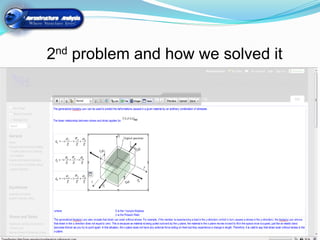
2. The tools which wikispaces provide to us are too limited
   but somehow it was effective.
3. We couldn’t make a better design because of this limited
   tools and it needs $ to open this tools on wikispaces.
4. Other team members weren’t able to deal with the site
   and we sloved this problems by a several meetings.
5. Our logo
1st problem and how we solved it
2nd problem and how we solved it
3rd problem and how we solved it
Objectives
 The main objective of the project about

  this course is to provide future aeronautical
  engineers with the means of analyzing and
  designing various load bearing structures.
  This can be done by learning them How to analyze a system of
  forces and obtain the reactions at the supports of structures and
  How to analyse the forces in plain trusses. Later, they will study the
  nature of stress and strain, and the properties of cross sections,
  finally, they will be introduced to the forces and stresses in
  members subject to axial, torsion, and bending loading.
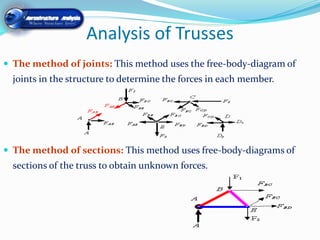
Analysis of Trusses
 The method of joints: This method uses the free-body-diagram of
  joints in the structure to determine the forces in each member.


 The method of sections: This method uses free-body-diagrams of
  sections of the truss to obtain unknown forces.
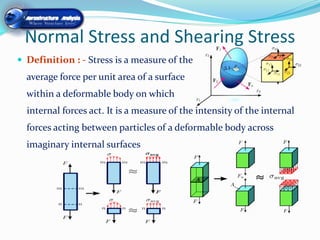
Normal Stress and Shearing Stress
 Definition : - Stress is a measure of the
  average force per unit area of a surface
  within a deformable body on which
  internal forces act. It is a measure of the intensity of the internal
  forces acting between particles of a deformable body across
  imaginary internal surfaces
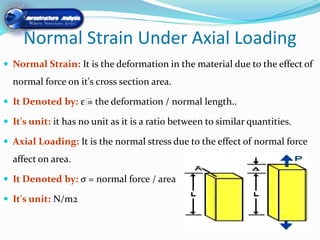
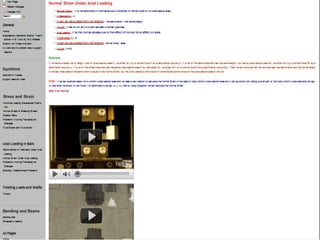
Normal Strain Under Axial Loading
 Normal Strain: It is the deformation in the material due to the effect of
  normal force on it's cross section area.

 It Denoted by: ε the deformation / normal length..
                  =

 It's unit: it has no unit as it is a ratio between to similar quantities.

 Axial Loading: It is the normal stress due to the effect of normal force
  affect on area.

 It Denoted by: σ = normal force / area

 It's unit: N/m2
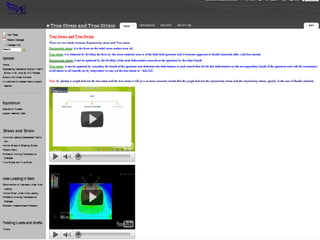
True Stress and True Strain
 There are two kinds of stress; Engineering stress and True stress.

 Engineering stress: it is the force divided by the initial cross section area

 True stress: it is obtained by dividing the force by the instantaneous cross
  sectional area.
 Engineering strain: it can be obtained by the dividing of the total
  deformation occurred on the specimen by the initial length
 True strain: it can be obtained by recording the length of the specimen and
  determine the deformation in each record then divide this deformation on
  the corresponding length of the specimen and with the summation of all
  stains in all records (or by integration) we can get the true strain εt =
  ln(L/L0)
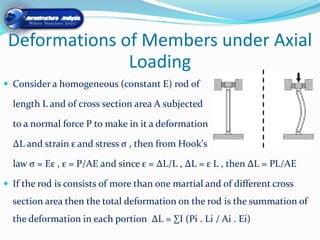
Deformations of Members under Axial
               Loading
 Consider a homogeneous (constant E) rod of

  length L and of cross section area A subjected

  to a normal force P to make in it a deformation

  ∆L and strain ε and stress σ , then from Hook's

  law σ = Eε , ε = P/AE and since ε = ∆L/L , ∆L = ε L , then ∆L = PL/AE

 If the rod is consists of more than one martial and of different cross
  section area then the total deformation on the rod is the summation of
  the deformation in each portion ∆L = ∑I (Pi . Li / Ai . Ei)
Statically Indeterminate Problems
 Statically Indeterminate Problems

 They are problems in which the internal forces cannot be determined
 from statics alone. In fact, in most of these problems the reactions
 themselves-which are external forces-cannot be determined by simply
 drawing a free-body diagram of the member and writing the
 corresponding equilibrium equations. The equilibrium equations must
 be complemented by relations involving deformations obtained by
 considering the geometry of the problem. Because statics is not
 sufficient to determine either the reactions or the internal forces,
 problems of this type are said to be statically indeterminate.
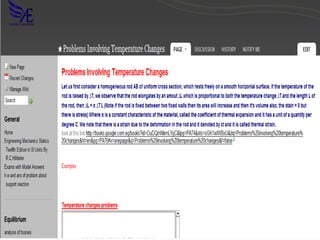
Problems Involving Temperature
                 Changes
 Let us first consider a homogeneous rod AB of uniform cross section,
  which rests freely on a smooth horizontal surface. If the temperature of
  the rod is raised by ∆T, we observe that the rod elongates by an amount
  ∆L which is proportional to both the temperature change ∆T and the
  length L of the rod, then ∆L = α ∆T L (Note if the rod is fixed between
  two fixed walls then its area will increase and then it's volume also, the
  stain = 0 but there is stress) Where α is a constant characteristic of the
  material, called the coefficient of thermal expansion and it has a unit of
  a quantity per degree C.
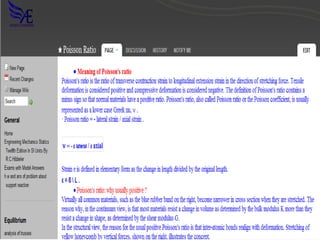
Poisson's Ratio
 Meaning of Poisson's ratio:

  Poisson's ratio is the ratio of transverse contraction strain to longitudinal
  extension strain in the direction of stretching force. Tensile deformation
  is considered positive and compressive deformation is considered
  negative. The definition of Poisson's ratio contains a minus sign so that
  normal materials have a positive ratio. Poisson's ratio, also called Poisson
  ratio or the Poisson coefficient, is usually represented as a lower case
  Greek nu, ν .
  · Poisson ratio = - lateral strain / axial strain .
Multiaxial Loading; Generalized Hooke’s
                  Law
 The generalized Hooke's Law can be used to predict the deformations
  caused in a given material by an arbitrary combination of stresses.
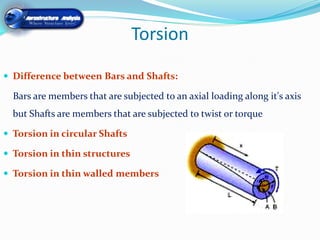
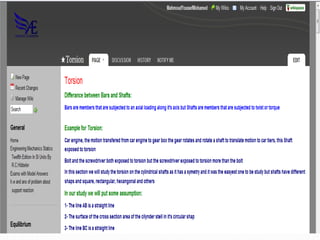
Torsion

 Difference between Bars and Shafts:

  Bars are members that are subjected to an axial loading along it's axis
  but Shafts are members that are subjected to twist or torque

 Torsion in circular Shafts

 Torsion in thin structures

 Torsion in thin walled members
Questions
Thanks for all

Aerostructure analysis WIKI project

  • 2.
    Why wiki ? A wiki is a website designed for multiple people to collaborate by adding and editing content. Aerostructure Analysis wiki is an example of a wiki. A wiki farm is a collection of individual wikis, usually hosted by the same website. Browse through a list of wikis by category
  • 3.
  • 4.
    The problems whichwe faced 1. When we started the project we found that having the material must be with it’s references, but we found that there is a lot of material without a references so couldn’t put it in the wiki. And we solved this problem by adding some videos and presentations instead of this unlicensed data. 2. The tools which wikispaces provide to us are too limited but somehow it was effective. 3. We couldn’t make a better design because of this limited tools and it needs $ to open this tools on wikispaces. 4. Other team members weren’t able to deal with the site and we sloved this problems by a several meetings. 5. Our logo
  • 5.
    1st problem andhow we solved it
  • 6.
    2nd problem andhow we solved it
  • 7.
    3rd problem andhow we solved it
  • 8.
    Objectives  The mainobjective of the project about this course is to provide future aeronautical engineers with the means of analyzing and designing various load bearing structures. This can be done by learning them How to analyze a system of forces and obtain the reactions at the supports of structures and How to analyse the forces in plain trusses. Later, they will study the nature of stress and strain, and the properties of cross sections, finally, they will be introduced to the forces and stresses in members subject to axial, torsion, and bending loading.
  • 9.
    Analysis of Trusses The method of joints: This method uses the free-body-diagram of joints in the structure to determine the forces in each member.  The method of sections: This method uses free-body-diagrams of sections of the truss to obtain unknown forces.
  • 11.
    Normal Stress andShearing Stress  Definition : - Stress is a measure of the average force per unit area of a surface within a deformable body on which internal forces act. It is a measure of the intensity of the internal forces acting between particles of a deformable body across imaginary internal surfaces
  • 13.
    Normal Strain UnderAxial Loading  Normal Strain: It is the deformation in the material due to the effect of normal force on it's cross section area.  It Denoted by: ε the deformation / normal length.. =  It's unit: it has no unit as it is a ratio between to similar quantities.  Axial Loading: It is the normal stress due to the effect of normal force affect on area.  It Denoted by: σ = normal force / area  It's unit: N/m2
  • 15.
    True Stress andTrue Strain  There are two kinds of stress; Engineering stress and True stress.  Engineering stress: it is the force divided by the initial cross section area  True stress: it is obtained by dividing the force by the instantaneous cross sectional area.  Engineering strain: it can be obtained by the dividing of the total deformation occurred on the specimen by the initial length  True strain: it can be obtained by recording the length of the specimen and determine the deformation in each record then divide this deformation on the corresponding length of the specimen and with the summation of all stains in all records (or by integration) we can get the true strain εt = ln(L/L0)
  • 17.
    Deformations of Membersunder Axial Loading  Consider a homogeneous (constant E) rod of length L and of cross section area A subjected to a normal force P to make in it a deformation ∆L and strain ε and stress σ , then from Hook's law σ = Eε , ε = P/AE and since ε = ∆L/L , ∆L = ε L , then ∆L = PL/AE  If the rod is consists of more than one martial and of different cross section area then the total deformation on the rod is the summation of the deformation in each portion ∆L = ∑I (Pi . Li / Ai . Ei)
  • 19.
    Statically Indeterminate Problems Statically Indeterminate Problems They are problems in which the internal forces cannot be determined from statics alone. In fact, in most of these problems the reactions themselves-which are external forces-cannot be determined by simply drawing a free-body diagram of the member and writing the corresponding equilibrium equations. The equilibrium equations must be complemented by relations involving deformations obtained by considering the geometry of the problem. Because statics is not sufficient to determine either the reactions or the internal forces, problems of this type are said to be statically indeterminate.
  • 21.
    Problems Involving Temperature Changes  Let us first consider a homogeneous rod AB of uniform cross section, which rests freely on a smooth horizontal surface. If the temperature of the rod is raised by ∆T, we observe that the rod elongates by an amount ∆L which is proportional to both the temperature change ∆T and the length L of the rod, then ∆L = α ∆T L (Note if the rod is fixed between two fixed walls then its area will increase and then it's volume also, the stain = 0 but there is stress) Where α is a constant characteristic of the material, called the coefficient of thermal expansion and it has a unit of a quantity per degree C.
  • 23.
    Poisson's Ratio  Meaningof Poisson's ratio: Poisson's ratio is the ratio of transverse contraction strain to longitudinal extension strain in the direction of stretching force. Tensile deformation is considered positive and compressive deformation is considered negative. The definition of Poisson's ratio contains a minus sign so that normal materials have a positive ratio. Poisson's ratio, also called Poisson ratio or the Poisson coefficient, is usually represented as a lower case Greek nu, ν . · Poisson ratio = - lateral strain / axial strain .
  • 25.
    Multiaxial Loading; GeneralizedHooke’s Law  The generalized Hooke's Law can be used to predict the deformations caused in a given material by an arbitrary combination of stresses.
  • 27.
    Torsion  Difference betweenBars and Shafts: Bars are members that are subjected to an axial loading along it's axis but Shafts are members that are subjected to twist or torque  Torsion in circular Shafts  Torsion in thin structures  Torsion in thin walled members
  • 29.
  • 30.