STRESS AND STRAIN
Contributors
1)Khurram Nasim
2) Samiullah
3) Yousaf
4) Talha Mukhtar
5) Qasim Ibrar
Semester 5th
Department Geology
University Of Haripur
PRESENTATION OUTLINES
1) Stress
1.1) Terminologies related to stress
1.2) Types of stress
2) Strain
2.1) Terminologies related to strain
2.2) Types of strain
3) Relation Between Stress and Strain
4) Stress and strain Diagram
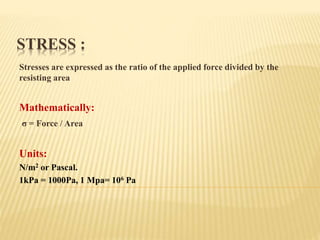
STRESS :
Stresses are expressed as the ratio of the applied force divided by the
resisting area
Mathematically:
σ = Force / Area
Units:
N/m2 or Pascal.
1kPa = 1000Pa, 1 Mpa= 106 Pa
TERMINOLOGIES RELATED TO STRESS
 Stressor:
A stressor is anything that has the effect of causing stress.
 Stress capacity:
While it is unclear precisely how much stress a person can carry,
since each person has some stress in their lives, we say he/she has a
capacity for stress. Similarly in case of Rocks, how much capacity
they have to bear stress.
 Stress-load:
Everyone, even children, must carry some amount of stress in their
daily lives. When we think of stress as having an amount, or quantity,
we refer to this as the person’s stress-load. And here in case of rocks,
we say that how much an already existing stress is applied on a rock.
TYPES OF STRESS
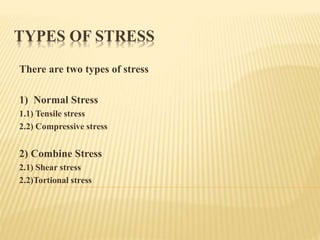
There are two types of stress
1) Normal Stress
1.1) Tensile stress
2.2) Compressive stress
2) Combine Stress
2.1) Shear stress
2.2)Tortional stress
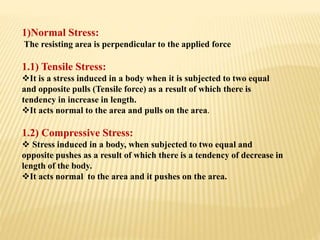
1)Normal Stress:
The resisting area is perpendicular to the applied force
1.1) Tensile Stress:
It is a stress induced in a body when it is subjected to two equal
and opposite pulls (Tensile force) as a result of which there is
tendency in increase in length.
It acts normal to the area and pulls on the area.
1.2) Compressive Stress:
 Stress induced in a body, when subjected to two equal and
opposite pushes as a result of which there is a tendency of decrease in
length of the body.
It acts normal to the area and it pushes on the area.
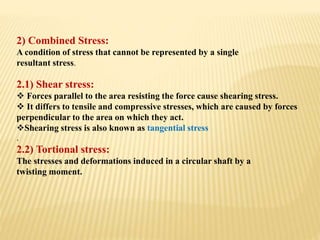
2) Combined Stress:
A condition of stress that cannot be represented by a single
resultant stress.
2.1) Shear stress:
 Forces parallel to the area resisting the force cause shearing stress.
 It differs to tensile and compressive stresses, which are caused by forces
perpendicular to the area on which they act.
Shearing stress is also known as tangential stress
.
2.2) Tortional stress:
The stresses and deformations induced in a circular shaft by a
twisting moment.
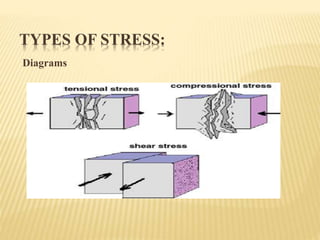
TYPES OF STRESS:
Diagrams
STRAIN:
When a body is subjected to some external force, there is some change in the
dimension of the body. The ratio of change in dimension of body to its
original dimension is called as strain.
Strain is a dimensionless quantity.
TERMINOLOGIES RELATED TO
STRAIN:
Longitudinal or Linear Strain
Strain that changes the length of a line without changing its direction.
Can be either compressional or tensional.
Compression
Longitudinal strain that shortens an object.
Tension
Longitudinal strain that lengthens an object.
Shear
 Strain that changes the angles of an object.
Shear causes lines to rotate.
Infinitesimal Strain
 Strain that is tiny, a few percent or less.
 Allows a number of useful mathematical simplifications and
approximations.
Finite Strain
 Strain larger than a few percent.
Requires a more complicated mathematical treatment than
infinitesimal strain.
Homogeneous Strain
• Uniform strain.
• Straight lines in the original object remain straight.
• Parallel lines remain parallel.
• Circles deform to ellipses.
• Note that this definition rules out folding, since an originally
straight layer has to remain straight.
Inhomogeneous Strain
• How real geology behaves.
• Deformation varies from place to place.
• Lines may bend and do not necessarily remain parallel.
TYPES OF STRAIN
1. Tensile Strain
2. Compression Strain
3. Volumetric Strain
4. Shear Strain
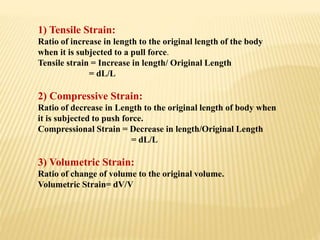
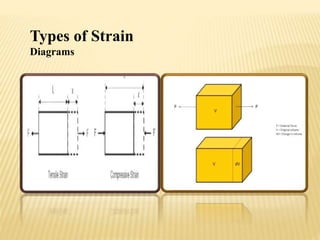
1) Tensile Strain:
Ratio of increase in length to the original length of the body
when it is subjected to a pull force.
Tensile strain = Increase in length/ Original Length
= dL/L
2) Compressive Strain:
Ratio of decrease in Length to the original length of body when
it is subjected to push force.
Compressional Strain = Decrease in length/Original Length
= dL/L
3) Volumetric Strain:
Ratio of change of volume to the original volume.
Volumetric Strain= dV/V
Types of Strain
Diagrams
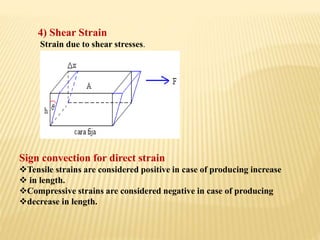
4) Shear Strain
Strain due to shear stresses.
Sign convection for direct strain
Tensile strains are considered positive in case of producing increase
 in length.
Compressive strains are considered negative in case of producing
decrease in length.
Relation between Stress and Strain
Hooke’s Law:
“Within Elastic limit the ratio of stress applied to strain
developed is constant”.
The constant is known as Modulus of elasticity or Young’s Modulus
or Elastic Modulus.
Mathematically:
E= Stress/Strain
Young’s Modulus E, is generally assumed to be same in tension or
Compression and for most of engineering application has high
Numerical value.
Typically E=210×10*9 N/m*2 for steel
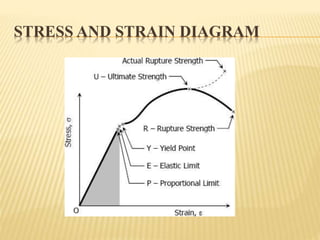
STRESS AND STRAIN DIAGRAM

Stress and strain

  • 1.
    STRESS AND STRAIN Contributors 1)KhurramNasim 2) Samiullah 3) Yousaf 4) Talha Mukhtar 5) Qasim Ibrar Semester 5th Department Geology University Of Haripur
  • 2.
    PRESENTATION OUTLINES 1) Stress 1.1)Terminologies related to stress 1.2) Types of stress 2) Strain 2.1) Terminologies related to strain 2.2) Types of strain 3) Relation Between Stress and Strain 4) Stress and strain Diagram
  • 3.
    STRESS : Stresses areexpressed as the ratio of the applied force divided by the resisting area Mathematically: σ = Force / Area Units: N/m2 or Pascal. 1kPa = 1000Pa, 1 Mpa= 106 Pa
  • 4.
    TERMINOLOGIES RELATED TOSTRESS  Stressor: A stressor is anything that has the effect of causing stress.  Stress capacity: While it is unclear precisely how much stress a person can carry, since each person has some stress in their lives, we say he/she has a capacity for stress. Similarly in case of Rocks, how much capacity they have to bear stress.  Stress-load: Everyone, even children, must carry some amount of stress in their daily lives. When we think of stress as having an amount, or quantity, we refer to this as the person’s stress-load. And here in case of rocks, we say that how much an already existing stress is applied on a rock.
  • 5.
    TYPES OF STRESS Thereare two types of stress 1) Normal Stress 1.1) Tensile stress 2.2) Compressive stress 2) Combine Stress 2.1) Shear stress 2.2)Tortional stress
  • 6.
    1)Normal Stress: The resistingarea is perpendicular to the applied force 1.1) Tensile Stress: It is a stress induced in a body when it is subjected to two equal and opposite pulls (Tensile force) as a result of which there is tendency in increase in length. It acts normal to the area and pulls on the area. 1.2) Compressive Stress:  Stress induced in a body, when subjected to two equal and opposite pushes as a result of which there is a tendency of decrease in length of the body. It acts normal to the area and it pushes on the area.
  • 7.
    2) Combined Stress: Acondition of stress that cannot be represented by a single resultant stress. 2.1) Shear stress:  Forces parallel to the area resisting the force cause shearing stress.  It differs to tensile and compressive stresses, which are caused by forces perpendicular to the area on which they act. Shearing stress is also known as tangential stress . 2.2) Tortional stress: The stresses and deformations induced in a circular shaft by a twisting moment.
  • 8.
  • 9.
    STRAIN: When a bodyis subjected to some external force, there is some change in the dimension of the body. The ratio of change in dimension of body to its original dimension is called as strain. Strain is a dimensionless quantity.
  • 10.
    TERMINOLOGIES RELATED TO STRAIN: Longitudinalor Linear Strain Strain that changes the length of a line without changing its direction. Can be either compressional or tensional. Compression Longitudinal strain that shortens an object. Tension Longitudinal strain that lengthens an object.
  • 11.
    Shear  Strain thatchanges the angles of an object. Shear causes lines to rotate. Infinitesimal Strain  Strain that is tiny, a few percent or less.  Allows a number of useful mathematical simplifications and approximations. Finite Strain  Strain larger than a few percent. Requires a more complicated mathematical treatment than infinitesimal strain.
  • 12.
    Homogeneous Strain • Uniformstrain. • Straight lines in the original object remain straight. • Parallel lines remain parallel. • Circles deform to ellipses. • Note that this definition rules out folding, since an originally straight layer has to remain straight. Inhomogeneous Strain • How real geology behaves. • Deformation varies from place to place. • Lines may bend and do not necessarily remain parallel.
  • 13.
    TYPES OF STRAIN 1.Tensile Strain 2. Compression Strain 3. Volumetric Strain 4. Shear Strain
  • 14.
    1) Tensile Strain: Ratioof increase in length to the original length of the body when it is subjected to a pull force. Tensile strain = Increase in length/ Original Length = dL/L 2) Compressive Strain: Ratio of decrease in Length to the original length of body when it is subjected to push force. Compressional Strain = Decrease in length/Original Length = dL/L 3) Volumetric Strain: Ratio of change of volume to the original volume. Volumetric Strain= dV/V
  • 15.
  • 16.
    4) Shear Strain Straindue to shear stresses. Sign convection for direct strain Tensile strains are considered positive in case of producing increase  in length. Compressive strains are considered negative in case of producing decrease in length.
  • 17.
    Relation between Stressand Strain Hooke’s Law: “Within Elastic limit the ratio of stress applied to strain developed is constant”. The constant is known as Modulus of elasticity or Young’s Modulus or Elastic Modulus. Mathematically: E= Stress/Strain Young’s Modulus E, is generally assumed to be same in tension or Compression and for most of engineering application has high Numerical value. Typically E=210×10*9 N/m*2 for steel
  • 18.