Mechanics of Material
Simple Stresses & Strain
 Stress:
 when some external
system of load acts on a
body, the internal forces
(equal & opposite) are
set up at various
section of the body,
which resist the
external force. This
force per unit area at
any section is known as
stress.
 Let us consider a
rectangular bar of some
cross–sectional area and
subjected to some load
or force (in Newton’s)
 Let us imagine that the
same rectangular bar is
assumed to be cut into
two halves at section X-
X. The each portion of
this rectangular bar is in
equilibrium under the
action of load P and the
internal forces acting at
the section X-X has been
shown.
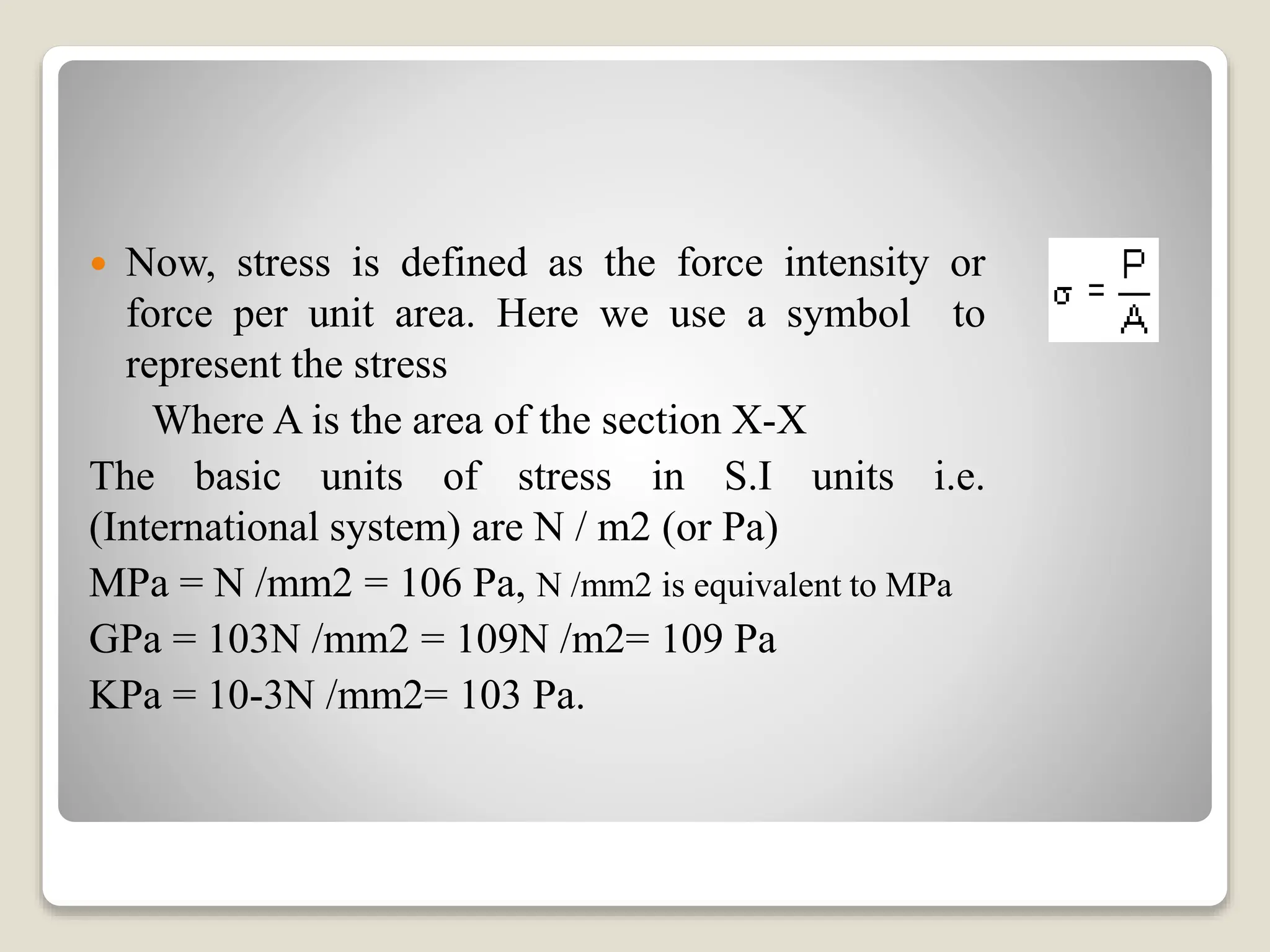
 Now, stress is defined as the force intensity or
force per unit area. Here we use a symbol to
represent the stress
Where A is the area of the section X-X
The basic units of stress in S.I units i.e.
(International system) are N / m2 (or Pa)
MPa = N /mm2 = 106 Pa, N /mm2 is equivalent to MPa
GPa = 103N /mm2 = 109N /m2= 109 Pa
KPa = 10-3N /mm2= 103 Pa.
TYPES OF STRESSES:
 Only two basic stresses exist: (1) normal
stress and (2) shear shear stress. Other
stresses either are similar to these basic
stresses or are a combination of this e.g.
bending stress is a combination tensile,
compressive and shear stresses. Torsional
stress, as encountered in twisting of a shaft
is a shearing stress.
 Bearing Stress: When one
object presses against another,
it is referred to a bearing
stress (They are in fact the
compressive stresses).
 Here resulting force intensities
are known as shear stresses,
the mean shear stress being
equal to
 Where P is the total force and
A the area over which it acts
 Strain: Strain is the deformation of a material from stress. It is simply a
ratio of the change in length to the original length. Deformations that are
applied perpendicular to the cross section are normal strains.
 Linear Strain: Linear strain of a deformed body is defined as the ratio of
the change in length of the body due to the deformation to its original
length in the direction of the force. If L is the original length and dL the
change in length occurred due to the deformation, the linear strain e
induced is given by ε=dL/L.
 Linear strain may be a tensile strain, εt or a compressive
strain εc according as dl refers to an increase in length or a decrease in
length of the body. If we consider one of these as +ve then the other
should be considered as –ve, as these are opposite in nature.
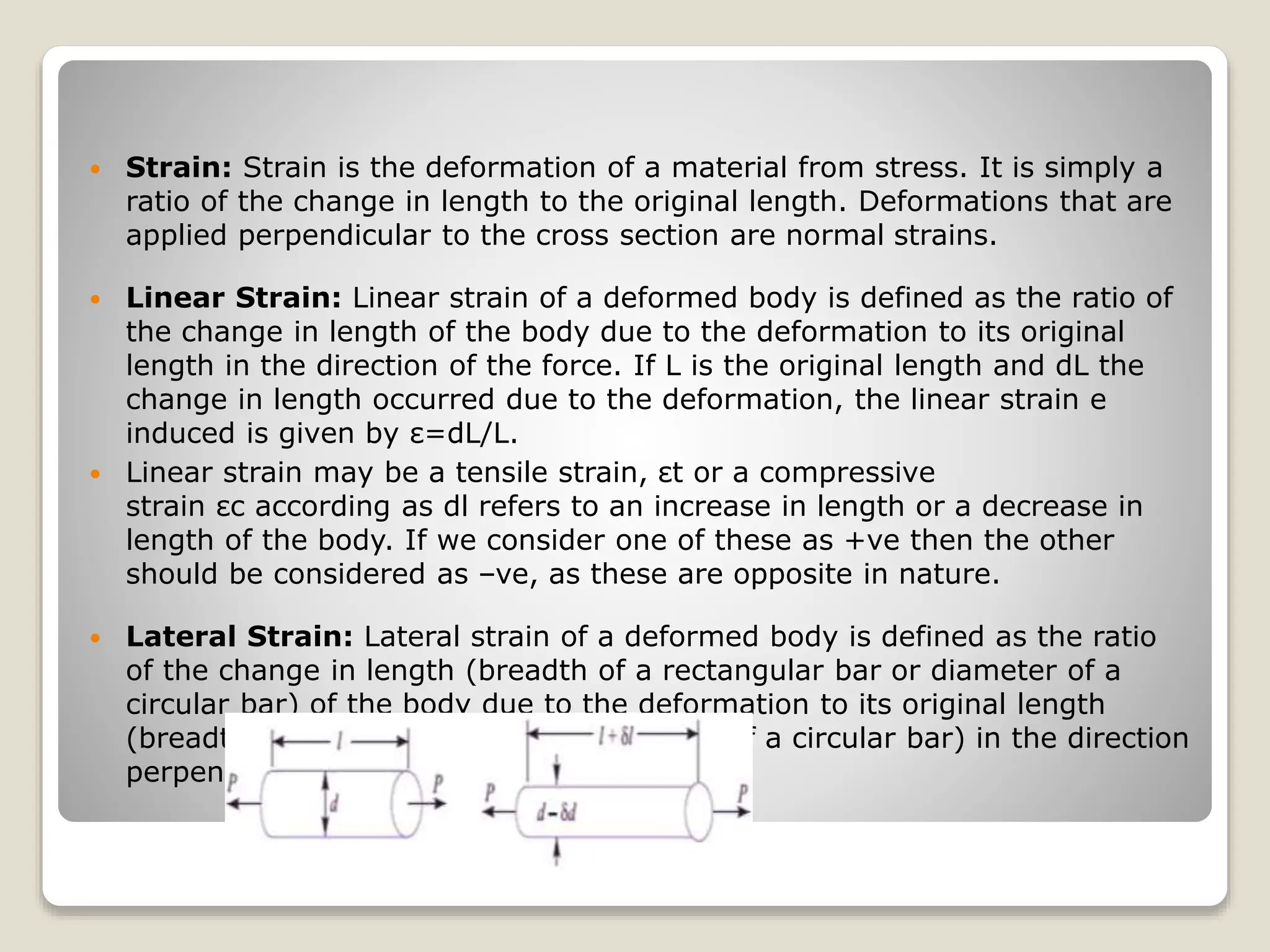
 Lateral Strain: Lateral strain of a deformed body is defined as the ratio
of the change in length (breadth of a rectangular bar or diameter of a
circular bar) of the body due to the deformation to its original length
(breadth of a rectangular bar or diameter of a circular bar) in the direction
perpendicular to the force.
Volumetric Strain
 Volumetric Strain is defined as
the ratio of change in volume to
the initial volume.
Shear Strain:
 Shear strain is defined as the strain accompanying a
shearing action. It is the angle in radian measure through
which the body gets distorted when subjected to an
external shearing action. It is denoted by ε
 Consider a cube ABCD subjected to equal and opposite
forces Q across the top and bottom forces AB and CD. If
the bottom face is taken fixed, the cube gets distorted
through angle Φ to the shape ABC’D’. Now strain or
deformation per unit length is
 Shear strain of cube = CC’ / CD = CC’ / BC = Φ radian
Hooks law
 Hooks law: Hooke’s law stated that within
elastic limit, The linear relationship
between stress and strain for a bar in
simple tension or compression is
expressed by the equation, Stress
Strain, = Eε
 In which is the axial stress, e is the axial
strain, and E is a constant of
proportionality known as the modulus of
elasticity for the material. The modulus of
elasticity is the slope of the stress-strain
diagram in the linearly elastic region.
 The equation = Eε is commonly known as
Hooke’s law
Elastic Constants
Elastic Constants:
 The elastic constants mostly used in
engineering mechanics E, G and K can be
defined as follows
 Modulus of elasticity (Young's modulus) (E)
describes tensile elasticity, or the tendency
of an object to deform along an axis when
opposing forces are applied along that axis;
it is defined as the ratio of tensile stress to
tensile strain. It is often referred to simply
as the elastic modulus.
 Modulus of Rigidity or Shear Modulus (G): is the
coefficient of elasticity for a shearing or torsion force.
Modulus of Rigidity is the coefficient of elasticity for a
shearing force. It is defined as "the ratio of shear stress to
the displacement per unit sample length”
 Bulk modulus (K): When a body is subjected to like and
equal direct stress along three mutually perpendicular
directions, the ratio of this direct stress to corresponding
volumetric strain is called Bulk modulus.
 The Bulk Modulus Elasticity or Volume Modulus is a
material property characterizing the compressibility of a fluid,
how easy a unit volume of a fluid can be changed when
changing the pressure working upon it. It describes
the elastic properties of a solid or fluid when it is under
pressure on all surfaces.
 Factor of Safety (FoS) or safety factor (SF): is a term
describing the load carrying capacity of a system beyond
the expected or actual loads. Essentially, the factor of
safety is how much stronger the system is than it usually
needs to be for an intended load.
 It is a multiplier applied to the calculated maximum stress
to which a component will be subjected. Typically, for
components whose failure could result in substantial
financial loss, or serious injury or death, a safety factor of at
least four (4) is used. Non-critical components generally
have a safety factor of two (2). Safety factors are needed to
account for imperfections in materials, flaws in assembly,
material degradation, and unexpected stresses.
Properties of Materials
 Some properties of materials which judge the strength of
materials are given below:
 Elasticity: It is the property by virtue of which a material
deforms under the applied load and it is enabled to return to
its original position when the load is removed.
 Plasticity: It is the property of the material by which it
undergoes inelastic strain beyond those at the elastic limit is
known as the plasticity. It is also defined as unrecoverable
strain.
 Ductility: It is the property of the material by which it
undergoes considerable amount of deformation without
rupture. A ductile material must possess a high degree of
plasticity and strength.
 Brittleness: It is lack of ductility, a brittle material rupture
with little or no plastic deformation.
Properties of Materials
 Strength: This is the maximum stress that a
material can take. This is equal to maximum load
divided by area.
 Hardness: It is the ability of material to resist
against surface abrasion or indentation.
 Toughness: It is the property of material which
enables it to absorb energy without fracture. It is
represented by area under stress-strain curve upto
fracture.

 Fatigue: Fatigue is the progressive and localized
structural damage that occurs when a material is
subjected to cyclic loading or repeated loading and
unloading.

MOM Simple Stress & Strain Chapter I .pptx

  • 1.
  • 2.
     Stress:  whensome external system of load acts on a body, the internal forces (equal & opposite) are set up at various section of the body, which resist the external force. This force per unit area at any section is known as stress.
  • 3.
     Let usconsider a rectangular bar of some cross–sectional area and subjected to some load or force (in Newton’s)  Let us imagine that the same rectangular bar is assumed to be cut into two halves at section X- X. The each portion of this rectangular bar is in equilibrium under the action of load P and the internal forces acting at the section X-X has been shown.
  • 4.
     Now, stressis defined as the force intensity or force per unit area. Here we use a symbol to represent the stress Where A is the area of the section X-X The basic units of stress in S.I units i.e. (International system) are N / m2 (or Pa) MPa = N /mm2 = 106 Pa, N /mm2 is equivalent to MPa GPa = 103N /mm2 = 109N /m2= 109 Pa KPa = 10-3N /mm2= 103 Pa.
  • 5.
    TYPES OF STRESSES: Only two basic stresses exist: (1) normal stress and (2) shear shear stress. Other stresses either are similar to these basic stresses or are a combination of this e.g. bending stress is a combination tensile, compressive and shear stresses. Torsional stress, as encountered in twisting of a shaft is a shearing stress.
  • 8.
     Bearing Stress:When one object presses against another, it is referred to a bearing stress (They are in fact the compressive stresses).  Here resulting force intensities are known as shear stresses, the mean shear stress being equal to  Where P is the total force and A the area over which it acts
  • 10.
     Strain: Strainis the deformation of a material from stress. It is simply a ratio of the change in length to the original length. Deformations that are applied perpendicular to the cross section are normal strains.  Linear Strain: Linear strain of a deformed body is defined as the ratio of the change in length of the body due to the deformation to its original length in the direction of the force. If L is the original length and dL the change in length occurred due to the deformation, the linear strain e induced is given by ε=dL/L.  Linear strain may be a tensile strain, εt or a compressive strain εc according as dl refers to an increase in length or a decrease in length of the body. If we consider one of these as +ve then the other should be considered as –ve, as these are opposite in nature.  Lateral Strain: Lateral strain of a deformed body is defined as the ratio of the change in length (breadth of a rectangular bar or diameter of a circular bar) of the body due to the deformation to its original length (breadth of a rectangular bar or diameter of a circular bar) in the direction perpendicular to the force.
  • 12.
    Volumetric Strain  VolumetricStrain is defined as the ratio of change in volume to the initial volume.
  • 13.
    Shear Strain:  Shearstrain is defined as the strain accompanying a shearing action. It is the angle in radian measure through which the body gets distorted when subjected to an external shearing action. It is denoted by ε  Consider a cube ABCD subjected to equal and opposite forces Q across the top and bottom forces AB and CD. If the bottom face is taken fixed, the cube gets distorted through angle Φ to the shape ABC’D’. Now strain or deformation per unit length is  Shear strain of cube = CC’ / CD = CC’ / BC = Φ radian
  • 14.
    Hooks law  Hookslaw: Hooke’s law stated that within elastic limit, The linear relationship between stress and strain for a bar in simple tension or compression is expressed by the equation, Stress Strain, = Eε  In which is the axial stress, e is the axial strain, and E is a constant of proportionality known as the modulus of elasticity for the material. The modulus of elasticity is the slope of the stress-strain diagram in the linearly elastic region.  The equation = Eε is commonly known as Hooke’s law
  • 15.
    Elastic Constants Elastic Constants: The elastic constants mostly used in engineering mechanics E, G and K can be defined as follows  Modulus of elasticity (Young's modulus) (E) describes tensile elasticity, or the tendency of an object to deform along an axis when opposing forces are applied along that axis; it is defined as the ratio of tensile stress to tensile strain. It is often referred to simply as the elastic modulus.
  • 16.
     Modulus ofRigidity or Shear Modulus (G): is the coefficient of elasticity for a shearing or torsion force. Modulus of Rigidity is the coefficient of elasticity for a shearing force. It is defined as "the ratio of shear stress to the displacement per unit sample length”  Bulk modulus (K): When a body is subjected to like and equal direct stress along three mutually perpendicular directions, the ratio of this direct stress to corresponding volumetric strain is called Bulk modulus.  The Bulk Modulus Elasticity or Volume Modulus is a material property characterizing the compressibility of a fluid, how easy a unit volume of a fluid can be changed when changing the pressure working upon it. It describes the elastic properties of a solid or fluid when it is under pressure on all surfaces.
  • 17.
     Factor ofSafety (FoS) or safety factor (SF): is a term describing the load carrying capacity of a system beyond the expected or actual loads. Essentially, the factor of safety is how much stronger the system is than it usually needs to be for an intended load.  It is a multiplier applied to the calculated maximum stress to which a component will be subjected. Typically, for components whose failure could result in substantial financial loss, or serious injury or death, a safety factor of at least four (4) is used. Non-critical components generally have a safety factor of two (2). Safety factors are needed to account for imperfections in materials, flaws in assembly, material degradation, and unexpected stresses.
  • 18.
    Properties of Materials Some properties of materials which judge the strength of materials are given below:  Elasticity: It is the property by virtue of which a material deforms under the applied load and it is enabled to return to its original position when the load is removed.  Plasticity: It is the property of the material by which it undergoes inelastic strain beyond those at the elastic limit is known as the plasticity. It is also defined as unrecoverable strain.  Ductility: It is the property of the material by which it undergoes considerable amount of deformation without rupture. A ductile material must possess a high degree of plasticity and strength.  Brittleness: It is lack of ductility, a brittle material rupture with little or no plastic deformation.
  • 19.
    Properties of Materials Strength: This is the maximum stress that a material can take. This is equal to maximum load divided by area.  Hardness: It is the ability of material to resist against surface abrasion or indentation.  Toughness: It is the property of material which enables it to absorb energy without fracture. It is represented by area under stress-strain curve upto fracture.   Fatigue: Fatigue is the progressive and localized structural damage that occurs when a material is subjected to cyclic loading or repeated loading and unloading.