Business Communication-III Module 1 : Non-Verbal Communication Principles, Kinesics, Proxemics,  Paralanguage and Visible Code Module 2 : Speaking Skills: Pronunciation Skills, Conversational English, Effective Presentation. Module 3:  Interviews and  GDs
Communication Transfer of Information  From a Sender to a Receiver With the Information Being Understood  By the Receiver
The Two… Verbal Communication: Oral and Written. Non-Verbal Communication
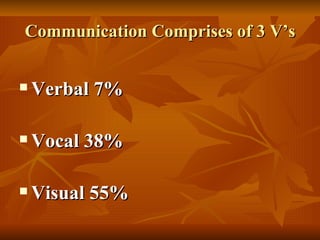
Communication Comprises of 3 V’s Verbal 7% Vocal 38% Visual 55%
Non-Verbal Communication PRINCIPLES 1.Supplements Verbal  Communication 2.Regulates Interaction 3. Establishes Relationships 4. Reflects Cultural Values
Forms  of Non-Verbal Communication Conscious Non- Verbal Communication Subconscious  (Subliminal)  Non Verbal Communication
Aims & Goals of Non Verbal Communication a. To Create impressions through Body Language & Para-language b. To Initiate and Manage Interactions c. To Express Emotions d. To Convey Deception e. To Convey Power
NON VERBAL COMMUNICATION  TYPES Body Language Para Language Space Language Time Language Sign Language
Body Language Appearance Posture Gestures Eye contact Handshake
Para Language   (Manner of Commuication) Pitch Speed/Tempo Pause Soft or Loud Tone
Space Language Proxemics Intimate Zone Personal Social Public
Time Language Time Management Planning Organizing Avoid time robbers
Sign Language Audio Signs Visual Signs& Symbols
Guidelines to Improve non verbal communication A . Monitor your Non Verbal  Communication B .  Learn to Interpret Others C .  Develop Self-Awareness
D .  Develop Observation Skills E.  Ask for Feedback F.  Videotape Yourself and Improve
Some Negative Gestures Nervousness Hands in pocket Biting nails Scratching Looking at the Ceiling
Negative Gestures 2.   Aggressiveness Staring Pointing at Someone Showing a Fist
Negative Gestures 3 .  Rudeness Shaking Hands too Hard Whisper Yawn Looking at watch
Negative Gestures 4.  Self Centeredness Eyes closed while talking Head bent back wards
Negative Gestures 5 .  Superiority Not acknowledging greetings Shouting orders Continue to work as others speak Reclining in chair
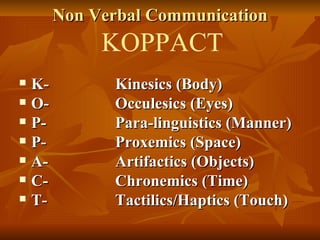
Non Verbal Communication   KOPPACT K- Kinesics (Body) O- Occulesics (Eyes) P- Para-linguistics (Manner) P- Proxemics (Space) A- Artifactics (Objects) C- Chronemics (Time) T- Tactilics/Haptics (Touch)
 

Aed031 Non Verbal Communication

  • 1.
  • 2.
    Business Communication-III Module1 : Non-Verbal Communication Principles, Kinesics, Proxemics, Paralanguage and Visible Code Module 2 : Speaking Skills: Pronunciation Skills, Conversational English, Effective Presentation. Module 3: Interviews and GDs
  • 3.
    Communication Transfer ofInformation From a Sender to a Receiver With the Information Being Understood By the Receiver
  • 4.
    The Two… VerbalCommunication: Oral and Written. Non-Verbal Communication
  • 5.
    Communication Comprises of3 V’s Verbal 7% Vocal 38% Visual 55%
  • 6.
    Non-Verbal Communication PRINCIPLES1.Supplements Verbal Communication 2.Regulates Interaction 3. Establishes Relationships 4. Reflects Cultural Values
  • 7.
    Forms ofNon-Verbal Communication Conscious Non- Verbal Communication Subconscious (Subliminal) Non Verbal Communication
  • 8.
    Aims & Goalsof Non Verbal Communication a. To Create impressions through Body Language & Para-language b. To Initiate and Manage Interactions c. To Express Emotions d. To Convey Deception e. To Convey Power
  • 9.
    NON VERBAL COMMUNICATION TYPES Body Language Para Language Space Language Time Language Sign Language
  • 10.
    Body Language AppearancePosture Gestures Eye contact Handshake
  • 11.
    Para Language (Manner of Commuication) Pitch Speed/Tempo Pause Soft or Loud Tone
  • 12.
    Space Language ProxemicsIntimate Zone Personal Social Public
  • 13.
    Time Language TimeManagement Planning Organizing Avoid time robbers
  • 14.
    Sign Language AudioSigns Visual Signs& Symbols
  • 15.
    Guidelines to Improvenon verbal communication A . Monitor your Non Verbal Communication B . Learn to Interpret Others C . Develop Self-Awareness
  • 16.
    D . Develop Observation Skills E. Ask for Feedback F. Videotape Yourself and Improve
  • 17.
    Some Negative GesturesNervousness Hands in pocket Biting nails Scratching Looking at the Ceiling
  • 18.
    Negative Gestures 2. Aggressiveness Staring Pointing at Someone Showing a Fist
  • 19.
    Negative Gestures 3. Rudeness Shaking Hands too Hard Whisper Yawn Looking at watch
  • 20.
    Negative Gestures 4. Self Centeredness Eyes closed while talking Head bent back wards
  • 21.
    Negative Gestures 5. Superiority Not acknowledging greetings Shouting orders Continue to work as others speak Reclining in chair
  • 22.
    Non Verbal Communication KOPPACT K- Kinesics (Body) O- Occulesics (Eyes) P- Para-linguistics (Manner) P- Proxemics (Space) A- Artifactics (Objects) C- Chronemics (Time) T- Tactilics/Haptics (Touch)
  • 23.