Class IX
INFORMATION TECHNOLOGY
UNIT 1: COMMUNICATION
SKILLS
SESSION 2: VERBAL COMMUNICATION
VERBAL COMMUNICATION
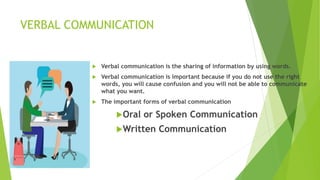
 Verbal communication is the sharing of information by using words.
 Verbal communication is important because if you do not use the right
words, you will cause confusion and you will not be able to communicate
what you want.
 The important forms of verbal communication
Oral or Spoken Communication
Written Communication
Oral or Spoken Communication
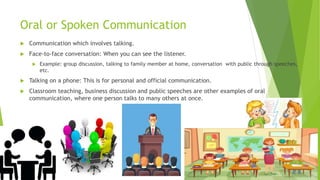
 Communication which involves talking.
 Face-to-face conversation: When you can see the listener.
 Example: group discussion, talking to family member at home, conversation with public through speeches,
etc.
 Talking on a phone: This is for personal and official communication.
 Classroom teaching, business discussion and public speeches are other examples of oral
communication, where one person talks to many others at once.
Written Communication
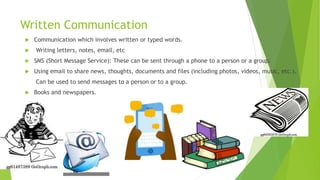
 Communication which involves written or typed words.
 Writing letters, notes, email, etc
 SMS (Short Message Service): These can be sent through a phone to a person or a group.
 Using email to share news, thoughts, documents and files (including photos, videos, music, etc.).
Can be used to send messages to a person or to a group.
 Books and newspapers.
Advantages of verbal communication
 It is easy and quick
 You can say what you want and get a quick response.
 Easy to exchange ideas.
 You keep changing your communication as per the other person’s reply.
Disadvantages of verbal communication
 cultural differences between the sender and receiver of the information.
 These differences may be due to the use of different languages, inability to understand the colloquial
phrases used by the other individual, and the accent.
 Sometimes the meanings become confusing and difficult to understand if the right words are not used.
3Ps of Public Speaking
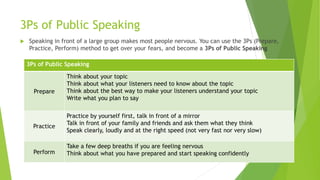
 Speaking in front of a large group makes most people nervous. You can use the 3Ps (Prepare,
Practice, Perform) method to get over your fears, and become a 3Ps of Public Speaking
3Ps of Public Speaking
Prepare
Think about your topic
Think about what your listeners need to know about the topic
Think about the best way to make your listeners understand your topic
Write what you plan to say
Practice
Practice by yourself first, talk in front of a mirror
Talk in front of your family and friends and ask them what they think
Speak clearly, loudly and at the right speed (not very fast nor very slow)
Perform
Take a few deep breaths if you are feeling nervous
Think about what you have prepared and start speaking confidently
SESSION 3
NON-VERBAL COMMUNICATION
Non-Verbal Communication
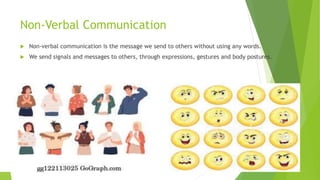
 Non-verbal communication is the message we send to others without using any words.
 We send signals and messages to others, through expressions, gestures and body postures.
Advantages of Non-Verbal Communication
 Non-verbal communication makes our message stronger. Using the right gestures while speaking
makes our message more effective.
 Knowing non-verbal communication helps us understand our audience’s reaction and adjust our
behaviour or communication accordingly.
 Using the right gestures and postures helps us to be professional at work.
 If verbal messages are blocked by noise or distance, etc., we can use hand movements to exchange
our message.
Types of Non-verbal Communication
 Facial Expression
 Posture
 Gesture or Body Language
 Touch
 Space
 Eye Contact
 Paralanguage
Facial Expression
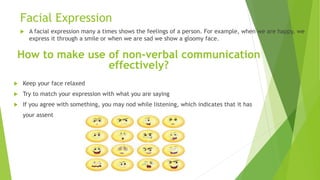
 A facial expression many a times shows the feelings of a person. For example, when we are happy, we
express it through a smile or when we are sad we show a gloomy face.
How to make use of non-verbal communication
effectively?
 Keep your face relaxed
 Try to match your expression with what you are saying
 If you agree with something, you may nod while listening, which indicates that it has
your assent
Posture
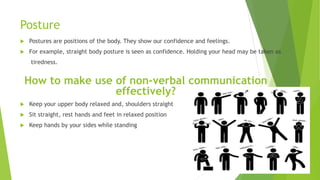
 Postures are positions of the body. They show our confidence and feelings.
 For example, straight body posture is seen as confidence. Holding your head may be taken as
tiredness.
How to make use of non-verbal communication
effectively?
 Keep your upper body relaxed and, shoulders straight
 Sit straight, rest hands and feet in relaxed position
 Keep hands by your sides while standing
Gestures or Body Language
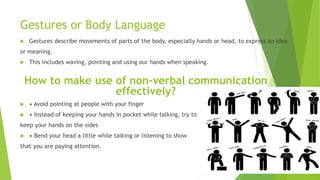
 Gestures describe movements of parts of the body, especially hands or head, to express an idea
or meaning.
 This includes waving, pointing and using our hands when speaking.
How to make use of non-verbal communication
effectively?
 • Avoid pointing at people with your finger
 • Instead of keeping your hands in pocket while talking, try to
keep your hands on the sides
 • Bend your head a little while talking or listening to show
that you are paying attention.
Touch
 We communicate a great deal through our touch, such as shaking hands and patting on the back.
How to make use of non-verbal communication
effectively?
 Shake hands firmly
 • Avoid other touch gestures, such as stroking your hair, scratching your nose, tugging on your clothes,
etc., during formal communication
Space
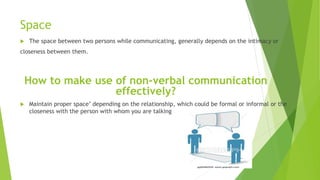
 The space between two persons while communicating, generally depends on the intimacy or
closeness between them.
How to make use of non-verbal communication
effectively?
 Maintain proper space’ depending on the relationship, which could be formal or informal or the
closeness with the person with whom you are talking
Eye Contact
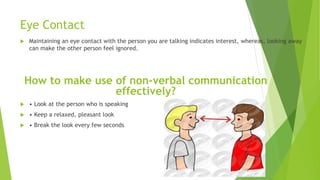
 Maintaining an eye contact with the person you are talking indicates interest, whereas, looking away
can make the other person feel ignored.
How to make use of non-verbal communication
effectively?
 • Look at the person who is speaking
 • Keep a relaxed, pleasant look
 • Break the look every few seconds
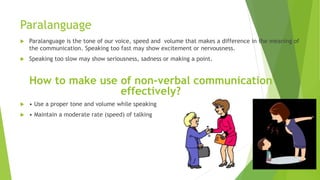
Paralanguage
 Paralanguage is the tone of our voice, speed and volume that makes a difference in the meaning of
the communication. Speaking too fast may show excitement or nervousness.
 Speaking too slow may show seriousness, sadness or making a point.
How to make use of non-verbal communication
effectively?
 • Use a proper tone and volume while speaking
 • Maintain a moderate rate (speed) of talking
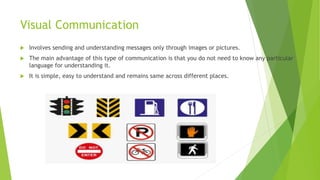
Visual Communication
 Involves sending and understanding messages only through images or pictures.
 The main advantage of this type of communication is that you do not need to know any particular
language for understanding it.
 It is simple, easy to understand and remains same across different places.
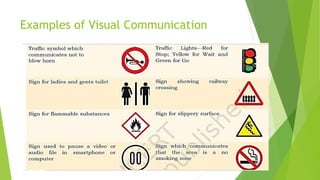
Examples of Visual Communication

IX Unit 1 Verbal & Non-Verbal Communication.pptx

  • 1.
    Class IX INFORMATION TECHNOLOGY UNIT1: COMMUNICATION SKILLS
  • 2.
    SESSION 2: VERBALCOMMUNICATION
  • 3.
    VERBAL COMMUNICATION  Verbalcommunication is the sharing of information by using words.  Verbal communication is important because if you do not use the right words, you will cause confusion and you will not be able to communicate what you want.  The important forms of verbal communication Oral or Spoken Communication Written Communication
  • 4.
    Oral or SpokenCommunication  Communication which involves talking.  Face-to-face conversation: When you can see the listener.  Example: group discussion, talking to family member at home, conversation with public through speeches, etc.  Talking on a phone: This is for personal and official communication.  Classroom teaching, business discussion and public speeches are other examples of oral communication, where one person talks to many others at once.
  • 5.
    Written Communication  Communicationwhich involves written or typed words.  Writing letters, notes, email, etc  SMS (Short Message Service): These can be sent through a phone to a person or a group.  Using email to share news, thoughts, documents and files (including photos, videos, music, etc.). Can be used to send messages to a person or to a group.  Books and newspapers.
  • 6.
    Advantages of verbalcommunication  It is easy and quick  You can say what you want and get a quick response.  Easy to exchange ideas.  You keep changing your communication as per the other person’s reply. Disadvantages of verbal communication  cultural differences between the sender and receiver of the information.  These differences may be due to the use of different languages, inability to understand the colloquial phrases used by the other individual, and the accent.  Sometimes the meanings become confusing and difficult to understand if the right words are not used.
  • 7.
    3Ps of PublicSpeaking  Speaking in front of a large group makes most people nervous. You can use the 3Ps (Prepare, Practice, Perform) method to get over your fears, and become a 3Ps of Public Speaking 3Ps of Public Speaking Prepare Think about your topic Think about what your listeners need to know about the topic Think about the best way to make your listeners understand your topic Write what you plan to say Practice Practice by yourself first, talk in front of a mirror Talk in front of your family and friends and ask them what they think Speak clearly, loudly and at the right speed (not very fast nor very slow) Perform Take a few deep breaths if you are feeling nervous Think about what you have prepared and start speaking confidently
  • 8.
  • 9.
    Non-Verbal Communication  Non-verbalcommunication is the message we send to others without using any words.  We send signals and messages to others, through expressions, gestures and body postures.
  • 10.
    Advantages of Non-VerbalCommunication  Non-verbal communication makes our message stronger. Using the right gestures while speaking makes our message more effective.  Knowing non-verbal communication helps us understand our audience’s reaction and adjust our behaviour or communication accordingly.  Using the right gestures and postures helps us to be professional at work.  If verbal messages are blocked by noise or distance, etc., we can use hand movements to exchange our message.
  • 11.
    Types of Non-verbalCommunication  Facial Expression  Posture  Gesture or Body Language  Touch  Space  Eye Contact  Paralanguage
  • 12.
    Facial Expression  Afacial expression many a times shows the feelings of a person. For example, when we are happy, we express it through a smile or when we are sad we show a gloomy face. How to make use of non-verbal communication effectively?  Keep your face relaxed  Try to match your expression with what you are saying  If you agree with something, you may nod while listening, which indicates that it has your assent
  • 13.
    Posture  Postures arepositions of the body. They show our confidence and feelings.  For example, straight body posture is seen as confidence. Holding your head may be taken as tiredness. How to make use of non-verbal communication effectively?  Keep your upper body relaxed and, shoulders straight  Sit straight, rest hands and feet in relaxed position  Keep hands by your sides while standing
  • 14.
    Gestures or BodyLanguage  Gestures describe movements of parts of the body, especially hands or head, to express an idea or meaning.  This includes waving, pointing and using our hands when speaking. How to make use of non-verbal communication effectively?  • Avoid pointing at people with your finger  • Instead of keeping your hands in pocket while talking, try to keep your hands on the sides  • Bend your head a little while talking or listening to show that you are paying attention.
  • 15.
    Touch  We communicatea great deal through our touch, such as shaking hands and patting on the back. How to make use of non-verbal communication effectively?  Shake hands firmly  • Avoid other touch gestures, such as stroking your hair, scratching your nose, tugging on your clothes, etc., during formal communication
  • 16.
    Space  The spacebetween two persons while communicating, generally depends on the intimacy or closeness between them. How to make use of non-verbal communication effectively?  Maintain proper space’ depending on the relationship, which could be formal or informal or the closeness with the person with whom you are talking
  • 17.
    Eye Contact  Maintainingan eye contact with the person you are talking indicates interest, whereas, looking away can make the other person feel ignored. How to make use of non-verbal communication effectively?  • Look at the person who is speaking  • Keep a relaxed, pleasant look  • Break the look every few seconds
  • 18.
    Paralanguage  Paralanguage isthe tone of our voice, speed and volume that makes a difference in the meaning of the communication. Speaking too fast may show excitement or nervousness.  Speaking too slow may show seriousness, sadness or making a point. How to make use of non-verbal communication effectively?  • Use a proper tone and volume while speaking  • Maintain a moderate rate (speed) of talking
  • 19.
    Visual Communication  Involvessending and understanding messages only through images or pictures.  The main advantage of this type of communication is that you do not need to know any particular language for understanding it.  It is simple, easy to understand and remains same across different places.
  • 20.
    Examples of VisualCommunication