

TYPES AND POSITION
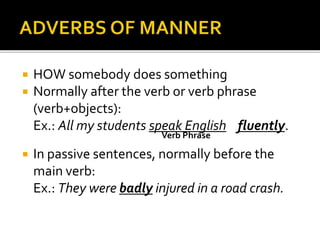
 HOW somebody does something 
 Normally after the verb or verb phrase 
(verb+objects): 
Ex.: All my students speak English fluently. 
Verb Phrase 
 In passive sentences, normally before the 
main verb: 
Ex.: They were badly injured in a road crash.
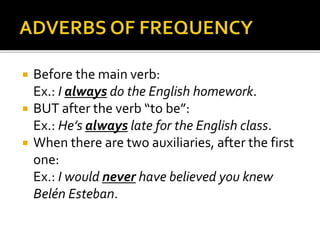
 Before the main verb: 
Ex.: I always do the English homework. 
 BUT after the verb “to be”: 
Ex.: He’s always late for the English class. 
 When there are two auxiliaries, after the first 
one: 
Ex.: I would never have believed you knew 
Belén Esteban.
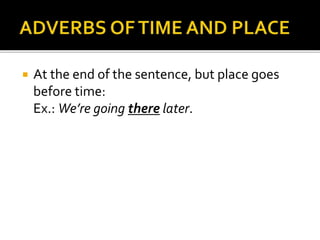
 At the end of the sentence, but place goes 
before time: 
Ex.: We’re going there later.
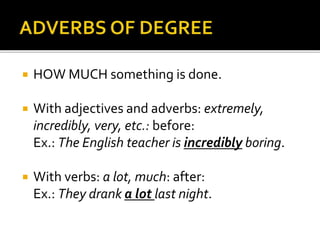
 HOW MUCH something is done. 
 With adjectives and adverbs: extremely, 
incredibly, very, etc.: before: 
Ex.: The English teacher is incredibly boring. 
 With verbs: a lot, much: after: 
Ex.: They drank a lot last night.
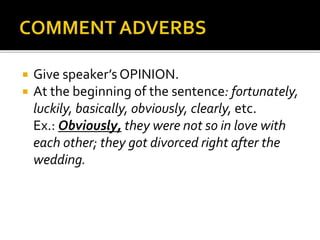
 Give speaker’s OPINION. 
 At the beginning of the sentence: fortunately, 
luckily, basically, obviously, clearly, etc. 
Ex.: Obviously, they were not so in love with 
each other; they got divorced right after the 
wedding.
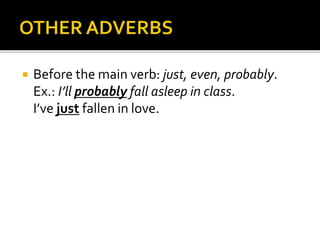
 Before the main verb: just, even, probably. 
Ex.: I’ll probably fall asleep in class. 
I’ve just fallen in love.

Adverbs and adverbial phrases

  • 1.
  • 2.
     HOW somebodydoes something  Normally after the verb or verb phrase (verb+objects): Ex.: All my students speak English fluently. Verb Phrase  In passive sentences, normally before the main verb: Ex.: They were badly injured in a road crash.
  • 3.
     Before themain verb: Ex.: I always do the English homework.  BUT after the verb “to be”: Ex.: He’s always late for the English class.  When there are two auxiliaries, after the first one: Ex.: I would never have believed you knew Belén Esteban.
  • 4.
     At theend of the sentence, but place goes before time: Ex.: We’re going there later.
  • 5.
     HOW MUCHsomething is done.  With adjectives and adverbs: extremely, incredibly, very, etc.: before: Ex.: The English teacher is incredibly boring.  With verbs: a lot, much: after: Ex.: They drank a lot last night.
  • 6.
     Give speaker’sOPINION.  At the beginning of the sentence: fortunately, luckily, basically, obviously, clearly, etc. Ex.: Obviously, they were not so in love with each other; they got divorced right after the wedding.
  • 7.
     Before themain verb: just, even, probably. Ex.: I’ll probably fall asleep in class. I’ve just fallen in love.