

Good Writing Daniel Novak
Anything that can be said can be said simply. -Ludwig Wittgenstein
Simple Writing Two ways to simplify and clarify your writing: Reduce adverbs and adjectives Simple sentence orders
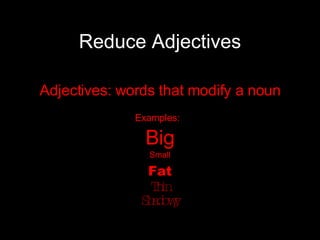
Reduce Adjectives Adjectives: words that modify a noun Examples:  Big Small Fat Thin Shadowy
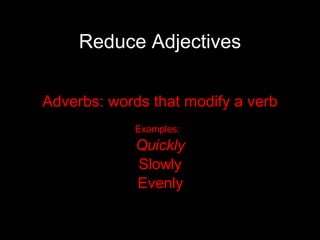
Reduce Adjectives Adverbs: words that modify a verb Examples:  Quickly Slowly Evenly
Reduce Adjectives Adjectives and adverbs  should be used  sparingly. Too many modifiers can tire the reader.
Reduce Adjectives Adjectives and adverbs  cannot replace  good nouns and verbs.
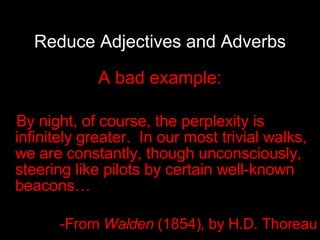
Reduce Adjectives and Adverbs A bad example: By night, of course, the perplexity is infinitely greater.  In our most trivial walks, we are constantly, though unconsciously, steering like pilots by certain well-known beacons… -From  Walden  (1854),   by   H.D. Thoreau
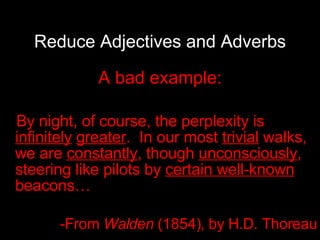
Reduce Adjectives and Adverbs A bad example: By night, of course, the perplexity is  infinitely   greater .  In our most  trivial  walks, we are  constantly , though  unconsciously , steering like pilots by  certain well-known  beacons… -From  Walden  (1854),   by   H.D. Thoreau
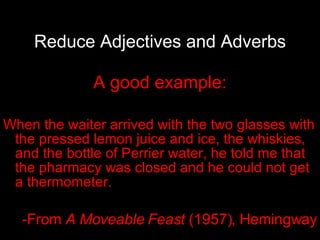
Reduce Adjectives and Adverbs A good example: When the waiter arrived with the two glasses with the pressed lemon juice and ice, the whiskies, and the bottle of Perrier water, he told me that the pharmacy was closed and he could not get a thermometer. -From  A Moveable Feast  (1957), Hemingway
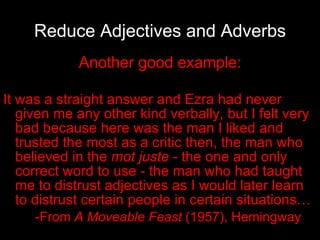
Reduce Adjectives and Adverbs Another good example: It was a straight answer and Ezra had never given me any other kind verbally, but I felt very bad because here was the man I liked and trusted the most as a critic then, the man who believed in the  mot juste  - the one and only correct word to use - the man who had taught me to distrust adjectives as I would later learn to distrust certain people in certain situations… -From  A Moveable Feast  (1957), Hemingway
Reduce Adjectives and Adverbs Even though the second and third examples uses more words, they are mostly nouns and verbs.
Reduce Adjectives and Adverbs Nouns and verbs are  the principle components of  the English language.
Reduce Adjectives and Adverbs Select them  carefully .
Simple Writing Good English writing has two components: Good nouns Good verbs
Simple Writing Before we begin this section, let’s make a distinction between two types of writing:
Simple Writing Passive writing and Active writing
Simple Writing Passive writing occurs when no transference of action takes place.
Simple Writing Common examples: Having something Being something
Simple Writing In context: Daniel is 22 years old. Daniel has a laptop.
Simple Writing Daniel is 22 years old. Daniel has a laptop. Nothing happens in these sentences. They are boring to read.
Simple Writing Active writing occurs when someone does something, or performs an action on someone else.
Simple Writing In context: Daniel crossed the street. Daniel teaches English.
Simple Writing Daniel crossed the street. Daniel teaches English. Things happened in these sentences. Readers like when things happen.
Simple Writing The basic structure of English goes as follows: Subject  -  Verb  -  Object
Simple Writing Basically: Someone did something to someone
Simple Writing Every sentence you ever write should be based on those components.
Simple Writing The ‘subject-verb-object’ formula leads to simple, active writing.
Simple Writing Let’s look at a bad example: The brightly colored bus was moving.
Simple Writing Let’s look at another bad example: The brightly colored bus was on the street. Once again, nothing is happening!
Simple Writing How will you avoid this  type of passive writing?
Simple Writing Avoid the English verbs  “ to be”  “ to have” It is the most common verb in the language, but also the most boring.
Simple Writing Examples: Is Was Are Have been Were
Simple Writing When a sentence  is  composed around the ‘to be’ and ‘to have’ verbs,  nothing happens. A static state  is  described.
Simple Writing By composing sentences with the subject - verb - object  formula,  you will use fewer ‘to be’ verbs.
Simple Writing Let’s look at a better example: The  bus   cruised  down the  street . The bus did something to the street.
Simple Writing This is the key to good writing.
Simple Writing Let’s start with a very simple exercise.
Simple Writing First: pick a noun Examples: You Me The bus
Simple Writing Second: pick a verb Examples: Cruised Drove Crashed
Simple Writing Third: pick an object Examples: Street Road Car
Simple Writing Fourth: use the verb to relate the nouns Examples: You drove your car. I crashed my car into the bus.
Simple Writing Remember: Subject - verb - object
Simple Writing Let’s try and write some perfect sentences.
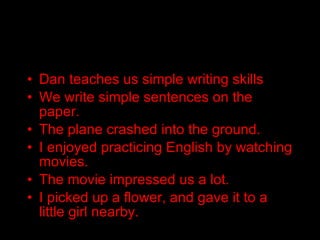
Dan teaches us simple writing skills We write simple sentences on the paper. The plane crashed into the ground. I enjoyed practicing English by watching movies. The movie impressed us a lot. I picked up a flower, and gave it to a little girl nearby.
Simple Writing Keeping in mind what we’ve just reviewed,   write 7 sentences about a recent vacation you took. Do your best!  I will ask for examples.
Simple Writing Now, let’s hear some examples.
Simple Writing I left for Italy to present my paper at a seminar. I set off on my first journey abroad on June 23 rd .
Break time!
Let’s try another activity.
The most amazing six words you will ever read.
In the 1920s, Ernest Hemingway bet his colleagues $10 that he could write a complete story in just six words.  They paid up.
The story?
For sale. Baby shoes. Never worn.
To sharpen your writing skills, let’s try Hemingway’s exercise.
Good Writing Write the story of your life  in exactly six words. You have about 10 minutes…
Good Writing This is a very, very hard exercise! It forces you to be concise, interesting, and simple all at once.
Good Writing If you don’t like yours, don’t worry. Keep practicing!
Good Writing Let’s hear some examples from the class.
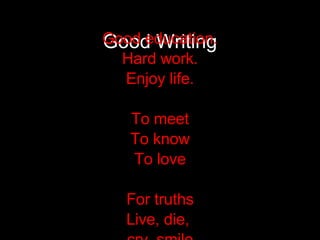
Good Writing Good education. Hard work. Enjoy life. To meet To know To love For truths Live, die,  cry, smile
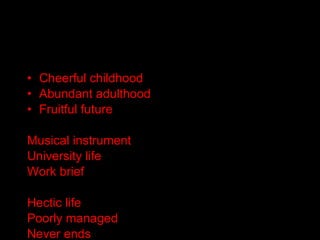
Cheerful childhood Abundant adulthood Fruitful future Musical instrument University life Work brief Hectic life Poorly managed Never ends
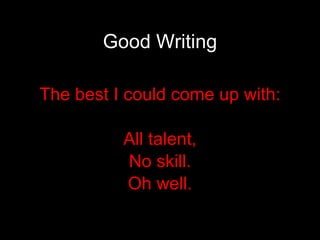
Good Writing The best I could come up with: All talent, No skill. Oh well.
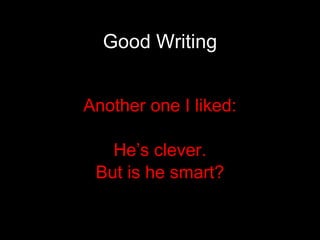
Good Writing Another one I liked: He’s clever. But is he smart?
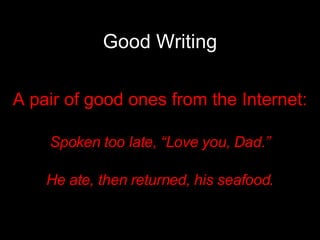
Good Writing A pair of good ones from the Internet: Spoken too late, “Love you, Dad.” He ate, then returned, his seafood.
Good Writing The point of this exercise is simple: The words you choose matter, so choose them carefully.
Good Writing Make every word count.
Good Writing Let’s try another exercise. This one is based on Haiku.
Good Writing Write three sentences, each about one thing you did today BUT Use no more than 15 words, and no more than 30 syllables.
Good Writing Please take about 10 minutes.
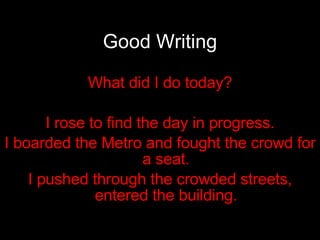
Good Writing What did I do today? I rose to find the day in progress. I boarded the Metro and fought the crowd for a seat. I pushed through the crowded streets, entered the building.
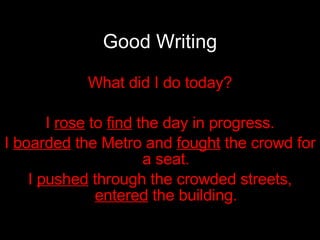
Good Writing What did I do today? I  rose  to  find  the day in progress. I  boarded  the Metro and  fought  the crowd for a seat. I  pushed  through the crowded streets,  entered  the building.
Good Writing Let’s hear some examples.
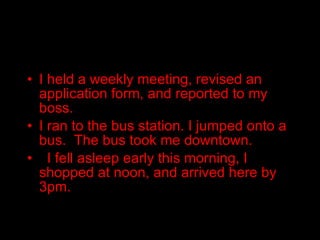
I held a weekly meeting, revised an application form, and reported to my boss. I ran to the bus station. I jumped onto a bus.  The bus took me downtown.  I fell asleep early this morning, I shopped at noon, and arrived here by 3pm.
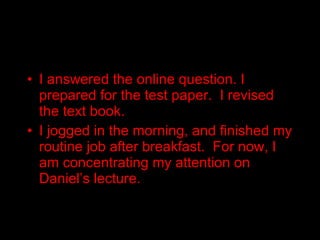
I answered the online question. I prepared for the test paper.  I revised the text book. I jogged in the morning, and finished my routine job after breakfast.  For now, I am concentrating my attention on Daniel’s lecture.
Good Writing So, why did I have you do this exercise? To illustrate two important rules.
Good Writing Avoid words that contain more than two syllables. (There are a few exceptions.  I’ll explain.)
Good Writing Long words are harder to read, and usually come from Latin. Most readers prefer shorter, Germanic words. Consult a dictionary and thesaurus often!
Good Writing Sentences should never run more than two printed lines, or about 20 words. If they run longer, split them into two sentences. There are a few exceptions.
Editing
Editing The Three Rules of Editing
Editing Editing is as much an art as a science.
Editing How will you know what to remove? How will you know how to reorganize?
Editing Follow the three rules.
Editing Be Logical Logic is the way to win over your reader.
Editing 2. Be Consistent Readers get confused by inconsistent language, logic, and presentation.
Editing 3. Murder your Darlings Do not love any of your writings so much that you cannot delete them and start again.
Editing 3. Murder your Darlings Remember:  Being clever isn’t the same as being smart.
Editing Let’s take a look back  at your mini-essays.
Editing Are they logical? Are they consistent? Are they too clever?
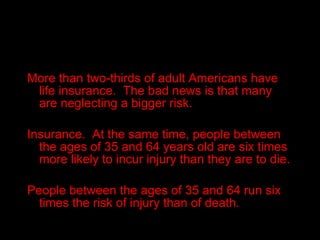
More than two-thirds of adult Americans have life insurance.  The bad news is that many are neglecting a bigger risk. Insurance.  At the same time, people between the ages of 35 and 64 years old are six times more likely to incur injury than they are to die. People between the ages of 35 and 64 run six times the risk of injury than of death.
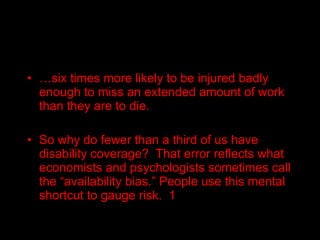
… six times more likely to be injured badly enough to miss an extended amount of work than they are to die. So why do fewer than a third of us have disability coverage?  That error reflects what economists and psychologists sometimes call the “availability bias.” People use this mental shortcut to gauge risk.  1
Editing If this class has a forum,  I would love to see your results from today’s activities. Please post them, and I’ll have a look.
Editing If we haven’t run out of time,  I’ll take questions about anything.
Thank you for your attention. You’ve been great! See you on August 7 th !
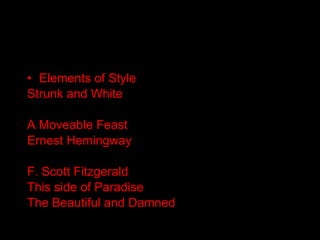
Elements of Style Strunk and White A Moveable Feast Ernest Hemingway F. Scott Fitzgerald This side of Paradise The Beautiful and Damned

Good Writing

  • 1.
  • 2.
    Anything that canbe said can be said simply. -Ludwig Wittgenstein
  • 3.
    Simple Writing Twoways to simplify and clarify your writing: Reduce adverbs and adjectives Simple sentence orders
  • 4.
    Reduce Adjectives Adjectives:words that modify a noun Examples: Big Small Fat Thin Shadowy
  • 5.
    Reduce Adjectives Adverbs:words that modify a verb Examples: Quickly Slowly Evenly
  • 6.
    Reduce Adjectives Adjectivesand adverbs should be used sparingly. Too many modifiers can tire the reader.
  • 7.
    Reduce Adjectives Adjectivesand adverbs cannot replace good nouns and verbs.
  • 8.
    Reduce Adjectives andAdverbs A bad example: By night, of course, the perplexity is infinitely greater. In our most trivial walks, we are constantly, though unconsciously, steering like pilots by certain well-known beacons… -From Walden (1854), by H.D. Thoreau
  • 9.
    Reduce Adjectives andAdverbs A bad example: By night, of course, the perplexity is infinitely greater . In our most trivial walks, we are constantly , though unconsciously , steering like pilots by certain well-known beacons… -From Walden (1854), by H.D. Thoreau
  • 10.
    Reduce Adjectives andAdverbs A good example: When the waiter arrived with the two glasses with the pressed lemon juice and ice, the whiskies, and the bottle of Perrier water, he told me that the pharmacy was closed and he could not get a thermometer. -From A Moveable Feast (1957), Hemingway
  • 11.
    Reduce Adjectives andAdverbs Another good example: It was a straight answer and Ezra had never given me any other kind verbally, but I felt very bad because here was the man I liked and trusted the most as a critic then, the man who believed in the mot juste - the one and only correct word to use - the man who had taught me to distrust adjectives as I would later learn to distrust certain people in certain situations… -From A Moveable Feast (1957), Hemingway
  • 12.
    Reduce Adjectives andAdverbs Even though the second and third examples uses more words, they are mostly nouns and verbs.
  • 13.
    Reduce Adjectives andAdverbs Nouns and verbs are the principle components of the English language.
  • 14.
    Reduce Adjectives andAdverbs Select them carefully .
  • 15.
    Simple Writing GoodEnglish writing has two components: Good nouns Good verbs
  • 16.
    Simple Writing Beforewe begin this section, let’s make a distinction between two types of writing:
  • 17.
    Simple Writing Passivewriting and Active writing
  • 18.
    Simple Writing Passivewriting occurs when no transference of action takes place.
  • 19.
    Simple Writing Commonexamples: Having something Being something
  • 20.
    Simple Writing Incontext: Daniel is 22 years old. Daniel has a laptop.
  • 21.
    Simple Writing Danielis 22 years old. Daniel has a laptop. Nothing happens in these sentences. They are boring to read.
  • 22.
    Simple Writing Activewriting occurs when someone does something, or performs an action on someone else.
  • 23.
    Simple Writing Incontext: Daniel crossed the street. Daniel teaches English.
  • 24.
    Simple Writing Danielcrossed the street. Daniel teaches English. Things happened in these sentences. Readers like when things happen.
  • 25.
    Simple Writing Thebasic structure of English goes as follows: Subject - Verb - Object
  • 26.
    Simple Writing Basically:Someone did something to someone
  • 27.
    Simple Writing Everysentence you ever write should be based on those components.
  • 28.
    Simple Writing The‘subject-verb-object’ formula leads to simple, active writing.
  • 29.
    Simple Writing Let’slook at a bad example: The brightly colored bus was moving.
  • 30.
    Simple Writing Let’slook at another bad example: The brightly colored bus was on the street. Once again, nothing is happening!
  • 31.
    Simple Writing Howwill you avoid this type of passive writing?
  • 32.
    Simple Writing Avoidthe English verbs “ to be” “ to have” It is the most common verb in the language, but also the most boring.
  • 33.
    Simple Writing Examples:Is Was Are Have been Were
  • 34.
    Simple Writing Whena sentence is composed around the ‘to be’ and ‘to have’ verbs, nothing happens. A static state is described.
  • 35.
    Simple Writing Bycomposing sentences with the subject - verb - object formula, you will use fewer ‘to be’ verbs.
  • 36.
    Simple Writing Let’slook at a better example: The bus cruised down the street . The bus did something to the street.
  • 37.
    Simple Writing Thisis the key to good writing.
  • 38.
    Simple Writing Let’sstart with a very simple exercise.
  • 39.
    Simple Writing First:pick a noun Examples: You Me The bus
  • 40.
    Simple Writing Second:pick a verb Examples: Cruised Drove Crashed
  • 41.
    Simple Writing Third:pick an object Examples: Street Road Car
  • 42.
    Simple Writing Fourth:use the verb to relate the nouns Examples: You drove your car. I crashed my car into the bus.
  • 43.
    Simple Writing Remember:Subject - verb - object
  • 44.
    Simple Writing Let’stry and write some perfect sentences.
  • 45.
    Dan teaches ussimple writing skills We write simple sentences on the paper. The plane crashed into the ground. I enjoyed practicing English by watching movies. The movie impressed us a lot. I picked up a flower, and gave it to a little girl nearby.
  • 46.
    Simple Writing Keepingin mind what we’ve just reviewed, write 7 sentences about a recent vacation you took. Do your best! I will ask for examples.
  • 47.
    Simple Writing Now,let’s hear some examples.
  • 48.
    Simple Writing Ileft for Italy to present my paper at a seminar. I set off on my first journey abroad on June 23 rd .
  • 49.
  • 50.
  • 51.
    The most amazingsix words you will ever read.
  • 52.
    In the 1920s,Ernest Hemingway bet his colleagues $10 that he could write a complete story in just six words. They paid up.
  • 53.
  • 54.
    For sale. Babyshoes. Never worn.
  • 55.
    To sharpen yourwriting skills, let’s try Hemingway’s exercise.
  • 56.
    Good Writing Writethe story of your life in exactly six words. You have about 10 minutes…
  • 57.
    Good Writing Thisis a very, very hard exercise! It forces you to be concise, interesting, and simple all at once.
  • 58.
    Good Writing Ifyou don’t like yours, don’t worry. Keep practicing!
  • 59.
    Good Writing Let’shear some examples from the class.
  • 60.
    Good Writing Goodeducation. Hard work. Enjoy life. To meet To know To love For truths Live, die, cry, smile
  • 61.
    Cheerful childhood Abundantadulthood Fruitful future Musical instrument University life Work brief Hectic life Poorly managed Never ends
  • 62.
    Good Writing Thebest I could come up with: All talent, No skill. Oh well.
  • 63.
    Good Writing Anotherone I liked: He’s clever. But is he smart?
  • 64.
    Good Writing Apair of good ones from the Internet: Spoken too late, “Love you, Dad.” He ate, then returned, his seafood.
  • 65.
    Good Writing Thepoint of this exercise is simple: The words you choose matter, so choose them carefully.
  • 66.
    Good Writing Makeevery word count.
  • 67.
    Good Writing Let’stry another exercise. This one is based on Haiku.
  • 68.
    Good Writing Writethree sentences, each about one thing you did today BUT Use no more than 15 words, and no more than 30 syllables.
  • 69.
    Good Writing Pleasetake about 10 minutes.
  • 70.
    Good Writing Whatdid I do today? I rose to find the day in progress. I boarded the Metro and fought the crowd for a seat. I pushed through the crowded streets, entered the building.
  • 71.
    Good Writing Whatdid I do today? I rose to find the day in progress. I boarded the Metro and fought the crowd for a seat. I pushed through the crowded streets, entered the building.
  • 72.
    Good Writing Let’shear some examples.
  • 73.
    I held aweekly meeting, revised an application form, and reported to my boss. I ran to the bus station. I jumped onto a bus. The bus took me downtown. I fell asleep early this morning, I shopped at noon, and arrived here by 3pm.
  • 74.
    I answered theonline question. I prepared for the test paper. I revised the text book. I jogged in the morning, and finished my routine job after breakfast. For now, I am concentrating my attention on Daniel’s lecture.
  • 75.
    Good Writing So,why did I have you do this exercise? To illustrate two important rules.
  • 76.
    Good Writing Avoidwords that contain more than two syllables. (There are a few exceptions. I’ll explain.)
  • 77.
    Good Writing Longwords are harder to read, and usually come from Latin. Most readers prefer shorter, Germanic words. Consult a dictionary and thesaurus often!
  • 78.
    Good Writing Sentencesshould never run more than two printed lines, or about 20 words. If they run longer, split them into two sentences. There are a few exceptions.
  • 79.
  • 80.
    Editing The ThreeRules of Editing
  • 81.
    Editing Editing isas much an art as a science.
  • 82.
    Editing How willyou know what to remove? How will you know how to reorganize?
  • 83.
    Editing Follow thethree rules.
  • 84.
    Editing Be LogicalLogic is the way to win over your reader.
  • 85.
    Editing 2. BeConsistent Readers get confused by inconsistent language, logic, and presentation.
  • 86.
    Editing 3. Murderyour Darlings Do not love any of your writings so much that you cannot delete them and start again.
  • 87.
    Editing 3. Murderyour Darlings Remember: Being clever isn’t the same as being smart.
  • 88.
    Editing Let’s takea look back at your mini-essays.
  • 89.
    Editing Are theylogical? Are they consistent? Are they too clever?
  • 90.
    More than two-thirdsof adult Americans have life insurance. The bad news is that many are neglecting a bigger risk. Insurance. At the same time, people between the ages of 35 and 64 years old are six times more likely to incur injury than they are to die. People between the ages of 35 and 64 run six times the risk of injury than of death.
  • 91.
    … six timesmore likely to be injured badly enough to miss an extended amount of work than they are to die. So why do fewer than a third of us have disability coverage? That error reflects what economists and psychologists sometimes call the “availability bias.” People use this mental shortcut to gauge risk. 1
  • 92.
    Editing If thisclass has a forum, I would love to see your results from today’s activities. Please post them, and I’ll have a look.
  • 93.
    Editing If wehaven’t run out of time, I’ll take questions about anything.
  • 94.
    Thank you foryour attention. You’ve been great! See you on August 7 th !
  • 95.
    Elements of StyleStrunk and White A Moveable Feast Ernest Hemingway F. Scott Fitzgerald This side of Paradise The Beautiful and Damned