ADVERBS: PART OF SPEECH
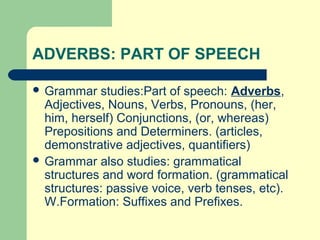
 Grammar

studies:Part of speech: Adverbs,
Adjectives, Nouns, Verbs, Pronouns, (her,
him, herself) Conjunctions, (or, whereas)
Prepositions and Determiners. (articles,
demonstrative adjectives, quantifiers)
 Grammar also studies: grammatical
structures and word formation. (grammatical
structures: passive voice, verb tenses, etc).
W.Formation: Suffixes and Prefixes.
Definition of Adverb:
Part of Speech
that describes verbs, adjectives,
other adverbs or sentences.
--one word (e.g. “carefully”)
-- or a phrase (in the morning).
FORMATION OF ADVERBS:
 Here

we refer mainly to One-word adverbs.
 Adjectives + -ly.
 Adjectives ending in –l: we add –ly.
(e.g.: carefully).
Adjectives ending in –le: we drop the –e and
add -y: e.g.: gently.
Adjectives ending in ic: they take –ally:
dramatically. With exceptions:Publicly.
ADVERBS VS. ADJECTIVES
 Some

words seem to be adverbs but they
are adjectives: cowardly, elderly, friendly,
lively, lonely, likely.
 Some adverbs are used without –ly in
everyday speech: Slow. Quick. Loud. Cheap.
 Some adverbs are different whereas with or
without –ly: Deep/Deeply. Hard/ Hardly.
Pretty/ Prettily. High/highly. Near/nearly
ADVERBS VS. ADJECTIVES
 Some

words are both adverbs and
adjectives:

 Right-

Wrong.
 Hourly- Dayly- Monthly- Weekly.
 Fast- Deep Early- Late.
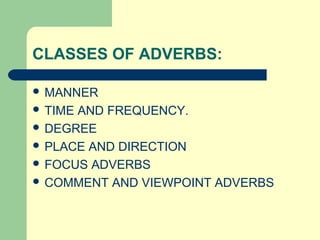
CLASSES OF ADVERBS:
 MANNER
 TIME

AND FREQUENCY.
 DEGREE
 PLACE AND DIRECTION
 FOCUS ADVERBS
 COMMENT AND VIEWPOINT ADVERBS
ADVERBS OF MANNER:
They express how the action is
performed.
Ex:
 Angrily, Emphatically.
 By bus, by train.
 Some are expressions or more-than-one-word
adverbials: Ex:
 In a quiet, threatening voice, …
 In amazement

ADVERBS OF TIME AND FREQUENCY
 Adverbs

of Time: Tomorrow –
Yesterday Adverbs of Frequency: They state how
often something happens. (once a
day, regularly).
 They can be:
 Adverbs of Time – definite time-:
 Tomorrow- Yesterday.
 Adverbs of Time: indefinite time: some
day. One day.
ADVERBS OF DEGREE
 They

describe how the action is done:
whether it is done totally or partially.
E.g.:
 Almost; fully; completely.
 Hardly;
 Rather; quite; nearly. Scarcely
 Expressions: “quite hardly”. “Almost
completely”.
ADVERBS OF PLACE AND DIRECTION
They are mainly prepositional phrases and
adverbials.
E.g.:
 Under the table.
 Next to the bookshelf.
 Towards the station.
 Or: “there”. “here”.
FOCUS ADVERBS
They draw attention to the most important part
of what we are talking about.
 E.g.: especially, mainly, particularly,
specifically.
 There

north.

will be snow today, particularly in the
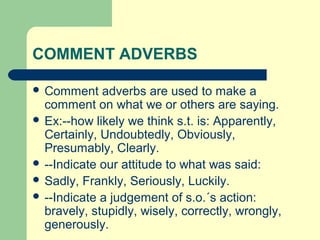
COMMENT ADVERBS
 Comment

adverbs are used to make a
comment on what we or others are saying.
 Ex:--how likely we think s.t. is: Apparently,
Certainly, Undoubtedly, Obviously,
Presumably, Clearly.
 --Indicate our attitude to what was said:
 Sadly, Frankly, Seriously, Luckily.
 --Indicate a judgement of s.o.´s action:
bravely, stupidly, wisely, correctly, wrongly,
generously.
VIEWPOINT ADVERBS



V.P. make clear what viewpoint we are speaking from
They identify what features of something are being talked
about. E.g.Financially, it was a disaster for his family.

And many expressions:
 Politically speaking.
 From a political point of view.
 As far as politics are concerned
 In terms of politics
 In political terms.
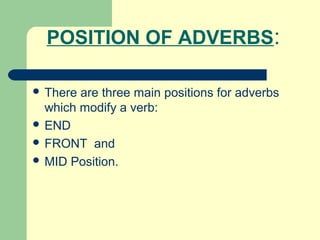
POSITION OF ADVERBS:
 There

are three main positions for adverbs
which modify a verb:
 END
 FRONT and
 MID Position.
END POSITION:
The adverb is placed after the verb, either
immediately after the verb, or later in the
clause:
 They

played quietly all day.
 He sat in the corner, quietly.
FRONT AND MID POSITION:
 FRONT

POSITION: The adverb is placed
before the subject. Ex: Sometimes I feel like
going home.
 MID POSITION:Between the subject and
verb.
 Ex: He is always playing football there.
 **Or immediately after verb “to be” or the
auxiliary verb. Ex: He usually plays better
than me.
END POSITION:
 The

adverb goes after the VERB + THE
OBJECT.
 Ex: We considered the problem briefly.
 If

the object is a long expression, the
adverb goes before the object:
 Ex: We considered briefly the long-term
solution to the problem.
 If

there is a verb followed by an ing-form, we
avoid putting the adverb in the middle, so it
goes after the ing form.

 Ex:

He began running quickly.

 End

position is usual for many adverbials of
place, definite frequency and definite time:

 Ex:



They live upstairs.

She goes there weekly.
She will go there in May.
FRONT POSITION:
 Most

types of adverb commonly go in front
position in a clause. In particular:
 --Connecting adverbs: to make clear the
logical relation to the previous sentence.
 “As a result”.
 Similarly The same happened with…
 Afterwards, …
… CONNECTING ADVERBS/ FRONT
POSITION:
 --Time

and place adverbs: Add more
information about a previous reference to a
time or place or show a contrast:
Tomorrow,… Nearby.
 --Comment

and Viewpoint Adverbs.
 “Sincerely, we can say that …”
MID POSITION:
 --Degree

adverbs:
 We almost missed the train.
 I greatly admire your work.
 --Adverbs

which indicate the order of events:
 I first met her in 1997.
 But in order to list actions we put them in
front position.
MID POSITION ADVERBS:
 Adverbs

of frequency when it is only 1 word:
 I often get there late.
 I regularly take a bus to get there.
 --But

adverbial closes of indefinite frequency
(As a rule, On many occasions, from time to
time) are used in front or end position
MANY ADVERBS ALTOGETHER
 Usually

if there are adverbs of manner, place
and time, the order is: Manner- place-time.
Ex: We usually go the park once a week.
 In case of verbs of movement or direction,
the order is: Place- Manner- time.
 We will arrive at the station by bus,
tomorrow.
THANK YOU,
TEACHER…

GRAMMAR I. ADVERBS

  • 1.
    ADVERBS: PART OFSPEECH  Grammar studies:Part of speech: Adverbs, Adjectives, Nouns, Verbs, Pronouns, (her, him, herself) Conjunctions, (or, whereas) Prepositions and Determiners. (articles, demonstrative adjectives, quantifiers)  Grammar also studies: grammatical structures and word formation. (grammatical structures: passive voice, verb tenses, etc). W.Formation: Suffixes and Prefixes.
  • 2.
    Definition of Adverb: Partof Speech that describes verbs, adjectives, other adverbs or sentences. --one word (e.g. “carefully”) -- or a phrase (in the morning).
  • 3.
    FORMATION OF ADVERBS: Here we refer mainly to One-word adverbs.  Adjectives + -ly.  Adjectives ending in –l: we add –ly. (e.g.: carefully). Adjectives ending in –le: we drop the –e and add -y: e.g.: gently. Adjectives ending in ic: they take –ally: dramatically. With exceptions:Publicly.
  • 4.
    ADVERBS VS. ADJECTIVES Some words seem to be adverbs but they are adjectives: cowardly, elderly, friendly, lively, lonely, likely.  Some adverbs are used without –ly in everyday speech: Slow. Quick. Loud. Cheap.  Some adverbs are different whereas with or without –ly: Deep/Deeply. Hard/ Hardly. Pretty/ Prettily. High/highly. Near/nearly
  • 5.
    ADVERBS VS. ADJECTIVES Some words are both adverbs and adjectives:  Right- Wrong.  Hourly- Dayly- Monthly- Weekly.  Fast- Deep Early- Late.
  • 6.
    CLASSES OF ADVERBS: MANNER  TIME AND FREQUENCY.  DEGREE  PLACE AND DIRECTION  FOCUS ADVERBS  COMMENT AND VIEWPOINT ADVERBS
  • 7.
    ADVERBS OF MANNER: Theyexpress how the action is performed. Ex:  Angrily, Emphatically.  By bus, by train.  Some are expressions or more-than-one-word adverbials: Ex:  In a quiet, threatening voice, …  In amazement 
  • 8.
    ADVERBS OF TIMEAND FREQUENCY  Adverbs of Time: Tomorrow – Yesterday Adverbs of Frequency: They state how often something happens. (once a day, regularly).  They can be:  Adverbs of Time – definite time-:  Tomorrow- Yesterday.  Adverbs of Time: indefinite time: some day. One day.
  • 9.
    ADVERBS OF DEGREE They describe how the action is done: whether it is done totally or partially. E.g.:  Almost; fully; completely.  Hardly;  Rather; quite; nearly. Scarcely  Expressions: “quite hardly”. “Almost completely”.
  • 10.
    ADVERBS OF PLACEAND DIRECTION They are mainly prepositional phrases and adverbials. E.g.:  Under the table.  Next to the bookshelf.  Towards the station.  Or: “there”. “here”.
  • 11.
    FOCUS ADVERBS They drawattention to the most important part of what we are talking about.  E.g.: especially, mainly, particularly, specifically.  There north. will be snow today, particularly in the
  • 12.
    COMMENT ADVERBS  Comment adverbsare used to make a comment on what we or others are saying.  Ex:--how likely we think s.t. is: Apparently, Certainly, Undoubtedly, Obviously, Presumably, Clearly.  --Indicate our attitude to what was said:  Sadly, Frankly, Seriously, Luckily.  --Indicate a judgement of s.o.´s action: bravely, stupidly, wisely, correctly, wrongly, generously.
  • 13.
    VIEWPOINT ADVERBS   V.P. makeclear what viewpoint we are speaking from They identify what features of something are being talked about. E.g.Financially, it was a disaster for his family. And many expressions:  Politically speaking.  From a political point of view.  As far as politics are concerned  In terms of politics  In political terms.
  • 14.
    POSITION OF ADVERBS: There are three main positions for adverbs which modify a verb:  END  FRONT and  MID Position.
  • 15.
    END POSITION: The adverbis placed after the verb, either immediately after the verb, or later in the clause:  They played quietly all day.  He sat in the corner, quietly.
  • 16.
    FRONT AND MIDPOSITION:  FRONT POSITION: The adverb is placed before the subject. Ex: Sometimes I feel like going home.  MID POSITION:Between the subject and verb.  Ex: He is always playing football there.  **Or immediately after verb “to be” or the auxiliary verb. Ex: He usually plays better than me.
  • 17.
    END POSITION:  The adverbgoes after the VERB + THE OBJECT.  Ex: We considered the problem briefly.  If the object is a long expression, the adverb goes before the object:  Ex: We considered briefly the long-term solution to the problem.
  • 18.
     If there isa verb followed by an ing-form, we avoid putting the adverb in the middle, so it goes after the ing form.  Ex: He began running quickly.  End position is usual for many adverbials of place, definite frequency and definite time:  Ex:   They live upstairs. She goes there weekly. She will go there in May.
  • 19.
    FRONT POSITION:  Most typesof adverb commonly go in front position in a clause. In particular:  --Connecting adverbs: to make clear the logical relation to the previous sentence.  “As a result”.  Similarly The same happened with…  Afterwards, …
  • 20.
    … CONNECTING ADVERBS/FRONT POSITION:  --Time and place adverbs: Add more information about a previous reference to a time or place or show a contrast: Tomorrow,… Nearby.  --Comment and Viewpoint Adverbs.  “Sincerely, we can say that …”
  • 21.
    MID POSITION:  --Degree adverbs: We almost missed the train.  I greatly admire your work.  --Adverbs which indicate the order of events:  I first met her in 1997.  But in order to list actions we put them in front position.
  • 22.
    MID POSITION ADVERBS: Adverbs of frequency when it is only 1 word:  I often get there late.  I regularly take a bus to get there.  --But adverbial closes of indefinite frequency (As a rule, On many occasions, from time to time) are used in front or end position
  • 23.
    MANY ADVERBS ALTOGETHER Usually if there are adverbs of manner, place and time, the order is: Manner- place-time. Ex: We usually go the park once a week.  In case of verbs of movement or direction, the order is: Place- Manner- time.  We will arrive at the station by bus, tomorrow.
  • 24.

Editor's Notes