O F M A N N E R
O F T I M E
O F P L A C E
O F F R E Q U E N C Y
O F R E A S O N
O F C O N D I T I O N
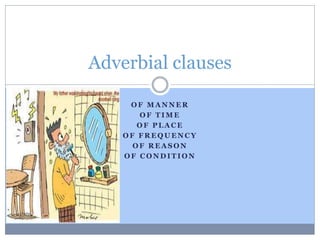
Adverbial clauses
WHAT ARE THE ADVERB CLAUSES?
 Adverb clauses are clauses that function as adverbs.
 An adverbial clause is a group of words which plays the
role of an adverb. (Like all clauses, an adverbial clause
will contain a subject and a verb.)
 For example:
 Keep hitting the gong hourly.(normal adverb)
 Keep hitting the gong until I tell you to stop. (adverbial
clause)
 An adverbial clause is a dependent clause. This means it
cannot stand alone as meaningful sentence in its own
right.
 An adverbial clause usually starts with a subordinating
conjunction (e.g., although, because, if, until, when)
JERRY IS SURPRISED
THEY WERE POPULAR
THE CHILDREN SCREAMED
ADVERBS CATEGORIES
 All adverbs (including adverbial clauses) can usually
be categorized as one of the following:
 Adverbs of Time
 Adverbs of Place
 Adverbs of Manner
 Adverbs of Degree or Comparison
 Adverbs of Condition
 Adverbs of Concession or contrast
 Adverbs of Reason
KINDS OF THE ADVERBIAL CLAUSES
 Adverbial clauses answer the adverb questions:
 How? I walk faster than David walks.
 When? I walk before the sun goes down.
 Where? I walk wherever the trail is paved.
 Why? I walk because it makes me feel good.
 To what extent? I walk more now than I walked a month ago.
 Under what condition? I walk if it’s not raining.

Time: after, when, until, soon, before, once, while, as soon as, whenever, by the time
 Condition: if, whether or not, provided, in case, unless, even if, in the event
 Cause and effect: because, as, since, so, in order that, now that, inasmuch as
 Contrast: though, although, while, whereas, even though
 Most of the time, an adverb clause will be separated from the other clause with a comma. Here
are a few examples of sentences with and without commas:
 Whether you like it or not, you have to go. (The adverb clause “Whether you like it or not” puts
a condition on the action.)
 She enjoyed the party more than he did. (The adverb clause 'than he did' modifies the adverb
“more”.)
Adverbs of Time
 An adverb of time states WHEN something happens or
HOW OFTEN. An adverb of time often starts with one of
the following subordinating conjunctions: after, as, as
long as, as soon as, before, no sooner
than, since, until, when, or while.
 Here are some examples:
 After the game has finished, the king and pawn go into
the same box. (Italian Proverb)
 I stopped believing in Santa Claus when my mother took
me to see him in a department store, and he asked for my
autograph. (Shirley Temple)
 As soon as you trust yourself, you will know how to live.
(Johann Wolfgang von Goethe)
STRUCTURE IN A DIAGRAME
Adverbs of Place
 An adverb of place states WHERE something
happens. An adverb of place often starts with a
preposition (e.g., in, on, near) or one of the following
subordinating conjunctions: anywhere, everywhere,
where, or wherever.
 Here are some examples:
 In a world where there is so much to be done, I felt
strongly impressed that there must be something for
me to do. (Dorothea Dix)
 I am not afraid of the pen, the scaffold, or the sword.
I will tell the truth wherever I please. (Mother Jones)
Adverbs of Manner
 An adverb of manner states HOW something is done.
An adverb of manner often starts with one of the
following subordinating conjunctions: as, like, or the
way.
 Here are some examples:
 He acts like it is a joke.
 We don't have conversations. You talk at me the way
a teacher talks to a naughty student.
 Except for an occasional heart attack, I feel as young
as I ever did. (Robert Benchley)
Adverbs of Degree or Comparison
 An adverb of degree states to what degree something
is done or offers a comparison. An adverb of degree
often starts with one of the following subordinating
conjunctions: than, as...as, so...as, or the...the.
 Here are some examples:
 A vacuum is a hell of a lot better than some of the
stuff that nature replaces it with. (Tennessee
Williams)
 He is as smart as he is tall.
 She is not so bright as she thinks she is.
OMITTED VERBS
 Sometimes, the verb in an adverb of degree is
understood (i.e., not present).
 For example:
 You are taller than I.
 (In this example, the verb am has been omitted. This
is permissible.)
 You are taller than I am. (This is the full version.)
 You are taller than me. (This is the colloquial
version.)
Adverbs of Condition
 An adverb of condition states the condition for the main
idea to come into effect. An adverb of condition often
starts with if or unless.
 Here are some examples:
 If the facts don't fit the theory, change the facts. (Albert
Einstein)
 If the English language made any sense, a catastrophe
would be an apostrophe with fur. (Doug Larson)
 If all the rich people in the world divided up their money
among themselves, there wouldn't be enough to go
around. (Christina Stead, 1903-1983)
Adverbs of Concession (Contrast)
 An adverb of concession offers a statement which
contrasts with the main idea. An adverb of
concession often starts with one of the following
subordinating conjunctions: though, although, even
though, while, whereas, or even if.
 Here are some examples:
 Although golf was originally restricted to wealthy,
overweight Protestants, today it's open to anybody
who owns hideous clothing. (Dave Barry)
 A loud voice cannot compete with a clear voice, even
if it's a whisper. (Barry Neil Kaufman)
Adverbs of Reason
 An adverb of reason offers a reason for the main
idea. An adverb of reason often starts with one of the
following subordinating
conjunctions: as, because, given, or since.
 Here are some examples:
 I don't have a bank account, because I don't know
my mother's maiden name. (Paula Poundstone)
 Since you are like no other being ever created since
the beginning of time, you are incomparable.
(Brenda Ueland)
MIX OF EXERCISES
2.You shouldn't drive ________ drinking alcohol.
1. after
2. even though
3. in order that
4. if
3.You may get malaria ________ you are bitten by a mosquito.
1. before
2. so that
3. if
4. though
4.You need proper shoes to go hiking in the mountains ________ the ground is rough and hard.
1. even though
2. so that
3. before
4. because
5.You should give the iron time to heat up ________ you iron your clothes.
1. before
2. although
3. so that
4. because
6.________ the dolphin lives in the sea, it is not a fish — it's a mammal.
1. although
2. after
3. so that
4. whether
1.You will have to pay higher insurance ________ you buy a sports car.
1. although
2. so that
3. before
4. if
MORE EXERCISES
 We keep our bread in the fridge ________ it doesn't go bad.
 ? although
 ? so that
 ? since
 ? after
 ________ Volkswagen cars are cheap, they last a long time.
 ? in order that
 ? after
 ? although
 ? because
 The five-cent coin looks very Canadian ________ it has a picture of a beaver on it.
 ? so that
 ? since
 ? before
 ? though
 Hockey players wear lots of protective clothing ________ they don't get hurt.
 ? in order that
 ? because
 ? though
 ? after
1. __________________ he always did well on his English tests, his parents were not surprised that
he got an A.
When
Since
2. You should keep the milk in the refrigerator, __________________ it doesn't go bad.
since
so that
3. __________________ he thinks he's smart, he isn't.
Although
After
4. You should say goodbye to your brother ________________ you leave for Europe.
before
since
5. ________________ my father has high blood pressure, he has to watch what he eats.
Before
Since
6. ________________ I came to this country, I didn't speak a word of English!
Before
Since
7. I'll let you know ________________ I come back.
because
after
8. He doesn't understand ________________ he doesn't speak French very well.
so that
because
9. He spoke slowly ________________ she would understand.
because
so that
10. ________________ you stop crying, I'll buy you an ice cream.
If
Since
What Are Adverbial Phrases?
 Adverbial phrase is the term for two or more words
which play the role of an adverb. Look at these examples:
 I will sit quietly.(normal adverb)
 I will sit in silence.(adverbial phrase)
 I will sit like a monk meditates.(adverbial clause)

(When the multi-word adverb contains a subject and a
verb (like in this example), it is an adverbial clause as
opposed to an adverbial phrase.)
 In the examples above, all the adverbs tell us how the
person will sit. They are all adverbs of manner. When
used to modify a verb, an adverb (including an adverbial
phrase and an adverbial clause) will usually
describe when, where, or how something happens.
When (Adverbial Phrase of Time)
 An adverbial phrase of time states when something happens or how
often.
 For example: I'll do it in a minute.
 After the game, the king and pawn go into the same box. (Italian
Proverb)
 Do not wait for the last judgment. It takes place every day. (Albert
Camus)

Examples:
 In an hour
 Any time
 Before next week
 After they go to bed
 Never at midnight
 After the sunset
 Only two days ago
Where (Adverbial Phrase of Place)
 An adverbial phrase of place states where something happens.
 For example: I used to work in a fire-hydrant factory. You couldn't
park anywhere near the place. (Steven Wright)
 Opera is when a guy gets stabbed in the back and, instead of
bleeding, he sings. (Ed Gardner)
 Examples:
 At the corner
 In the world
 Through the looking glass
 Over the rainbow
 Under the sea
 By the light of the moon
 Around the sun

How (Adverbial Phrase of Manner)
 An adverbial phrase of manner states how something is done.
For example: He would always talk with a nationalistic tone.
 He sings in a low register.
 People who say they sleep like a baby usually don't have one.
(Leo J. Burke)
 Examples:
 With great regret
 In dismay
 Like a monk in meditation
 As if I care
 In silence
 With a song in my heart
 Like greased lightning

Why (Adverbial Phrase of Cause and
effect)
 Examples:
 To understand better
 For making cookies
 Since she was getting married
 So that I won’t get lost
 Lest she forget

Adverbial Phrases Without Adverbs
 Many adverbial phrases, paradoxically, do not
contain an adverb. Such adverb-less adverbial
phrases are typically prepositional phrases, as
[italicized] in the examples below:
 On Friday night, I'm playing squash.
- Their marriage broke up in the most painful way.
- May I, on behalf of the shareholders, congratulate
you?
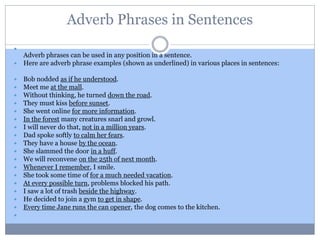
Adverb Phrases in Sentences

Adverb phrases can be used in any position in a sentence.
 Here are adverb phrase examples (shown as underlined) in various places in sentences:
 Bob nodded as if he understood.
 Meet me at the mall.
 Without thinking, he turned down the road.
 They must kiss before sunset.
 She went online for more information.
 In the forest many creatures snarl and growl.
 I will never do that, not in a million years.
 Dad spoke softly to calm her fears.
 They have a house by the ocean.
 She slammed the door in a huff.
 We will reconvene on the 25th of next month.
 Whenever I remember, I smile.
 She took some time of for a much needed vacation.
 At every possible turn, problems blocked his path.
 I saw a lot of trash beside the highway.
 He decided to join a gym to get in shape.
 Every time Jane runs the can opener, the dog comes to the kitchen.

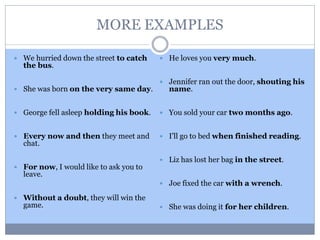
MORE EXAMPLES
 We hurried down the street to catch
the bus.
 She was born on the very same day.
 George fell asleep holding his book.
 Every now and then they meet and
chat.
 For now, I would like to ask you to
leave.
 Without a doubt, they will win the
game.
 He loves you very much.
 Jennifer ran out the door, shouting his
name.
 You sold your car two months ago.
 I'll go to bed when finished reading.
 Liz has lost her bag in the street.
 Joe fixed the car with a wrench.
 She was doing it for her children.
LINKS TO CHECK
 http://www.english-grammar-
revolution.com/adverb-clauses.html
 http://www.grammar-
monster.com/glossary/adverbial_clauses.htm

material_2015F2_LNG400_11_52281.ppt

  • 1.
    O F MA N N E R O F T I M E O F P L A C E O F F R E Q U E N C Y O F R E A S O N O F C O N D I T I O N Adverbial clauses
  • 2.
    WHAT ARE THEADVERB CLAUSES?  Adverb clauses are clauses that function as adverbs.  An adverbial clause is a group of words which plays the role of an adverb. (Like all clauses, an adverbial clause will contain a subject and a verb.)  For example:  Keep hitting the gong hourly.(normal adverb)  Keep hitting the gong until I tell you to stop. (adverbial clause)  An adverbial clause is a dependent clause. This means it cannot stand alone as meaningful sentence in its own right.  An adverbial clause usually starts with a subordinating conjunction (e.g., although, because, if, until, when)
  • 3.
  • 4.
  • 5.
  • 6.
    ADVERBS CATEGORIES  Alladverbs (including adverbial clauses) can usually be categorized as one of the following:  Adverbs of Time  Adverbs of Place  Adverbs of Manner  Adverbs of Degree or Comparison  Adverbs of Condition  Adverbs of Concession or contrast  Adverbs of Reason
  • 7.
    KINDS OF THEADVERBIAL CLAUSES  Adverbial clauses answer the adverb questions:  How? I walk faster than David walks.  When? I walk before the sun goes down.  Where? I walk wherever the trail is paved.  Why? I walk because it makes me feel good.  To what extent? I walk more now than I walked a month ago.  Under what condition? I walk if it’s not raining.  Time: after, when, until, soon, before, once, while, as soon as, whenever, by the time  Condition: if, whether or not, provided, in case, unless, even if, in the event  Cause and effect: because, as, since, so, in order that, now that, inasmuch as  Contrast: though, although, while, whereas, even though  Most of the time, an adverb clause will be separated from the other clause with a comma. Here are a few examples of sentences with and without commas:  Whether you like it or not, you have to go. (The adverb clause “Whether you like it or not” puts a condition on the action.)  She enjoyed the party more than he did. (The adverb clause 'than he did' modifies the adverb “more”.)
  • 8.
    Adverbs of Time An adverb of time states WHEN something happens or HOW OFTEN. An adverb of time often starts with one of the following subordinating conjunctions: after, as, as long as, as soon as, before, no sooner than, since, until, when, or while.  Here are some examples:  After the game has finished, the king and pawn go into the same box. (Italian Proverb)  I stopped believing in Santa Claus when my mother took me to see him in a department store, and he asked for my autograph. (Shirley Temple)  As soon as you trust yourself, you will know how to live. (Johann Wolfgang von Goethe)
  • 9.
  • 10.
    Adverbs of Place An adverb of place states WHERE something happens. An adverb of place often starts with a preposition (e.g., in, on, near) or one of the following subordinating conjunctions: anywhere, everywhere, where, or wherever.  Here are some examples:  In a world where there is so much to be done, I felt strongly impressed that there must be something for me to do. (Dorothea Dix)  I am not afraid of the pen, the scaffold, or the sword. I will tell the truth wherever I please. (Mother Jones)
  • 11.
    Adverbs of Manner An adverb of manner states HOW something is done. An adverb of manner often starts with one of the following subordinating conjunctions: as, like, or the way.  Here are some examples:  He acts like it is a joke.  We don't have conversations. You talk at me the way a teacher talks to a naughty student.  Except for an occasional heart attack, I feel as young as I ever did. (Robert Benchley)
  • 12.
    Adverbs of Degreeor Comparison  An adverb of degree states to what degree something is done or offers a comparison. An adverb of degree often starts with one of the following subordinating conjunctions: than, as...as, so...as, or the...the.  Here are some examples:  A vacuum is a hell of a lot better than some of the stuff that nature replaces it with. (Tennessee Williams)  He is as smart as he is tall.  She is not so bright as she thinks she is.
  • 13.
    OMITTED VERBS  Sometimes,the verb in an adverb of degree is understood (i.e., not present).  For example:  You are taller than I.  (In this example, the verb am has been omitted. This is permissible.)  You are taller than I am. (This is the full version.)  You are taller than me. (This is the colloquial version.)
  • 14.
    Adverbs of Condition An adverb of condition states the condition for the main idea to come into effect. An adverb of condition often starts with if or unless.  Here are some examples:  If the facts don't fit the theory, change the facts. (Albert Einstein)  If the English language made any sense, a catastrophe would be an apostrophe with fur. (Doug Larson)  If all the rich people in the world divided up their money among themselves, there wouldn't be enough to go around. (Christina Stead, 1903-1983)
  • 15.
    Adverbs of Concession(Contrast)  An adverb of concession offers a statement which contrasts with the main idea. An adverb of concession often starts with one of the following subordinating conjunctions: though, although, even though, while, whereas, or even if.  Here are some examples:  Although golf was originally restricted to wealthy, overweight Protestants, today it's open to anybody who owns hideous clothing. (Dave Barry)  A loud voice cannot compete with a clear voice, even if it's a whisper. (Barry Neil Kaufman)
  • 16.
    Adverbs of Reason An adverb of reason offers a reason for the main idea. An adverb of reason often starts with one of the following subordinating conjunctions: as, because, given, or since.  Here are some examples:  I don't have a bank account, because I don't know my mother's maiden name. (Paula Poundstone)  Since you are like no other being ever created since the beginning of time, you are incomparable. (Brenda Ueland)
  • 17.
    MIX OF EXERCISES 2.Youshouldn't drive ________ drinking alcohol. 1. after 2. even though 3. in order that 4. if 3.You may get malaria ________ you are bitten by a mosquito. 1. before 2. so that 3. if 4. though 4.You need proper shoes to go hiking in the mountains ________ the ground is rough and hard. 1. even though 2. so that 3. before 4. because 5.You should give the iron time to heat up ________ you iron your clothes. 1. before 2. although 3. so that 4. because 6.________ the dolphin lives in the sea, it is not a fish — it's a mammal. 1. although 2. after 3. so that 4. whether 1.You will have to pay higher insurance ________ you buy a sports car. 1. although 2. so that 3. before 4. if
  • 18.
    MORE EXERCISES  Wekeep our bread in the fridge ________ it doesn't go bad.  ? although  ? so that  ? since  ? after  ________ Volkswagen cars are cheap, they last a long time.  ? in order that  ? after  ? although  ? because  The five-cent coin looks very Canadian ________ it has a picture of a beaver on it.  ? so that  ? since  ? before  ? though  Hockey players wear lots of protective clothing ________ they don't get hurt.  ? in order that  ? because  ? though  ? after
  • 19.
    1. __________________ healways did well on his English tests, his parents were not surprised that he got an A. When Since 2. You should keep the milk in the refrigerator, __________________ it doesn't go bad. since so that 3. __________________ he thinks he's smart, he isn't. Although After 4. You should say goodbye to your brother ________________ you leave for Europe. before since 5. ________________ my father has high blood pressure, he has to watch what he eats. Before Since 6. ________________ I came to this country, I didn't speak a word of English! Before Since 7. I'll let you know ________________ I come back. because after 8. He doesn't understand ________________ he doesn't speak French very well. so that because 9. He spoke slowly ________________ she would understand. because so that 10. ________________ you stop crying, I'll buy you an ice cream. If Since
  • 20.
    What Are AdverbialPhrases?  Adverbial phrase is the term for two or more words which play the role of an adverb. Look at these examples:  I will sit quietly.(normal adverb)  I will sit in silence.(adverbial phrase)  I will sit like a monk meditates.(adverbial clause)  (When the multi-word adverb contains a subject and a verb (like in this example), it is an adverbial clause as opposed to an adverbial phrase.)  In the examples above, all the adverbs tell us how the person will sit. They are all adverbs of manner. When used to modify a verb, an adverb (including an adverbial phrase and an adverbial clause) will usually describe when, where, or how something happens.
  • 21.
    When (Adverbial Phraseof Time)  An adverbial phrase of time states when something happens or how often.  For example: I'll do it in a minute.  After the game, the king and pawn go into the same box. (Italian Proverb)  Do not wait for the last judgment. It takes place every day. (Albert Camus)  Examples:  In an hour  Any time  Before next week  After they go to bed  Never at midnight  After the sunset  Only two days ago
  • 22.
    Where (Adverbial Phraseof Place)  An adverbial phrase of place states where something happens.  For example: I used to work in a fire-hydrant factory. You couldn't park anywhere near the place. (Steven Wright)  Opera is when a guy gets stabbed in the back and, instead of bleeding, he sings. (Ed Gardner)  Examples:  At the corner  In the world  Through the looking glass  Over the rainbow  Under the sea  By the light of the moon  Around the sun 
  • 23.
    How (Adverbial Phraseof Manner)  An adverbial phrase of manner states how something is done. For example: He would always talk with a nationalistic tone.  He sings in a low register.  People who say they sleep like a baby usually don't have one. (Leo J. Burke)  Examples:  With great regret  In dismay  Like a monk in meditation  As if I care  In silence  With a song in my heart  Like greased lightning 
  • 24.
    Why (Adverbial Phraseof Cause and effect)  Examples:  To understand better  For making cookies  Since she was getting married  So that I won’t get lost  Lest she forget 
  • 25.
    Adverbial Phrases WithoutAdverbs  Many adverbial phrases, paradoxically, do not contain an adverb. Such adverb-less adverbial phrases are typically prepositional phrases, as [italicized] in the examples below:  On Friday night, I'm playing squash. - Their marriage broke up in the most painful way. - May I, on behalf of the shareholders, congratulate you?
  • 26.
    Adverb Phrases inSentences  Adverb phrases can be used in any position in a sentence.  Here are adverb phrase examples (shown as underlined) in various places in sentences:  Bob nodded as if he understood.  Meet me at the mall.  Without thinking, he turned down the road.  They must kiss before sunset.  She went online for more information.  In the forest many creatures snarl and growl.  I will never do that, not in a million years.  Dad spoke softly to calm her fears.  They have a house by the ocean.  She slammed the door in a huff.  We will reconvene on the 25th of next month.  Whenever I remember, I smile.  She took some time of for a much needed vacation.  At every possible turn, problems blocked his path.  I saw a lot of trash beside the highway.  He decided to join a gym to get in shape.  Every time Jane runs the can opener, the dog comes to the kitchen. 
  • 27.
    MORE EXAMPLES  Wehurried down the street to catch the bus.  She was born on the very same day.  George fell asleep holding his book.  Every now and then they meet and chat.  For now, I would like to ask you to leave.  Without a doubt, they will win the game.  He loves you very much.  Jennifer ran out the door, shouting his name.  You sold your car two months ago.  I'll go to bed when finished reading.  Liz has lost her bag in the street.  Joe fixed the car with a wrench.  She was doing it for her children.
  • 28.
    LINKS TO CHECK http://www.english-grammar- revolution.com/adverb-clauses.html  http://www.grammar- monster.com/glossary/adverbial_clauses.htm