WELCOME
BY
LAVANYA K S (21)
NIVEDITHA SUDARSANAN (28)
PARVATHY S M (29)
ROMINI YESUDAS (35)
Project Assisted By Project Guided By
DHANYA M AJITH .A
Asst. Prof in ECE Asst. Prof in ECE
SEENA R
Asst. Prof in ECE
INTRODUCTION
• Today, technology has become an integrated part of people’s
lives. It has, and continues to influence many aspects of daily
life and has allowed better social interaction, ease of
transportation etc.
• Home automation or sensible home may be delineated as
introduction of technology within the home atmosphere to
provide ease and protection to its occupants.
• By using the technology of the Internet of Things, the
examination and execution of home automation have got
additional average.
WHY SMART HOME?
• Smart Home is Applicable in various aspect of our home and
environment to suite our different preferences
• Comfort or Ease of Control
• Entertainment
• Security
• Convenience all time
• Life time personalization
• User friendly
LITERATURE SURVEY
• The work of John J. Greichen discussed
challenges faced by home automation systems
include high manufacturing costs, high
development costs
• Kelly, Sean Dieter Tebje, Nagender Kumar
Suryadevara, and Subhas Chandra
Mukhopadhyay. "Towards the implementation
of IoT for environmental condition monitoring
in homes."
PROPOSED IoT ARCHITECTURE
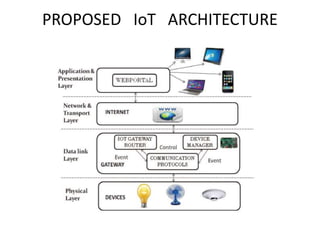
• The physical layer consists of the devices which are to be controlled.
• The data link layer consist of IoT gateway router, device manager and
various communication protocols.
• The raspberry pi is used as the IoT gateway which communicates to
personal computer or smart phone by means internet in the network and
transport layer.
• The application and presentation layer consist of web portal which is
nothing but designing a web page by which we can control the various
appliances .
• The appliances can also be controlled by creating an app in mobile phone
which is similar to web portal.
BLOCK DIAGRAM
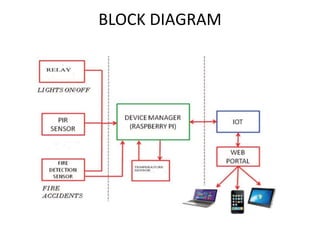
• From the raspberry pi, by means of wifi configuration and IoT
concept we can turn ON/OFF the light by using the relay.
• Relays are switches that open and close circuits
electromechanically or electronically.,
• The PIR sensor is used to detect the human being presence
and sent messages in any case of there is a theft
• The lights and fans can be controlled by creating web server in
personal computer, tablet or we can create an app in mobile.
CIRCUIT DIAGRAM
• The Internet of things (IoTs) can be defined as connecting the
various types of objects like smart phones, personal computer and
Tablets to internet.
• The aim of the IoT is that enable things to be connected any
time, any where with any thing and anyone
• IoT brings in very new fangled type of communication between
things and people and also between things.
• With the introduction of IoTs, the research and development of
home automation are becoming popular in the recent days.
• IoTs technology is used to come in with innovative idea and
great growth for smart homes to improve the living standards
of life.
• The IoT-based architecture provides high-level flexibility at
the communication and information.
• It is an approach which is relevant in many different
environments such as patient monitoring system, security,
traffic signal control or controlling various applications.
Raspberry pi
• The Raspberry Pi is a low cost credit card size single board computer
developed by raspberry pi foundation.
 Raspberry pi is controlled by a modified version of Debian Linux .
The core of the home automation system is this minicomputer.
 Several generations of Raspberry Pis have been released.
 Here we are using model raspberry pi 3.
Features
• 1GB RAM
• 4 USB ports
• Consist of 40 pins
• Full HDMI port
• Ethernet port
• Camera interface (CSI)
• Display interface (DSI)
• Micro SD card slot
Pin Diagram
Raspbian
• Raspbian is the computer operating
system used for Raspberry Pi.
• It is a debian based computer operating system
• It is also called Noobs OS.
• This OS can be downloaded from the website
‘raspberrypi.org’
PYTHON
• Python is a widely used high-level programming language for
general purpose programming.
• It has wide range of applications from Web development ,
scientific and mathematical computing to desktop graphical
user Interfaces.
• Python allows you to write programs having greater
functionality with fewer lines of code.
LM35
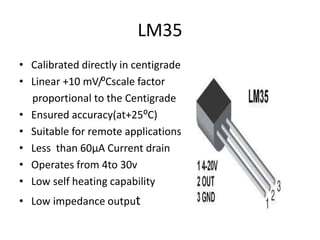
• Calibrated directly in centigrade
• Linear +10 mV/⁰Cscale factor
proportional to the Centigrade
• Ensured accuracy(at+25⁰C)
• Suitable for remote applications
• Less than 60µA Current drain
• Operates from 4to 30v
• Low self heating capability
• Low impedance output
PIN DIAGRAM
RELAYS
• A relay is an electrically operated switch
• control high-current AC loads from lower voltage DC control
circuitry.
• switched by a much lower voltage and at a much lower
current than most mechanical relays.
Features
• Trigger Current: 7.5mA/12V
• Control Voltage: 24-380V AC
• Input Voltage: 3-32V DC
• Zero Cross trigger method
MQ6
• High sensitivity to LPG, iso-butane, propane
• Small sensitivity to alcohol, smoke.
• Fast response .
• Stable and long life
• Simple drive circuit
• Resistance value of MQ-6 is difference to various kinds
and various concentration gases
• calibrate the detector for 1000ppm of LPG concentration in air
• Load resistance ( RL) about 20KΩ(10KΩ to 47KΩ).
• When accurately measuring, the proper alarm point for the gas detector
should be determined after considering the temperature and humidity
influence.
• The sensor requires two voltage inputs: heater voltage (VH) and circuit
voltage(VC).
• VH is used to supply standard working temperature to the sensor and it can adopt
DC or AC power,
• VRL is the voltage of load resistance RL which is in series with sensor.
• Vc supplies the detect voltage to load resistance RL and it should adopts DC power
PIR Sensor
• A device used to detect motion by receiving infrared radiation.
• They are small, inexpensive, low-power, easy to use
• PIRs are basically made of a pyroelectric sensor, which can detect
levels of infrared radiation
• Along with the pyroelectic sensor is a bunch of supporting circuitry,
resistors and capacitors
• . This chip takes the output of the sensor and does some minor
processing on it to emit a digital output pulse from the analog
sensor.
• Digital pulse high (3V) when triggered (motion detected) digital low when
idle (no motion detected).
• Pulse lengths are determined by resistors and capacitors on the PCB and
differ from sensor to sensor.
• Sensitivity range: up to 20 feet (6 meters) 110° x 70° detection range
• Power supply: 5V-12V input voltage for most modules
Wi-Fi
• A radio technology that networks the devices
• Refers to wireless LAN products based on the IEEE802.11g specification
• Provides easy connections to the internet and buisness networks while
travelling
• The main attractive feature of this technology is that it can provide
wireless broad band connection within a specific geographic boundary
• A Wi-Fi hot spot is created by installing an access point to an internet
connection
• An access point acts as abase station
• When Wi-Fi enabled device encounters a hotspots the device can then
connect to that network wirelessly
• A single access point can support up to 30 users and can function within a
range of 100-150 feet indoors and up to 300 feet out doors
MCP3008 ADC
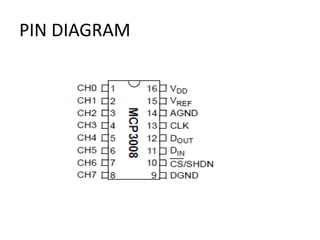
• The MCP3008 is a 10bit 8-channel Analogue-to-digital
converter (ADC).
• It is cheap, easy to connect and doesn’t require any
additional components.
• It uses the SPI bus protocol which is supported by the Pi’s
GPIO header.
PIN DIAGRAM
WEB SERVER
• Various applications located at home can be
remotely controlled
• information are stored in embedded system
• Such type of web servers are called embedded
web server
• we will use the Raspberry Pi to induce the
information from servers
• Raspberry pi also can serve sound, video,
workable programs
USER INTERFACE
• the user will see and act with.
• the android enabled phone makes control
• provides a range of pre-build program parts
• provides other User interface modules
• enable the user to look at the device status
ADVANTAGES
• Flexibility
• Programmatically control devices
• Better scalability and security
• Energy saving
• Improved comfort and safe
DISADVANTAGE
• High cost
• Damage of cable affect entire system
• Signal receiving problem
• Human error occur
• Huge system crash
FUTURE SCOPE
• Controlling various household devices of
house with internet
• Industrial automation and management
through internet
• machine-driven fireplace exit systems
• improvement of security problems in
extremely restricted areas.
CONCLUSION
• we have introduced the event of a home
management
• security system exploitation using Raspberry
pi and IoT
• The system is suitable for remotely controlling
the home appliances .
• The system may be employed in many places
like banks, hospitals etc
Thank you

Smart home Environment using iot

  • 1.
  • 2.
    BY LAVANYA K S(21) NIVEDITHA SUDARSANAN (28) PARVATHY S M (29) ROMINI YESUDAS (35) Project Assisted By Project Guided By DHANYA M AJITH .A Asst. Prof in ECE Asst. Prof in ECE SEENA R Asst. Prof in ECE
  • 3.
    INTRODUCTION • Today, technologyhas become an integrated part of people’s lives. It has, and continues to influence many aspects of daily life and has allowed better social interaction, ease of transportation etc. • Home automation or sensible home may be delineated as introduction of technology within the home atmosphere to provide ease and protection to its occupants. • By using the technology of the Internet of Things, the examination and execution of home automation have got additional average.
  • 4.
    WHY SMART HOME? •Smart Home is Applicable in various aspect of our home and environment to suite our different preferences • Comfort or Ease of Control • Entertainment • Security • Convenience all time • Life time personalization • User friendly
  • 5.
    LITERATURE SURVEY • Thework of John J. Greichen discussed challenges faced by home automation systems include high manufacturing costs, high development costs • Kelly, Sean Dieter Tebje, Nagender Kumar Suryadevara, and Subhas Chandra Mukhopadhyay. "Towards the implementation of IoT for environmental condition monitoring in homes."
  • 6.
  • 7.
    • The physicallayer consists of the devices which are to be controlled. • The data link layer consist of IoT gateway router, device manager and various communication protocols. • The raspberry pi is used as the IoT gateway which communicates to personal computer or smart phone by means internet in the network and transport layer. • The application and presentation layer consist of web portal which is nothing but designing a web page by which we can control the various appliances . • The appliances can also be controlled by creating an app in mobile phone which is similar to web portal.
  • 8.
  • 9.
    • From theraspberry pi, by means of wifi configuration and IoT concept we can turn ON/OFF the light by using the relay. • Relays are switches that open and close circuits electromechanically or electronically., • The PIR sensor is used to detect the human being presence and sent messages in any case of there is a theft • The lights and fans can be controlled by creating web server in personal computer, tablet or we can create an app in mobile.
  • 10.
  • 11.
    • The Internetof things (IoTs) can be defined as connecting the various types of objects like smart phones, personal computer and Tablets to internet. • The aim of the IoT is that enable things to be connected any time, any where with any thing and anyone • IoT brings in very new fangled type of communication between things and people and also between things. • With the introduction of IoTs, the research and development of home automation are becoming popular in the recent days.
  • 12.
    • IoTs technologyis used to come in with innovative idea and great growth for smart homes to improve the living standards of life. • The IoT-based architecture provides high-level flexibility at the communication and information. • It is an approach which is relevant in many different environments such as patient monitoring system, security, traffic signal control or controlling various applications.
  • 13.
    Raspberry pi • TheRaspberry Pi is a low cost credit card size single board computer developed by raspberry pi foundation.  Raspberry pi is controlled by a modified version of Debian Linux . The core of the home automation system is this minicomputer.  Several generations of Raspberry Pis have been released.  Here we are using model raspberry pi 3.
  • 14.
    Features • 1GB RAM •4 USB ports • Consist of 40 pins • Full HDMI port • Ethernet port • Camera interface (CSI) • Display interface (DSI) • Micro SD card slot
  • 15.
  • 17.
    Raspbian • Raspbian isthe computer operating system used for Raspberry Pi. • It is a debian based computer operating system • It is also called Noobs OS. • This OS can be downloaded from the website ‘raspberrypi.org’
  • 18.
    PYTHON • Python isa widely used high-level programming language for general purpose programming. • It has wide range of applications from Web development , scientific and mathematical computing to desktop graphical user Interfaces. • Python allows you to write programs having greater functionality with fewer lines of code.
  • 19.
    LM35 • Calibrated directlyin centigrade • Linear +10 mV/⁰Cscale factor proportional to the Centigrade • Ensured accuracy(at+25⁰C) • Suitable for remote applications • Less than 60µA Current drain • Operates from 4to 30v • Low self heating capability • Low impedance output
  • 20.
  • 21.
    RELAYS • A relayis an electrically operated switch • control high-current AC loads from lower voltage DC control circuitry. • switched by a much lower voltage and at a much lower current than most mechanical relays.
  • 22.
    Features • Trigger Current:7.5mA/12V • Control Voltage: 24-380V AC • Input Voltage: 3-32V DC • Zero Cross trigger method
  • 23.
    MQ6 • High sensitivityto LPG, iso-butane, propane • Small sensitivity to alcohol, smoke. • Fast response . • Stable and long life • Simple drive circuit • Resistance value of MQ-6 is difference to various kinds and various concentration gases • calibrate the detector for 1000ppm of LPG concentration in air • Load resistance ( RL) about 20KΩ(10KΩ to 47KΩ). • When accurately measuring, the proper alarm point for the gas detector should be determined after considering the temperature and humidity influence.
  • 24.
    • The sensorrequires two voltage inputs: heater voltage (VH) and circuit voltage(VC). • VH is used to supply standard working temperature to the sensor and it can adopt DC or AC power, • VRL is the voltage of load resistance RL which is in series with sensor. • Vc supplies the detect voltage to load resistance RL and it should adopts DC power
  • 25.
    PIR Sensor • Adevice used to detect motion by receiving infrared radiation. • They are small, inexpensive, low-power, easy to use • PIRs are basically made of a pyroelectric sensor, which can detect levels of infrared radiation • Along with the pyroelectic sensor is a bunch of supporting circuitry, resistors and capacitors • . This chip takes the output of the sensor and does some minor processing on it to emit a digital output pulse from the analog sensor.
  • 26.
    • Digital pulsehigh (3V) when triggered (motion detected) digital low when idle (no motion detected). • Pulse lengths are determined by resistors and capacitors on the PCB and differ from sensor to sensor. • Sensitivity range: up to 20 feet (6 meters) 110° x 70° detection range • Power supply: 5V-12V input voltage for most modules
  • 27.
    Wi-Fi • A radiotechnology that networks the devices • Refers to wireless LAN products based on the IEEE802.11g specification • Provides easy connections to the internet and buisness networks while travelling • The main attractive feature of this technology is that it can provide wireless broad band connection within a specific geographic boundary • A Wi-Fi hot spot is created by installing an access point to an internet connection • An access point acts as abase station • When Wi-Fi enabled device encounters a hotspots the device can then connect to that network wirelessly • A single access point can support up to 30 users and can function within a range of 100-150 feet indoors and up to 300 feet out doors
  • 28.
    MCP3008 ADC • TheMCP3008 is a 10bit 8-channel Analogue-to-digital converter (ADC). • It is cheap, easy to connect and doesn’t require any additional components. • It uses the SPI bus protocol which is supported by the Pi’s GPIO header.
  • 29.
  • 30.
    WEB SERVER • Variousapplications located at home can be remotely controlled • information are stored in embedded system • Such type of web servers are called embedded web server • we will use the Raspberry Pi to induce the information from servers • Raspberry pi also can serve sound, video, workable programs
  • 31.
    USER INTERFACE • theuser will see and act with. • the android enabled phone makes control • provides a range of pre-build program parts • provides other User interface modules • enable the user to look at the device status
  • 32.
    ADVANTAGES • Flexibility • Programmaticallycontrol devices • Better scalability and security • Energy saving • Improved comfort and safe
  • 33.
    DISADVANTAGE • High cost •Damage of cable affect entire system • Signal receiving problem • Human error occur • Huge system crash
  • 34.
    FUTURE SCOPE • Controllingvarious household devices of house with internet • Industrial automation and management through internet • machine-driven fireplace exit systems • improvement of security problems in extremely restricted areas.
  • 35.
    CONCLUSION • we haveintroduced the event of a home management • security system exploitation using Raspberry pi and IoT • The system is suitable for remotely controlling the home appliances . • The system may be employed in many places like banks, hospitals etc
  • 36.