BeAl General Information
Origin
Plantation
Uses
General Information
It is called Belva in Sanskrit and scientifically known
as Aegle marmelos. This tree is native
to Bangladesh and India.
Bael is the most ancient sacred tree in India. Mostly,
it is planted near the temple and used as a
dedication to Gods. The leaves of the tree are used
to worship Lord Shiva . This leaf is trifoliate which
signifies the holy Trinity: Brahma, Vishnu and Shiva.
It also signifies the three eyes of Lord Shiva.
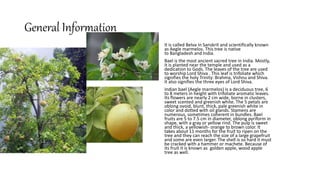
Indian bael (Aegle marmelos) is a deciduous tree, 6
to 8 meters in height with trifoliate aromatic leaves.
Its flowers are nearly 2 cm wide, borne in clusters,
sweet scented and greenish white. The 5 petals are
oblong ovoid, blunt, thick, pale greenish white in
color and dotted with oil glands. Stamens are
numerous, sometimes coherent in bundles. Bael
fruits are 5 to 7.5 cm in diameter, oblong pyriform in
shape, with a gray or yellow rind. The pulp is sweet
and thick, a yellowish- orange to brown color. It
takes about 11 months for the fruit to ripen on the
tree and they can reach the size of a large grapefruit
and some are even larger. The shell is so hard it must
be cracked with a hammer or machete. Because of
its fruit it is known as golden apple, wood apple
tree as well.
Origin
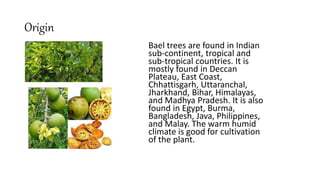
Bael trees are found in Indian
sub-continent, tropical and
sub-tropical countries. It is
mostly found in Deccan
Plateau, East Coast,
Chhattisgarh, Uttaranchal,
Jharkhand, Bihar, Himalayas,
and Madhya Pradesh. It is also
found in Egypt, Burma,
Bangladesh, Java, Philippines,
and Malay. The warm humid
climate is good for cultivation
of the plant.
Plantation
• Bael is usually propagated by seed. Bael can be grown in any type of soil such as
sandy, clay, water logged, unirrigated, acidic or alkaline in the pH range of 5–10.
Bael is usually propagated by seeds. The seeds are recalcitrant and can not be
stored for longer periods under normal storage conditions. Budding, patch or
shield on seedling rootstocks in June or July gives very good success. Air layering is
also successful under humid tropical conditions.
• The seedlings are not true to type and exhibit a lot of variability. It is, however,
essential to raise seedlings for rootstock. The seeds do not have dormancy, hence
fresh seeds are shown in June in a well prepared bed mixedwith properly
decomposed farmyard manure and sand. Seeds germinate within 3 weeks. The
seedlings become ready for transplanting 7 weeks after sowing. These seedlings
are ready for budding after a year. The scion shoots should be selected from
mother plants which are prolific bearers. Patch budding is ideal method with a
90% success rate.
Bael plants should be planted at a distance of 8m x 8m (Budded plants) or 10m x
10m (seedlings). Pits of 90cm x 90cm x 90cm size are dug and filled with a
mixture of top soil + 25 kg farmyard manure and 50 g gamma BHC up to a level of
6 cm from the ground level. Irrigate the pits to let the soil settle down. February-
March or July-August is the right time for planting
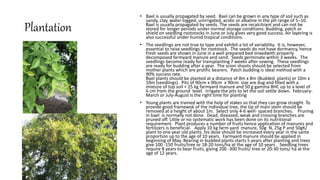
• Young plants are trained with the help of stakes so that they can grow straight. To
provide good framewok of the individual tree, the tip of main stem should be
removed at a height of about 1m. Select only 4-6 well- spaced branches. Pruning
in bael is normally not done. Dead, diseased, weak and crossing branches are
pruned off. Little or no systematic work has been done on its nutritional
requirement. Plant produces a number of fruits hence application of manures and
fertilizers is beneficial. Apply 10 kg farm yard manure, 50g N, 25g P and 50gK/
plant to one year old plants. his dose should be increased every year in the same
proportion up to the age of 10 years. Farmyard manure should be applied in
beginning of May. Bearing in budded plants starts 5 years after planting and trees
give 100 -150 fruits/tree or 18-20 tons/ha at the age of 10 years . Seedling trees
require 8 years to bear fruits, giving 200 -300 fruits/ tree or 20-30 tons/ ha at the
age of 12 years.
Uses
Bael has enough medicinal value because of the presence of various alkaloids, polysaccharides, and essential oils. And it shows high antioxidant activity. It is used in the anti-cancer
activity.
Baels are full of beta carotene, Vitamin B and a small quantity of Vitamin C and numerous bioactive compounds are extracted from it. In India, it has enough traditional value and has
been used to cure various diseases since time immemorial.
various parts of the tree are used for its curative, pesticidal and nutritive properties. Fresh half ripe Bael fruit is mildly astringent and used to cure dysentery, diarrhoea, hepatitis,
tuberculosis, dyspepsia and good for heart and brain. Roots have antidiarrhoetic, antidote to snake venom, anti-inflammatory and wound healing properties. The Bael fruit is one of the
most nutritious fruits, rich in riboflavin and used for the preparation of a number of products like candy, squash, toffee, slab, pulp powder and nectar. The leaves and seed oil have
pesticidal properties.
• Tonic prepared from flowers can be used in epilepsy.
• The extract also can be used for the treatment of dysentery and diabetics.
• The leaves are used for a diabetic.
• The infusion of leaves can be used against peptic ulcer. Leaves are also useful for the treatment of Jaundice, leucorrhea, wounds, deafness, conjunctivitis.
• Raw leaves can be used to cure gastric problems and irritation in the bowel.
• Oil prepared from leaves is proved to stop insect infestation.
• The leaves are also used in pediatric disorder. Extract from leaves is used in the anti-fungal activity.
• The leaf juice with honey is used during fever and cold.
• The fruits are used to prepare squashes and cold drinks. The unripe fruits can be used after roasting.
• It also can be used against the urinary complaint.
• The fruits are also used to increase appetite.
• Because of bitter and pungent taste of the fresh fruit, it can be used to decrease the blood sugar.
• The oil extracts from bael can be used to cure respiratory disorders like asthma or cold. This oil can also provide resistance to cold when applied on the scalp before a head bath.

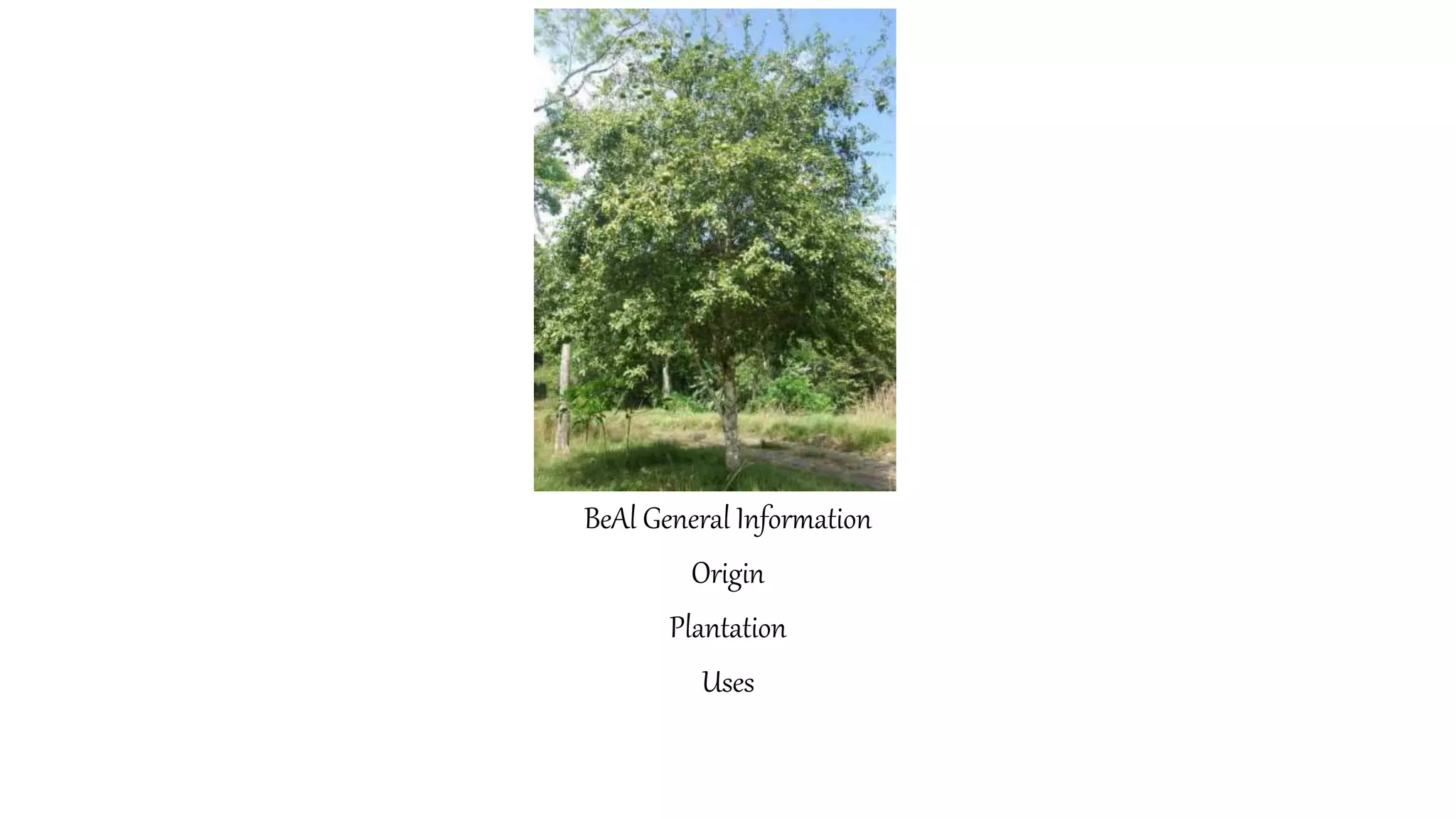
Beal tree

  • 1.
  • 2.
    General Information It iscalled Belva in Sanskrit and scientifically known as Aegle marmelos. This tree is native to Bangladesh and India. Bael is the most ancient sacred tree in India. Mostly, it is planted near the temple and used as a dedication to Gods. The leaves of the tree are used to worship Lord Shiva . This leaf is trifoliate which signifies the holy Trinity: Brahma, Vishnu and Shiva. It also signifies the three eyes of Lord Shiva. Indian bael (Aegle marmelos) is a deciduous tree, 6 to 8 meters in height with trifoliate aromatic leaves. Its flowers are nearly 2 cm wide, borne in clusters, sweet scented and greenish white. The 5 petals are oblong ovoid, blunt, thick, pale greenish white in color and dotted with oil glands. Stamens are numerous, sometimes coherent in bundles. Bael fruits are 5 to 7.5 cm in diameter, oblong pyriform in shape, with a gray or yellow rind. The pulp is sweet and thick, a yellowish- orange to brown color. It takes about 11 months for the fruit to ripen on the tree and they can reach the size of a large grapefruit and some are even larger. The shell is so hard it must be cracked with a hammer or machete. Because of its fruit it is known as golden apple, wood apple tree as well.
  • 3.
    Origin Bael trees arefound in Indian sub-continent, tropical and sub-tropical countries. It is mostly found in Deccan Plateau, East Coast, Chhattisgarh, Uttaranchal, Jharkhand, Bihar, Himalayas, and Madhya Pradesh. It is also found in Egypt, Burma, Bangladesh, Java, Philippines, and Malay. The warm humid climate is good for cultivation of the plant.
  • 4.
    Plantation • Bael isusually propagated by seed. Bael can be grown in any type of soil such as sandy, clay, water logged, unirrigated, acidic or alkaline in the pH range of 5–10. Bael is usually propagated by seeds. The seeds are recalcitrant and can not be stored for longer periods under normal storage conditions. Budding, patch or shield on seedling rootstocks in June or July gives very good success. Air layering is also successful under humid tropical conditions. • The seedlings are not true to type and exhibit a lot of variability. It is, however, essential to raise seedlings for rootstock. The seeds do not have dormancy, hence fresh seeds are shown in June in a well prepared bed mixedwith properly decomposed farmyard manure and sand. Seeds germinate within 3 weeks. The seedlings become ready for transplanting 7 weeks after sowing. These seedlings are ready for budding after a year. The scion shoots should be selected from mother plants which are prolific bearers. Patch budding is ideal method with a 90% success rate. Bael plants should be planted at a distance of 8m x 8m (Budded plants) or 10m x 10m (seedlings). Pits of 90cm x 90cm x 90cm size are dug and filled with a mixture of top soil + 25 kg farmyard manure and 50 g gamma BHC up to a level of 6 cm from the ground level. Irrigate the pits to let the soil settle down. February- March or July-August is the right time for planting • Young plants are trained with the help of stakes so that they can grow straight. To provide good framewok of the individual tree, the tip of main stem should be removed at a height of about 1m. Select only 4-6 well- spaced branches. Pruning in bael is normally not done. Dead, diseased, weak and crossing branches are pruned off. Little or no systematic work has been done on its nutritional requirement. Plant produces a number of fruits hence application of manures and fertilizers is beneficial. Apply 10 kg farm yard manure, 50g N, 25g P and 50gK/ plant to one year old plants. his dose should be increased every year in the same proportion up to the age of 10 years. Farmyard manure should be applied in beginning of May. Bearing in budded plants starts 5 years after planting and trees give 100 -150 fruits/tree or 18-20 tons/ha at the age of 10 years . Seedling trees require 8 years to bear fruits, giving 200 -300 fruits/ tree or 20-30 tons/ ha at the age of 12 years.
  • 5.
    Uses Bael has enoughmedicinal value because of the presence of various alkaloids, polysaccharides, and essential oils. And it shows high antioxidant activity. It is used in the anti-cancer activity. Baels are full of beta carotene, Vitamin B and a small quantity of Vitamin C and numerous bioactive compounds are extracted from it. In India, it has enough traditional value and has been used to cure various diseases since time immemorial. various parts of the tree are used for its curative, pesticidal and nutritive properties. Fresh half ripe Bael fruit is mildly astringent and used to cure dysentery, diarrhoea, hepatitis, tuberculosis, dyspepsia and good for heart and brain. Roots have antidiarrhoetic, antidote to snake venom, anti-inflammatory and wound healing properties. The Bael fruit is one of the most nutritious fruits, rich in riboflavin and used for the preparation of a number of products like candy, squash, toffee, slab, pulp powder and nectar. The leaves and seed oil have pesticidal properties. • Tonic prepared from flowers can be used in epilepsy. • The extract also can be used for the treatment of dysentery and diabetics. • The leaves are used for a diabetic. • The infusion of leaves can be used against peptic ulcer. Leaves are also useful for the treatment of Jaundice, leucorrhea, wounds, deafness, conjunctivitis. • Raw leaves can be used to cure gastric problems and irritation in the bowel. • Oil prepared from leaves is proved to stop insect infestation. • The leaves are also used in pediatric disorder. Extract from leaves is used in the anti-fungal activity. • The leaf juice with honey is used during fever and cold. • The fruits are used to prepare squashes and cold drinks. The unripe fruits can be used after roasting. • It also can be used against the urinary complaint. • The fruits are also used to increase appetite. • Because of bitter and pungent taste of the fresh fruit, it can be used to decrease the blood sugar. • The oil extracts from bael can be used to cure respiratory disorders like asthma or cold. This oil can also provide resistance to cold when applied on the scalp before a head bath.