Methods in Teaching: Developing Classroom
Instructional Techniques
By: Ahmad Khan
Lecturer, ASBA & ASIT (English)
Prepared and Presented By: Ahmad Khan 1
Objectives:
Become aware of the use of methods, techniques and strategies in your teaching.
Learn about other methods and their application.
Discuss the connection between teaching objectives and methods.
Prepared and Presented By: Ahmad Khan 2
Teaching ?
"Teaching is an art – but effective teaching consists of a set of
skills that can be acquired, improved and extended."(Gralki, 1990)
Prepared and Presented By: Ahmad Khan 3
Effective Teaching Applies…
Methods
Techniques
Strategies
Prepared and Presented By: Ahmad Khan 4
Procedure:
First, please consider your own applicationof methods. Which methods did you use? Let us first
roughly define a method as “any sort of teaching activity”. List at least three methods you know, or you
used or experienced during your studies. Now describe how you succeeded in applying it.
Chart:
Name of the method Description / When and
why did you apply it?
What did you
experience?
Advantage / What was
good about using this
method and why?
Disadvantage / What was bad
about using the method?
........................ ......................... ............................ ...............................
Prepared and Presented By: Ahmad Khan 5
What is a Method?
A method is a description of the way that information or behavior is carried forward
or consolidated during the instructional process.
Examples
 "No interaction": lecture---------------------------------------------
 "teacher centered interaction": interactive lecture -------------
 "Group centered interaction": group work ------------------------
Prepared and Presented By: Ahmad Khan 6
What is a Technique?
A technique is a detailed list of rules or a guideline for any (teaching) activity.
Examples
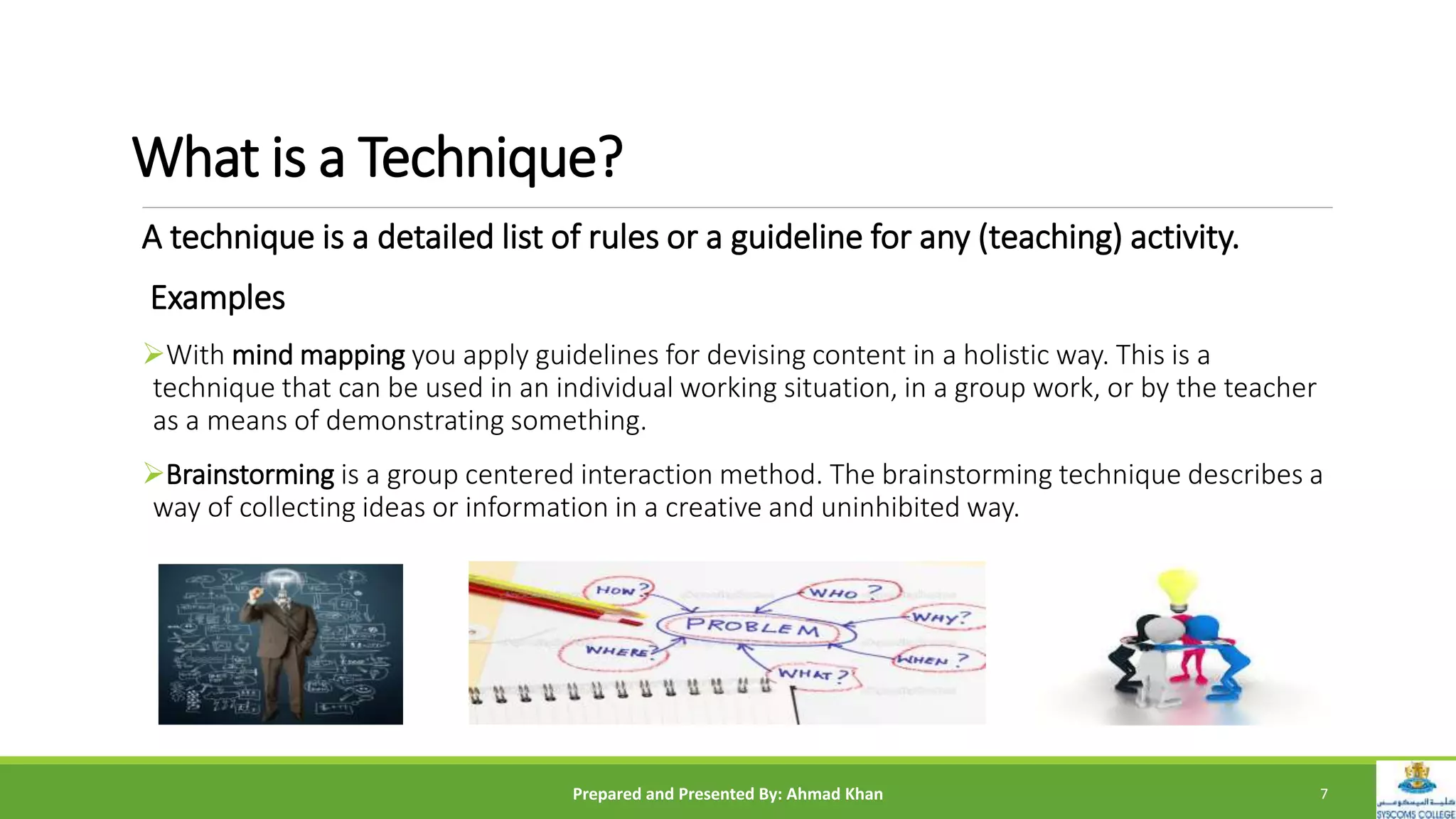
With mind mapping you apply guidelines for devising content in a holistic way. This is a
technique that can be used in an individual working situation, in a group work, or by the teacher
as a means of demonstrating something.
Brainstorming is a group centered interaction method. The brainstorming technique describes a
way of collecting ideas or information in a creative and uninhibited way.
Prepared and Presented By: Ahmad Khan 7
What is a Strategy?
A strategy defines the basic procedure of how the content is
elaborated during the teaching process.
There are two possible alternatives:
1. The Cognitive Approach
2. The Affective Approach
Prepared and Presented By: Ahmad Khan 8
1. The Cognitive Approach (Teacher-Centered)
The cognitive approach is expository, as information is given in a structured and
organized process (top-down). The student’s role in this is passive, consuming and
“breathing in”. The teacher is the constitutive element: he informs, tells, shows, asks,
corrects, etc.
Prepared and Presented By: Ahmad Khan 9
2. The Affective Approach (Student-Centered)
The affective approach is based on “discovering”, and uses the curiosity of the student
to let him find out something on his own. There is little or no information given, just an
issue to explore. Students have to be active and inquisitive to solve the problem. The
teacher is not involved. In this student centered strategy, students learn by doing, by
experiencing, and by observing.
Prepared and Presented By: Ahmad Khan 10
Role of a Teacher:
Prepared and Presented By: Ahmad Khan 11
A teacher can be described as…
Prepared and Presented By: Ahmad Khan 12
List of Methods
Lecture
Presentation
Discussion
Lecture discussion
Group work
Cooperative/Collaborative learning
Puzzle method (Jigsaw teaching techniques)
Role play
Case method
Debate
Fishbowl
Brainstorming
Buzz groups
Prepared and Presented By: Ahmad Khan 13
Methods and Objectives
The methods you want to apply in your teaching are tightly linked to the
objectives you formulated in your planning process.
To select a method, the two following questions should be answered:
 What can I do to help the students to achieve the teaching objectives?
 What do the students have to do to achieve the teaching objectives?
Prepared and Presented By: Ahmad Khan 14
How to choose the appropriate method?
1. You can choose the method based on the level of BLOOMS TAXONOMY.
Level one way - no group
activity
teacher centered
activities
group centered
activities
Knowledge lectures
presentations
reading
giving individual tasks
lecture discussion
laboratory work
exchange of experience
brainstorming
collecting previous
knowledge
Comprehension lecture
presentation by students
individual exercise
lecture discussion
laboratory work
debate
group work, discussion
(e.g. fishbowl)
problem solving
simulation, role play
Application
-
laboratory work
tutorials
practical exercises
field work
project work
problem solving
simulation, case study
Transfer (analysis,
synthesis and
evaluation)
-
discussions
experiments
laboratory work
strategic games
experiments
problem solving
Prepared and Presented By: Ahmad Khan 15
2. You can also choose the method considering theGROUP SIZE.
Pairs (2): Any group work which is not based on collecting a lot of ideas – it is more for the exchange of
knowledge or experience.
Small group (3-10): Any group work based on collecting ideas, the exchange of knowledge or experience, or
producing something.
Medium group (10-20): Interactive lectures, case studies etc. Divide the class in small groups.
Large group (more than 20): Lectures, augmented with buzz groups and discussions, expert panel, open
space, separating in small group activities, and project work.
Prepared and Presented By: Ahmad Khan 16
Conclusion:
If you choose a method you also have to take into account the surrounding or
environmental constraints:
How long is your lecture, how much “new content” do you want to introduce?
How many students do you have in the class?
How much time do you have?
Is the classroom appropriate for the groups to work?
Keep in mind, that student centered methods are time consuming, but very
motivating and efficient!
Prepared and Presented By: Ahmad Khan 17
Source:
https://www.google.ae/?gfe_rd=cr&ei=ePALVdO3MMzDVPWYgegH#q=teaching+methods+techniques+and+strategies
Thank You
?
Prepared and Presented By: Ahmad Khan 18

Methods in teaching

  • 1.
    Methods in Teaching:Developing Classroom Instructional Techniques By: Ahmad Khan Lecturer, ASBA & ASIT (English) Prepared and Presented By: Ahmad Khan 1
  • 2.
    Objectives: Become aware ofthe use of methods, techniques and strategies in your teaching. Learn about other methods and their application. Discuss the connection between teaching objectives and methods. Prepared and Presented By: Ahmad Khan 2
  • 3.
    Teaching ? "Teaching isan art – but effective teaching consists of a set of skills that can be acquired, improved and extended."(Gralki, 1990) Prepared and Presented By: Ahmad Khan 3
  • 4.
  • 5.
    Procedure: First, please consideryour own applicationof methods. Which methods did you use? Let us first roughly define a method as “any sort of teaching activity”. List at least three methods you know, or you used or experienced during your studies. Now describe how you succeeded in applying it. Chart: Name of the method Description / When and why did you apply it? What did you experience? Advantage / What was good about using this method and why? Disadvantage / What was bad about using the method? ........................ ......................... ............................ ............................... Prepared and Presented By: Ahmad Khan 5
  • 6.
    What is aMethod? A method is a description of the way that information or behavior is carried forward or consolidated during the instructional process. Examples  "No interaction": lecture---------------------------------------------  "teacher centered interaction": interactive lecture -------------  "Group centered interaction": group work ------------------------ Prepared and Presented By: Ahmad Khan 6
  • 7.
    What is aTechnique? A technique is a detailed list of rules or a guideline for any (teaching) activity. Examples With mind mapping you apply guidelines for devising content in a holistic way. This is a technique that can be used in an individual working situation, in a group work, or by the teacher as a means of demonstrating something. Brainstorming is a group centered interaction method. The brainstorming technique describes a way of collecting ideas or information in a creative and uninhibited way. Prepared and Presented By: Ahmad Khan 7
  • 8.
    What is aStrategy? A strategy defines the basic procedure of how the content is elaborated during the teaching process. There are two possible alternatives: 1. The Cognitive Approach 2. The Affective Approach Prepared and Presented By: Ahmad Khan 8
  • 9.
    1. The CognitiveApproach (Teacher-Centered) The cognitive approach is expository, as information is given in a structured and organized process (top-down). The student’s role in this is passive, consuming and “breathing in”. The teacher is the constitutive element: he informs, tells, shows, asks, corrects, etc. Prepared and Presented By: Ahmad Khan 9
  • 10.
    2. The AffectiveApproach (Student-Centered) The affective approach is based on “discovering”, and uses the curiosity of the student to let him find out something on his own. There is little or no information given, just an issue to explore. Students have to be active and inquisitive to solve the problem. The teacher is not involved. In this student centered strategy, students learn by doing, by experiencing, and by observing. Prepared and Presented By: Ahmad Khan 10
  • 11.
    Role of aTeacher: Prepared and Presented By: Ahmad Khan 11
  • 12.
    A teacher canbe described as… Prepared and Presented By: Ahmad Khan 12
  • 13.
    List of Methods Lecture Presentation Discussion Lecturediscussion Group work Cooperative/Collaborative learning Puzzle method (Jigsaw teaching techniques) Role play Case method Debate Fishbowl Brainstorming Buzz groups Prepared and Presented By: Ahmad Khan 13
  • 14.
    Methods and Objectives Themethods you want to apply in your teaching are tightly linked to the objectives you formulated in your planning process. To select a method, the two following questions should be answered:  What can I do to help the students to achieve the teaching objectives?  What do the students have to do to achieve the teaching objectives? Prepared and Presented By: Ahmad Khan 14
  • 15.
    How to choosethe appropriate method? 1. You can choose the method based on the level of BLOOMS TAXONOMY. Level one way - no group activity teacher centered activities group centered activities Knowledge lectures presentations reading giving individual tasks lecture discussion laboratory work exchange of experience brainstorming collecting previous knowledge Comprehension lecture presentation by students individual exercise lecture discussion laboratory work debate group work, discussion (e.g. fishbowl) problem solving simulation, role play Application - laboratory work tutorials practical exercises field work project work problem solving simulation, case study Transfer (analysis, synthesis and evaluation) - discussions experiments laboratory work strategic games experiments problem solving Prepared and Presented By: Ahmad Khan 15
  • 16.
    2. You canalso choose the method considering theGROUP SIZE. Pairs (2): Any group work which is not based on collecting a lot of ideas – it is more for the exchange of knowledge or experience. Small group (3-10): Any group work based on collecting ideas, the exchange of knowledge or experience, or producing something. Medium group (10-20): Interactive lectures, case studies etc. Divide the class in small groups. Large group (more than 20): Lectures, augmented with buzz groups and discussions, expert panel, open space, separating in small group activities, and project work. Prepared and Presented By: Ahmad Khan 16
  • 17.
    Conclusion: If you choosea method you also have to take into account the surrounding or environmental constraints: How long is your lecture, how much “new content” do you want to introduce? How many students do you have in the class? How much time do you have? Is the classroom appropriate for the groups to work? Keep in mind, that student centered methods are time consuming, but very motivating and efficient! Prepared and Presented By: Ahmad Khan 17
  • 18.