Pedagogical content
Knowledge –Lee shulman,
Goldston
Submitted by:
Surbhi Agrawal
153539
THE TEACHER
 In recent years the profession of teaching has reached a
maturity to the point of being considered a producer of
own knowledge necessary to the practice.
 The teacher is no longer seen as a technician, but as an
intellectual actor and the specialized literature
advocates teaching as a profession, and it recognizes
that the teacher has “knowledge base”, a set of skills
that are developed during his teaching activity.
Contd…
 Every profession has a body of knowledge that set it
apart from others and makes people who master such
skills considered suitable professionals to exercise the
profession.
 Interestingly, for the profession that educates all other,
the teachers; there is no consensus about the body of
knowledge necessary to be a teacher, even about its
existence.
What Matters Most in the Professional
Learning of Content Teachers in Classrooms
with Diverse Student Populations
 The professional learning of teachers is an ongoing
process of knowledge building and skill development in
effective teaching practice (NPEAT, 2003).
 In the context of a diverse society, it is the process
through which teachers in high minority schools master
both content and diverse student pedagogy.
 In its pursuit of equity in education, the Intercultural
Development Research Association continually provides
many professional learning opportunities to teachers of
diverse student populations.
Contd…
 These represent an important part of IDRA efforts to
increase teaching quality and equity inside today’s
classrooms. IDRA president Dr. María "Cuca" Robledo
Montecel describes this major reform in a framework for
quality education, the Quality Schools Action Framework
(2005)
 Through several of IDRA’s professional development
models, like Math Smart!, Science Smart! and Coaching
and Mentoring of Novice Teachers, coaching and
mentoring are provided to beginning teachers and to
other teachers who strive to provide rigorous and
relevant content instruction to English language learners
and other culturally diverse students
Focus on Teacher Professional
Learning in Content Areas
 Many government-initiated school reform programs in
the United States focus substantially on the professional
learning of teachers).
 Content area teaching experts similarly seek the best
knowledge on how to prepare teachers of adolescents to
meet the demands unique to their specialization
Importance of Professional
Learning through an Equity Lens
 If all content teachers are formally trained, why is
professional learning still necessary?
 Both research and first-hand observations of teaching
and learning dynamics have discovered that what a
teacher knows and what he or she does and believes
have a major influence on how students learn.
Pedagogical Content
Knowledge
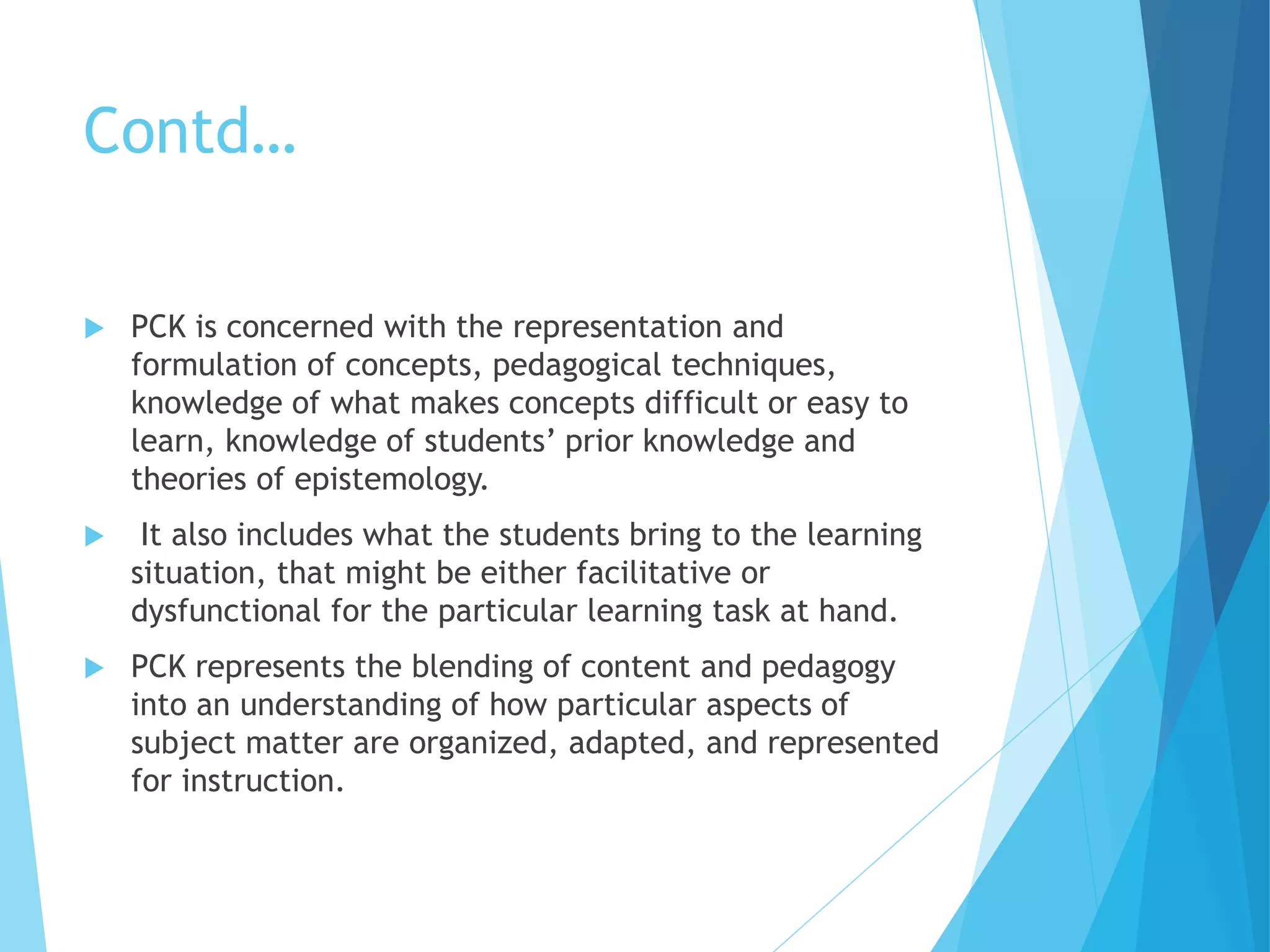
 In 1986, Shulman claimed that the emphases on teachers'
subject knowledge and pedagogy were being treated as
mutually exclusive. He believed that teacher education
programs should combine the two knowledge fields.
 To address this dichotomy, he introduced the notion
of pedagogical content knowledge (PCK) that includes
pedagogical knowledge and content knowledge
 Pedagogical knowledge means the “how” of teaching,
generally acquired through education coursework and
personal experiences. Content knowledge, on the other
hand, is the “what” of teaching. It is different from the
knowledge of a disciplinary expert and from general
pedagogical knowledge.
 In Shulman’s view, pedagogical content knowledge is a
form of practical knowledge that is used by teachers to
guide their actions in highly contextualized classroom
settings.
Contd..
 This form of practical knowledge entails, among other
things:
A. knowledge of how to structure and represent academic
content for direct teaching to students
B. knowledge of the common conceptions, misconceptions,
and difficulties that students encounter when learning
particular content
C. knowledge of the specific teaching strategies that can be
used to address students’ learning needs in particular
classroom circumstances
Contd…
 PCK is concerned with the representation and
formulation of concepts, pedagogical techniques,
knowledge of what makes concepts difficult or easy to
learn, knowledge of students’ prior knowledge and
theories of epistemology.
 It also includes what the students bring to the learning
situation, that might be either facilitative or
dysfunctional for the particular learning task at hand.
 PCK represents the blending of content and pedagogy
into an understanding of how particular aspects of
subject matter are organized, adapted, and represented
for instruction.
Key Elements or Principles by
Goldston
 Pedagogical content knowledge is a special combination
of content and pedagogy that is uniquely constructed by
teachers and thus is the "special" form of an educator’s
professional knowing and understanding.
 Pedagogical content knowledge also is known as craft
knowledge. It comprises integrated knowledge
representing teachers’ accumulated wisdom with respect
to their teaching practice: pedagogy, students, subject
matter, and the curriculum.
 Pedagogical content knowledge must be addressed within
the context of a diverse pedagogy.
How PCK is Developed
 Pedagogical content knowledge is deeply rooted in a
teacher’s everyday work. However, it is not opposite to
theoretical knowledge. It encompasses both theory
learned during teacher preparation as well as
experiences gained from ongoing schooling activities.
 The development of pedagogical content knowledge is
influenced by factors related to the teacher’s personal
background and by the context in which he or she works.
 Pedagogical content knowledge is deeply rooted in the
experiences and assets of students, their families and
communities.
Pedagogical Content Knowledge
in Core Content Areas
 PCK illustrates how the subject matter of a particular
discipline is transformed for communication with
learners.
 It includes recognition of what makes specific topics
difficult to learn, the conceptions students bring to the
learning of these concepts, and teaching strategies
tailored to this specific teaching situation.
 To teach all students according to today’s standards,
teachers indeed need to understand subject matter
deeply and flexibly so they can help students map their
own ideas, relate one idea to another, and re-direct their
thinking to create powerful learning.
Conclusion
 At the heart of effective content teaching is the
teachers’ pedagogical content knowledge.
 If we are to improve the quality of teaching and learning
in critical core content areas, we need to resist some old
traditions in professional learning

Pedagogical content knowledge –lee shulman, goldston

  • 1.
    Pedagogical content Knowledge –Leeshulman, Goldston Submitted by: Surbhi Agrawal 153539
  • 2.
    THE TEACHER  Inrecent years the profession of teaching has reached a maturity to the point of being considered a producer of own knowledge necessary to the practice.  The teacher is no longer seen as a technician, but as an intellectual actor and the specialized literature advocates teaching as a profession, and it recognizes that the teacher has “knowledge base”, a set of skills that are developed during his teaching activity.
  • 3.
    Contd…  Every professionhas a body of knowledge that set it apart from others and makes people who master such skills considered suitable professionals to exercise the profession.  Interestingly, for the profession that educates all other, the teachers; there is no consensus about the body of knowledge necessary to be a teacher, even about its existence.
  • 4.
    What Matters Mostin the Professional Learning of Content Teachers in Classrooms with Diverse Student Populations  The professional learning of teachers is an ongoing process of knowledge building and skill development in effective teaching practice (NPEAT, 2003).  In the context of a diverse society, it is the process through which teachers in high minority schools master both content and diverse student pedagogy.  In its pursuit of equity in education, the Intercultural Development Research Association continually provides many professional learning opportunities to teachers of diverse student populations.
  • 5.
    Contd…  These representan important part of IDRA efforts to increase teaching quality and equity inside today’s classrooms. IDRA president Dr. María "Cuca" Robledo Montecel describes this major reform in a framework for quality education, the Quality Schools Action Framework (2005)  Through several of IDRA’s professional development models, like Math Smart!, Science Smart! and Coaching and Mentoring of Novice Teachers, coaching and mentoring are provided to beginning teachers and to other teachers who strive to provide rigorous and relevant content instruction to English language learners and other culturally diverse students
  • 6.
    Focus on TeacherProfessional Learning in Content Areas  Many government-initiated school reform programs in the United States focus substantially on the professional learning of teachers).  Content area teaching experts similarly seek the best knowledge on how to prepare teachers of adolescents to meet the demands unique to their specialization
  • 7.
    Importance of Professional Learningthrough an Equity Lens  If all content teachers are formally trained, why is professional learning still necessary?  Both research and first-hand observations of teaching and learning dynamics have discovered that what a teacher knows and what he or she does and believes have a major influence on how students learn.
  • 8.
    Pedagogical Content Knowledge  In1986, Shulman claimed that the emphases on teachers' subject knowledge and pedagogy were being treated as mutually exclusive. He believed that teacher education programs should combine the two knowledge fields.  To address this dichotomy, he introduced the notion of pedagogical content knowledge (PCK) that includes pedagogical knowledge and content knowledge
  • 9.
     Pedagogical knowledgemeans the “how” of teaching, generally acquired through education coursework and personal experiences. Content knowledge, on the other hand, is the “what” of teaching. It is different from the knowledge of a disciplinary expert and from general pedagogical knowledge.  In Shulman’s view, pedagogical content knowledge is a form of practical knowledge that is used by teachers to guide their actions in highly contextualized classroom settings.
  • 10.
    Contd..  This formof practical knowledge entails, among other things: A. knowledge of how to structure and represent academic content for direct teaching to students B. knowledge of the common conceptions, misconceptions, and difficulties that students encounter when learning particular content C. knowledge of the specific teaching strategies that can be used to address students’ learning needs in particular classroom circumstances
  • 11.
    Contd…  PCK isconcerned with the representation and formulation of concepts, pedagogical techniques, knowledge of what makes concepts difficult or easy to learn, knowledge of students’ prior knowledge and theories of epistemology.  It also includes what the students bring to the learning situation, that might be either facilitative or dysfunctional for the particular learning task at hand.  PCK represents the blending of content and pedagogy into an understanding of how particular aspects of subject matter are organized, adapted, and represented for instruction.
  • 13.
    Key Elements orPrinciples by Goldston  Pedagogical content knowledge is a special combination of content and pedagogy that is uniquely constructed by teachers and thus is the "special" form of an educator’s professional knowing and understanding.  Pedagogical content knowledge also is known as craft knowledge. It comprises integrated knowledge representing teachers’ accumulated wisdom with respect to their teaching practice: pedagogy, students, subject matter, and the curriculum.  Pedagogical content knowledge must be addressed within the context of a diverse pedagogy.
  • 14.
    How PCK isDeveloped  Pedagogical content knowledge is deeply rooted in a teacher’s everyday work. However, it is not opposite to theoretical knowledge. It encompasses both theory learned during teacher preparation as well as experiences gained from ongoing schooling activities.  The development of pedagogical content knowledge is influenced by factors related to the teacher’s personal background and by the context in which he or she works.  Pedagogical content knowledge is deeply rooted in the experiences and assets of students, their families and communities.
  • 15.
    Pedagogical Content Knowledge inCore Content Areas  PCK illustrates how the subject matter of a particular discipline is transformed for communication with learners.  It includes recognition of what makes specific topics difficult to learn, the conceptions students bring to the learning of these concepts, and teaching strategies tailored to this specific teaching situation.  To teach all students according to today’s standards, teachers indeed need to understand subject matter deeply and flexibly so they can help students map their own ideas, relate one idea to another, and re-direct their thinking to create powerful learning.
  • 16.
    Conclusion  At theheart of effective content teaching is the teachers’ pedagogical content knowledge.  If we are to improve the quality of teaching and learning in critical core content areas, we need to resist some old traditions in professional learning