This presentation was funded by a grant from the ISDH and the CDC
Rapid Response Project
Grant 5 NU17CE002721-03-00. For more information, contact:
Judy.Reuter@rhin.com [Jul 2019]
RHI-EAGLE HIGHLANDS INPATIENT AND OUTPATIENT SERVICES
4141 Shore Drive
Indianapolis, IN 46254
RHI-NORTHWEST BRAIN INJURY CENTER 9531 Valparaiso Court
Indianapolis, IN 46268
RHI-CARMEL OUTPATIENT SERVICES
12425 Old Meridian Street, Suite B2
Carmel, IN 46032
RHI is a community collaboration between Indiana University Health and St. Vincent
Health
317-329-2000 | rhin.com
What is Brain Injury?
Flora McConnell Hammond, MD
Professor & Chair, Physical Medicine & Rehabilitation
Indiana University School of Medicine
Chief of Medical Affairs, Rehabilitation Hospital of Indiana
What is Brain Injury?
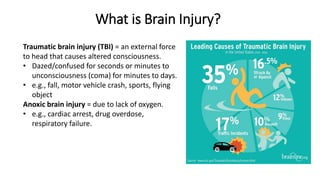
Traumatic brain injury (TBI) = an external force
to head that causes altered consciousness.
• Dazed/confused for seconds or minutes to
unconsciousness (coma) for minutes to days.
• e.g., fall, motor vehicle crash, sports, flying
object
Anoxic brain injury = due to lack of oxygen.
• e.g., cardiac arrest, drug overdose,
respiratory failure.
Who does brain injury affect?: Anyone, Anytime, Anywhere …
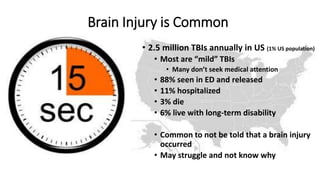
• 2.5 million TBIs annually in US (1% US population)
• Most are “mild” TBIs
• Many don’t seek medical attention
• 88% seen in ED and released
• 11% hospitalized
• 3% die
• 6% live with long-term disability
• Common to not be told that a brain injury
occurred
• May struggle and not know why
Brain Injury is Common
Mild TBI is AKA:
• Concussion
• Mild head injury
• Minimal head injury
• Benign head Injury
• Trivial head injury
• Low risk
• Grade I, Class I
• Dinged
• Bell Rung
• Acquired brain injury
• Complicated vs. uncomplicated
• Commotio cerebri
Concussion
=
Mild TBI
Definition of Mild TBI
An applied force that causes:
• Altered mental state at the
time of the incident; or
• Loss of consciousness <30
minutes; or
• Loss of memory of the
event immediately before
or after (PTA) <24 hours
• Loss of consciousness is not
related to symptom development
• Brain injury diagnosis is not based
on not imaging
• CT scan imaging is normal in most
mild TBI (80-90%) & some moderate-
to-severe TBI
• Diffuse axonal injury (due to shearing
forces) not always seen on CT scan
Mild Traumatic Brain Injury
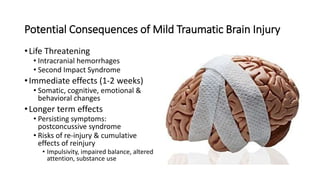
•Life Threatening
• Intracranial hemorrhages
• Second Impact Syndrome
•Immediate effects (1-2 weeks)
• Somatic, cognitive, emotional &
behavioral changes
•Longer term effects
• Persisting symptoms:
postconcussive syndrome
• Risks of re-injury & cumulative
effects of reinjury
• Impulsivity, impaired balance, altered
attention, substance use
Potential Consequences of Mild Traumatic Brain Injury
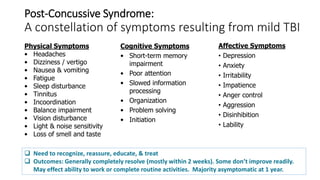
Post-Concussive Syndrome:
A constellation of symptoms resulting from mild TBI
Physical Symptoms
• Headaches
• Dizziness / vertigo
• Nausea & vomiting
• Fatigue
• Sleep disturbance
• Tinnitus
• Incoordination
• Balance impairment
• Vision disturbance
• Light & noise sensitivity
• Loss of smell and taste
Cognitive Symptoms
• Short-term memory
impairment
• Poor attention
• Slowed information
processing
• Organization
• Problem solving
• Initiation
Affective Symptoms
• Depression
• Anxiety
• Irritability
• Impatience
• Anger control
• Aggression
• Disinhibition
• Lability
 Need to recognize, reassure, educate, & treat
 Outcomes: Generally completely resolve (mostly within 2 weeks). Some don’t improve readily.
May effect ability to work or complete routine activities. Majority asymptomatic at 1 year.
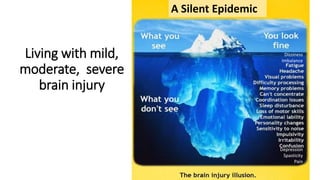
Living with mild,
moderate, severe
brain injury
Dizziness
Imbalance
Depression
Spasticity
Pain
A Silent Epidemic
Pain & Brain Injury
• Fractures, and later possible
osteoarthritis
• Complex regional pain syndrome
• Peripheral nerve injury
• Headaches
• Management of pain after brain
injury has unique considerations
• Important to know if one has history
of brain injury

What-is-Brain-Injury-Flora-2019-7-25.pptx

  • 1.
    This presentation wasfunded by a grant from the ISDH and the CDC Rapid Response Project Grant 5 NU17CE002721-03-00. For more information, contact: Judy.Reuter@rhin.com [Jul 2019] RHI-EAGLE HIGHLANDS INPATIENT AND OUTPATIENT SERVICES 4141 Shore Drive Indianapolis, IN 46254 RHI-NORTHWEST BRAIN INJURY CENTER 9531 Valparaiso Court Indianapolis, IN 46268 RHI-CARMEL OUTPATIENT SERVICES 12425 Old Meridian Street, Suite B2 Carmel, IN 46032 RHI is a community collaboration between Indiana University Health and St. Vincent Health 317-329-2000 | rhin.com What is Brain Injury? Flora McConnell Hammond, MD Professor & Chair, Physical Medicine & Rehabilitation Indiana University School of Medicine Chief of Medical Affairs, Rehabilitation Hospital of Indiana
  • 2.
    What is BrainInjury? Traumatic brain injury (TBI) = an external force to head that causes altered consciousness. • Dazed/confused for seconds or minutes to unconsciousness (coma) for minutes to days. • e.g., fall, motor vehicle crash, sports, flying object Anoxic brain injury = due to lack of oxygen. • e.g., cardiac arrest, drug overdose, respiratory failure.
  • 3.
    Who does braininjury affect?: Anyone, Anytime, Anywhere …
  • 4.
    • 2.5 millionTBIs annually in US (1% US population) • Most are “mild” TBIs • Many don’t seek medical attention • 88% seen in ED and released • 11% hospitalized • 3% die • 6% live with long-term disability • Common to not be told that a brain injury occurred • May struggle and not know why Brain Injury is Common
  • 5.
    Mild TBI isAKA: • Concussion • Mild head injury • Minimal head injury • Benign head Injury • Trivial head injury • Low risk • Grade I, Class I • Dinged • Bell Rung • Acquired brain injury • Complicated vs. uncomplicated • Commotio cerebri Concussion = Mild TBI
  • 6.
    Definition of MildTBI An applied force that causes: • Altered mental state at the time of the incident; or • Loss of consciousness <30 minutes; or • Loss of memory of the event immediately before or after (PTA) <24 hours • Loss of consciousness is not related to symptom development • Brain injury diagnosis is not based on not imaging • CT scan imaging is normal in most mild TBI (80-90%) & some moderate- to-severe TBI • Diffuse axonal injury (due to shearing forces) not always seen on CT scan Mild Traumatic Brain Injury
  • 7.
    •Life Threatening • Intracranialhemorrhages • Second Impact Syndrome •Immediate effects (1-2 weeks) • Somatic, cognitive, emotional & behavioral changes •Longer term effects • Persisting symptoms: postconcussive syndrome • Risks of re-injury & cumulative effects of reinjury • Impulsivity, impaired balance, altered attention, substance use Potential Consequences of Mild Traumatic Brain Injury
  • 8.
    Post-Concussive Syndrome: A constellationof symptoms resulting from mild TBI Physical Symptoms • Headaches • Dizziness / vertigo • Nausea & vomiting • Fatigue • Sleep disturbance • Tinnitus • Incoordination • Balance impairment • Vision disturbance • Light & noise sensitivity • Loss of smell and taste Cognitive Symptoms • Short-term memory impairment • Poor attention • Slowed information processing • Organization • Problem solving • Initiation Affective Symptoms • Depression • Anxiety • Irritability • Impatience • Anger control • Aggression • Disinhibition • Lability  Need to recognize, reassure, educate, & treat  Outcomes: Generally completely resolve (mostly within 2 weeks). Some don’t improve readily. May effect ability to work or complete routine activities. Majority asymptomatic at 1 year.
  • 9.
    Living with mild, moderate,severe brain injury Dizziness Imbalance Depression Spasticity Pain A Silent Epidemic
  • 10.
    Pain & BrainInjury • Fractures, and later possible osteoarthritis • Complex regional pain syndrome • Peripheral nerve injury • Headaches • Management of pain after brain injury has unique considerations • Important to know if one has history of brain injury

Editor's Notes

  • #4 Anyone… Young (late teens – 20’s) due to MVC and sports. Elderly due to falls. Traumatic BI: Most commonly due to falls & MVC. Anoxic brain injury: Most commonly due to cardiac arrest & drug overdose. TBI causes altered consciousness: Dazed/confused for seconds or minutes to unconsciousness (coma) for minutes to days.
  • #5 Extremely common: 1 every 15 seconds. Most walk away with no treatment needed. Many other need treatment. 11% hospitalized only 6% go on to live with longterm disability Many not diagnosed or never told that they had a brain injury.
  • #6 Concussion is a brain injury,… a mild TBI. Lots of terms for mild TBI. “Mild” --- misleading -just what it looks like in the first 24 hours; does not have to do with outcome/consequences
  • #7 MILD TBI: What is it: dazed, confused, +/- LOC (less than 30 minutes) LOC not required & does not determine presence of longterm effects CT SCAN is usually normal; Occasionally have findings on CT scan (10-20%). Brain injury diagnosis is not based on imaging.
  • #8 Risks: -Intracranial bleeding in hours after the injury (elderly, on anticoagulants) -2nd impact syndrome: Repeat injury soon after  second impact syndrome [Severe brain swelling resulting from suffering a 2nd TBI before recovering from a 1st TBI] Catastrophic (50% die). Refractory to treatment. Swelling  brain herniation  severe damage/death. (Younger population (< 21 y.o.) at high risk due to higher water volume & less space within the skull to accommodate for swelling.) - Outcomes: - Generally completely resolve (mostly within 2 weeks). - Some don’t improve readily. May effect ability to work or complete routine activities. - Majority asymptomatic at 1 year.
  • #10 .
  • #11 10