1
STUDY AREA DELINEATION &
PLANNING SURVEYS
2
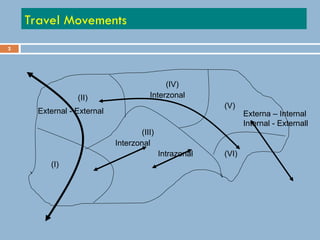
Travel Movements
(I)
(II)
(III)
(VI)
(V)
(IV)
Intrazonal
Interzonal
Interzonal
Externa – Internal
Internal - Externall
External - External
3
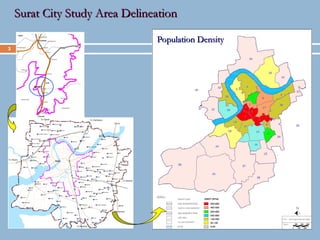
Surat City Study Area Delineation
Population Density
Population Density
4
5
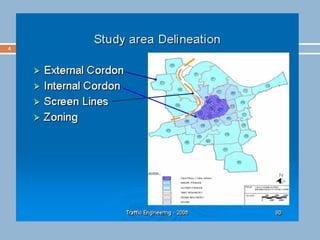
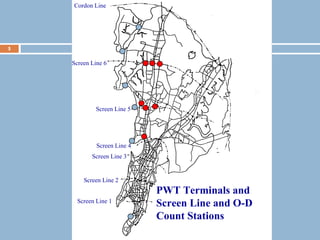
Screen Line 1
Screen Line 2
Screen Line 3
Screen Line 5
Screen Line 4
Screen Line 6
Cordon Line
PWT Terminals and
Screen Line and O-D
Count Stations
6
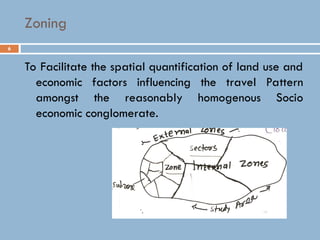
Zoning
To Facilitate the spatial quantification of land use and
economic factors influencing the travel Pattern
amongst the reasonably homogenous Socio
economic conglomerate.
7
STTP - APUTP09
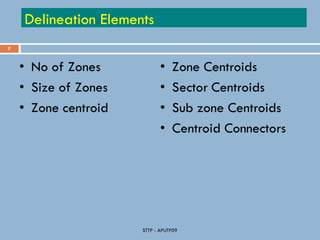
Delineation Elements
8
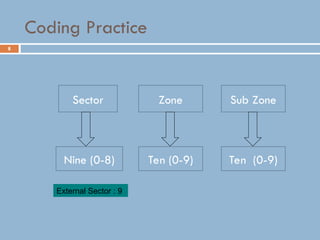
Coding Practice
Ten (0-9)
Sector Zone Sub Zone
Nine (0-8) Ten (0-9)
External Sector : 9
9
STTP - APUTP09
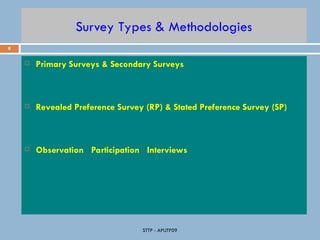
Survey Types & Methodologies
 Primary Surveys & Secondary Surveys
 Revealed Preference Survey (RP) & Stated Preference Survey (SP)
 Observation Participation Interviews
10
Conti……
 Survey Approaches:
1. At the Home
2. During The Trip
3. At the destination end of Trip
11
STTP - APUTP09
Urban Transportation Planning Studies
 Inventories
 Classificational Studies
 Volume Studies
 Capacity Studies
 Pedestrians Studies
 Mass Transits Studies
 Parking Studies
 O-D Studies
 Traffic Impact Studies
12
Transportation Planning Studies
Transportation Planning Studies:
 Inventories
1. Road Way: Geometrics, Control Devices, Pavement
Condition.
2. Parking Inventories.
3. Transit Inventories.
4. Land use and Zoning.
13
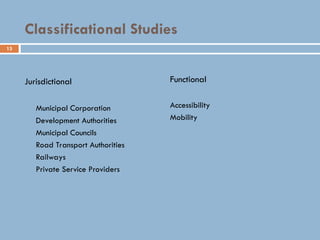
Classificational Studies
Jurisdictional
Municipal Corporation
Development Authorities
Municipal Councils
Road Transport Authorities
Railways
Private Service Providers
Functional
Accessibility
Mobility
14
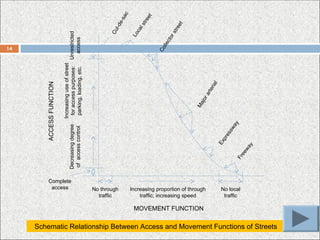
MOVEMENT FUNCTION
Complete
access
Decreasing
degree
of
access
control
No through
traffic
Increasing proportion of through
traffic; increasing speed
No local
traffic
F
r
e
e
w
a
y
E
x
p
r
e
s
s
w
a
y
M
a
j
o
r
a
r
t
e
r
i
a
l
C
o
l
l
e
c
t
o
r
s
t
r
e
e
t
L
o
c
a
l
s
t
r
e
e
t
C
u
l
-
d
e
-
s
a
c
Unrestricted
access
Increasing
use
of
street
for
access
purposes:
parking,
loading,
etc.
ACCESS
FUNCTION
Schematic Relationship Between Access and Movement Functions of Streets
15
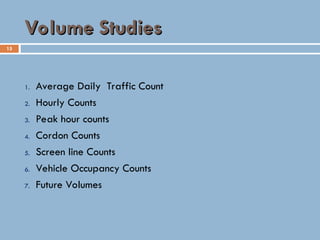
Volume Studies
Volume Studies
1. Average Daily Traffic Count
2. Hourly Counts
3. Peak hour counts
4. Cordon Counts
5. Screen line Counts
6. Vehicle Occupancy Counts
7. Future Volumes
16
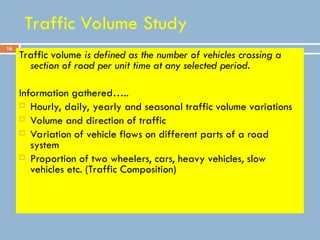
Traffic Volume Study
Traffic volume is defined as the number of vehicles crossing a
section of road per unit time at any selected period.
Information gathered…..
 Hourly, daily, yearly and seasonal traffic volume variations
 Volume and direction of traffic
 Variation of vehicle flows on different parts of a road
system
 Proportion of two wheelers, cars, heavy vehicles, slow
vehicles etc. (Traffic Composition)
17
 Average Annual Flow
 Average Annual Daily Traffic (AADT)
Total yearly volume divided by number of days in a
year (365)
 Average Daily Traffic (ADT)
Total volume during certain number of days divided
by number of days
 Hourly Volume (HV)
18
Uses of traffic volume studies
 Annual Total Traffic Volume
 Measuring & establishing trends in traffic volume
 Annual travel in vehicle – km used for economic analysis
 Computation of accident rates
 Estimation of highway user revenues
19
 AADT or ADT Volumes
 Highway planning activities: Development of express
ways ,Urban free ways, Bye – passes etc.
 Prioritisation of highway improvement programmes
 Measuring present demand for service
 Evaluating the present traffic flow with respect to
existing highway system
20
 Peak Hourly Volumes
 Geometric design with respect to number and width of lanes,
intersection design etc.
 Determination of deficiency in capacity
 Justifying use of control devices such as signals, rotary, markings
etc.
 Developing operational programmes such as one way street,
designation of streets etc.
 Justifying other regulatory measures like parking, turning, stopping
etc.
 Highway classification
 Justifying enforcement and its planning
21
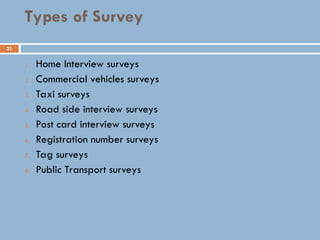
Types of Survey
1. Home Interview surveys
2. Commercial vehicles surveys
3. Taxi surveys
4. Road side interview surveys
5. Post card interview surveys
6. Registration number surveys
7. Tag surveys
8. Public Transport surveys
22
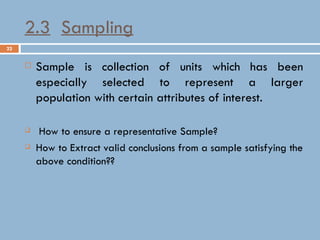
2.3 Sampling
 Sample is collection of units which has been
especially selected to represent a larger
population with certain attributes of interest.
 How to ensure a representative Sample?
 How to Extract valid conclusions from a sample satisfying the
above condition??
23
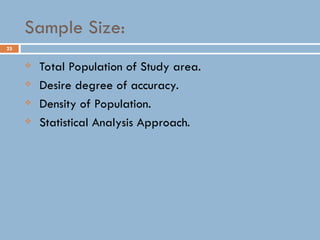
Sample Size:
 Total Population of Study area.
 Desire degree of accuracy.
 Density of Population.
 Statistical Analysis Approach.
24
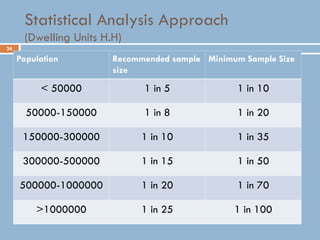
Statistical Analysis Approach
(Dwelling Units H.H)
Population Recommended sample
size
Minimum Sample Size
< 50000 1 in 5 1 in 10
50000-150000 1 in 8 1 in 20
150000-300000 1 in 10 1 in 35
300000-500000 1 in 15 1 in 50
500000-1000000 1 in 20 1 in 70
>1000000 1 in 25 1 in 100
25
Sampling Methods
 Simple Random Sampling
 Stratified Random Sampling
26
……….Later……………..

UTSP_1 Urban Transportation Engineering PDF Chapter-2

  • 1.
    1 STUDY AREA DELINEATION& PLANNING SURVEYS
  • 2.
  • 3.
    3 Surat City StudyArea Delineation Surat City Study Area Delineation Population Density Population Density
  • 4.
  • 5.
    5 Screen Line 1 ScreenLine 2 Screen Line 3 Screen Line 5 Screen Line 4 Screen Line 6 Cordon Line PWT Terminals and Screen Line and O-D Count Stations
  • 6.
    6 Zoning To Facilitate thespatial quantification of land use and economic factors influencing the travel Pattern amongst the reasonably homogenous Socio economic conglomerate.
  • 7.
  • 8.
    8 Coding Practice Ten (0-9) SectorZone Sub Zone Nine (0-8) Ten (0-9) External Sector : 9
  • 9.
    9 STTP - APUTP09 SurveyTypes & Methodologies  Primary Surveys & Secondary Surveys  Revealed Preference Survey (RP) & Stated Preference Survey (SP)  Observation Participation Interviews
  • 10.
    10 Conti……  Survey Approaches: 1.At the Home 2. During The Trip 3. At the destination end of Trip
  • 11.
    11 STTP - APUTP09 UrbanTransportation Planning Studies  Inventories  Classificational Studies  Volume Studies  Capacity Studies  Pedestrians Studies  Mass Transits Studies  Parking Studies  O-D Studies  Traffic Impact Studies
  • 12.
    12 Transportation Planning Studies TransportationPlanning Studies:  Inventories 1. Road Way: Geometrics, Control Devices, Pavement Condition. 2. Parking Inventories. 3. Transit Inventories. 4. Land use and Zoning.
  • 13.
    13 Classificational Studies Jurisdictional Municipal Corporation DevelopmentAuthorities Municipal Councils Road Transport Authorities Railways Private Service Providers Functional Accessibility Mobility
  • 14.
    14 MOVEMENT FUNCTION Complete access Decreasing degree of access control No through traffic Increasingproportion of through traffic; increasing speed No local traffic F r e e w a y E x p r e s s w a y M a j o r a r t e r i a l C o l l e c t o r s t r e e t L o c a l s t r e e t C u l - d e - s a c Unrestricted access Increasing use of street for access purposes: parking, loading, etc. ACCESS FUNCTION Schematic Relationship Between Access and Movement Functions of Streets
  • 15.
    15 Volume Studies Volume Studies 1.Average Daily Traffic Count 2. Hourly Counts 3. Peak hour counts 4. Cordon Counts 5. Screen line Counts 6. Vehicle Occupancy Counts 7. Future Volumes
  • 16.
    16 Traffic Volume Study Trafficvolume is defined as the number of vehicles crossing a section of road per unit time at any selected period. Information gathered…..  Hourly, daily, yearly and seasonal traffic volume variations  Volume and direction of traffic  Variation of vehicle flows on different parts of a road system  Proportion of two wheelers, cars, heavy vehicles, slow vehicles etc. (Traffic Composition)
  • 17.
    17  Average AnnualFlow  Average Annual Daily Traffic (AADT) Total yearly volume divided by number of days in a year (365)  Average Daily Traffic (ADT) Total volume during certain number of days divided by number of days  Hourly Volume (HV)
  • 18.
    18 Uses of trafficvolume studies  Annual Total Traffic Volume  Measuring & establishing trends in traffic volume  Annual travel in vehicle – km used for economic analysis  Computation of accident rates  Estimation of highway user revenues
  • 19.
    19  AADT orADT Volumes  Highway planning activities: Development of express ways ,Urban free ways, Bye – passes etc.  Prioritisation of highway improvement programmes  Measuring present demand for service  Evaluating the present traffic flow with respect to existing highway system
  • 20.
    20  Peak HourlyVolumes  Geometric design with respect to number and width of lanes, intersection design etc.  Determination of deficiency in capacity  Justifying use of control devices such as signals, rotary, markings etc.  Developing operational programmes such as one way street, designation of streets etc.  Justifying other regulatory measures like parking, turning, stopping etc.  Highway classification  Justifying enforcement and its planning
  • 21.
    21 Types of Survey 1.Home Interview surveys 2. Commercial vehicles surveys 3. Taxi surveys 4. Road side interview surveys 5. Post card interview surveys 6. Registration number surveys 7. Tag surveys 8. Public Transport surveys
  • 22.
    22 2.3 Sampling  Sampleis collection of units which has been especially selected to represent a larger population with certain attributes of interest.  How to ensure a representative Sample?  How to Extract valid conclusions from a sample satisfying the above condition??
  • 23.
    23 Sample Size:  TotalPopulation of Study area.  Desire degree of accuracy.  Density of Population.  Statistical Analysis Approach.
  • 24.
    24 Statistical Analysis Approach (DwellingUnits H.H) Population Recommended sample size Minimum Sample Size < 50000 1 in 5 1 in 10 50000-150000 1 in 8 1 in 20 150000-300000 1 in 10 1 in 35 300000-500000 1 in 15 1 in 50 500000-1000000 1 in 20 1 in 70 >1000000 1 in 25 1 in 100
  • 25.
    25 Sampling Methods  SimpleRandom Sampling  Stratified Random Sampling
  • 26.