+


    Using Blogs and Wikis in the 21st
    Century Classroom: A Study in
    Evaluation
    Tim Stafford, MS MA
    Director of Digital Media Center & Sr. Instructional Designer
    Virtualis Media Group - Zellwood, Florida
+
    Introduction:
    Goals of this Session
       Analyze some key elements of adult learning:

       Evaluate some technological implications for Bloom’s
        Taxonomy

       Analyze the role of rubrics in subjective learning landscapes

       Evaluate the power of wiki’s and blogs to become assessment
        vehicles, especially in terms of connectivist learning theory.

       Questions and answers
+
    Key Elements of Adult Learning

       McClusky’s Theory of Margin

       Illeris’s Three Dimensional Learning Model

       Jarvis’s Learning Process

       Brookfield’s Reflective Teaching Model
+
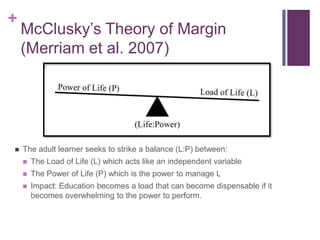
    McClusky’s Theory of Margin
    (Merriam et al. 2007)


   The adult learner seeks to strike a balance (L:P) between:
       The Load of Life (L) which acts like an independent variable
       The Power of Life (P) which is the power to manage L
       Impact: Education becomes a load that can become dispensable if it
        becomes overwhelming to the power to perform.
+
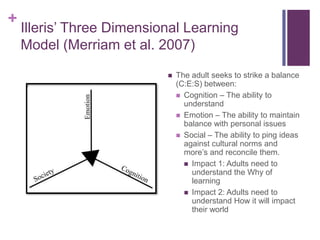
    Illeris’ Three Dimensional Learning
    Model (Merriam et al. 2007)
                              The adult seeks to strike a balance
                               (C:E:S) between:
                                Cognition – The ability to
                                 understand
                                Emotion – The ability to maintain
                                 balance with personal issues
                                Social – The ability to ping ideas
                                 against cultural norms and
                                 more’s and reconcile them.
                                  Impact 1: Adults need to
                                   understand the Why of
                                   learning
                                  Impact 2: Adults need to
                                   understand How it will impact
                                   their world
+
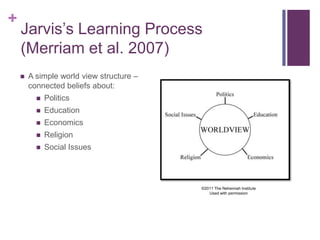
    Jarvis’s Learning Process
    (Merriam et al. 2007)
       A simple world view structure –
        connected beliefs about:
             Politics
             Education
             Economics
             Religion
             Social Issues


                                          ©2011 The Nehemiah Institute
                                             Used with permission
+
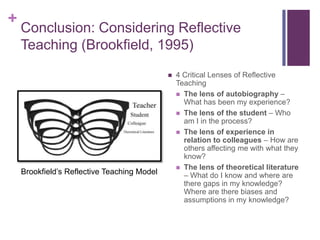
    Conclusion: Considering Reflective
    Teaching (Brookfield, 1995)
                                                4 Critical Lenses of Reflective
                                                 Teaching
                                                  The lens of autobiography –
                                                   What has been my experience?
                                                  The lens of the student – Who
                                                   am I in the process?
                                                  The lens of experience in
                                                   relation to colleagues – How are
                                                   others affecting me with what they
                                                   know?
                                                  The lens of theoretical literature
    Brookfield’s Reflective Teaching Model         – What do I know and where are
                                                   there gaps in my knowledge?
                                                   Where are there biases and
                                                   assumptions in my knowledge?
+
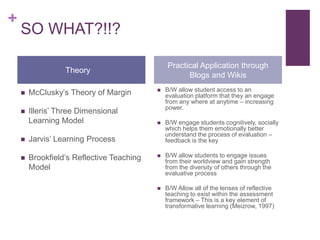
    SO WHAT?!!?

                                               Practical Application through
                  Theory
                                                     Blogs and Wikis
                                              B/W allow student access to an
       McClusky’s Theory of Margin            evaluation platform that they an engage
                                               from any where at anytime – increasing
                                               power.
       Illeris’ Three Dimensional
        Learning Model                        B/W engage students cognitively, socially
                                               which helps them emotionally better
                                               understand the process of evaluation –
       Jarvis’ Learning Process               feedback is the key

       Brookfield’s Reflective Teaching      B/W allow students to engage issues
                                               from their worldview and gain strength
        Model                                  from the diversity of others through the
                                               evaluative process

                                              B/W Allow all of the lenses of reflective
                                               teaching to exist within the assessment
                                               framework – This is a key element of
                                               transformative learning (Meizrow, 1997)
+
    Bloom’s Taxonomy and
    Rubric Creation
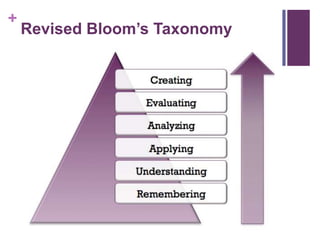
       Traditional Bloom’s Taxonomy

       An updated version that tackles technological considerations

       Creating Rubrics
+
    Revised Bloom’s Taxonomy
+
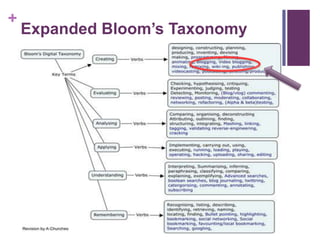
    Expanded Bloom’s Taxonomy
+
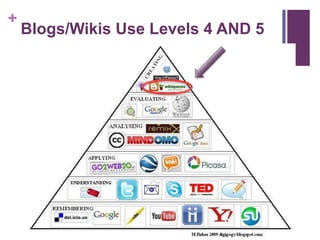
    Blogs/Wikis Use Levels 4 AND 5
+
    Creating Rubrics

       Short Film on Rubrics

       Rubrics allow the instructor to give the learner the information
        he/she needs to control the course of their evaluative process.

       Rubrics allow for flexible grading when taking other issues into
        consideration

       Rubrics offer a standardization that can help address individual
        learner needs by allowing them to interact with the tools and
        process so as to customize their experience and allow them to
        set their own goals

       Rubistar offers a great help for instructors and Rubric design
+
    SO WHAT?!!?

                                               Practical Application through
                  Theory
                                                     Blogs and Wikis

       Bloom’s Taxonomy                      Bloom’s confirms that B/W hold
                                               the possibility of synthesis or
       Connectivism                           create-level learning.

                                              Rubrics allow us to standardize
       Migrating to Rubrics for Lerner-       assessment structures in
        centered Curriculum Evaluation         subjective learning environemnts
                                               like B/W.

                                              With e-learning and m-learning
                                               well established, a merger toward
                                               ubiquitous learning (u-learning) is
                                               a new horizon based on the
                                               power of social media and B/W
                                               can be easily employed in these
                                               constructs
+
    Kirkpatrick’ s 4 Levels of Evaluation
    (1994)
       Reaction - how the learners react to the learning process
           “Was the learning worth my time?”

       Learning - the extent to which the learners gain knowledge and
        skills
           What knowledge was acquired?
           What skills were developed or enhanced?
           What attitudes were changed?

       Behavior - capability to perform the learned skills while on the job
           “Do people use their newly acquired learning on the job?”

       Results - includes such items as ROI, efficiency, morale, etc.
+ Understanding the
 Theory of Connectivism (Siemens, 2006)
    Connectivism holds that people are connected through
     learning, and that a structure can be built on these connections.
        A node
        A network
        A community

    Virtually any element that we can scrutinize or experience can
     become node. Thoughts, feelings, interactions with others, and
     new data and information can be seen as nodes.

    The aggregation of these nodes results in a network. Networks
     can combine to form still larger networks (each node in a larger
     network can be a network of nodes itself).

    A community, for example is a rich learning network of individuals
     who in themselves are completed learning networks.
+ Key Terms in the Theory of Connectivism

     Amplification: The connection of        Enacting new domains of
      one concept or skill set with            knowledge:. We all possess
      another complementary concept            some levels of knowledge. When
      or skill set that produces a             that knowledge is connected with
      greater impact than each element         the knowledge of other
      could produce on its own.                people, we are able to access
                                               more complex domains of
     Resonance: Resonance is                  knowledge
      capacity for connections to form
      based on the attributes of               Connected specialization: In
      connect-able nodes. Nodes that           complex systems, individual
      are too unlike each other will not       agents/nodes become
      form a meaningful connection.            increasingly specialized.
                                               Connections have an impact –
     Synchronization: Nodes/concep            but we don’t want random
      ts aligning themselves to other          connections for connections
      agents/concepts (fireflies is a          sake. We need connections that
      common example).                         increase the capacity of a
                                               network of individuals to create
                                               and grow knowledge.
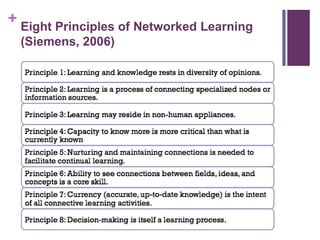
+ Eight Principles of Networked Learning
  (Siemens, 2006)
+
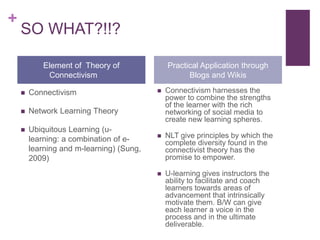
    SO WHAT?!!?

            Element of Theory of              Practical Application through
             Connectivism                           Blogs and Wikis

       Connectivism                         Connectivism harnesses the
                                              power to combine the strengths
                                              of the learner with the rich
       Network Learning Theory               networking of social media to
                                              create new learning spheres.
       Ubiquitous Learning (u-
        learning: a combination of e-        NLT give principles by which the
                                              complete diversity found in the
        learning and m-learning) (Sung,       connectivist theory has the
        2009)                                 promise to empower.

                                             U-learning gives instructors the
                                              ability to facilitate and coach
                                              learners towards areas of
                                              advancement that intrinsically
                                              motivate them. B/W can give
                                              each learner a voice in the
                                              process and in the ultimate
                                              deliverable.
+
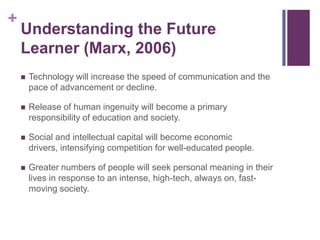
    Understanding the Future
    Learner (Marx, 2006)
       Technology will increase the speed of communication and the
        pace of advancement or decline.

       Release of human ingenuity will become a primary
        responsibility of education and society.

       Social and intellectual capital will become economic
        drivers, intensifying competition for well-educated people.

       Greater numbers of people will seek personal meaning in their
        lives in response to an intense, high-tech, always on, fast-
        moving society.
+
    References

       Brookfield, S. D. (1995). Becoming a critically reflective teacher. Sab Francisco, CA: Jossey-Bass, Inc.

       Marx, G. (2006). Sixteen trends, their profound impact on our future: Implications for
        students, education, communities, countries, and the whole of society. Alexandria, VA: Gary Marx and Educational
        Research Service.

       Mayer, R. E., & Clark, R. C. (2010). Instructional strategies for receptive learning environments. In K. H. Silber & W.
        R. Foshay (Eds.), Handbook of improving performance in the workplace (Vol. 1, pp. 298-328). San Francisco:
        Pfeiffer, An Imprint of Wiley.

       Meizrow, J. (1997). Transformation theory of adult learning. In P. Cranton (Ed.), In defense of the lifeworld (pp. 39-
        70). State University of New York Press.

       Merriam, S. B., Caffarella, R. S., & Baumgartner, R. M. (2007). Learning in adulthood: A comprehensive guide
        (Third ed.). San Francisco: John Wiley & Sons, Inc.

       Siemens, G. (2005, November 5). Connectivism: Learning as network-creation [Weblog post]. Retrieved from
        http://www.astd.org/LC/2005/1105_seimens.htm

       Sung, J.-S. (2009, December). U-learning model design based on ubiquitous environment. International Journal of
        Science and Technology, 13, 77-88. Retrieved from EBSCOhost database.
+
    Contact information

                      Tim Stafford, MS, MA

                      E-mail –
                       t.stafford@virtualismediagroup.com

                      Phone – 407 703 1319

                      Website
                          VMG – www.virtualismediagroup.com
                          Internet Radio – Stating in
                           September, 2011 –
                           www.blogtalkradio,com/vmg
                          Twitter - @tmstaffordllc

E learning-guild-presentation-wikis-blogs (snapped)

  • 1.
    + Using Blogs and Wikis in the 21st Century Classroom: A Study in Evaluation Tim Stafford, MS MA Director of Digital Media Center & Sr. Instructional Designer Virtualis Media Group - Zellwood, Florida
  • 2.
    + Introduction: Goals of this Session  Analyze some key elements of adult learning:  Evaluate some technological implications for Bloom’s Taxonomy  Analyze the role of rubrics in subjective learning landscapes  Evaluate the power of wiki’s and blogs to become assessment vehicles, especially in terms of connectivist learning theory.  Questions and answers
  • 3.
    + Key Elements of Adult Learning  McClusky’s Theory of Margin  Illeris’s Three Dimensional Learning Model  Jarvis’s Learning Process  Brookfield’s Reflective Teaching Model
  • 4.
    + McClusky’s Theory of Margin (Merriam et al. 2007)  The adult learner seeks to strike a balance (L:P) between:  The Load of Life (L) which acts like an independent variable  The Power of Life (P) which is the power to manage L  Impact: Education becomes a load that can become dispensable if it becomes overwhelming to the power to perform.
  • 5.
    + Illeris’ Three Dimensional Learning Model (Merriam et al. 2007)  The adult seeks to strike a balance (C:E:S) between:  Cognition – The ability to understand  Emotion – The ability to maintain balance with personal issues  Social – The ability to ping ideas against cultural norms and more’s and reconcile them.  Impact 1: Adults need to understand the Why of learning  Impact 2: Adults need to understand How it will impact their world
  • 6.
    + Jarvis’s Learning Process (Merriam et al. 2007)  A simple world view structure – connected beliefs about:  Politics  Education  Economics  Religion  Social Issues ©2011 The Nehemiah Institute Used with permission
  • 7.
    + Conclusion: Considering Reflective Teaching (Brookfield, 1995)  4 Critical Lenses of Reflective Teaching  The lens of autobiography – What has been my experience?  The lens of the student – Who am I in the process?  The lens of experience in relation to colleagues – How are others affecting me with what they know?  The lens of theoretical literature Brookfield’s Reflective Teaching Model – What do I know and where are there gaps in my knowledge? Where are there biases and assumptions in my knowledge?
  • 8.
    + SO WHAT?!!? Practical Application through Theory Blogs and Wikis  B/W allow student access to an  McClusky’s Theory of Margin evaluation platform that they an engage from any where at anytime – increasing power.  Illeris’ Three Dimensional Learning Model  B/W engage students cognitively, socially which helps them emotionally better understand the process of evaluation –  Jarvis’ Learning Process feedback is the key  Brookfield’s Reflective Teaching  B/W allow students to engage issues from their worldview and gain strength Model from the diversity of others through the evaluative process  B/W Allow all of the lenses of reflective teaching to exist within the assessment framework – This is a key element of transformative learning (Meizrow, 1997)
  • 9.
    + Bloom’s Taxonomy and Rubric Creation  Traditional Bloom’s Taxonomy  An updated version that tackles technological considerations  Creating Rubrics
  • 10.
    + Revised Bloom’s Taxonomy
  • 11.
    + Expanded Bloom’s Taxonomy
  • 12.
    + Blogs/Wikis Use Levels 4 AND 5
  • 13.
    + Creating Rubrics  Short Film on Rubrics  Rubrics allow the instructor to give the learner the information he/she needs to control the course of their evaluative process.  Rubrics allow for flexible grading when taking other issues into consideration  Rubrics offer a standardization that can help address individual learner needs by allowing them to interact with the tools and process so as to customize their experience and allow them to set their own goals  Rubistar offers a great help for instructors and Rubric design
  • 14.
    + SO WHAT?!!? Practical Application through Theory Blogs and Wikis  Bloom’s Taxonomy  Bloom’s confirms that B/W hold the possibility of synthesis or  Connectivism create-level learning.  Rubrics allow us to standardize  Migrating to Rubrics for Lerner- assessment structures in centered Curriculum Evaluation subjective learning environemnts like B/W.  With e-learning and m-learning well established, a merger toward ubiquitous learning (u-learning) is a new horizon based on the power of social media and B/W can be easily employed in these constructs
  • 15.
    + Kirkpatrick’ s 4 Levels of Evaluation (1994)  Reaction - how the learners react to the learning process  “Was the learning worth my time?”  Learning - the extent to which the learners gain knowledge and skills  What knowledge was acquired?  What skills were developed or enhanced?  What attitudes were changed?  Behavior - capability to perform the learned skills while on the job  “Do people use their newly acquired learning on the job?”  Results - includes such items as ROI, efficiency, morale, etc.
  • 16.
    + Understanding the Theory of Connectivism (Siemens, 2006)  Connectivism holds that people are connected through learning, and that a structure can be built on these connections.  A node  A network  A community  Virtually any element that we can scrutinize or experience can become node. Thoughts, feelings, interactions with others, and new data and information can be seen as nodes.  The aggregation of these nodes results in a network. Networks can combine to form still larger networks (each node in a larger network can be a network of nodes itself).  A community, for example is a rich learning network of individuals who in themselves are completed learning networks.
  • 17.
    + Key Termsin the Theory of Connectivism  Amplification: The connection of  Enacting new domains of one concept or skill set with knowledge:. We all possess another complementary concept some levels of knowledge. When or skill set that produces a that knowledge is connected with greater impact than each element the knowledge of other could produce on its own. people, we are able to access more complex domains of  Resonance: Resonance is knowledge capacity for connections to form based on the attributes of  Connected specialization: In connect-able nodes. Nodes that complex systems, individual are too unlike each other will not agents/nodes become form a meaningful connection. increasingly specialized. Connections have an impact –  Synchronization: Nodes/concep but we don’t want random ts aligning themselves to other connections for connections agents/concepts (fireflies is a sake. We need connections that common example). increase the capacity of a network of individuals to create and grow knowledge.
  • 18.
    + Eight Principlesof Networked Learning (Siemens, 2006)
  • 19.
    + SO WHAT?!!? Element of Theory of Practical Application through Connectivism Blogs and Wikis  Connectivism  Connectivism harnesses the power to combine the strengths of the learner with the rich  Network Learning Theory networking of social media to create new learning spheres.  Ubiquitous Learning (u- learning: a combination of e-  NLT give principles by which the complete diversity found in the learning and m-learning) (Sung, connectivist theory has the 2009) promise to empower.  U-learning gives instructors the ability to facilitate and coach learners towards areas of advancement that intrinsically motivate them. B/W can give each learner a voice in the process and in the ultimate deliverable.
  • 20.
    + Understanding the Future Learner (Marx, 2006)  Technology will increase the speed of communication and the pace of advancement or decline.  Release of human ingenuity will become a primary responsibility of education and society.  Social and intellectual capital will become economic drivers, intensifying competition for well-educated people.  Greater numbers of people will seek personal meaning in their lives in response to an intense, high-tech, always on, fast- moving society.
  • 21.
    + References  Brookfield, S. D. (1995). Becoming a critically reflective teacher. Sab Francisco, CA: Jossey-Bass, Inc.  Marx, G. (2006). Sixteen trends, their profound impact on our future: Implications for students, education, communities, countries, and the whole of society. Alexandria, VA: Gary Marx and Educational Research Service.  Mayer, R. E., & Clark, R. C. (2010). Instructional strategies for receptive learning environments. In K. H. Silber & W. R. Foshay (Eds.), Handbook of improving performance in the workplace (Vol. 1, pp. 298-328). San Francisco: Pfeiffer, An Imprint of Wiley.  Meizrow, J. (1997). Transformation theory of adult learning. In P. Cranton (Ed.), In defense of the lifeworld (pp. 39- 70). State University of New York Press.  Merriam, S. B., Caffarella, R. S., & Baumgartner, R. M. (2007). Learning in adulthood: A comprehensive guide (Third ed.). San Francisco: John Wiley & Sons, Inc.  Siemens, G. (2005, November 5). Connectivism: Learning as network-creation [Weblog post]. Retrieved from http://www.astd.org/LC/2005/1105_seimens.htm  Sung, J.-S. (2009, December). U-learning model design based on ubiquitous environment. International Journal of Science and Technology, 13, 77-88. Retrieved from EBSCOhost database.
  • 22.
    + Contact information  Tim Stafford, MS, MA  E-mail – t.stafford@virtualismediagroup.com  Phone – 407 703 1319  Website  VMG – www.virtualismediagroup.com  Internet Radio – Stating in September, 2011 – www.blogtalkradio,com/vmg  Twitter - @tmstaffordllc