February 1, 2012


    Student
    Development
    Theory
    Richard Dettling


1                  University of Phoenix
2      February 1, 2012


Workshop Goals
 Familiarize
            staff and faculty on student
  development theory
 Acquaint participants on
     The importance
     The history, and
     Utility of various theories
3                       February 1, 2012


Student Development Theory
 Student
        development is about becoming
 a more complex individual
                                                (Gardner, 2009).


 Student  development is characterized as
 the way a student grows, progresses, or
 increases his or her developmental
 capabilities as a result of enrollment in an
 institution of higher education
                            Evans, Forney, & Guido-DiBrito, 1998)
4                      February 1, 2012


 William    Perry
  Theory of Intellectual and
  Ethical Development

 Belenky,Clinchy,
 Goldberger, &
 Tarule‘s
  Women‘s Ways of Knowing

 Lawrence
 Kohlberg                          Agenda
  Theory of Moral
  Development                      Student Development Theory

 Carol    Gilligan
  Theory of Women‘s Moral
  Development

                                                  University of Phoenix
5         February 1, 2012


Perry‘s Theory of Intellectual
and Ethical Development
6                          February 1, 2012


Perry‘s Theory of Intellectual
and Ethical Development
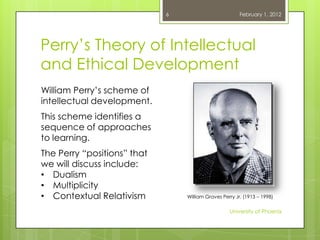
William Perry‘s scheme of
intellectual development.
This scheme identifies a
sequence of approaches
to learning.
The Perry ―positions‖ that
we will discuss include:
• Dualism
• Multiplicity
• Contextual Relativism          William Graves Perry Jr. (1913 – 1998)


                                                   University of Phoenix
7                          February 1, 2012


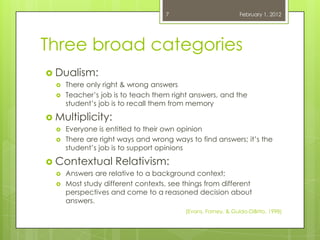
Three broad categories
 Dualism:
     There only right & wrong answers
     Teacher‘s job is to teach them right answers, and the
      student‘s job is to recall them from memory

 Multiplicity:
     Everyone is entitled to their own opinion
     There are right ways and wrong ways to find answers; it‘s the
      student‘s job is to support opinions

 Contextual        Relativism:
     Answers are relative to a background context;
     Most study different contexts, see things from different
      perspectives and come to a reasoned decision about
      answers.
                                          (Evans, Forney, & Guido-DiBrito, 1998)
8                           February 1, 2012


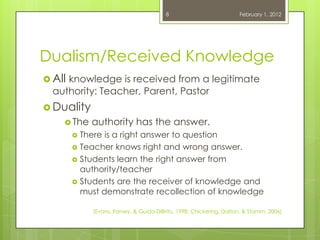
Dualism/Received Knowledge
 All knowledge is received from a legitimate
 authority: Teacher, Parent, Pastor
 Duality
     The   authority has the answer.
       There is a right answer to question
       Teacher knows right and wrong answer.
       Students learn the right answer from
        authority/teacher
       Students are the receiver of knowledge and
        must demonstrate recollection of knowledge

            (Evans, Forney, & Guido-DiBrito, 1998; Chickering, Dalton, & Stamm, 2006)
9        February 1, 2012


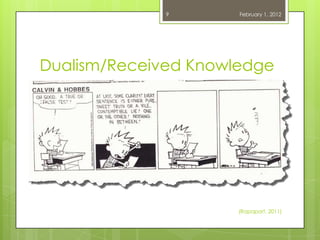
Dualism/Received Knowledge


                      (Rapaport, 2011)
10                            February 1, 2012


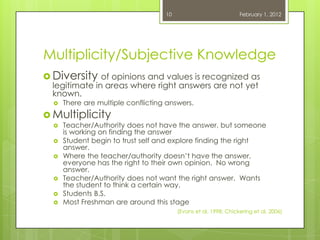
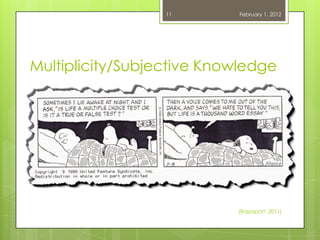
Multiplicity/Subjective Knowledge
 Diversity of opinions and values is recognized as
  legitimate in areas where right answers are not yet
  known.
     There are multiple conflicting answers.
 Multiplicity
     Teacher/Authority does not have the answer, but someone
      is working on finding the answer
     Student begin to trust self and explore finding the right
      answer.
     Where the teacher/authority doesn‘t have the answer,
      everyone has the right to their own opinion. No wrong
      answer.
     Teacher/Authority does not want the right answer. Wants
      the student to think a certain way.
     Students B.S.
     Most Freshman are around this stage
                                         (Evans et al, 1998; Chickering et al, 2006)
11        February 1, 2012


Multiplicity/Subjective Knowledge


                           (Rapaport, 2011)
12   February 1, 2012


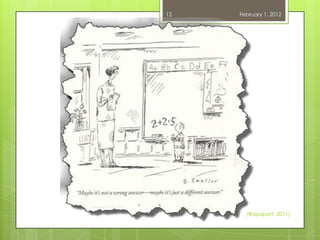
       (Rapaport, 2011)
13                            February 1, 2012


Relativism/Procedural Knowledge
 Diversity of opinion, values and judgment derived
  from coherent
  sources, evidences, logics, systems, and patterns
  allowing for analysis and comparison.
 Relativism
       All proposed solutions must be supported by
        reasons
               they must be viewed in context and relative to their
                support
       Everything is relative but not equally valid
           There are no right or wrong answers, it depends on the
            situation, but some answers might be better than others.
       All answers must be support and put into context.
       Peers are legitimate sources of learning if they
        follow rules of adequacy.
                                             (Evans et al, 1998; Chickering et al, 2006)
14       February 1, 2012


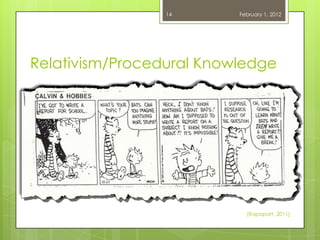
Relativism/Procedural Knowledge


                            (Rapaport, 2011)
15                  February 1, 2012


Students Make Their Own Meaning
 When A teacher says:
     “Today we’ll learn 4 different ways to gain a
        competitive advantage in business.”

A    student thinks:
     Dualist – Which is the correct one?
              – Why bother with the wrong ones?
     Multiplist - Only 4? Gee, I can think of a dozen!
     Relativist – What ethics underlie each of them?
                  – Which is the most efficient competitive
                    advantage ?

                                                      (Rapaport, 2011)
16                        February 1, 2012


―It is not knowledge, but the act of learning, not
possession but the act of getting there, which
grants the greatest enjoyment.‖


                          Karl Friedrich Gauss, Letter to Bolyai


―The search for truth is more precious than its possession.‖


                           Albert Einstein, Ideas and Opinions


                                 (Furman University, 2012; Goodreads, 2012)
17        February 1, 2012


Belenky, Clinchy, Goldberger,
& Tarule‘s Women‘s Ways of
Knowing
18                           February 1, 2012


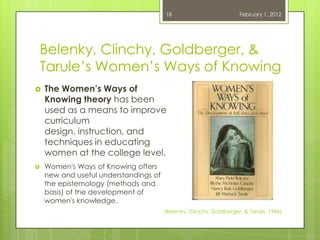
Belenky, Clinchy, Goldberger, &
Tarule‘s Women‘s Ways of Knowing
   The Women’s Ways of
    Knowing theory has been
    used as a means to improve
    curriculum
    design, instruction, and
    techniques in educating
    women at the college level.
   Women's Ways of Knowing offers
    new and useful understandings of
    the epistemology (methods and
    basis) of the development of
    women's knowledge.
                                       (Belenky, Clinchy, Goldberger, & Tarule, 1986)
19                            February 1, 2012


The Development of
Self, Voice, and Mind
 Despitethe progress of the women‘s
 movement, many women still feel
 silenced in their families and schools.
    Women did not fit into traditional
     development theory
      Previousdevelopment research was done
       predominately on white men of privilege
      Excluding women from the research


                                (Evans et al, 1998; Chickering et al, 2006)
20                            February 1, 2012


The Development of
Self, Voice, and Mind
   Research in the late 1970s
     Why women doubt their intellectual
    competence and speak so frequently
              of problems
   For many women, formal education was not
    central to their development
       Instead, they noted that the most valuable lessons
        were derived from relationships, crises, and
        community involvements.

                                    (Evans et al, 1998; Chickering et al, 2006)
21                            February 1, 2012


Five Epistemological Perspectives
   1.   Silence
   2.   Received Knowledge
   3.   Subjective Knowledge
   4.   Procedural Knowledge
   5.   Constructed Knowledge


                (Belenky et al, 1986; Evans et al, 1998; Chickering et al, 2006)
22                            February 1, 2012


Five Epistemological Perspectives
1.       Silence
        Characterized by low self esteem, mindless, voiceless,
         and obedient
        All authority over knowledge exists outside one‘s self
        Disconnection between the known and the knower
        Only broken by validation of the individual
2.       Received Knowledge
        Knowledge is dualistic, either right or wrong, black or
         white
        Listening to others, and truth resides in others, not in the
         self
        There is only one correct answer to each question
        The recipient, not the creator of knowledge

                                            (Evans et al, 1998; Chickering et al, 2006)
23                            February 1, 2012


Five Epistemological Perspectives
1.       Subjective Knowledge
        One‘s own inner knowledge is considered superior to the
         knowledge of others
        The power of knowing is internal
        Analyzing the past to understand the future
        A new voice, barely a whisper, begins to speak
2.       Procedural Knowledge
        Ability to objectively express and receive knowledge (two
         kinds)
        Separate knowledge is analytical and reasonable, critical
         thinking
        Connected knowing is based on intuition and ‗gut feeling‘
        Begins integrating separate and connected knowing into a
         single voice
                                         (Evans et al, 1998; Chickering et al, 2006)
24                            February 1, 2012


Five Epistemological Perspectives
5.       Constructed Knowledge
        Integration of subjective and objective knowledge
        Both feeling and thought present in ways of knowing
        All knowledge is constructed, one becomes part of
         their own knowledge
        Believe in another‘s beliefs, while not adopting them
        Hear another‘s voice without losing their own voice
        Making a space for one‘s self where her voice will
         always be heard


                                        (Evans et al, 1998; Chickering et al, 2006)
25                            February 1, 2012


Five Epistemological
Perspectives Theory Basis
  Builton William Perry’s Theory of Intellectual
   Development
  Also Kohlberg’s Theory of Moral
   Development
  And Gilligan’s Theory of Women‘s Moral
   Development


                              (Evans et al, 1998; Chickering et al, 2006)
26             February 1, 2012


Major Findings
   Women think differently than men
   Women need to know that they are already
    smart in order to learn
   Women acquire knowledge more readily
    through experience than instruction
   Validation of self by a women‘s community
    fuels further development and fosters learning
   Women feel their way into learning and make
    sense of their world from the inside out
27                February 1, 2012


Theory to Practice
 Teach    the teachers
     Understand students‘ development level
 Let   them try their wings
     Support the journey of self discovery
 Engage   the students in the process of their
 own education
  Facilitate ‗active‘ learning environments
28        February 1, 2012


Kohlberg‘s Theory of
Moral Development
29                         February 1, 2012


Kohlberg‘s Theory of Moral
Development
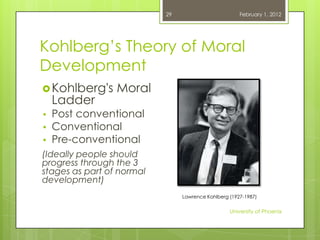
 Kohlberg's     Moral
    Ladder
•   Post conventional
•   Conventional
•   Pre-conventional
(Ideally people should
progress through the 3
stages as part of normal
development)
                                Lawrence Kohlberg (1927-1987)


                                                  University of Phoenix
30              February 1, 2012


Moral Development
   Moral development involves thoughts,
    feelings, and behaviors regarding standard of
    right and wrong
   Moral development consists of intrapersonal
    and interpersonal dimensions
   The transformations that occur in a person‘s
    form or structure of thought with regard to
    what is viewed as right or necessary


                                         (Evans et al, 1998 )
31                            February 1, 2012


    Levels of Moral Development
    Level 1: Pre-conventional Morality

      Stage 1                       Stage 2
   Punishment-Obedience         Instrumental Relativist
    Orientation Individual        Orientation Individual
    obeys rules in order to       conforms to society‘s
    avoid punishment              rules in order to
                                  receive rewards.


                                   (Evans et al, 1998 ;Jorgensen, 2006, June)
32                            February 1, 2012


    Levels of Moral Development
    Level 2: Conventional Morality

      Stage 3                        Stage 4
   Good Boy – Nice Girl          Law and Order
    Orientation / Individual       Orientation /
    behaves morally in             Conformity to
    order to gain approval         authority to avoid
    from other people.             censure and guilt


                                    (Evans et al, 1998 ;Jorgensen, 2006, June)
33                            February 1, 2012


    Levels of Moral Development
    Level 3: Post-conventional Morality

      Stage 5                        Stage 6
   Social Contract               Universal Ethical
    Orientation / Individual       Principle Orientation /
    is concerned with              Individual is entirely
    individual rights and          guided by his or her
    democratically                 own conscience.
    decided laws


                                    (Evans et al, 1998 ;Jorgensen, 2006, June)
34        February 1, 2012


Gilligan‘s Theory of Women‘s
Moral Development
35                      February 1, 2012


Gilligan‘s Theory of Women‘s
Moral Development
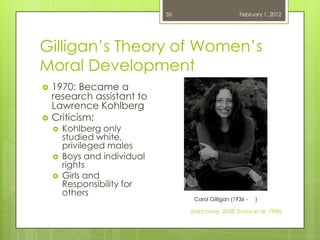
   1970: Became a
    research assistant to
    Lawrence Kohlberg
   Criticism:
       Kohlberg only
        studied white,
        privileged males
       Boys and individual
        rights
       Girls and
        Responsibility for
        others
                                    Carol Gilligan (1936 -   )

                                   (Kretchmar, 2008; Evans et al, 1998)
36                 February 1, 2012


Influences
 Laurence   Kohlberg
 Freud
 ErikErikson
 Several decades of changing cultures
  and shifting views
 Her students today


                    (Kretchmar, 2008; Evans et al, 1998)
37                   February 1, 2012


Theory
 Stage- Preconventional
   Goal- Individual Survival
   Age- Not Listed


 Transition
   Selfishness to Responsibility


 Stage- Conventional
   Goal- Self Sacrifice is Goodness
   Age- Not Listed
                                (Kretchmar, 2008; Evans et al, 1998)
38                      February 1, 2012


Theory Cont…
 Transition
    Goodness to Truth that she is a person too


 Stage-   Postconventional
    Goal- Principle of Nonviolence: do not hurt
     others or self
    Age- Maybe Never


                                (Kretchmar, 2008; Evans et al, 1998)
39           February 1, 2012


How it Applies to a Teacher
 Realizethere is a difference between
  males and females.
 Males are egocentric and females are
  more prone to care for others.
40                 February 1, 2012


References
   Belenky, M.F., Clinchy, B.
    M., Goldberger, N.R., Tarule, J.M. (1986). Women‘s ways
    of knowing: The development of self voice and mind.
    New York: Basic Books Inc
   Chickering, A. W., Dalton, J. C., & Stamm, L. (1993).
    Encouraging Authenticity and Spirituality in Higher
    Education (2nd ed.). San Francisco, CA: Jossey-bass.
   Goodreads (2012) Albert Einstein. Retrieved from
    http://www.goodreads.com/quotes/show/45649
   Evans, N. J., Forney, D. S., & Guido-DiBrito, F. (1998).
    Student development in college: Theory, research, and
    practice. San Francisco: Jossey-Bass
41                February 1, 2012


References
   Furman University (2012) Favorite Math Quotes - Karl
    Friedrich Gauss. Retrieved from
    http://www.gateways2learning.com/Quotes.htm
   Gardner, S. K. (2009). Student Development Theory: A
    Primer. ASHE Higher Education Report, 34(6), 15-28.
   Kretchmar, J. (2008). Moral Development. Moral
    Development — Research Starters Education. Retreived
    from EBSCOHost,
   Rapaport, W.J. (2011) William Perry's Scheme of
    Intellectual and Ethical Development: A journey along
    the 9 "Perry" positions. Retrieved from
    http://www.cse.buffalo.edu/~rapaport/perry.positions.h
    tml

Student Development Theory

  • 1.
    February 1, 2012 Student Development Theory Richard Dettling 1 University of Phoenix
  • 2.
    2 February 1, 2012 Workshop Goals  Familiarize staff and faculty on student development theory  Acquaint participants on  The importance  The history, and  Utility of various theories
  • 3.
    3 February 1, 2012 Student Development Theory  Student development is about becoming a more complex individual (Gardner, 2009).  Student development is characterized as the way a student grows, progresses, or increases his or her developmental capabilities as a result of enrollment in an institution of higher education Evans, Forney, & Guido-DiBrito, 1998)
  • 4.
    4 February 1, 2012  William Perry Theory of Intellectual and Ethical Development  Belenky,Clinchy, Goldberger, & Tarule‘s Women‘s Ways of Knowing  Lawrence Kohlberg Agenda Theory of Moral Development Student Development Theory  Carol Gilligan Theory of Women‘s Moral Development University of Phoenix
  • 5.
    5 February 1, 2012 Perry‘s Theory of Intellectual and Ethical Development
  • 6.
    6 February 1, 2012 Perry‘s Theory of Intellectual and Ethical Development William Perry‘s scheme of intellectual development. This scheme identifies a sequence of approaches to learning. The Perry ―positions‖ that we will discuss include: • Dualism • Multiplicity • Contextual Relativism William Graves Perry Jr. (1913 – 1998) University of Phoenix
  • 7.
    7 February 1, 2012 Three broad categories  Dualism:  There only right & wrong answers  Teacher‘s job is to teach them right answers, and the student‘s job is to recall them from memory  Multiplicity:  Everyone is entitled to their own opinion  There are right ways and wrong ways to find answers; it‘s the student‘s job is to support opinions  Contextual Relativism:  Answers are relative to a background context;  Most study different contexts, see things from different perspectives and come to a reasoned decision about answers. (Evans, Forney, & Guido-DiBrito, 1998)
  • 8.
    8 February 1, 2012 Dualism/Received Knowledge  All knowledge is received from a legitimate authority: Teacher, Parent, Pastor  Duality  The authority has the answer.  There is a right answer to question  Teacher knows right and wrong answer.  Students learn the right answer from authority/teacher  Students are the receiver of knowledge and must demonstrate recollection of knowledge (Evans, Forney, & Guido-DiBrito, 1998; Chickering, Dalton, & Stamm, 2006)
  • 9.
    9 February 1, 2012 Dualism/Received Knowledge (Rapaport, 2011)
  • 10.
    10 February 1, 2012 Multiplicity/Subjective Knowledge  Diversity of opinions and values is recognized as legitimate in areas where right answers are not yet known.  There are multiple conflicting answers.  Multiplicity  Teacher/Authority does not have the answer, but someone is working on finding the answer  Student begin to trust self and explore finding the right answer.  Where the teacher/authority doesn‘t have the answer, everyone has the right to their own opinion. No wrong answer.  Teacher/Authority does not want the right answer. Wants the student to think a certain way.  Students B.S.  Most Freshman are around this stage (Evans et al, 1998; Chickering et al, 2006)
  • 11.
    11 February 1, 2012 Multiplicity/Subjective Knowledge (Rapaport, 2011)
  • 12.
    12 February 1, 2012 (Rapaport, 2011)
  • 13.
    13 February 1, 2012 Relativism/Procedural Knowledge  Diversity of opinion, values and judgment derived from coherent sources, evidences, logics, systems, and patterns allowing for analysis and comparison.  Relativism  All proposed solutions must be supported by reasons  they must be viewed in context and relative to their support  Everything is relative but not equally valid  There are no right or wrong answers, it depends on the situation, but some answers might be better than others.  All answers must be support and put into context.  Peers are legitimate sources of learning if they follow rules of adequacy. (Evans et al, 1998; Chickering et al, 2006)
  • 14.
    14 February 1, 2012 Relativism/Procedural Knowledge (Rapaport, 2011)
  • 15.
    15 February 1, 2012 Students Make Their Own Meaning  When A teacher says: “Today we’ll learn 4 different ways to gain a competitive advantage in business.” A student thinks:  Dualist – Which is the correct one? – Why bother with the wrong ones?  Multiplist - Only 4? Gee, I can think of a dozen!  Relativist – What ethics underlie each of them? – Which is the most efficient competitive advantage ? (Rapaport, 2011)
  • 16.
    16 February 1, 2012 ―It is not knowledge, but the act of learning, not possession but the act of getting there, which grants the greatest enjoyment.‖ Karl Friedrich Gauss, Letter to Bolyai ―The search for truth is more precious than its possession.‖ Albert Einstein, Ideas and Opinions (Furman University, 2012; Goodreads, 2012)
  • 17.
    17 February 1, 2012 Belenky, Clinchy, Goldberger, & Tarule‘s Women‘s Ways of Knowing
  • 18.
    18 February 1, 2012 Belenky, Clinchy, Goldberger, & Tarule‘s Women‘s Ways of Knowing  The Women’s Ways of Knowing theory has been used as a means to improve curriculum design, instruction, and techniques in educating women at the college level.  Women's Ways of Knowing offers new and useful understandings of the epistemology (methods and basis) of the development of women's knowledge. (Belenky, Clinchy, Goldberger, & Tarule, 1986)
  • 19.
    19 February 1, 2012 The Development of Self, Voice, and Mind  Despitethe progress of the women‘s movement, many women still feel silenced in their families and schools.  Women did not fit into traditional development theory  Previousdevelopment research was done predominately on white men of privilege  Excluding women from the research (Evans et al, 1998; Chickering et al, 2006)
  • 20.
    20 February 1, 2012 The Development of Self, Voice, and Mind  Research in the late 1970s Why women doubt their intellectual competence and speak so frequently of problems  For many women, formal education was not central to their development  Instead, they noted that the most valuable lessons were derived from relationships, crises, and community involvements. (Evans et al, 1998; Chickering et al, 2006)
  • 21.
    21 February 1, 2012 Five Epistemological Perspectives 1. Silence 2. Received Knowledge 3. Subjective Knowledge 4. Procedural Knowledge 5. Constructed Knowledge (Belenky et al, 1986; Evans et al, 1998; Chickering et al, 2006)
  • 22.
    22 February 1, 2012 Five Epistemological Perspectives 1. Silence  Characterized by low self esteem, mindless, voiceless, and obedient  All authority over knowledge exists outside one‘s self  Disconnection between the known and the knower  Only broken by validation of the individual 2. Received Knowledge  Knowledge is dualistic, either right or wrong, black or white  Listening to others, and truth resides in others, not in the self  There is only one correct answer to each question  The recipient, not the creator of knowledge (Evans et al, 1998; Chickering et al, 2006)
  • 23.
    23 February 1, 2012 Five Epistemological Perspectives 1. Subjective Knowledge  One‘s own inner knowledge is considered superior to the knowledge of others  The power of knowing is internal  Analyzing the past to understand the future  A new voice, barely a whisper, begins to speak 2. Procedural Knowledge  Ability to objectively express and receive knowledge (two kinds)  Separate knowledge is analytical and reasonable, critical thinking  Connected knowing is based on intuition and ‗gut feeling‘  Begins integrating separate and connected knowing into a single voice (Evans et al, 1998; Chickering et al, 2006)
  • 24.
    24 February 1, 2012 Five Epistemological Perspectives 5. Constructed Knowledge  Integration of subjective and objective knowledge  Both feeling and thought present in ways of knowing  All knowledge is constructed, one becomes part of their own knowledge  Believe in another‘s beliefs, while not adopting them  Hear another‘s voice without losing their own voice  Making a space for one‘s self where her voice will always be heard (Evans et al, 1998; Chickering et al, 2006)
  • 25.
    25 February 1, 2012 Five Epistemological Perspectives Theory Basis  Builton William Perry’s Theory of Intellectual Development  Also Kohlberg’s Theory of Moral Development  And Gilligan’s Theory of Women‘s Moral Development (Evans et al, 1998; Chickering et al, 2006)
  • 26.
    26 February 1, 2012 Major Findings  Women think differently than men  Women need to know that they are already smart in order to learn  Women acquire knowledge more readily through experience than instruction  Validation of self by a women‘s community fuels further development and fosters learning  Women feel their way into learning and make sense of their world from the inside out
  • 27.
    27 February 1, 2012 Theory to Practice  Teach the teachers  Understand students‘ development level  Let them try their wings  Support the journey of self discovery  Engage the students in the process of their own education  Facilitate ‗active‘ learning environments
  • 28.
    28 February 1, 2012 Kohlberg‘s Theory of Moral Development
  • 29.
    29 February 1, 2012 Kohlberg‘s Theory of Moral Development  Kohlberg's Moral Ladder • Post conventional • Conventional • Pre-conventional (Ideally people should progress through the 3 stages as part of normal development) Lawrence Kohlberg (1927-1987) University of Phoenix
  • 30.
    30 February 1, 2012 Moral Development  Moral development involves thoughts, feelings, and behaviors regarding standard of right and wrong  Moral development consists of intrapersonal and interpersonal dimensions  The transformations that occur in a person‘s form or structure of thought with regard to what is viewed as right or necessary (Evans et al, 1998 )
  • 31.
    31 February 1, 2012 Levels of Moral Development Level 1: Pre-conventional Morality Stage 1 Stage 2  Punishment-Obedience  Instrumental Relativist Orientation Individual Orientation Individual obeys rules in order to conforms to society‘s avoid punishment rules in order to receive rewards. (Evans et al, 1998 ;Jorgensen, 2006, June)
  • 32.
    32 February 1, 2012 Levels of Moral Development Level 2: Conventional Morality Stage 3 Stage 4  Good Boy – Nice Girl  Law and Order Orientation / Individual Orientation / behaves morally in Conformity to order to gain approval authority to avoid from other people. censure and guilt (Evans et al, 1998 ;Jorgensen, 2006, June)
  • 33.
    33 February 1, 2012 Levels of Moral Development Level 3: Post-conventional Morality Stage 5 Stage 6  Social Contract  Universal Ethical Orientation / Individual Principle Orientation / is concerned with Individual is entirely individual rights and guided by his or her democratically own conscience. decided laws (Evans et al, 1998 ;Jorgensen, 2006, June)
  • 34.
    34 February 1, 2012 Gilligan‘s Theory of Women‘s Moral Development
  • 35.
    35 February 1, 2012 Gilligan‘s Theory of Women‘s Moral Development  1970: Became a research assistant to Lawrence Kohlberg  Criticism:  Kohlberg only studied white, privileged males  Boys and individual rights  Girls and Responsibility for others Carol Gilligan (1936 - ) (Kretchmar, 2008; Evans et al, 1998)
  • 36.
    36 February 1, 2012 Influences  Laurence Kohlberg  Freud  ErikErikson  Several decades of changing cultures and shifting views  Her students today (Kretchmar, 2008; Evans et al, 1998)
  • 37.
    37 February 1, 2012 Theory  Stage- Preconventional  Goal- Individual Survival  Age- Not Listed  Transition  Selfishness to Responsibility  Stage- Conventional  Goal- Self Sacrifice is Goodness  Age- Not Listed (Kretchmar, 2008; Evans et al, 1998)
  • 38.
    38 February 1, 2012 Theory Cont…  Transition  Goodness to Truth that she is a person too  Stage- Postconventional  Goal- Principle of Nonviolence: do not hurt others or self  Age- Maybe Never (Kretchmar, 2008; Evans et al, 1998)
  • 39.
    39 February 1, 2012 How it Applies to a Teacher  Realizethere is a difference between males and females.  Males are egocentric and females are more prone to care for others.
  • 40.
    40 February 1, 2012 References  Belenky, M.F., Clinchy, B. M., Goldberger, N.R., Tarule, J.M. (1986). Women‘s ways of knowing: The development of self voice and mind. New York: Basic Books Inc  Chickering, A. W., Dalton, J. C., & Stamm, L. (1993). Encouraging Authenticity and Spirituality in Higher Education (2nd ed.). San Francisco, CA: Jossey-bass.  Goodreads (2012) Albert Einstein. Retrieved from http://www.goodreads.com/quotes/show/45649  Evans, N. J., Forney, D. S., & Guido-DiBrito, F. (1998). Student development in college: Theory, research, and practice. San Francisco: Jossey-Bass
  • 41.
    41 February 1, 2012 References  Furman University (2012) Favorite Math Quotes - Karl Friedrich Gauss. Retrieved from http://www.gateways2learning.com/Quotes.htm  Gardner, S. K. (2009). Student Development Theory: A Primer. ASHE Higher Education Report, 34(6), 15-28.  Kretchmar, J. (2008). Moral Development. Moral Development — Research Starters Education. Retreived from EBSCOHost,  Rapaport, W.J. (2011) William Perry's Scheme of Intellectual and Ethical Development: A journey along the 9 "Perry" positions. Retrieved from http://www.cse.buffalo.edu/~rapaport/perry.positions.h tml

Editor's Notes

  • #7 William Perry – head of counseling, Harvard, 1950s• Discovered 9 “positions” from which students viewed knowledge & learning• Has been replicated & adjusted (and criticized)
  • #8 Dualism:There only right & wrong answersTeacher’s job is to teach them right answers, and the student’s job is to recall them from memoryMultiplicity:Everyone is entitled to their own opinionThere are right ways and wrong ways to find answers; it’s the student’s job is to support opinionsContextual Relativism:Answers are relative to a background context;Most study different contexts, see things from different perspectives and come to a reasoned decision about answers.
  • #9 Students’ Assumptions about Teachers• Basic Dualism:– This teacher knows the answers to my questions.• Full Dualism:– Good teachers know the answers; bad ones don’t. This particular teachermay or may not be that knowledgeable.
  • #11 • Early Multiplism:– Discipline X may or may not be advanced enough to answer my questions.I’m going to this teacher to find out if X knows enough. S/he will tell methe answers, or give me the procedure (ritual) to work it out on my own.• Late Multiplism:– There are no answers to my questions; what I think is as valid as what theteacher thinks.
  • #14 • Contextual Relativism:– There are a number of answers to my question, depending on how you lookat it; maybe this teacher can help me see the alternatives more clearly.• Pre-Commitment:– There are a number of answers to my question, depending on how I look atit; maybe this teacher can help me decide what I should believ
  • #19 This theory is based on in-depth interviews with 135 women about their self image, moral dilemmas, relationships of importance, education and learning, visions for the future, and perceived catalysts for change (Belenky et al., 1986). Based on the interviews, some common themes among the women emerged and became the five epistemologies of Women’s Ways of Knowing
  • #23 The theory consists of five groups, advancing from the most basic form of thought and intellect to the most complex. The first epistemology is “women of silence.” These women lack a voice of their own, conduct very little or no internal dialogue, and typically grew up disconnected from the community. The next epistemology is “women of received knowledge.” These women are completely dependent on others for knowledge (Belenky et al., 1986).
  • #24 The third group, “subjective knowers,” believes truth is in personal experience (Evans, 2010). Many of these women have experienced sexual abuse (Belenky et al., 1986). “Procedural knowers” are at the next level of knowing and these women believe each of us looks at the world through a different lens. They rely on a combination of intuition and external authorities for answers.
  • #25 The last of the epistemologies, “constructed knowledge,” integrates intuitive knowledge with learned knowledge from others. These women have developed a personal narrative, do not loose voice while listening to others, and use themselves to rise to new ways of thinking (Belenky et al., 1986).
  • #31 One criticism of Kohlberg's theory is that it emphasizes justice to the exclusion of other values. As a consequence of this, it may not adequately address the arguments of people who value other moral aspects of actions (Evans et al, 1998 )
  • #32 Stage 1The concern is for self – “Will I get into trouble for doing (or not doing) it?”. Good behavior is associated with avoiding punishmentStage 2The concern is “What’s in it for me?”. Still egocentric in outlook but with a growing ability to see things from another person’s perspective. Action is judged right if it helps in satisfying one’s needs or involves a fair exchange
  • #33 Stage 3The concern is “What will people think of me?” and the desire is for group approval. Right action is one that would please or impress others. This often involves self-sacrifice but it provides the psychological pleasure of ‘approval of others’. Actions are also judged in relation to their intentionStage 4The concern now goes beyond one’s immediate group(s) to the larger society … to the maintenance of law and order. One’s obligation to the law overrides one’s obligations of loyalty to one’s family, friends and groups. To put it simply, no one or group is above the law
  • #34 Stage 5The concern is social utility or public interest. While rules are needed to maintain social order, they should not be blindly obeyed but should be set up (even changed) by social contract for the greater good of society. Right action is one that protects the rights of the individual according to rules agreed upon by the whole society.Stage 6The concern is for moral principles … an action is judged right if it is consistent with self-chosen ethical principles. These principles are not concrete moral rules but are universal principles of justice, reciprocity, equality, and human dignity.
  • #36 Another way to look at these differences is to view these two moralities as providing two distinct injunctions - the injunction not to treat others unfairly (justice) and the injunction not to turn away from someone in need (care). She presents these moralities as distinct, although potentially connected.1995: About the fact that boys are placed in stereotypical views just as males are. Leads to more criticism against Gilligan and how she researches on young children and interprets as super in depth. She has authored and coauthored numerous books and publications. Considered her principal publications in addition to In a Different Voice are: Women, Girls, and Psychotherapy: Reframing Resistance (1991), Meeting at the Crossroads (1992), Between Voice and Silence: Women and Girls, Race and Relationship (1995), The Birth of Pleasure 2002
  • #38 Almost identical to Kohlberg’s theory but lacks the ages and mainly applies to females. Also Gilligan’s theory aims towards interactions among people rather than independence from people.Female children start out with a selfish orientation. They then learn to care for others, and that selfishness is wrong. So in their second, conventional, stage, women typically feel it is wrong to act in their own interests, and that they should value instead the interests of others. They equate concern for themselves with selfishness. In the third, post-conventional stage, they learn that it is just as wrong to ignore their own interests as it is to ignore the interests of others. One way to this understanding comes through their concern with connecting with others. A connection, or relation, involves two people, and if either one is slighted, it harms the relationship