SONIA DÁVILA-COSME
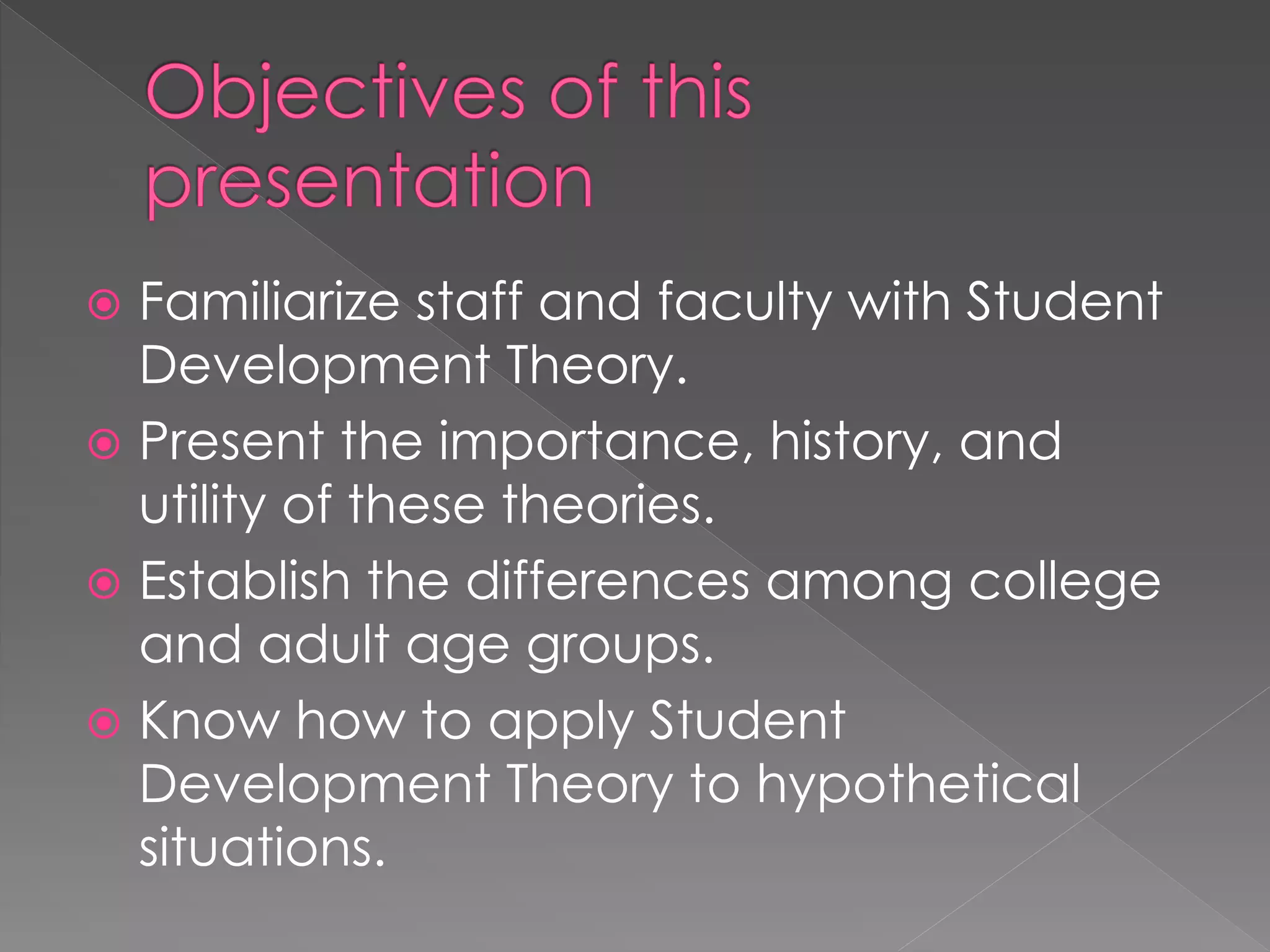
 Familiarize staff and faculty with Student
  Development Theory.
 Present the importance, history, and
  utility of these theories.
 Establish the differences among college
  and adult age groups.
 Know how to apply Student
  Development Theory to hypothetical
  situations.
   Development is a
    process in which
    individuals expand
    their capacities and
    present a growth in
    abilities and
    knowledge. This
    growth is based on
    experiences and can
    be psychological,
    social and
    intellectual.
 According to
  Piaget and Erikson
  human
  development can
  be divided in
  stages or periods.
 Erik H. Erikson
  present those
  periods in eight
  stages (Harder,
  2009).
   Student Development
    Theory (SDT)are a set of
    diverse theories that try to
    explain the way students
    develop, grow and mature
    during the years they are
    enrolled in a higher
    education institution (Evans,
    Forney and Guido-DiBrito,
    1998).
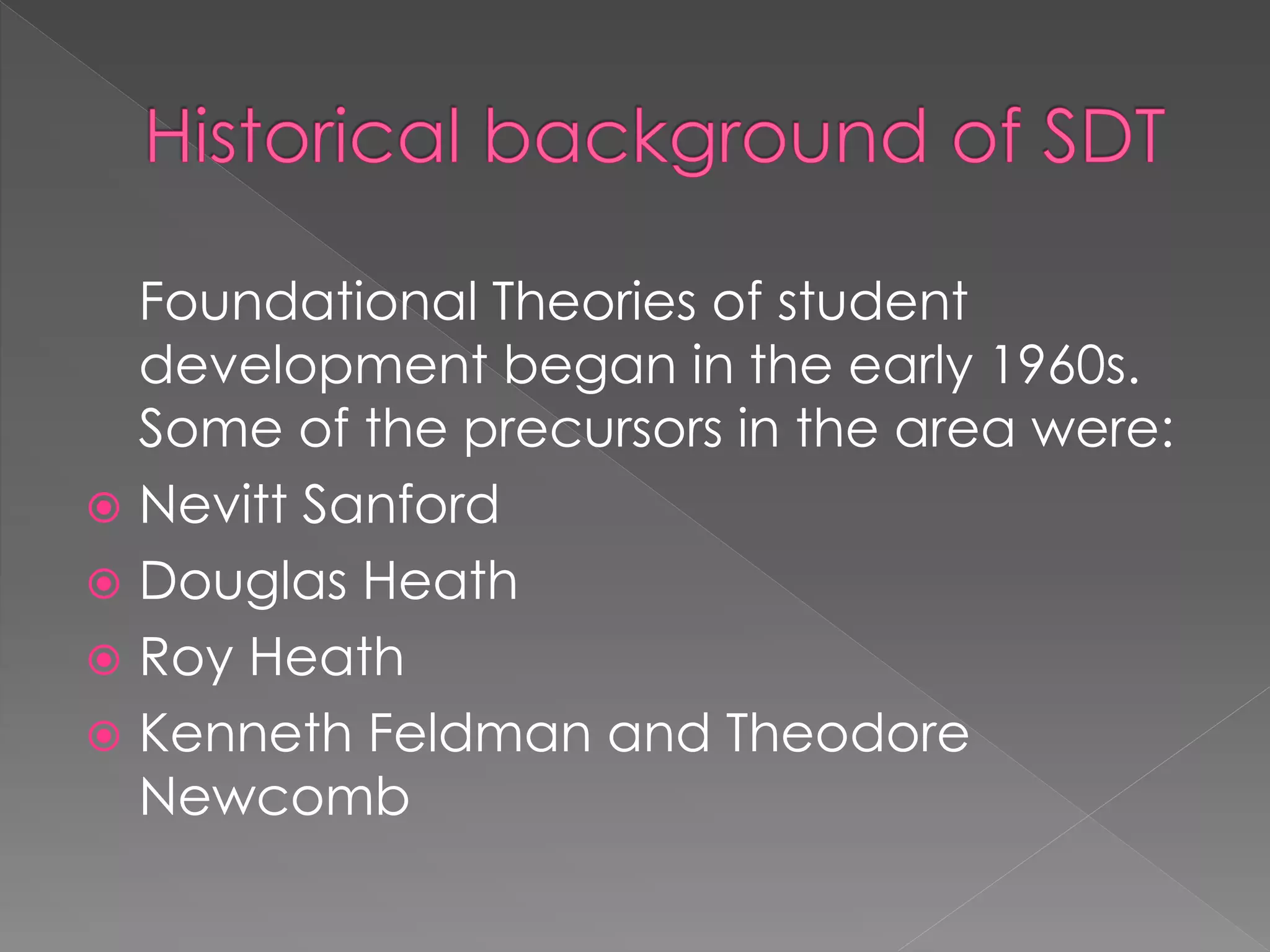
Foundational Theories of student
  development began in the early 1960s.
  Some of the precursors in the area were:
 Nevitt Sanford
 Douglas Heath
 Roy Heath
 Kenneth Feldman and Theodore
  Newcomb
   Ortiz (1995) and Evans et al. (1998)
    present that knowing Student
    Development Theories can help higher
    education personnel (staff, faculty, and
    administrators) to provide better
    programs and services based on student
    diversity and particularities.
 Psychosocial Theories
 Cognitive-structural
  Theories
 Moral development
  theories
 Typology and adult
  development theories
 Identity development
  theories
   Erik Erikson

   Arthur Chickering

   Arthur Chickering &
    Linda Reisser
   Jean Piaget


   William G. Perry, Jr.
   Lawrence Kohlberg


   Carol Gilligan


   There are gender
    differences among
    the two theories
   Myers-Briggs Type
    Indicator (Personality type
    theory). Developed by
    Katherine Cook Briggs and
    her daughter, Isabel Briggs
    Myers

   John Holland’s Career
    Development Theory

   David Kolb’s Experiential
    Learning Theory
   Racial and Ethnic Identity
    Development
    -Cross model of Psychological
     Nigrescence
    -Helm’s Model of White Identity
    -Phinney’s Model of Ethnic Identity


   Gay, Lesbian, and Bisexual
    Identity Development
    -Cass’s Model of Homosexual
    Identity Formation
    -D’Augelli’s Model of Lesbian, Gay,
    and Bisexual Development
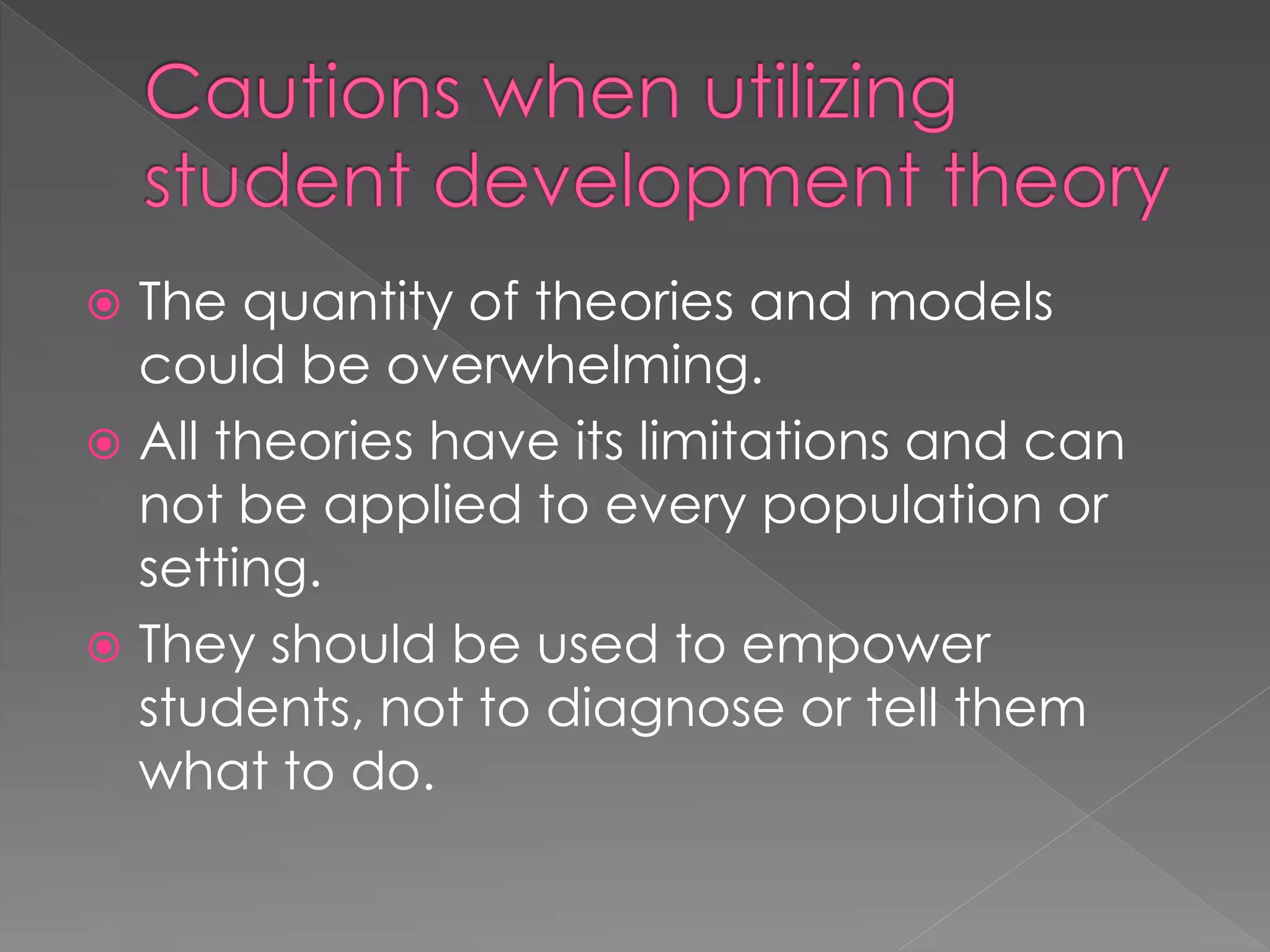
 The quantity of theories and models
  could be overwhelming.
 All theories have its limitations and can
  not be applied to every population or
  setting.
 They should be used to empower
  students, not to diagnose or tell them
  what to do.
When applying student development theories
  professionals should observe the following
  steps:
 Study and familiarize with diverse
  developmental models and typologies.
 Identify the issues or problems presented by
  the student.
 Select and apply the theories that relate to
  the issue and take decisions to improve
  services and environmental conditions.
   Michelle was recently admitted to the
    university. Her mother wants her to study
    physics because Michelle is very good at
    that, she has excellent grades and the
    opportunity to apply for a science
    scholarship. She also likes to paint and
    everybody tells her that she has talent.
    Michelle is not sure about her career
    choices. She does not want to disappoint
    her mother nor want to give up on painting
    because she loves it.
1)   Identify the issues or problems presented by the
     student.
     -the student is not sure about her career choices
     -the student has identified her abilities and preferences
     -the student feel guilty and does not want to disappoint her mother

2)   Apply the theories that relate to the issue and take
     decisions to improve services and environmental
     conditions.
     -Personality Type Theory/Career Development Theory/Gillian Theory
     of Moral Development
     -The institution can help Michelle providing her advising and
     counseling services to deal with her sentiments of guilt and family
     situation. They also could offer orientation services that will help her
     take well informed decisions regarding her career choices and
     future.
Is essential to recognize:
 Diversity (culture, ethnicity, gender).
 Individuality (personality, preferences,
  learning styles).
 Environment (experiences, campus
  climate, curricular and
  extracurricular activities).
Is also important
to recognize that
everyone in the
institution is a
teacher (Ruben,
2004).
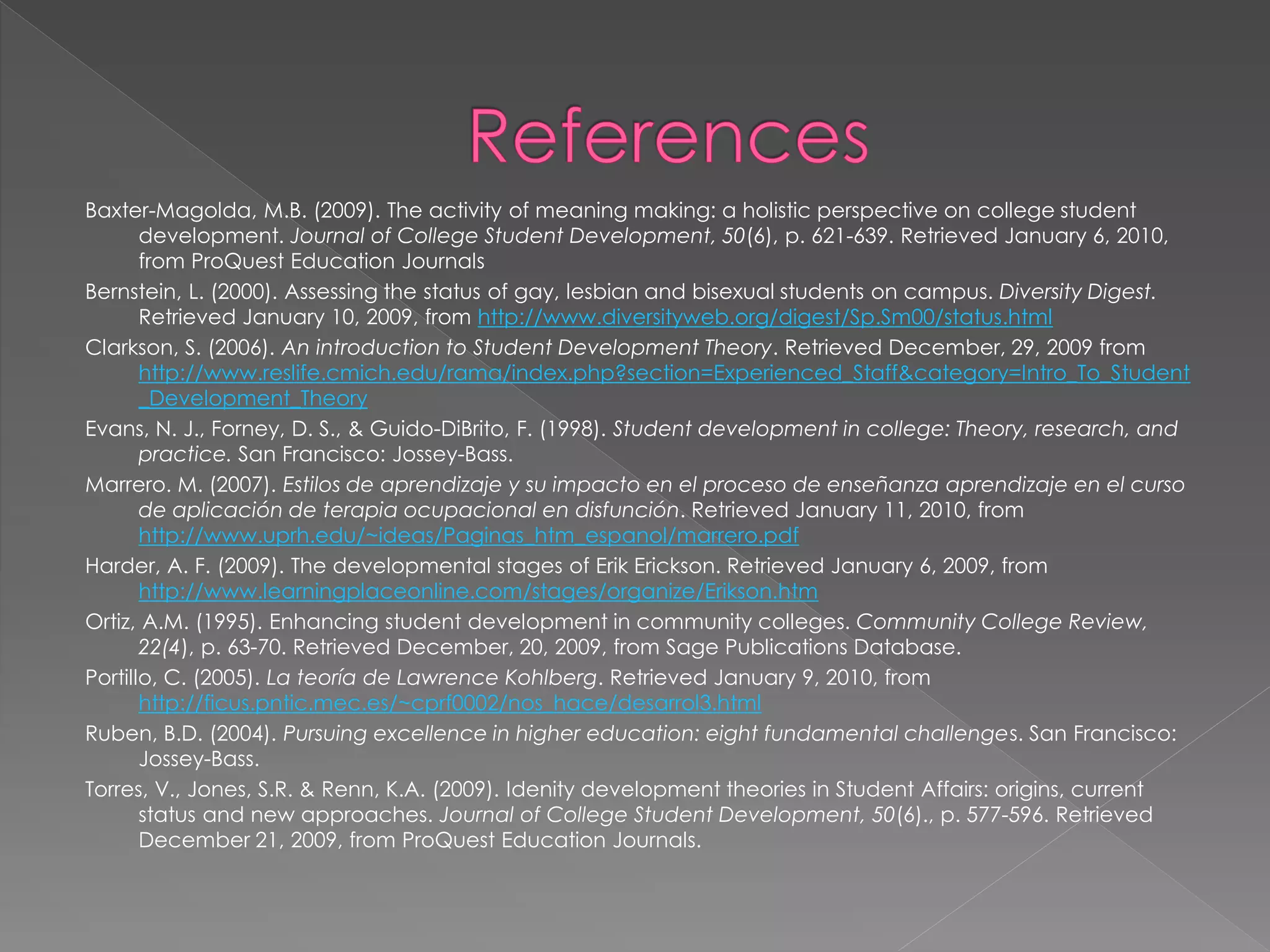
Baxter-Magolda, M.B. (2009). The activity of meaning making: a holistic perspective on college student
       development. Journal of College Student Development, 50(6), p. 621-639. Retrieved January 6, 2010,
       from ProQuest Education Journals
Bernstein, L. (2000). Assessing the status of gay, lesbian and bisexual students on campus. Diversity Digest.
       Retrieved January 10, 2009, from http://www.diversityweb.org/digest/Sp.Sm00/status.html
Clarkson, S. (2006). An introduction to Student Development Theory. Retrieved December, 29, 2009 from
       http://www.reslife.cmich.edu/rama/index.php?section=Experienced_Staff&category=Intro_To_Student
       _Development_Theory
Evans, N. J., Forney, D. S., & Guido-DiBrito, F. (1998). Student development in college: Theory, research, and
       practice. San Francisco: Jossey-Bass.
Marrero. M. (2007). Estilos de aprendizaje y su impacto en el proceso de enseñanza aprendizaje en el curso
       de aplicación de terapia ocupacional en disfunción. Retrieved January 11, 2010, from
       http://www.uprh.edu/~ideas/Paginas_htm_espanol/marrero.pdf
Harder, A. F. (2009). The developmental stages of Erik Erickson. Retrieved January 6, 2009, from
       http://www.learningplaceonline.com/stages/organize/Erikson.htm
Ortiz, A.M. (1995). Enhancing student development in community colleges. Community College Review,
       22(4), p. 63-70. Retrieved December, 20, 2009, from Sage Publications Database.
Portillo, C. (2005). La teoría de Lawrence Kohlberg. Retrieved January 9, 2010, from
       http://ficus.pntic.mec.es/~cprf0002/nos_hace/desarrol3.html
Ruben, B.D. (2004). Pursuing excellence in higher education: eight fundamental challenges. San Francisco:
       Jossey-Bass.
Torres, V., Jones, S.R. & Renn, K.A. (2009). Idenity development theories in Student Affairs: origins, current
       status and new approaches. Journal of College Student Development, 50(6)., p. 577-596. Retrieved
       December 21, 2009, from ProQuest Education Journals.

Student development theory

  • 1.
  • 2.
     Familiarize staffand faculty with Student Development Theory.  Present the importance, history, and utility of these theories.  Establish the differences among college and adult age groups.  Know how to apply Student Development Theory to hypothetical situations.
  • 3.
    Development is a process in which individuals expand their capacities and present a growth in abilities and knowledge. This growth is based on experiences and can be psychological, social and intellectual.
  • 4.
     According to Piaget and Erikson human development can be divided in stages or periods.  Erik H. Erikson present those periods in eight stages (Harder, 2009).
  • 5.
    Student Development Theory (SDT)are a set of diverse theories that try to explain the way students develop, grow and mature during the years they are enrolled in a higher education institution (Evans, Forney and Guido-DiBrito, 1998).
  • 6.
    Foundational Theories ofstudent development began in the early 1960s. Some of the precursors in the area were:  Nevitt Sanford  Douglas Heath  Roy Heath  Kenneth Feldman and Theodore Newcomb
  • 7.
    Ortiz (1995) and Evans et al. (1998) present that knowing Student Development Theories can help higher education personnel (staff, faculty, and administrators) to provide better programs and services based on student diversity and particularities.
  • 8.
     Psychosocial Theories Cognitive-structural Theories  Moral development theories  Typology and adult development theories  Identity development theories
  • 9.
    Erik Erikson  Arthur Chickering  Arthur Chickering & Linda Reisser
  • 10.
    Jean Piaget  William G. Perry, Jr.
  • 11.
    Lawrence Kohlberg  Carol Gilligan  There are gender differences among the two theories
  • 12.
    Myers-Briggs Type Indicator (Personality type theory). Developed by Katherine Cook Briggs and her daughter, Isabel Briggs Myers  John Holland’s Career Development Theory  David Kolb’s Experiential Learning Theory
  • 13.
    Racial and Ethnic Identity Development -Cross model of Psychological Nigrescence -Helm’s Model of White Identity -Phinney’s Model of Ethnic Identity  Gay, Lesbian, and Bisexual Identity Development -Cass’s Model of Homosexual Identity Formation -D’Augelli’s Model of Lesbian, Gay, and Bisexual Development
  • 14.
     The quantityof theories and models could be overwhelming.  All theories have its limitations and can not be applied to every population or setting.  They should be used to empower students, not to diagnose or tell them what to do.
  • 15.
    When applying studentdevelopment theories professionals should observe the following steps:  Study and familiarize with diverse developmental models and typologies.  Identify the issues or problems presented by the student.  Select and apply the theories that relate to the issue and take decisions to improve services and environmental conditions.
  • 16.
    Michelle was recently admitted to the university. Her mother wants her to study physics because Michelle is very good at that, she has excellent grades and the opportunity to apply for a science scholarship. She also likes to paint and everybody tells her that she has talent. Michelle is not sure about her career choices. She does not want to disappoint her mother nor want to give up on painting because she loves it.
  • 17.
    1) Identify the issues or problems presented by the student. -the student is not sure about her career choices -the student has identified her abilities and preferences -the student feel guilty and does not want to disappoint her mother 2) Apply the theories that relate to the issue and take decisions to improve services and environmental conditions. -Personality Type Theory/Career Development Theory/Gillian Theory of Moral Development -The institution can help Michelle providing her advising and counseling services to deal with her sentiments of guilt and family situation. They also could offer orientation services that will help her take well informed decisions regarding her career choices and future.
  • 18.
    Is essential torecognize:  Diversity (culture, ethnicity, gender).  Individuality (personality, preferences, learning styles).  Environment (experiences, campus climate, curricular and extracurricular activities).
  • 19.
    Is also important torecognize that everyone in the institution is a teacher (Ruben, 2004).
  • 20.
    Baxter-Magolda, M.B. (2009).The activity of meaning making: a holistic perspective on college student development. Journal of College Student Development, 50(6), p. 621-639. Retrieved January 6, 2010, from ProQuest Education Journals Bernstein, L. (2000). Assessing the status of gay, lesbian and bisexual students on campus. Diversity Digest. Retrieved January 10, 2009, from http://www.diversityweb.org/digest/Sp.Sm00/status.html Clarkson, S. (2006). An introduction to Student Development Theory. Retrieved December, 29, 2009 from http://www.reslife.cmich.edu/rama/index.php?section=Experienced_Staff&category=Intro_To_Student _Development_Theory Evans, N. J., Forney, D. S., & Guido-DiBrito, F. (1998). Student development in college: Theory, research, and practice. San Francisco: Jossey-Bass. Marrero. M. (2007). Estilos de aprendizaje y su impacto en el proceso de enseñanza aprendizaje en el curso de aplicación de terapia ocupacional en disfunción. Retrieved January 11, 2010, from http://www.uprh.edu/~ideas/Paginas_htm_espanol/marrero.pdf Harder, A. F. (2009). The developmental stages of Erik Erickson. Retrieved January 6, 2009, from http://www.learningplaceonline.com/stages/organize/Erikson.htm Ortiz, A.M. (1995). Enhancing student development in community colleges. Community College Review, 22(4), p. 63-70. Retrieved December, 20, 2009, from Sage Publications Database. Portillo, C. (2005). La teoría de Lawrence Kohlberg. Retrieved January 9, 2010, from http://ficus.pntic.mec.es/~cprf0002/nos_hace/desarrol3.html Ruben, B.D. (2004). Pursuing excellence in higher education: eight fundamental challenges. San Francisco: Jossey-Bass. Torres, V., Jones, S.R. & Renn, K.A. (2009). Idenity development theories in Student Affairs: origins, current status and new approaches. Journal of College Student Development, 50(6)., p. 577-596. Retrieved December 21, 2009, from ProQuest Education Journals.