



Critical Pedagogy
         Kurt Love, Ph.D.
Central Connecticut State University
Critical Pedagogy
•   Major Focus:
    Understanding and disrupting power imbalances that are
    present in educational settings especially connected to issues
    of race and class

•   Etymology:
    Critical Social Theory, Frankfurt School of Thought, Michel
    Foucault, Marxism, Critical Race Theory

•   Major Contributors:
    W.E.B. DuBois, Carter Woodson, Paulo Freire, bell hooks,
    Henry Giroux, Joe Kincheloe, Peter McLaren, Antonia Darder
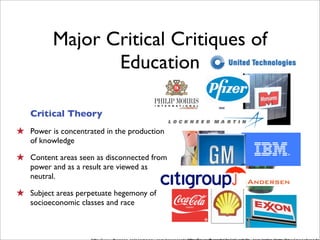
Major Critical Critiques of
                 Education

   Critical Theory
★ Power is concentrated in the production
   of knowledge

★ Content areas seen as disconnected from
   power and as a result are viewed as
   neutral.

★ Subject areas perpetuate hegemony of
   socioeconomic classes and race
3 Types of Curricula
•   Mainstream Curriculum - Curriculum that is
    explicit

•   Hidden Curriculum - Messages that are implicit

•   Null Curriculum - Messages that are silenced,
    omitted, or just simply not included. These also
    are critical views of the mainstream and hidden
    curricula
3 Types of Curricula
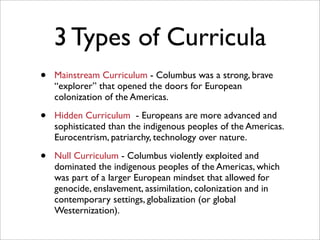
•   Mainstream Curriculum - Columbus was a strong, brave
    “explorer” that opened the doors for European
    colonization of the Americas.

•   Hidden Curriculum - Europeans are more advanced and
    sophisticated than the indigenous peoples of the Americas.
    Eurocentrism, patriarchy, technology over nature.

•   Null Curriculum - Columbus violently exploited and
    dominated the indigenous peoples of the Americas, which
    was part of a larger European mindset that allowed for
    genocide, enslavement, assimilation, colonization and in
    contemporary settings, globalization (or global
    Westernization).
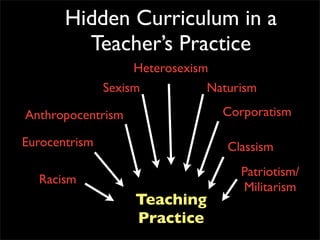
Hidden Curriculum in a
         Teacher’s Practice
                    Heterosexism
               Sexism           Naturism

Anthropocentrism                  Corporatism

Eurocentrism                       Classism
                                     Patriotism/
  Racism
                                     Militarism
                    Teaching
                    Practice
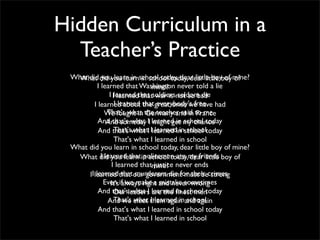
Hidden Curriculum in a
  Teacher’s Practice
 What did did you learnschool today, dear little boyboy mine?
   What you learn in in school today, dear little of of
           I learned that Washington never told a lie
                                 mine?
                 I Ilearned that soldiersnot so bad
                      learned that war is seldom die
         I learned about that great ones we have had
                    I learned the everybody's free
               We fought in the teacher said to me
                That's what Germany and in France
           And that's what II learned in my chance
                And someday might get school today
           And that's what I Ilearned in school today
                    That's what learned in school
                    That's what I learned in school
 What did you learn in school today, dear little boy of mine?
   What did you learn in school today,my friends boy of
             I learned that policemen are dear little
                   I learned thatmine? never ends
                                  justice
      II learned that our government must becrimes
          learned that murderers die for their strong
              Even if we make a and never wrong
                  It's always right mistake sometimes
           And that'sleaders learned finest men
                    Our what I are the in school today
                    That's what I learned in school
                And we elect them again and again
           And that's what I learned in school today
                    That's what I learned in school
Critical Pedagogy:
          Major Principles

•   Liberatory Education:
    An educational experience that allows for students
    to question power and power/knowledge
    relationships in society.

•   What is a power/knowledge relationship?
Liberatory Education
•   Identifying potential concepts that have embedded relationships of
    oppression, cultural colonization, or any form of social injustice.

    •   Questioning scientific method

    •   Questioning historical “facts”

    •   Using math as a tool for community investigation

    •   Questioning “profit”

    •   Questioning language

    •   Questioning public health policies

    •   Investigating poverty in our own community and globally
Critical Pedagogy:
          Major Principles


•   Class Struggle:
    The primary mode of analysis comes from looking
    at how socioeconomics limits people’s power. Jean
    Anyon’s study of how knowledge is treated
    differently based on the class of the students.
Class Struggle in
Educational Contexts
•   Jean Anyon’s (1981) study of how knowledge is
    treated differently based on the class of the
    students.

•   How is knowledge treated in the professional/elite
    schools? Middle class schools? Working class
    power schools?

•   How is knowledge treated in “honors” tracks?
    “Academic” or lower tracks?
Critical Pedagogy:
             Major Principles


• Cultural Capital:
  Those knowledges that are valued by the dominant
  elites
Cultural Capital
•   Knowing which fork to use.

•   Knowing how to play golf or sail.

•   Knowing what car to buy.

•   Knowing where to go on vacation that avoids the middle
    class people.

•   Knowing which private school to send your children.

•   Not saying “aks” in a job interview setting.

•   Not having an “accent.”
Critical Pedagogy:
             Major Principles


• Reading the World vs. Reading the Word:
 Understanding and investigating social justice issues vs.
 having technical decontextualized knowledge
Reading the World

• Excavating political meanings and cultural
  capital in texts
• Investigating ecological conditions in one’s
  community
• Incorporating the voices of subordinated
  groups as forms of analysis
Critical Pedagogy:
             Major Principles


• Naming:
 Exposing and identifying those social processes that
 promote hegemony and social injustice
Naming ☛ Hegemony
•   “The people participate in their own domination.”

•   Hegemony is the perpetuation of social injustices
    (i.e. classism, racism, sexism, heterosexism).

•   Hegemony allows for the powerful elites to retain
    their power while non-violently controlling the less
    powerful groups.

•   Hegemony is perpetuated through social consensus,
    social forms, and social structures including schools,
    church, media, political system, and family.
Naming ☛ Forms of Hegemony


•   Legitimization: Domination is seen as “just” or “fair”

    •   Example: Ranking schools in newspapers is fair.

•   Reification: Domination is seen as “normal” and
    “natural.” They are also seen as “always having been this
    way.”

    •   Example: Meritocracy is normal and natural.
Naming ☛ Forms of Hegemony

•   Fragmentation: Subordinated groups are divided and
    turned against one another.

    •   Example: Latin Kings, Los Solidos, 20 Luv -- Gangs in
        Hartford

•   Dissimulation: Domination is concealed.

    •   Example: Predatory lending practices by commercial
        banks and mortgage lenders.
Critical Pedagogy:
        Major Principles


• Cognizable Objects:
  An object from every day life that is used
  for deconstructing social processes that
  create social injustice.
Critical Pedagogy:
      Major Principles


• Generative Themes:
 Topics and questions raised by students
 become classroom topics for investigation
 and exploration.
Generative Themes
• Teacher listens to what students discuss
  amongst each other as well as the
  questions and comments they offer during
  class discussions.
• Over time, these topics become centralized
  for investigation, inquiry, and community-
  based work.
Generative Themes
•   Students interested in:

    •   Local politics and policy-making

    •   Decisions that affect their schools and neighborhoods

    •   Ecological conditions

    •   Community-based actions

    •   Issues present in media

    •   Cultural commons

Critical Pedagogy

  • 1.
    Critical Pedagogy Kurt Love, Ph.D. Central Connecticut State University
  • 2.
    Critical Pedagogy • Major Focus: Understanding and disrupting power imbalances that are present in educational settings especially connected to issues of race and class • Etymology: Critical Social Theory, Frankfurt School of Thought, Michel Foucault, Marxism, Critical Race Theory • Major Contributors: W.E.B. DuBois, Carter Woodson, Paulo Freire, bell hooks, Henry Giroux, Joe Kincheloe, Peter McLaren, Antonia Darder
  • 3.
    Major Critical Critiquesof Education Critical Theory ★ Power is concentrated in the production of knowledge ★ Content areas seen as disconnected from power and as a result are viewed as neutral. ★ Subject areas perpetuate hegemony of socioeconomic classes and race
  • 4.
    3 Types ofCurricula • Mainstream Curriculum - Curriculum that is explicit • Hidden Curriculum - Messages that are implicit • Null Curriculum - Messages that are silenced, omitted, or just simply not included. These also are critical views of the mainstream and hidden curricula
  • 5.
    3 Types ofCurricula • Mainstream Curriculum - Columbus was a strong, brave “explorer” that opened the doors for European colonization of the Americas. • Hidden Curriculum - Europeans are more advanced and sophisticated than the indigenous peoples of the Americas. Eurocentrism, patriarchy, technology over nature. • Null Curriculum - Columbus violently exploited and dominated the indigenous peoples of the Americas, which was part of a larger European mindset that allowed for genocide, enslavement, assimilation, colonization and in contemporary settings, globalization (or global Westernization).
  • 6.
    Hidden Curriculum ina Teacher’s Practice Heterosexism Sexism Naturism Anthropocentrism Corporatism Eurocentrism Classism Patriotism/ Racism Militarism Teaching Practice
  • 7.
    Hidden Curriculum ina Teacher’s Practice What did did you learnschool today, dear little boyboy mine? What you learn in in school today, dear little of of I learned that Washington never told a lie mine? I Ilearned that soldiersnot so bad learned that war is seldom die I learned about that great ones we have had I learned the everybody's free We fought in the teacher said to me That's what Germany and in France And that's what II learned in my chance And someday might get school today And that's what I Ilearned in school today That's what learned in school That's what I learned in school What did you learn in school today, dear little boy of mine? What did you learn in school today,my friends boy of I learned that policemen are dear little I learned thatmine? never ends justice II learned that our government must becrimes learned that murderers die for their strong Even if we make a and never wrong It's always right mistake sometimes And that'sleaders learned finest men Our what I are the in school today That's what I learned in school And we elect them again and again And that's what I learned in school today That's what I learned in school
  • 8.
    Critical Pedagogy: Major Principles • Liberatory Education: An educational experience that allows for students to question power and power/knowledge relationships in society. • What is a power/knowledge relationship?
  • 9.
    Liberatory Education • Identifying potential concepts that have embedded relationships of oppression, cultural colonization, or any form of social injustice. • Questioning scientific method • Questioning historical “facts” • Using math as a tool for community investigation • Questioning “profit” • Questioning language • Questioning public health policies • Investigating poverty in our own community and globally
  • 10.
    Critical Pedagogy: Major Principles • Class Struggle: The primary mode of analysis comes from looking at how socioeconomics limits people’s power. Jean Anyon’s study of how knowledge is treated differently based on the class of the students.
  • 11.
    Class Struggle in EducationalContexts • Jean Anyon’s (1981) study of how knowledge is treated differently based on the class of the students. • How is knowledge treated in the professional/elite schools? Middle class schools? Working class power schools? • How is knowledge treated in “honors” tracks? “Academic” or lower tracks?
  • 12.
    Critical Pedagogy: Major Principles • Cultural Capital: Those knowledges that are valued by the dominant elites
  • 13.
    Cultural Capital • Knowing which fork to use. • Knowing how to play golf or sail. • Knowing what car to buy. • Knowing where to go on vacation that avoids the middle class people. • Knowing which private school to send your children. • Not saying “aks” in a job interview setting. • Not having an “accent.”
  • 14.
    Critical Pedagogy: Major Principles • Reading the World vs. Reading the Word: Understanding and investigating social justice issues vs. having technical decontextualized knowledge
  • 15.
    Reading the World •Excavating political meanings and cultural capital in texts • Investigating ecological conditions in one’s community • Incorporating the voices of subordinated groups as forms of analysis
  • 16.
    Critical Pedagogy: Major Principles • Naming: Exposing and identifying those social processes that promote hegemony and social injustice
  • 17.
    Naming ☛ Hegemony • “The people participate in their own domination.” • Hegemony is the perpetuation of social injustices (i.e. classism, racism, sexism, heterosexism). • Hegemony allows for the powerful elites to retain their power while non-violently controlling the less powerful groups. • Hegemony is perpetuated through social consensus, social forms, and social structures including schools, church, media, political system, and family.
  • 18.
    Naming ☛ Formsof Hegemony • Legitimization: Domination is seen as “just” or “fair” • Example: Ranking schools in newspapers is fair. • Reification: Domination is seen as “normal” and “natural.” They are also seen as “always having been this way.” • Example: Meritocracy is normal and natural.
  • 19.
    Naming ☛ Formsof Hegemony • Fragmentation: Subordinated groups are divided and turned against one another. • Example: Latin Kings, Los Solidos, 20 Luv -- Gangs in Hartford • Dissimulation: Domination is concealed. • Example: Predatory lending practices by commercial banks and mortgage lenders.
  • 20.
    Critical Pedagogy: Major Principles • Cognizable Objects: An object from every day life that is used for deconstructing social processes that create social injustice.
  • 32.
    Critical Pedagogy: Major Principles • Generative Themes: Topics and questions raised by students become classroom topics for investigation and exploration.
  • 33.
    Generative Themes • Teacherlistens to what students discuss amongst each other as well as the questions and comments they offer during class discussions. • Over time, these topics become centralized for investigation, inquiry, and community- based work.
  • 34.
    Generative Themes • Students interested in: • Local politics and policy-making • Decisions that affect their schools and neighborhoods • Ecological conditions • Community-based actions • Issues present in media • Cultural commons