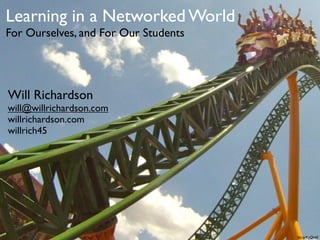
Learning in a Networked World
For Ourselves, and For Our Students


Will Richardson
will@willrichardson.com
willrichardson.com
willrich45


                                      bit.ly/KyQb6E
todaysmeet.com/EVSCREV12
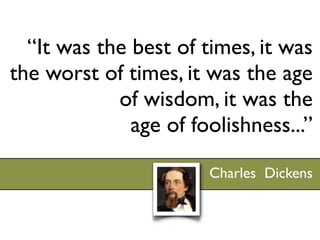
“It was the best of times, it was
the worst of times, it was the age
            of wisdom, it was the
              age of foolishness...”

                       Charles Dickens
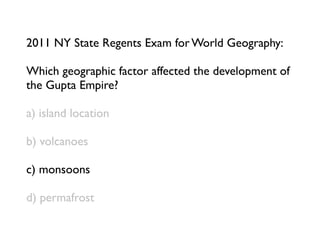
2011 NY State Regents Exam for World Geography:

Which geographic factor affected the development of
the Gupta Empire?
2011 NY State Regents Exam for World Geography:

Which geographic factor affected the development of
the Gupta Empire?

a) island location

b) volcanoes

c) monsoons

d) permafrost
2011 NY State Regents Exam for World Geography:

Which geographic factor affected the development of
the Gupta Empire?

a) island location

b) volcanoes

c) monsoons

d) permafrost
CHANGE
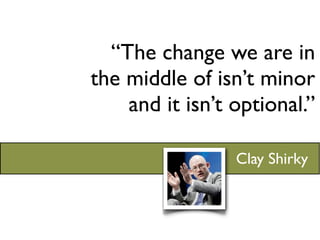
“The change we are in
the middle of isn’t minor
    and it isn’t optional.”

                 Clay Shirky
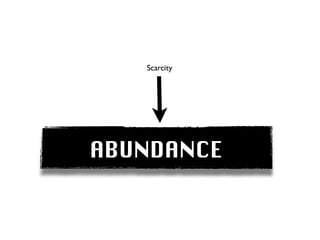
Scarcity
Scarcity


ABUNDANCE
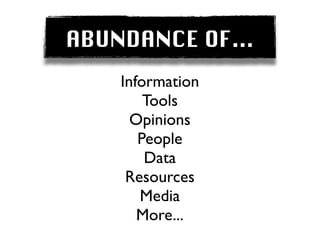
ABUNDANCE OF...
    Information
        Tools
      Opinions
       People
        Data
     Resources
       Media
       More...
ABUNDANCE OF...
             (Kids’ Version)


               Games
               Videos
              Networks
                Texts
              Hangouts
 All Sorts of Other Interesting Stuff
They Don’t Have Access to In School
...WHICH IS CHANGING

        Media
        Politics
      Journalism
       Medicine
        Books
       Business
        Music...
...WHICH IS CHANGING


      ...Education
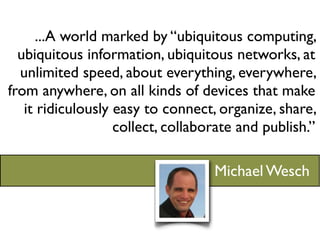
...A world marked by “ubiquitous computing,
  ubiquitous information, ubiquitous networks, at
  unlimited speed, about everything, everywhere,
from anywhere, on all kinds of devices that make
   it ridiculously easy to connect, organize, share,
                   collect, collaborate and publish.”

                                   Michael Wesch
...WHICH IS CHANGING


       Examples
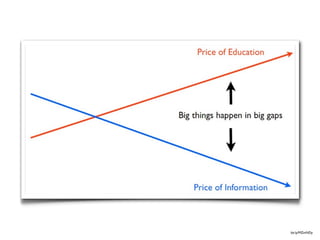
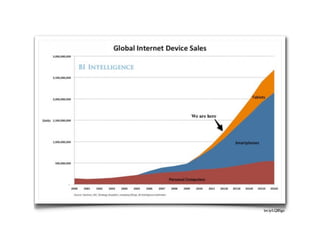
ABUNDANCE


Will Change Us.
bit.ly/MZmNDy
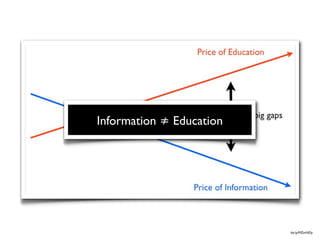
Information ≠ Education


                          bit.ly/MZmNDy
NEW REALITIES


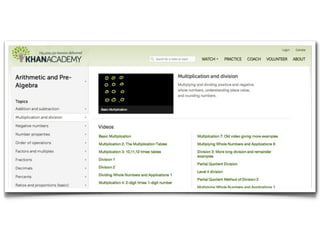
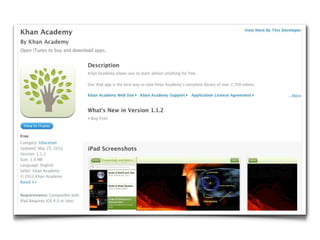
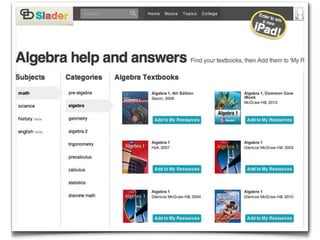
1. Content and Knowledge is Everywhere
NEW REALITIES


1. Content and Knowledge is Everywhere
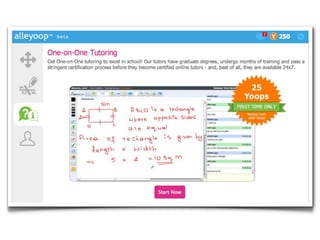
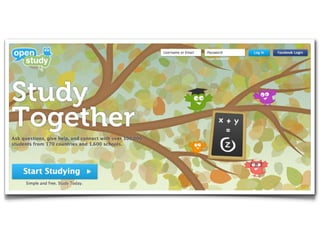
       2. Teachers are Everywhere
NEW REALITIES

1. Content and Knowledge is Everywhere
       2. Teachers are Everywhere
           3. Data is Everywhere
NEW REALITIES

1. Content and Knowledge is Everywhere
       2. Teachers are Everywhere
           3. Data is Everywhere
  4. Networks are the New Classrooms
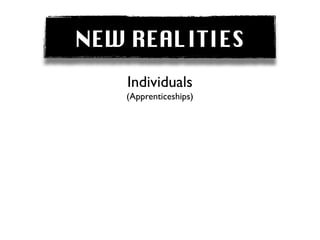
NEW REALITIES
    Individuals
   (Apprenticeships)
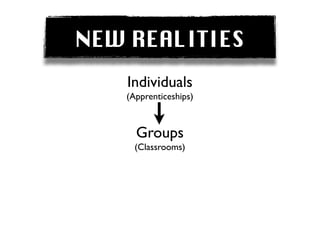
NEW REALITIES
    Individuals
   (Apprenticeships)


     Groups
     (Classrooms)
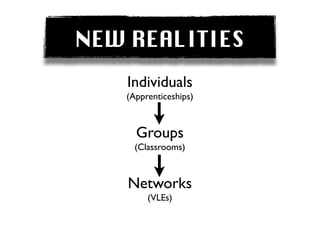
NEW REALITIES
    Individuals
   (Apprenticeships)


     Groups
     (Classrooms)


    Networks
        (VLEs)
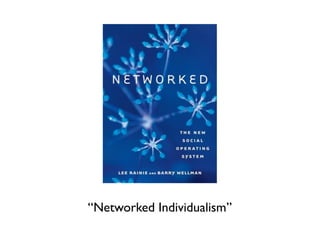
“Networked Individualism”
NEW REALITIES

1. Content and Knowledge is Everywhere
       2. Teachers are Everywhere
           3. Data is Everywhere
  4. Networks are the New Classrooms
        5. Learning is On Demand
bit.ly/LQ85go
change
CHANGE
KEY QUESTION


What is the primary value of school when
content and teachers are no longer scarce?
KEY QUESTION


 The answer to that question starts with:
“What do we want our students to learn?”
KEY QUESTION


“And what do you mean by ‘learning’?”
KEY QUESTION


  “Higher student achievement?”
“Improved student performance?”
   “Better student outcomes?”
       “College readiness?”
KEY QUESTION


“And what do you mean by ‘learning’?”

              Discuss.
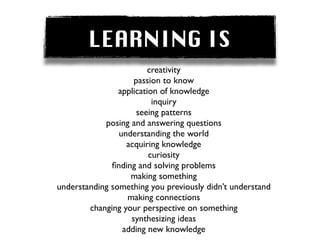
LEARNING IS
                         creativity
                    passion to know
                application of knowledge
                          inquiry
                     seeing patterns
            posing and answering questions
                understanding the world
                  acquiring knowledge
                         curiosity
              finding and solving problems
                   making something
understanding something you previously didn’t understand
                  making connections
        changing your perspective on something
                   synthesizing ideas
                 adding new knowledge
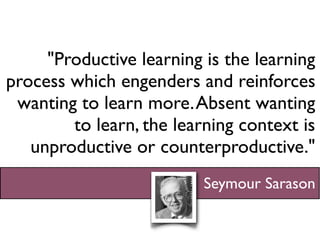
"Productive learning is the learning
process which engenders and reinforces
 wanting to learn more. Absent wanting
        to learn, the learning context is
   unproductive or counterproductive."
                          Seymour Sarason
LEARNING IS
                         creativity
                    passion to know
                application of knowledge
                          inquiry
                     seeing patterns
            posing and answering questions
                understanding the world
                  acquiring knowledge
                         curiosity
              finding and solving problems
                   making something
understanding something you previously didn’t understand
                  making connections
        changing your perspective on something
                   synthesizing ideas
                 adding new knowledge
REMEMBER:


If we don’t assess what we value,
   we will value what we assess.
“The illiterate of the
21st Century will not be those
   who cannot read and write,
        but those who cannot
   learn, unlearn, and relearn.”
                       Alvin Toffler
NEW REALITIES


1. Content and Knowledge is Everywhere
       2. Teachers are Everywhere
  3. Networks are the New Classrooms
        4. Learning is On Demand
UNLEARNING


So, given these new realities,
what do we have to “unlearn”?
UNLEARNING


 Five Part Process
UNLEARNING

1. Understand: The contexts for change
UNLEARNING

1. Understand: The contexts for change
    2. Feel: Anger, grief, excitement
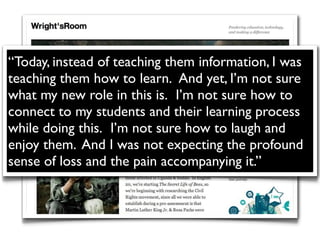
“Today, instead of teaching them information, I was
teaching them how to learn.  And yet, I’m not sure
what my new role in this is.  I’m not sure how to
connect to my students and their learning process
while doing this.  I’m not sure how to laugh and
enjoy them. And I was not expecting the profound
sense of loss and the pain accompanying it.”
UNLEARNING

    1. Understand: The contexts for change
        2. Feel: Anger, grief, excitement
3. Reflect: Examine your own learning practice
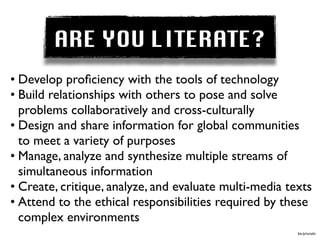
ARE YOU LITERATE?
• Develop proficiency with the tools of technology  
• Build relationships with others to pose and solve
  problems collaboratively and cross-culturally  
• Design and share information for global communities
  to meet a variety of purposes  
• Manage, analyze and synthesize multiple streams of
  simultaneous information  
• Create, critique, analyze, and evaluate multi-media texts  
• Attend to the ethical responsibilities required by these
  complex environments
                                                         bit.ly/nctelit
UNLEARNING

    1. Understand: The contexts for change
        2. Feel: Anger, grief, excitement
3. Reflect: Examine your own learning practice
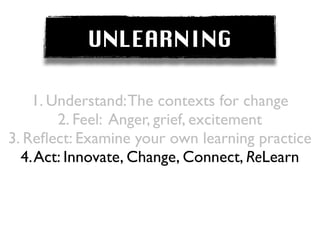
  4. Act: Innovate, Change, Connect, ReLearn
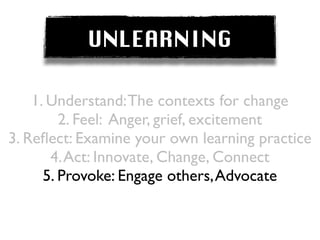
UNLEARNING

    1. Understand: The contexts for change
         2. Feel: Anger, grief, excitement
3. Reflect: Examine your own learning practice
       4. Act: Innovate, Change, Connect
      5. Provoke: Engage others, Advocate
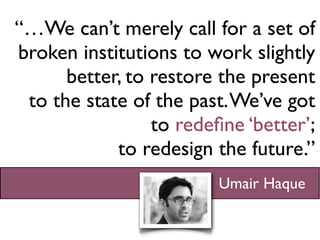
“…We can’t merely call for a set of
broken institutions to work slightly
      better, to restore the present
 to the state of the past. We’ve got
                 to redefine ‘better’;
            to redesign the future.”
                         Umair Haque
UNLEARNING

Three Things to Unlearn
UNLEARNING

Three Things to Unlearn

      1. Delivery
UNLEARNING


 UnDelivery Idea:
UNLEARNING


      UnDelivery Idea:

Let Students Design One Unit
UNLEARNING

Three Things to Unlearn

       1. Delivery
    2. Competition
UNLEARNING


UnCompetiton Idea:
UNLEARNING


UnCompetiton Idea:

 Share Everything
UNLEARNING

Three Things to Unlearn

       1. Delivery
    2. Competition
    3. Assessment
UNLEARNING

UnAssessment Idea

Not Open Book Test
Not Open Phone...
UNLEARNING

UnAssessment Idea

Not Open Book Test,
 Not Open Phone...

 ...Open Network
BE BOLD
2020?
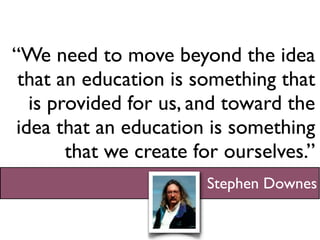
“We need to move beyond the idea
 that an education is something that
  is provided for us, and toward the
idea that an education is something
       that we create for ourselves.”
                       Stephen Downes
KEY QUESTION


What is the primary value of school when
content and teachers are no longer scarce?
“In times of change, learners
inherit the Earth, while the learned
          find themselves beautifully
equipped to deal with a world that
                   no longer exists.”
                          Eric Hoffer
THE END


       Thanks!

will@willrichardson.com
       @willrich45
   willrichardson.com

Evansville

  • 1.
    Learning in aNetworked World For Ourselves, and For Our Students Will Richardson will@willrichardson.com willrichardson.com willrich45 bit.ly/KyQb6E
  • 2.
  • 5.
    “It was thebest of times, it was the worst of times, it was the age of wisdom, it was the age of foolishness...” Charles Dickens
  • 6.
    2011 NY StateRegents Exam for World Geography:
  • 7.
    2011 NY StateRegents Exam for World Geography: Which geographic factor affected the development of the Gupta Empire?
  • 8.
    2011 NY StateRegents Exam for World Geography: Which geographic factor affected the development of the Gupta Empire? a) island location b) volcanoes c) monsoons d) permafrost
  • 9.
    2011 NY StateRegents Exam for World Geography: Which geographic factor affected the development of the Gupta Empire? a) island location b) volcanoes c) monsoons d) permafrost
  • 11.
  • 12.
    “The change weare in the middle of isn’t minor and it isn’t optional.” Clay Shirky
  • 13.
  • 14.
  • 15.
    ABUNDANCE OF... Information Tools Opinions People Data Resources Media More...
  • 16.
    ABUNDANCE OF... (Kids’ Version) Games Videos Networks Texts Hangouts All Sorts of Other Interesting Stuff They Don’t Have Access to In School
  • 17.
    ...WHICH IS CHANGING Media Politics Journalism Medicine Books Business Music...
  • 18.
  • 19.
    ...A world markedby “ubiquitous computing, ubiquitous information, ubiquitous networks, at unlimited speed, about everything, everywhere, from anywhere, on all kinds of devices that make it ridiculously easy to connect, organize, share, collect, collaborate and publish.” Michael Wesch
  • 20.
  • 24.
  • 25.
  • 26.
  • 27.
    NEW REALITIES 1. Contentand Knowledge is Everywhere
  • 33.
    NEW REALITIES 1. Contentand Knowledge is Everywhere 2. Teachers are Everywhere
  • 38.
    NEW REALITIES 1. Contentand Knowledge is Everywhere 2. Teachers are Everywhere 3. Data is Everywhere
  • 41.
    NEW REALITIES 1. Contentand Knowledge is Everywhere 2. Teachers are Everywhere 3. Data is Everywhere 4. Networks are the New Classrooms
  • 42.
    NEW REALITIES Individuals (Apprenticeships)
  • 43.
    NEW REALITIES Individuals (Apprenticeships) Groups (Classrooms)
  • 44.
    NEW REALITIES Individuals (Apprenticeships) Groups (Classrooms) Networks (VLEs)
  • 49.
  • 50.
    NEW REALITIES 1. Contentand Knowledge is Everywhere 2. Teachers are Everywhere 3. Data is Everywhere 4. Networks are the New Classrooms 5. Learning is On Demand
  • 51.
  • 54.
  • 55.
  • 56.
    KEY QUESTION What isthe primary value of school when content and teachers are no longer scarce?
  • 57.
    KEY QUESTION Theanswer to that question starts with: “What do we want our students to learn?”
  • 58.
    KEY QUESTION “And whatdo you mean by ‘learning’?”
  • 59.
    KEY QUESTION “Higher student achievement?” “Improved student performance?” “Better student outcomes?” “College readiness?”
  • 60.
    KEY QUESTION “And whatdo you mean by ‘learning’?” Discuss.
  • 61.
    LEARNING IS creativity passion to know application of knowledge inquiry seeing patterns posing and answering questions understanding the world acquiring knowledge curiosity finding and solving problems making something understanding something you previously didn’t understand making connections changing your perspective on something synthesizing ideas adding new knowledge
  • 62.
    "Productive learning isthe learning process which engenders and reinforces wanting to learn more. Absent wanting to learn, the learning context is unproductive or counterproductive." Seymour Sarason
  • 63.
    LEARNING IS creativity passion to know application of knowledge inquiry seeing patterns posing and answering questions understanding the world acquiring knowledge curiosity finding and solving problems making something understanding something you previously didn’t understand making connections changing your perspective on something synthesizing ideas adding new knowledge
  • 64.
    REMEMBER: If we don’tassess what we value, we will value what we assess.
  • 65.
    “The illiterate ofthe 21st Century will not be those who cannot read and write, but those who cannot learn, unlearn, and relearn.” Alvin Toffler
  • 66.
    NEW REALITIES 1. Contentand Knowledge is Everywhere 2. Teachers are Everywhere 3. Networks are the New Classrooms 4. Learning is On Demand
  • 67.
    UNLEARNING So, given thesenew realities, what do we have to “unlearn”?
  • 68.
  • 69.
    UNLEARNING 1. Understand: Thecontexts for change
  • 71.
    UNLEARNING 1. Understand: Thecontexts for change 2. Feel: Anger, grief, excitement
  • 74.
    “Today, instead ofteaching them information, I was teaching them how to learn.  And yet, I’m not sure what my new role in this is.  I’m not sure how to connect to my students and their learning process while doing this.  I’m not sure how to laugh and enjoy them. And I was not expecting the profound sense of loss and the pain accompanying it.”
  • 75.
    UNLEARNING 1. Understand: The contexts for change 2. Feel: Anger, grief, excitement 3. Reflect: Examine your own learning practice
  • 76.
    ARE YOU LITERATE? •Develop proficiency with the tools of technology   • Build relationships with others to pose and solve problems collaboratively and cross-culturally   • Design and share information for global communities to meet a variety of purposes   • Manage, analyze and synthesize multiple streams of simultaneous information   • Create, critique, analyze, and evaluate multi-media texts   • Attend to the ethical responsibilities required by these complex environments bit.ly/nctelit
  • 77.
    UNLEARNING 1. Understand: The contexts for change 2. Feel: Anger, grief, excitement 3. Reflect: Examine your own learning practice 4. Act: Innovate, Change, Connect, ReLearn
  • 80.
    UNLEARNING 1. Understand: The contexts for change 2. Feel: Anger, grief, excitement 3. Reflect: Examine your own learning practice 4. Act: Innovate, Change, Connect 5. Provoke: Engage others, Advocate
  • 83.
    “…We can’t merelycall for a set of broken institutions to work slightly better, to restore the present to the state of the past. We’ve got to redefine ‘better’; to redesign the future.” Umair Haque
  • 84.
  • 85.
    UNLEARNING Three Things toUnlearn 1. Delivery
  • 86.
  • 87.
    UNLEARNING UnDelivery Idea: Let Students Design One Unit
  • 88.
    UNLEARNING Three Things toUnlearn 1. Delivery 2. Competition
  • 89.
  • 90.
  • 91.
    UNLEARNING Three Things toUnlearn 1. Delivery 2. Competition 3. Assessment
  • 92.
    UNLEARNING UnAssessment Idea Not OpenBook Test Not Open Phone...
  • 93.
    UNLEARNING UnAssessment Idea Not OpenBook Test, Not Open Phone... ...Open Network
  • 94.
  • 98.
  • 102.
    “We need tomove beyond the idea that an education is something that is provided for us, and toward the idea that an education is something that we create for ourselves.” Stephen Downes
  • 103.
    KEY QUESTION What isthe primary value of school when content and teachers are no longer scarce?
  • 104.
    “In times ofchange, learners inherit the Earth, while the learned find themselves beautifully equipped to deal with a world that no longer exists.” Eric Hoffer
  • 105.
    THE END Thanks! will@willrichardson.com @willrich45 willrichardson.com

Editor's Notes