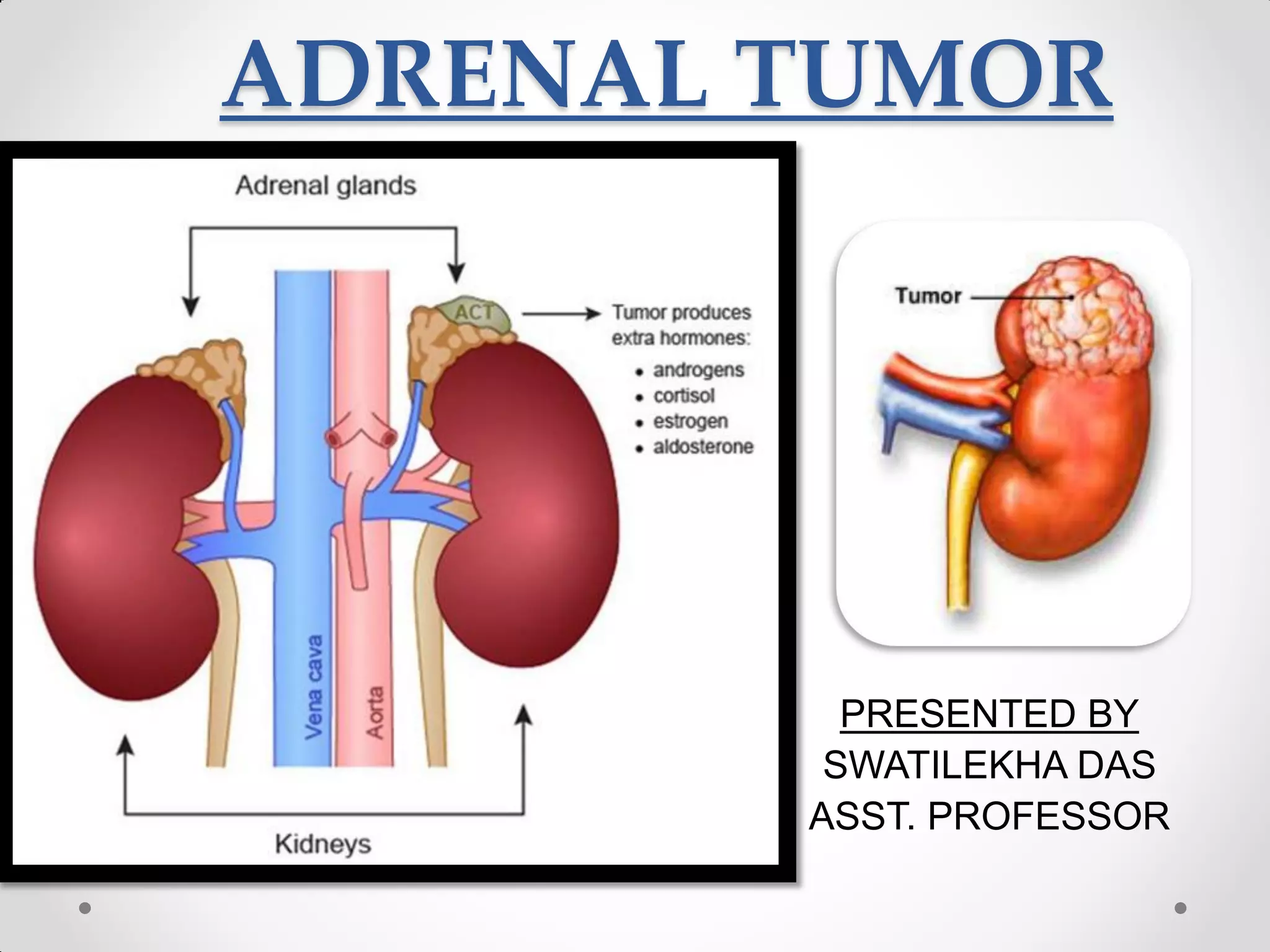
ADRENAL TUMOR
PRESENTED BY
SWATILEKHA DAS
ASST. PROFESSOR
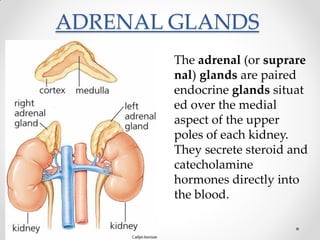
ADRENAL GLANDS
The adrenal (or suprare
nal) glands are paired
endocrine glands situat
ed over the medial
aspect of the upper
poles of each kidney.
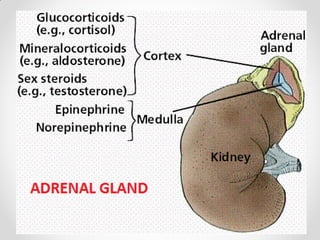
They secrete steroid and
catecholamine
hormones directly into
the blood.
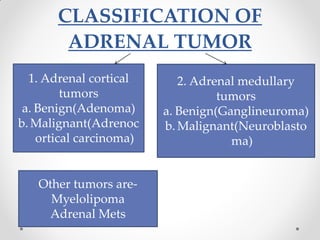
CLASSIFICATION OF
ADRENAL TUMOR
1. Adrenal cortical
tumors
a. Benign(Adenoma)
b. Malignant(Adrenoc
ortical carcinoma)
2. Adrenal medullary
tumors
a. Benign(Ganglineuroma)
b. Malignant(Neuroblasto
ma)
Other tumors are-
Myelolipoma
Adrenal Mets
Adrenal Cortical Adenoma
• Most common neoplasms arising from the adrenal gland.
• The incidence of adenomas rises with age
• May be unilateral or bilateral.
Clinical Manifestations
• Small size,non hormone producing are usually
asymptomatic, incidently diagnosed in CT/MRI done for
some other.
• Large size, non functioning tumors frequently present
with abdominal discomfort or back pain. With increasing
use of abdominal imaging they are detected early now.
• Hormone producing adenomas will produce signs &
symptoms of the hormones produced that is :
a. Cushing syndrome if increased level of Cortisol
b. Conn’s syndrome if increased of Aldosteron
Cushing syndrome
• Weight gain / central obesity
• Diabetes
• Hypertension
• Depression
• Osteoporosis
• Skin changes (strial, facial plethora, ecchymosis, acne)
• Hypokalemia
Conn’s syndrome
• Headache
• Muscle weakness
• Hypertension
• Cramps
• Polyuria
• Nocturia
• Intermittent paralysis
• Polydipsia
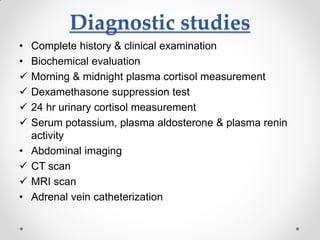
Diagnostic studies
• Complete history & clinical examination
• Biochemical evaluation
 Morning & midnight plasma cortisol measurement
 Dexamethasone suppression test
 24 hr urinary cortisol measurement
 Serum potassium, plasma aldosterone & plasma renin
activity
• Abdominal imaging
 CT scan
 MRI scan
• Adrenal vein catheterization
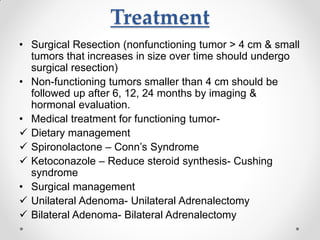
Treatment
• Surgical Resection (nonfunctioning tumor > 4 cm & small
tumors that increases in size over time should undergo
surgical resection)
• Non-functioning tumors smaller than 4 cm should be
followed up after 6, 12, 24 months by imaging &
hormonal evaluation.
• Medical treatment for functioning tumor-
 Dietary management
 Spironolactone – Conn’s Syndrome
 Ketoconazole – Reduce steroid synthesis- Cushing
syndrome
• Surgical management
 Unilateral Adenoma- Unilateral Adrenalectomy
 Bilateral Adenoma- Bilateral Adrenalectomy
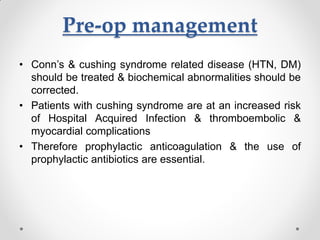
Pre-op management
• Conn’s & cushing syndrome related disease (HTN, DM)
should be treated & biochemical abnormalities should be
corrected.
• Patients with cushing syndrome are at an increased risk
of Hospital Acquired Infection & thromboembolic &
myocardial complications
• Therefore prophylactic anticoagulation & the use of
prophylactic antibiotics are essential.
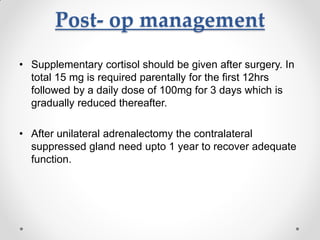
Post- op management
• Supplementary cortisol should be given after surgery. In
total 15 mg is required parentally for the first 12hrs
followed by a daily dose of 100mg for 3 days which is
gradually reduced thereafter.
• After unilateral adrenalectomy the contralateral
suppressed gland need upto 1 year to recover adequate
function.
Adrenocortical Carcinoma
• A rare malignancy with an incidence of 0.5 to2 per million
but gradually poor prognosis.
• Peaks in children in the first decade of life and adults in
the fourth to fifth decades of life.
• Slight female predominance.
• The majority of adrenocortical carcinomas are unilateral/
Clinical Features
• Approx. 60% present with evidence of steroid hormones
excess i.e. Cushing syndrome. Else any hormone
excess can be the presentation.
• Patients with non-functioning tumors frequently complain
of abdominal discomfort or back pain caused by large
tumors.
Diagnostic Studies
• History taking & physical examination
• Biochemical evaluation –
 Morning & midnight plasma cortisol measurement
 Dexamethasone suppression test
 24 hr urinary cortisol measurement
 Serum potassium, plasma aldosterone & plasma renin activity
• Abdominal imaging-
 CT scan
 MRI scan
 MRI angiography
 As distant metastasis is frequently present so a CT scan of
the lung is recommended.
Treatment
• Complete tumor resection is associated with favourable
outcome.
• Laparoscopic adrenalectomy is associated with a high
incidence of local recurrence & can’t be recommended.
• Adjuvent chemotherapy- patients should be treated with
alone or in combination with Etoposide, Doxorubisin or
Cisplatin in 30% & 50% of cases respectively.
• Adjuvent Rdiotherapy- May reduce the rate of local
recurrence.
• Follow up- After surgery, restaging every 3 months is
required as the risk of tumor relapse is high.
Staging of Adrenal Carcinoma
The WHO clasification of 2004 is based on the Mcfarlane
Classification & defines four stages:
I stage – Tumor < 5 cm
II stage – Tumor >5 cm
III stage – Locally invasive tumors
IV Stage – Tumor with distant metastasis
Surgery of the Adrenal Gland
• Laparoscopic or Retroperitoneoscopic Adrenalectomy
had become the gold standard in the resection of
Adrenal tumors, except for tumors with signs of
malignancy.
• An open approach should be considered if radiological
signs, distant metastases large tumors (>8-10 cm) or a
distant hormonal pattern suggest malignancy.
the surgical access in such cases should be
Thoracoabdominal.
Adrenal tumor, classification, management - easy explanation

Adrenal tumor, classification, management - easy explanation

  • 1.
  • 2.
    ADRENAL GLANDS The adrenal(or suprare nal) glands are paired endocrine glands situat ed over the medial aspect of the upper poles of each kidney. They secrete steroid and catecholamine hormones directly into the blood.
  • 4.
    CLASSIFICATION OF ADRENAL TUMOR 1.Adrenal cortical tumors a. Benign(Adenoma) b. Malignant(Adrenoc ortical carcinoma) 2. Adrenal medullary tumors a. Benign(Ganglineuroma) b. Malignant(Neuroblasto ma) Other tumors are- Myelolipoma Adrenal Mets
  • 5.
    Adrenal Cortical Adenoma •Most common neoplasms arising from the adrenal gland. • The incidence of adenomas rises with age • May be unilateral or bilateral.
  • 6.
    Clinical Manifestations • Smallsize,non hormone producing are usually asymptomatic, incidently diagnosed in CT/MRI done for some other. • Large size, non functioning tumors frequently present with abdominal discomfort or back pain. With increasing use of abdominal imaging they are detected early now. • Hormone producing adenomas will produce signs & symptoms of the hormones produced that is : a. Cushing syndrome if increased level of Cortisol b. Conn’s syndrome if increased of Aldosteron
  • 7.
    Cushing syndrome • Weightgain / central obesity • Diabetes • Hypertension • Depression • Osteoporosis • Skin changes (strial, facial plethora, ecchymosis, acne) • Hypokalemia
  • 8.
    Conn’s syndrome • Headache •Muscle weakness • Hypertension • Cramps • Polyuria • Nocturia • Intermittent paralysis • Polydipsia
  • 9.
    Diagnostic studies • Completehistory & clinical examination • Biochemical evaluation  Morning & midnight plasma cortisol measurement  Dexamethasone suppression test  24 hr urinary cortisol measurement  Serum potassium, plasma aldosterone & plasma renin activity • Abdominal imaging  CT scan  MRI scan • Adrenal vein catheterization
  • 10.
    Treatment • Surgical Resection(nonfunctioning tumor > 4 cm & small tumors that increases in size over time should undergo surgical resection) • Non-functioning tumors smaller than 4 cm should be followed up after 6, 12, 24 months by imaging & hormonal evaluation. • Medical treatment for functioning tumor-  Dietary management  Spironolactone – Conn’s Syndrome  Ketoconazole – Reduce steroid synthesis- Cushing syndrome • Surgical management  Unilateral Adenoma- Unilateral Adrenalectomy  Bilateral Adenoma- Bilateral Adrenalectomy
  • 11.
    Pre-op management • Conn’s& cushing syndrome related disease (HTN, DM) should be treated & biochemical abnormalities should be corrected. • Patients with cushing syndrome are at an increased risk of Hospital Acquired Infection & thromboembolic & myocardial complications • Therefore prophylactic anticoagulation & the use of prophylactic antibiotics are essential.
  • 12.
    Post- op management •Supplementary cortisol should be given after surgery. In total 15 mg is required parentally for the first 12hrs followed by a daily dose of 100mg for 3 days which is gradually reduced thereafter. • After unilateral adrenalectomy the contralateral suppressed gland need upto 1 year to recover adequate function.
  • 13.
    Adrenocortical Carcinoma • Arare malignancy with an incidence of 0.5 to2 per million but gradually poor prognosis. • Peaks in children in the first decade of life and adults in the fourth to fifth decades of life. • Slight female predominance. • The majority of adrenocortical carcinomas are unilateral/
  • 14.
    Clinical Features • Approx.60% present with evidence of steroid hormones excess i.e. Cushing syndrome. Else any hormone excess can be the presentation. • Patients with non-functioning tumors frequently complain of abdominal discomfort or back pain caused by large tumors.
  • 15.
    Diagnostic Studies • Historytaking & physical examination • Biochemical evaluation –  Morning & midnight plasma cortisol measurement  Dexamethasone suppression test  24 hr urinary cortisol measurement  Serum potassium, plasma aldosterone & plasma renin activity • Abdominal imaging-  CT scan  MRI scan  MRI angiography  As distant metastasis is frequently present so a CT scan of the lung is recommended.
  • 16.
    Treatment • Complete tumorresection is associated with favourable outcome. • Laparoscopic adrenalectomy is associated with a high incidence of local recurrence & can’t be recommended. • Adjuvent chemotherapy- patients should be treated with alone or in combination with Etoposide, Doxorubisin or Cisplatin in 30% & 50% of cases respectively. • Adjuvent Rdiotherapy- May reduce the rate of local recurrence. • Follow up- After surgery, restaging every 3 months is required as the risk of tumor relapse is high.
  • 17.
    Staging of AdrenalCarcinoma The WHO clasification of 2004 is based on the Mcfarlane Classification & defines four stages: I stage – Tumor < 5 cm II stage – Tumor >5 cm III stage – Locally invasive tumors IV Stage – Tumor with distant metastasis
  • 18.
    Surgery of theAdrenal Gland • Laparoscopic or Retroperitoneoscopic Adrenalectomy had become the gold standard in the resection of Adrenal tumors, except for tumors with signs of malignancy. • An open approach should be considered if radiological signs, distant metastases large tumors (>8-10 cm) or a distant hormonal pattern suggest malignancy. the surgical access in such cases should be Thoracoabdominal.