TERM PARER
ON
Farming System
Research
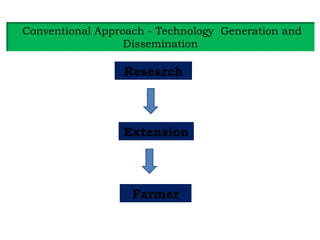
Farmer
Research
Extension
Conventional Approach - Technology Generation and
Dissemination
 Dependency of farmers upon external agro-technologies
and agro-technicians.
 Farmers - passive users of solutions.
Major Disadvantages of Conventional Approach
Farmers tends to live and operate in complex and diverse
environments.
 There is high degree of heterogeneity in their
circumstances and farming Systems.
 A significant micro differences are often enough to limit
diffusion.
Chambers et al., 1989
Jiggins, 1989
Defoer and Scoones, 2001
Need for FSR
 Dissemination of technologies was considered to be the
standard role of extension.
But,
 Segregation of research and extension from the farmers.
Farmers’ needs and priorities were not considered.
 The technologies were not beneficial to the resource-poor
farmers in risk-prone areas.
 Technologies did not meet the diversity of conditions that
local farmers had to cope with.
 Increasing concern on holistic understanding of farmers’
farming as well as socio-political environment to unravel
several connections of technology.
FARMING SYSTEMS RESEARCH
FSR involves a form of action research in which scientists
work with farmers in defining their problems and then
seeking solutions, with the aim of improving the benefits to
farmers in a sustainable way.
• Mike collision(1999): it is a diagnostic basket; a basket of
methods for researchers to elicit a better understanding of
farm households, family decisions and decision making
process.
Assumption
• Better understanding of farming systems would lead
innovations to be better accepted by farmers.
CHARACTERISTICS of FSR/E
1. Farmer based
2. Problem solving
3. Comprehensive
4. Interdisciplinary
5. Complementary
6. Interactive
7. Dynamic
8. Responsible to society
Basic activities of FSR/E
1. Location of the target area and stratifying into
sub areas.
2. Building knowledge of the research area by
interdisciplinary research teams to identify
problems and opportunities.
3. Setting the stage for on-farm research
4. Conducting on-farm research
1. Research managed trials
2. Superimposed trials
3. Farmer managed tests
5. Extension of results- multilocation trials.
FSR SUPORT- PARTICIPATORY
TECHNOLOGY DEVELOPMENT
Process of bringing together the local
communities with their own knowledge and
capacity for research with the researchers and
other professionals on one platform.
• Common features of FSR and PTD
a. Provided basic information on farming systems.
b. Enhanced the creation of integrated research
systems.
c. Client orientation and indigenous knowledge
orientation.
Source: Rajasekaran et.al
METHODOLOGICAL FRAMEWORK FOR
INTEGRATING IKS IN FSR/E
STEPS:
1. Recording the IKSs of farmers
2. Validating the farmer experiment
Extension process in which,
a. Understanding the rationale behind farmer experimentation
b. Recording the mode of conducting experiments
c. Identifying the farmers’ evaluation criteria
3. Conducting experimenter workshops
Farmer experimenters, SMSs, extension workers
4. Other farmer experimenters should evaluate
technology that has been tested during the
farmer experimentation procedure.
-productivity, sustainability, complexity, labor intensity,
etc.
5. Arrive at any one of the following decisions.
a. Drop the technological option that has been
tested
b. Technological option needs long-term research
c. Technological option is ready for further
dissemination
Source: Rajasekaran et.al,
CASE STUDIES
1) Integration of ITK on pest management
Field study in Mahendragarh district of Haryana-
community practice where in farmers grew coriander
around a chickpea field.
Rationality:
Farmers- Coriander repelled the pests.
Scientists- Coriander attracted the predators.
Note: The outcome was same, but not the causality.
Source: Gupta, 2007
2) Integration of ITK in weed control in Punjab.
Weeds- Phalaris minor in wheat
Echinoclova sp. in rice.
Weed scientists- spraying of herbicide solutions.
Some Farmers (who lacked the sprayers)- mixed the
recommended herbicides with sand, or even urea and
broadcasted.
This worked well and spread like wild fire.
Scientists were concerned about the validity of the practice.
Testing at the experimental station showed that the technique
was found to be nearly as effective as using a spray.
Note: scientists developed the technology and farmers modified
it accordingly to suit their economic conditions.
Source: Maurya, 1998
CONSTRAINTS IN INTEGRATING IKS IN
FSR/E
1. Formal research priorities are being biased too much
by political and commercial interests.
2. Unequal power relations between the actors involved
is questioned particularly in the discussion of IPRs on
indigenous genetic material and the associated
knowledge in both agriculture and medical sector.
3. Very little has been done on a systematic and broad
scale basis for scaling up of IK in innovation
development (Simpson, 1999)
4. Scaling up is seen as internally inconsistent as a result
of the very local character of knowledge (Simpson,
1999)
IMPORTANCE OF FSR
1. provide a frame of reference for
strengthening agri. extension.
2. understanding of various perspectives of
local people, bridging the communication
gap between outsiders and insiders.
3. Recognizes the accomplishments of local
farmers, helping outsiders familiarize with
local conditions.
4. Increases participation of farmers and their
organizations in integrating, utilizing and
disseminating what already exists.
5. People can solve all the problems.
SHORTCOMINGS of FSR/E
1. Difficult to fully understand the complex local
farming systems and decision logics.
2. Methods of innovation development used were
unsuitable for exploiting IKS of small scale/
subsistence farmers.
3. Available information was filed but hardly used
in the creation of innovations.
4. FSR researchers got trapped into the process of
generating more and more detailed information,
leaving the creation of innovations to others
(Floris, 2005)
Farming systems research

Farming systems research

  • 1.
  • 2.
    Farmer Research Extension Conventional Approach -Technology Generation and Dissemination
  • 3.
     Dependency offarmers upon external agro-technologies and agro-technicians.  Farmers - passive users of solutions. Major Disadvantages of Conventional Approach
  • 4.
    Farmers tends tolive and operate in complex and diverse environments.  There is high degree of heterogeneity in their circumstances and farming Systems.  A significant micro differences are often enough to limit diffusion. Chambers et al., 1989 Jiggins, 1989 Defoer and Scoones, 2001
  • 5.
    Need for FSR Dissemination of technologies was considered to be the standard role of extension. But,  Segregation of research and extension from the farmers. Farmers’ needs and priorities were not considered.  The technologies were not beneficial to the resource-poor farmers in risk-prone areas.  Technologies did not meet the diversity of conditions that local farmers had to cope with.  Increasing concern on holistic understanding of farmers’ farming as well as socio-political environment to unravel several connections of technology.
  • 6.
    FARMING SYSTEMS RESEARCH FSRinvolves a form of action research in which scientists work with farmers in defining their problems and then seeking solutions, with the aim of improving the benefits to farmers in a sustainable way. • Mike collision(1999): it is a diagnostic basket; a basket of methods for researchers to elicit a better understanding of farm households, family decisions and decision making process. Assumption • Better understanding of farming systems would lead innovations to be better accepted by farmers.
  • 7.
    CHARACTERISTICS of FSR/E 1.Farmer based 2. Problem solving 3. Comprehensive 4. Interdisciplinary 5. Complementary 6. Interactive 7. Dynamic 8. Responsible to society
  • 8.
    Basic activities ofFSR/E 1. Location of the target area and stratifying into sub areas. 2. Building knowledge of the research area by interdisciplinary research teams to identify problems and opportunities. 3. Setting the stage for on-farm research 4. Conducting on-farm research 1. Research managed trials 2. Superimposed trials 3. Farmer managed tests 5. Extension of results- multilocation trials.
  • 9.
    FSR SUPORT- PARTICIPATORY TECHNOLOGYDEVELOPMENT Process of bringing together the local communities with their own knowledge and capacity for research with the researchers and other professionals on one platform. • Common features of FSR and PTD a. Provided basic information on farming systems. b. Enhanced the creation of integrated research systems. c. Client orientation and indigenous knowledge orientation.
  • 10.
    Source: Rajasekaran et.al METHODOLOGICALFRAMEWORK FOR INTEGRATING IKS IN FSR/E STEPS: 1. Recording the IKSs of farmers 2. Validating the farmer experiment Extension process in which, a. Understanding the rationale behind farmer experimentation b. Recording the mode of conducting experiments c. Identifying the farmers’ evaluation criteria
  • 11.
    3. Conducting experimenterworkshops Farmer experimenters, SMSs, extension workers 4. Other farmer experimenters should evaluate technology that has been tested during the farmer experimentation procedure. -productivity, sustainability, complexity, labor intensity, etc. 5. Arrive at any one of the following decisions. a. Drop the technological option that has been tested b. Technological option needs long-term research c. Technological option is ready for further dissemination Source: Rajasekaran et.al,
  • 12.
    CASE STUDIES 1) Integrationof ITK on pest management Field study in Mahendragarh district of Haryana- community practice where in farmers grew coriander around a chickpea field. Rationality: Farmers- Coriander repelled the pests. Scientists- Coriander attracted the predators. Note: The outcome was same, but not the causality. Source: Gupta, 2007
  • 13.
    2) Integration ofITK in weed control in Punjab. Weeds- Phalaris minor in wheat Echinoclova sp. in rice. Weed scientists- spraying of herbicide solutions. Some Farmers (who lacked the sprayers)- mixed the recommended herbicides with sand, or even urea and broadcasted. This worked well and spread like wild fire. Scientists were concerned about the validity of the practice. Testing at the experimental station showed that the technique was found to be nearly as effective as using a spray. Note: scientists developed the technology and farmers modified it accordingly to suit their economic conditions. Source: Maurya, 1998
  • 14.
    CONSTRAINTS IN INTEGRATINGIKS IN FSR/E 1. Formal research priorities are being biased too much by political and commercial interests. 2. Unequal power relations between the actors involved is questioned particularly in the discussion of IPRs on indigenous genetic material and the associated knowledge in both agriculture and medical sector. 3. Very little has been done on a systematic and broad scale basis for scaling up of IK in innovation development (Simpson, 1999) 4. Scaling up is seen as internally inconsistent as a result of the very local character of knowledge (Simpson, 1999)
  • 15.
    IMPORTANCE OF FSR 1.provide a frame of reference for strengthening agri. extension. 2. understanding of various perspectives of local people, bridging the communication gap between outsiders and insiders. 3. Recognizes the accomplishments of local farmers, helping outsiders familiarize with local conditions.
  • 16.
    4. Increases participationof farmers and their organizations in integrating, utilizing and disseminating what already exists. 5. People can solve all the problems.
  • 17.
    SHORTCOMINGS of FSR/E 1.Difficult to fully understand the complex local farming systems and decision logics. 2. Methods of innovation development used were unsuitable for exploiting IKS of small scale/ subsistence farmers. 3. Available information was filed but hardly used in the creation of innovations. 4. FSR researchers got trapped into the process of generating more and more detailed information, leaving the creation of innovations to others (Floris, 2005)