DIFFUSION OF
INNOVATION
• Diffusion is a kind of social change,
define as the process by which
alteration occurs in the structure and
function of a social system
• When “new ideas” are invented,
diffused, and are adopted or rejected,
leading to certain consequences,
social change occurs.
2
CROSS CULTURAL
COMMUNICATION
Diffusion of
Innovation
Stages (Rogers et al)
•A WARENESS
•I NTEREST
•E VALUATION
•T RIAL
•A DOPTION
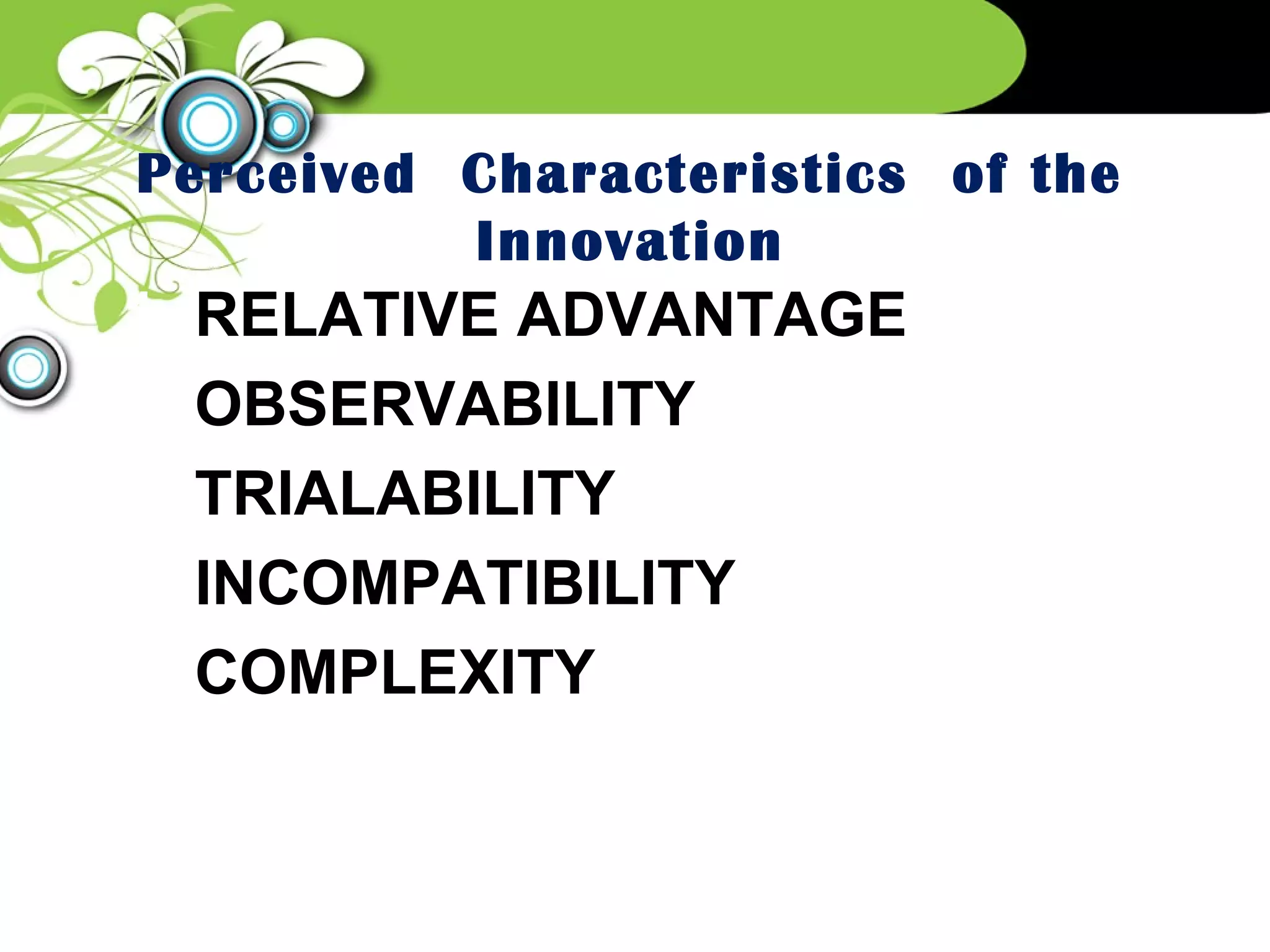
Perceived
Characteristics of
the Innovation
•RELATIVE
ADVANTAGE
•OBSERVABILITY
•TRIALABILITY
•INCOMPATIBILITY
•COMPLEXITY
3
STAGES in the INNOVATION-DECISION
PROCESS : 5 steps
1. KNOWLEDGE: occurs when an
individual / Dec-Making unit, in exposed
to the innovation’s existence.
2. PERSUASION: occurs when an
individual forms a favorable or
unfavorable attitude toward the
innovation
4Cont’d
STAGES in the INNOVATION-DECISION
PROCESS
3. DECISION occurs when an individual
engages in activities that lead to a
choice
to adopt or reject the innovation
4. IMPLEMENTATION occurs when an
individual puts an innovation into use
5Cont’d
STAGES in the INNOVATION-DECISION
PROCESS
5. CONFIRMATION occurs when an
individual seeks reinforcement of an
innovation decision that has already
been made, but he or she may reverse
this previous decision if exposed to
conflicting messages about the
innovation
6
STAGES in the INNOVATION-DECISION
PROCESS
Cont’d
Communication Channels
KNOW-LEDGE PERSUA-SION DECISIONPRIOR
CONDITION
1.Previous
practice
2.Felt needs
/problems
3.Innovative
ness
1.Norms of the
soc.system
Charact. Of
the Decision
making unit:
1.Soc—econ,
2.Personality
3.Commucatio
n behavior
Perceived
Charact of the
Innovation:
1Relative
advantage
2.Compatibility
3.Complexity
4.Trialability
5.Observability
1.Adoption
2.Rejection
8
STAGES in the INNOVATION-DECISION
PROCESSCOMMUNICATION CHANNELS
IMPLEMENTATION CONFIRMATIONDECISION
Continued Adoption
Later Adoption
Discontinuance
Continued Rejection
Adoption
Rejection
Two Types of Discontinuance
1. REPLACEMENT Discontinuance – in order to
adopt a better idea that supersedes it.
2. DISENCHANTMENT Discontinuance, is
decision to reject an idea as a results because
the innovation is inappropriate for the individual
or dissatisfaction with its performance.
misuse of an innovation -- functioned
disadvantageously …. Later adopters.
9
PRIOR CONDITION
1.Previous practice/s
2.Felt needs /problems
3.Innovativeness
4.Norms of the social system
10
Characteristics Of the Decision making
unit:
1.Socio-economic characteristics
2.Personality variables.. caring,
openness, fairness, etc. begin at
early life!
3.Communication behavior
11
Perceived Characteristics of the
Innovation
1. RELATIVE ADVANTAGE
2. OBSERVABILITY
3. TRIALABILITY
4. INCOMPATIBILITY
5. COMPLEXITY
12
The Hierarchy-of-Effects & the Stages-of Change
Correspond to Stages in the Innovation-Decision
Process (Rogers, 2003).
13
Stages in the Innovation-
Decision Process
Hierarchy-
of-Effects
Prochaska’s Stages –of
- Change
I. Knowledge Stage
1. Recall of Information
2. Comprehension of messages
3. Knowledge or skill for effectiveness
adoption of the innovation
I. Precontemplation
II. Persuasion Stage
4. Liking the innovation
5. Discussion of the new behavior with other
6. Acceptance of the message about the
innovation
II. Contemplation
continued
The Hierarchy-of-Effects & the Stages-of
Change Correspond to Stages in the
Innovation-Decision Process (Rogers, 2003).
14
Stages in the Innovation-
Decision Process
Hierarchy-
of-Effects
Prochaska’s Stages –of
- Change
IV. Implementation Stage
11. Acquisition to seek additional information
about the innovation.
12. Use the innovation on a regular basis
13. Continued use of the innovation
IV. Action
V. Confirmation Stage
14. Recognition of the benefit of using the
innovation.
15. Integration of the innovation into one’s
ongoing routine.
16. Promotion of the innovation to others.
V.. Maintenance
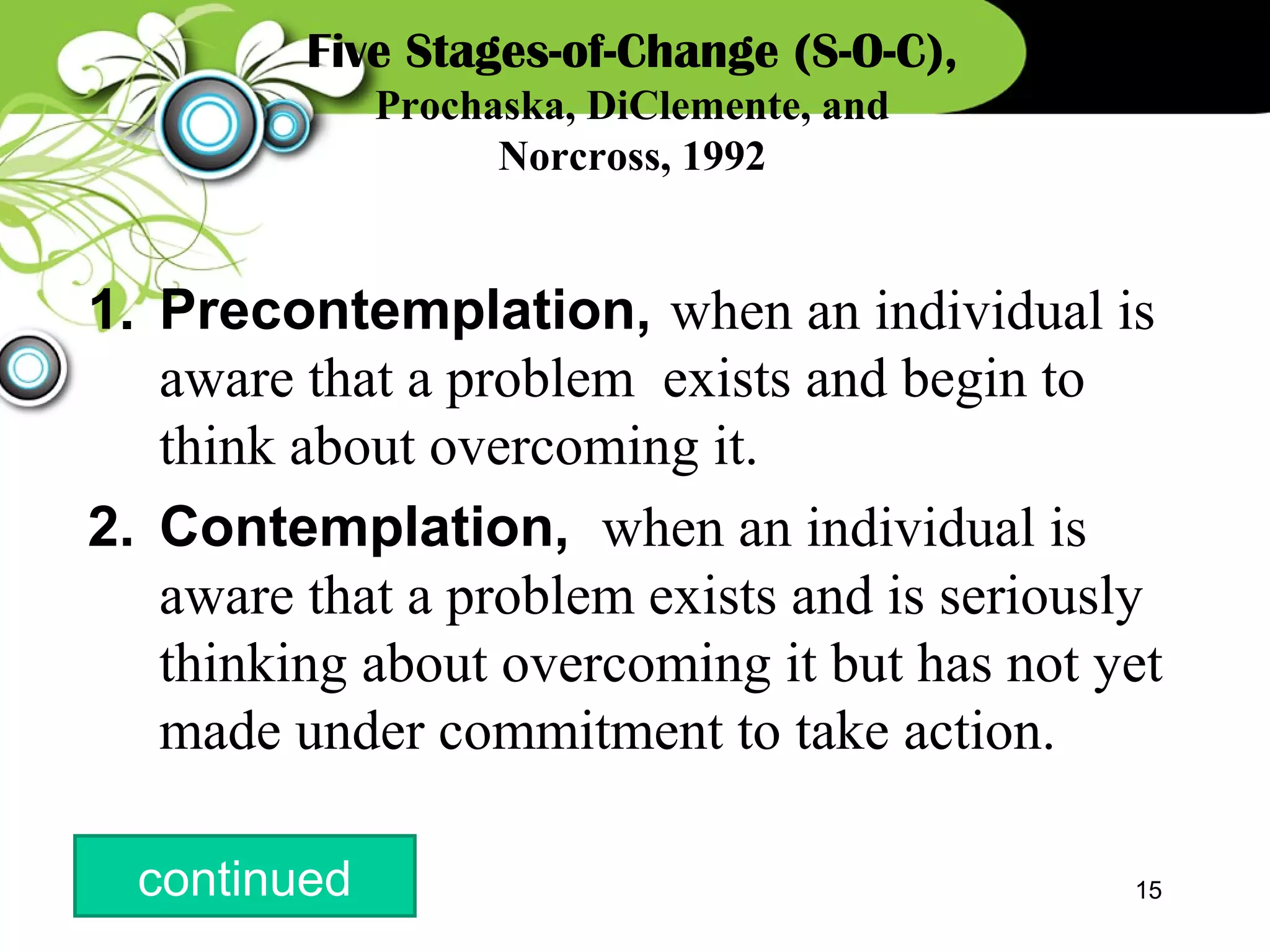
Five Stages-of-Change (S-O-C),
Prochaska, DiClemente, and
Norcross, 1992
1. Precontemplation, when an individual is
aware that a problem exists and begin to
think about overcoming it.
2. Contemplation, when an individual is
aware that a problem exists and is seriously
thinking about overcoming it but has not yet
made under commitment to take action.
15continued
Five Stages-of-Change (S-O-C),
Prochaska, DiClemente, and Norcross,
1992
3. Preparation, the stage at which an individual
intends to take action in the immediate future
but has not yet done it.
4. Action, when an individual changes behavior in
order to overcome the problem.
5. Maintenance, the stage at which an individual
consolidates and continues the behavior
change that was made previously.
16
TUGAS INDIVIDU
• CARI DAN JELASKAN KATEGORI
ADOPTER DALAM DIFUSI INOVASI
• DIKUMPULKAN SAAT UTS
KOMUNIKASI KESEHATAN
Daftar Pustaka
• Rogers, M. Everett, 1983.DIFFUSION
OF INNOVATIONS. Third edition. The
Free Press. A Division of Macmillan
Publishing Co., Inc. New York.
• Rogers, M. Everett, 2003.DIFFUSION
OF INNOVATIONS. Fifth edition. The
Free Press. A Division of Simon &
Schuster, Inc. New York, NY 10020
18
AWARENESS
KNOWLEDGE
Individu
menyadari
bahwa dirinya
berisiko tinggi
menderita
DM, individu
belum
mengetahui
dengan jelas
bagaimana
cara
pencegahan-
nya
INTEREST
PERSUASION
Individu tidak
ingin terkena
DM sehingga
mencari
informasi
mengenai
cara
pencegahan-
nya
EVALUATION
DECISION
Individu menimbang-nimbang
mengenai keuntungan dan
kerugian jika dia
mempraktekkan perilaku
yang bisa menghindarkannya
dari penyakit DM , yakni :
- Pemeriksaan gula darah
rutin
-Menjaga pola makan
melalui: mengurangi
absorpsi gula/mengganti
dengan gula rendah kalori,
mengurangi makanan
berBTM, bersoda
-Berolahraga secara teratur
EVALUATION
DECISION
Individu menimbang-
nimbang mengenai
keuntungan dan kerugian
jika dia mempraktekkan
perilaku yang bisa
menghindarkannya dari
penyakit DM , yakni :
- Pemeriksaan gula darah
rutin
-Menjaga pola makan
melalui: mengurangi
absorpsi gula/mengganti
dengan gula rendah kalori,
mengurangi makanan
berBTM, bersoda
-Berolahraga secara teratur
TRIAL
IMPLEMEN
TATION
Individu
melaksanakan
perilaku dalam
kurun waktu
tertentu untuk
selanjutnya
akan
dipertimbang-
kan lagi apakah
perilaku
tersebut akan
dilanjutkan atau
tidak
ADOPTION
CONFIRMA
TION
Individu
mengkonfirmasi
bahwa perilaku
berkontribusi
positif terhadap
dirinya (kadar
gula darah
normal) sehingga
individu akan
melanjutkan
perilaku tersebut

Diffusion of innovation

  • 1.
  • 2.
    • Diffusion isa kind of social change, define as the process by which alteration occurs in the structure and function of a social system • When “new ideas” are invented, diffused, and are adopted or rejected, leading to certain consequences, social change occurs. 2
  • 3.
    CROSS CULTURAL COMMUNICATION Diffusion of Innovation Stages(Rogers et al) •A WARENESS •I NTEREST •E VALUATION •T RIAL •A DOPTION Perceived Characteristics of the Innovation •RELATIVE ADVANTAGE •OBSERVABILITY •TRIALABILITY •INCOMPATIBILITY •COMPLEXITY 3
  • 4.
    STAGES in theINNOVATION-DECISION PROCESS : 5 steps 1. KNOWLEDGE: occurs when an individual / Dec-Making unit, in exposed to the innovation’s existence. 2. PERSUASION: occurs when an individual forms a favorable or unfavorable attitude toward the innovation 4Cont’d
  • 5.
    STAGES in theINNOVATION-DECISION PROCESS 3. DECISION occurs when an individual engages in activities that lead to a choice to adopt or reject the innovation 4. IMPLEMENTATION occurs when an individual puts an innovation into use 5Cont’d
  • 6.
    STAGES in theINNOVATION-DECISION PROCESS 5. CONFIRMATION occurs when an individual seeks reinforcement of an innovation decision that has already been made, but he or she may reverse this previous decision if exposed to conflicting messages about the innovation 6
  • 7.
    STAGES in theINNOVATION-DECISION PROCESS Cont’d Communication Channels KNOW-LEDGE PERSUA-SION DECISIONPRIOR CONDITION 1.Previous practice 2.Felt needs /problems 3.Innovative ness 1.Norms of the soc.system Charact. Of the Decision making unit: 1.Soc—econ, 2.Personality 3.Commucatio n behavior Perceived Charact of the Innovation: 1Relative advantage 2.Compatibility 3.Complexity 4.Trialability 5.Observability 1.Adoption 2.Rejection
  • 8.
    8 STAGES in theINNOVATION-DECISION PROCESSCOMMUNICATION CHANNELS IMPLEMENTATION CONFIRMATIONDECISION Continued Adoption Later Adoption Discontinuance Continued Rejection Adoption Rejection
  • 9.
    Two Types ofDiscontinuance 1. REPLACEMENT Discontinuance – in order to adopt a better idea that supersedes it. 2. DISENCHANTMENT Discontinuance, is decision to reject an idea as a results because the innovation is inappropriate for the individual or dissatisfaction with its performance. misuse of an innovation -- functioned disadvantageously …. Later adopters. 9
  • 10.
    PRIOR CONDITION 1.Previous practice/s 2.Feltneeds /problems 3.Innovativeness 4.Norms of the social system 10
  • 11.
    Characteristics Of theDecision making unit: 1.Socio-economic characteristics 2.Personality variables.. caring, openness, fairness, etc. begin at early life! 3.Communication behavior 11
  • 12.
    Perceived Characteristics ofthe Innovation 1. RELATIVE ADVANTAGE 2. OBSERVABILITY 3. TRIALABILITY 4. INCOMPATIBILITY 5. COMPLEXITY 12
  • 13.
    The Hierarchy-of-Effects &the Stages-of Change Correspond to Stages in the Innovation-Decision Process (Rogers, 2003). 13 Stages in the Innovation- Decision Process Hierarchy- of-Effects Prochaska’s Stages –of - Change I. Knowledge Stage 1. Recall of Information 2. Comprehension of messages 3. Knowledge or skill for effectiveness adoption of the innovation I. Precontemplation II. Persuasion Stage 4. Liking the innovation 5. Discussion of the new behavior with other 6. Acceptance of the message about the innovation II. Contemplation continued
  • 14.
    The Hierarchy-of-Effects &the Stages-of Change Correspond to Stages in the Innovation-Decision Process (Rogers, 2003). 14 Stages in the Innovation- Decision Process Hierarchy- of-Effects Prochaska’s Stages –of - Change IV. Implementation Stage 11. Acquisition to seek additional information about the innovation. 12. Use the innovation on a regular basis 13. Continued use of the innovation IV. Action V. Confirmation Stage 14. Recognition of the benefit of using the innovation. 15. Integration of the innovation into one’s ongoing routine. 16. Promotion of the innovation to others. V.. Maintenance
  • 15.
    Five Stages-of-Change (S-O-C), Prochaska,DiClemente, and Norcross, 1992 1. Precontemplation, when an individual is aware that a problem exists and begin to think about overcoming it. 2. Contemplation, when an individual is aware that a problem exists and is seriously thinking about overcoming it but has not yet made under commitment to take action. 15continued
  • 16.
    Five Stages-of-Change (S-O-C), Prochaska,DiClemente, and Norcross, 1992 3. Preparation, the stage at which an individual intends to take action in the immediate future but has not yet done it. 4. Action, when an individual changes behavior in order to overcome the problem. 5. Maintenance, the stage at which an individual consolidates and continues the behavior change that was made previously. 16
  • 17.
    TUGAS INDIVIDU • CARIDAN JELASKAN KATEGORI ADOPTER DALAM DIFUSI INOVASI • DIKUMPULKAN SAAT UTS KOMUNIKASI KESEHATAN
  • 18.
    Daftar Pustaka • Rogers,M. Everett, 1983.DIFFUSION OF INNOVATIONS. Third edition. The Free Press. A Division of Macmillan Publishing Co., Inc. New York. • Rogers, M. Everett, 2003.DIFFUSION OF INNOVATIONS. Fifth edition. The Free Press. A Division of Simon & Schuster, Inc. New York, NY 10020 18
  • 19.
    AWARENESS KNOWLEDGE Individu menyadari bahwa dirinya berisiko tinggi menderita DM,individu belum mengetahui dengan jelas bagaimana cara pencegahan- nya INTEREST PERSUASION Individu tidak ingin terkena DM sehingga mencari informasi mengenai cara pencegahan- nya EVALUATION DECISION Individu menimbang-nimbang mengenai keuntungan dan kerugian jika dia mempraktekkan perilaku yang bisa menghindarkannya dari penyakit DM , yakni : - Pemeriksaan gula darah rutin -Menjaga pola makan melalui: mengurangi absorpsi gula/mengganti dengan gula rendah kalori, mengurangi makanan berBTM, bersoda -Berolahraga secara teratur
  • 20.
    EVALUATION DECISION Individu menimbang- nimbang mengenai keuntungandan kerugian jika dia mempraktekkan perilaku yang bisa menghindarkannya dari penyakit DM , yakni : - Pemeriksaan gula darah rutin -Menjaga pola makan melalui: mengurangi absorpsi gula/mengganti dengan gula rendah kalori, mengurangi makanan berBTM, bersoda -Berolahraga secara teratur TRIAL IMPLEMEN TATION Individu melaksanakan perilaku dalam kurun waktu tertentu untuk selanjutnya akan dipertimbang- kan lagi apakah perilaku tersebut akan dilanjutkan atau tidak ADOPTION CONFIRMA TION Individu mengkonfirmasi bahwa perilaku berkontribusi positif terhadap dirinya (kadar gula darah normal) sehingga individu akan melanjutkan perilaku tersebut