Adolescence
•Transition from childhoodto adulthood.
•Derived from Latin adolescere - “to grow to maturity”
•Age range: ~10–19 years
•Rapid physical, emotional, social, and cognitive growth.
•Crucial for establishing healthy habits and requires supportive
environments.
3.
• “storm andstress” period (Stanley Hall)
• “Adolescence is that span of years during which
boys and girls move from childhood to adulthood
physically, mentally, emotionally and socially.”
(Dr. A.T. Jersild)
• Awkward age, Clumsy age, Difficult age, Stormy
period of life, Crisis of youth, etc.
4.
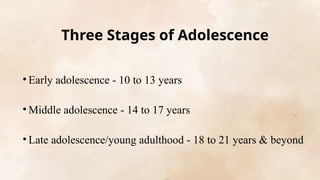
Three Stages ofAdolescence
• Early adolescence - 10 to 13 years
• Middle adolescence - 14 to 17 years
• Late adolescence/young adulthood - 18 to 21 years & beyond
5.
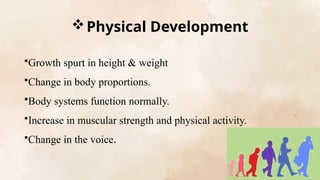
Physical Development
•Growth spurtin height & weight
•Change in body proportions.
•Body systems function normally.
•Increase in muscular strength and physical activity.
•Change in the voice.
6.
• Onset ofPuberty; sexual maturity.
• Development of secondary sex features.
7.
Emotional Development
•Emotions becomecomplex; true feelings are often
concealed.
•Emotional range widens; expressed even toward
abstract objects.
•Ability to bear tension in varied social situations.
•Increased compassion and concern for others’ feelings
8.
• Loyalties extendto peers and leaders beyond home.
• Greater perception and appreciation of people around
them.
• High hopes and aspirations for future life.
• Ability to tolerate loneliness.
• Capacity to externalize feelings in different situations.
9.
Social Development
•Increased influenceof the peer group.
•Increased self-consciousness about social position.
•Conformity to group norms
•Identification with adults and imitation of adult roles.
10.
•Friendships formed withthose matching their standards
and traits.
•Interest in opposite-sex friendships and social roles.
•Hero worship and role modeling of adults/leaders.
11.
Intellectual / Cognitive
Development
•Abstractthinking & reasoning skills develop
•Improved capacity to see relationships and solve complex problems
•Ability to think abstractly and symbolically
•Increased vocabulary, memory, and communication skills
12.
•Problem-solving, decision-making, andfuture planning
•Improved communication skills
•Awareness of people and issues beyond immediate environment
•Differentiation between ideals and reality
•Internalization of moral codes
13.
Moral & EthicalDevelopment
•Concern for justice, fairness, equality
•Development of conscience and personal values
•Shift from external authority to internal principles
14.
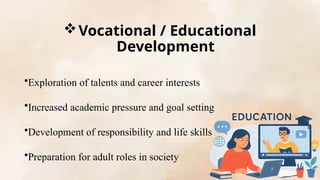
Vocational / Educational
Development
•Explorationof talents and career interests
•Increased academic pressure and goal setting
•Development of responsibility and life skills
•Preparation for adult roles in society
15.
Challenges of Adolescence
•Identitycrisis (Who am I?)
•Peer pressure and risk-taking behavior
•Emotional instability and stress
•Struggle for independence vs. family expectations
16.
Conclusion
• Adolescence isa critical stage shaping personality,
values, and future roles.
• Involves physical, cognitive, emotional, social, moral,
and vocational changes.
• Guidance, support, and healthy environment are
essential for positive growth.




![characteristics of indian adolescents [Autosaved].pptx](https://cdn.slidesharecdn.com/ss_thumbnails/characteristicsofindianadolescentsautosaved-231002095150-2a4e8005-thumbnail.jpg?width=640&height=640&fit=bounds)


