ECOLOGICAL SYSTEMS
THEORY
By Bronfenbrenner
Gurukasi Rajan, Yashaswini, Meera, Jeevanthika, Naveen, Vijayamathubalan,
Kirthika P
INTRODUCTION
This theory looks at a child’s development within the context of the system of
relationships that form his or her environment. Bronfenbrenner’s theory
defines complex “layers” of environment, each having an effect on a child’s
development.
The interaction between factors in the child’s maturing biology, his immediate
family/community environment, and the societal landscape fuels and steers his
development.
Changes or conflict in any one layer will ripple throughout other layers.
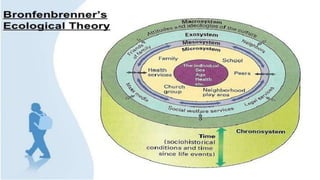
Layers of the Model ….
MICRO SYSTEM
❏ This is the layer closest to the child and contains the structures with which
the child has direct contact.
❏ Structures in the microsystem include family, school, neighborhood, or
childcare environments
❏ Relationships have impact in two directions - both away from the child and
toward the child. For example, a child’s parents may affect his beliefs and
behavior; however, the child also affects the behavior and beliefs of the
parent.
❏ Bronfenbrenner calls these bi-directional influences, and he shows how
they occur among all levels of environment.
MESO SYSTEM
❏ This layer provides the connection between the structures of the
child’s microsystem
❏ Examples: the connection between the child’s teacher and his
parents, between his church and his neighborhood, etc.
EXO SYSTEM
❏ This layer defines the larger social system in which the
child does not function directly.
❏ The structures in this layer impact the child’s development
by interacting with some structure in her microsystem
❏ Examples: Parent workplace schedules or community-
based family resources
MACRO SYSTEM
❏ The outermost layer in the child’s environment
❏ This layer is comprised of cultural values, customs, and laws
❏ The parent's ability or inability to carry out that responsibility toward
their child within the context of the child’s microsystem is affected.
❏ Example: If it is the belief of the culture that parents should be solely
responsible for raising their children, that culture is less likely to
provide resources to help parents
CHRONO SYSTEM
❏ This system encompasses the dimension of time as it relates to a
child’s environments
❏ Physiological changes that occur with the aging of a child. As
children get older, they may react differently to environmental
changes and may be more able to determine more how that change
will influence them.
❏ Example : A parent's promotion; Job loss by the providing member
will have a very high impact
What We Can Do …?
Implications
❖ Bronfenbrenner sees the instability and unpredictability of
family life we’ve let our economy create as the most
destructive force to a child’s development
❖ If the relationships in the immediate microsystem break
down, the child will not have the tools to explore other
parts of his environment.
❖ Knowing about the breakdown occurring within children’s homes, is it
possible for our educational system to make up for these deficiencies?
❖ For the educational community to attempt a primary role is to help our
society continue its denial of the real issue.
❖ The problems students and families face are caused by the conflict
between the workplace and family life – not between families and schools.
❖ Schools and teachers should work to support the primary relationship and
to create an environment that welcomes and nurtures families.
THANK YOU ...

Bronfenbrenner theory

  • 1.
    ECOLOGICAL SYSTEMS THEORY By Bronfenbrenner GurukasiRajan, Yashaswini, Meera, Jeevanthika, Naveen, Vijayamathubalan, Kirthika P
  • 2.
    INTRODUCTION This theory looksat a child’s development within the context of the system of relationships that form his or her environment. Bronfenbrenner’s theory defines complex “layers” of environment, each having an effect on a child’s development. The interaction between factors in the child’s maturing biology, his immediate family/community environment, and the societal landscape fuels and steers his development. Changes or conflict in any one layer will ripple throughout other layers.
  • 4.
    Layers of theModel ….
  • 5.
    MICRO SYSTEM ❏ Thisis the layer closest to the child and contains the structures with which the child has direct contact. ❏ Structures in the microsystem include family, school, neighborhood, or childcare environments ❏ Relationships have impact in two directions - both away from the child and toward the child. For example, a child’s parents may affect his beliefs and behavior; however, the child also affects the behavior and beliefs of the parent. ❏ Bronfenbrenner calls these bi-directional influences, and he shows how they occur among all levels of environment.
  • 6.
    MESO SYSTEM ❏ Thislayer provides the connection between the structures of the child’s microsystem ❏ Examples: the connection between the child’s teacher and his parents, between his church and his neighborhood, etc.
  • 7.
    EXO SYSTEM ❏ Thislayer defines the larger social system in which the child does not function directly. ❏ The structures in this layer impact the child’s development by interacting with some structure in her microsystem ❏ Examples: Parent workplace schedules or community- based family resources
  • 8.
    MACRO SYSTEM ❏ Theoutermost layer in the child’s environment ❏ This layer is comprised of cultural values, customs, and laws ❏ The parent's ability or inability to carry out that responsibility toward their child within the context of the child’s microsystem is affected. ❏ Example: If it is the belief of the culture that parents should be solely responsible for raising their children, that culture is less likely to provide resources to help parents
  • 9.
    CHRONO SYSTEM ❏ Thissystem encompasses the dimension of time as it relates to a child’s environments ❏ Physiological changes that occur with the aging of a child. As children get older, they may react differently to environmental changes and may be more able to determine more how that change will influence them. ❏ Example : A parent's promotion; Job loss by the providing member will have a very high impact
  • 10.
    What We CanDo …?
  • 11.
    Implications ❖ Bronfenbrenner seesthe instability and unpredictability of family life we’ve let our economy create as the most destructive force to a child’s development ❖ If the relationships in the immediate microsystem break down, the child will not have the tools to explore other parts of his environment.
  • 12.
    ❖ Knowing aboutthe breakdown occurring within children’s homes, is it possible for our educational system to make up for these deficiencies? ❖ For the educational community to attempt a primary role is to help our society continue its denial of the real issue. ❖ The problems students and families face are caused by the conflict between the workplace and family life – not between families and schools. ❖ Schools and teachers should work to support the primary relationship and to create an environment that welcomes and nurtures families.
  • 13.