on
Development
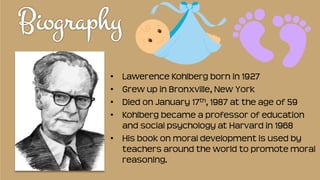
• Lawerence Kohlberg born in 1927
• Grew up in Bronxville, New York
• Died on January 17th, 1987 at the age of 59
• Kohlberg became a professor of education
and social psychology at Harvard in 1968
• His book on moral development is used by
teachers around the world to promote moral
reasoning.
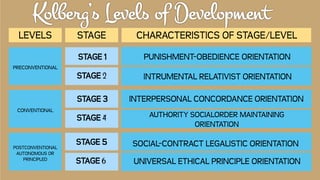
LEVELS STAGE CHARACTERISTICS OF STAGE/LEVEL
PRECONVENTIONAL
CONVENTIONAL
POSTCONVENTIONAL
AUTONOMOUS OR
PRINCIPLED
STAGE 1
STAGE 2
PUNISHMENT-OBEDIENCE ORIENTATION
INTRUMENTAL RELATIVIST ORIENTATION
STAGE 3
STAGE 4
INTERPERSONAL CONCORDANCE ORIENTATION
AUTHORITY SOCIALORDER MAINTAINING
ORIENTATION
STAGE 5
STAGE 6
SOCIAL-CONTRACT LEGALISTIC ORIENTATION
UNIVERSAL ETHICAL PRINCIPLE ORIENTATION
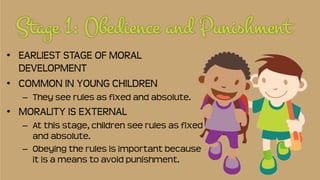
• EARLIEST STAGE OF MORAL
DEVELOPMENT
• COMMON IN YOUNG CHILDREN
– They see rules as fixed and absolute.
• MORALITY IS EXTERNAL
– At this stage, children see rules as fixed
and absolute.
– Obeying the rules is important because
it is a means to avoid punishment.
• At this stage of moral development, children
account for individual points of view and judge
actions based on how they serve individual needs.
• In the Heinz dilemma, children argued that the best
course of action was the choice that best-served
Heinz’s needs.
• Reciprocity is possible at this point in moral
development, but only if it serves one's own
interests.
• Often referred to as the "good boy-good girl"
orientation.
• At this stage children who are by now usually
entering their teens, see morality as more
than simple deals.
• Stage of moral development is focused on
living up to social expectations and roles (of
the family and community). There is an
emphasis on conformity, being "nice," and
behave in "good" ways.
• Good behavior means having good motives
and interpersonal feelings such as love,
empathy, trust, and concern for others.
• People begin to consider society as
a whole when making judgment.
• Law and order
– focus on maintaining law and
order and obeying laws
– Heinz’s motives
– Consequences of breaking the
law
• Stage 1 and stage 4 are giving the same response
– Similarity is they both agree that breaking the law is wrong
• Differences is for Stage 1 the child can’t explain why it is wrong, while
Stage 4 the adults are able to deliberate
• Education
– Follow rules and guide lines
• It is compulsory for all school-age students to attend school
• Respect property of others
• Wear appropriate uniform, appropriate shoes to be worn
At this stage, people begin to
account for the differing
values, opinions and beliefs of
other people.
Rules of law are important
for maintaining a society, but
members of the society
should agree upon these
standards.
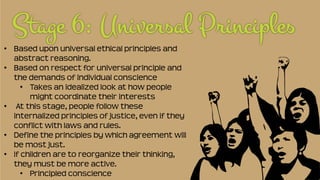
• Based upon universal ethical principles and
abstract reasoning.
• Based on respect for universal principle and
the demands of individual conscience
• Takes an idealized look at how people
might coordinate their interests
• At this stage, people follow these
internalized principles of justice, even if they
conflict with laws and rules.
• Define the principles by which agreement will
be most just.
• If children are to reorganize their thinking,
they must be more active.
• Principled conscience
Kohlberg's Theory on Moral Development

Kohlberg's Theory on Moral Development

  • 1.
  • 2.
    • Lawerence Kohlbergborn in 1927 • Grew up in Bronxville, New York • Died on January 17th, 1987 at the age of 59 • Kohlberg became a professor of education and social psychology at Harvard in 1968 • His book on moral development is used by teachers around the world to promote moral reasoning.
  • 4.
    LEVELS STAGE CHARACTERISTICSOF STAGE/LEVEL PRECONVENTIONAL CONVENTIONAL POSTCONVENTIONAL AUTONOMOUS OR PRINCIPLED STAGE 1 STAGE 2 PUNISHMENT-OBEDIENCE ORIENTATION INTRUMENTAL RELATIVIST ORIENTATION STAGE 3 STAGE 4 INTERPERSONAL CONCORDANCE ORIENTATION AUTHORITY SOCIALORDER MAINTAINING ORIENTATION STAGE 5 STAGE 6 SOCIAL-CONTRACT LEGALISTIC ORIENTATION UNIVERSAL ETHICAL PRINCIPLE ORIENTATION
  • 6.
    • EARLIEST STAGEOF MORAL DEVELOPMENT • COMMON IN YOUNG CHILDREN – They see rules as fixed and absolute. • MORALITY IS EXTERNAL – At this stage, children see rules as fixed and absolute. – Obeying the rules is important because it is a means to avoid punishment.
  • 7.
    • At thisstage of moral development, children account for individual points of view and judge actions based on how they serve individual needs. • In the Heinz dilemma, children argued that the best course of action was the choice that best-served Heinz’s needs. • Reciprocity is possible at this point in moral development, but only if it serves one's own interests.
  • 9.
    • Often referredto as the "good boy-good girl" orientation. • At this stage children who are by now usually entering their teens, see morality as more than simple deals. • Stage of moral development is focused on living up to social expectations and roles (of the family and community). There is an emphasis on conformity, being "nice," and behave in "good" ways. • Good behavior means having good motives and interpersonal feelings such as love, empathy, trust, and concern for others.
  • 10.
    • People beginto consider society as a whole when making judgment. • Law and order – focus on maintaining law and order and obeying laws – Heinz’s motives – Consequences of breaking the law
  • 11.
    • Stage 1and stage 4 are giving the same response – Similarity is they both agree that breaking the law is wrong • Differences is for Stage 1 the child can’t explain why it is wrong, while Stage 4 the adults are able to deliberate • Education – Follow rules and guide lines • It is compulsory for all school-age students to attend school • Respect property of others • Wear appropriate uniform, appropriate shoes to be worn
  • 13.
    At this stage,people begin to account for the differing values, opinions and beliefs of other people. Rules of law are important for maintaining a society, but members of the society should agree upon these standards.
  • 14.
    • Based uponuniversal ethical principles and abstract reasoning. • Based on respect for universal principle and the demands of individual conscience • Takes an idealized look at how people might coordinate their interests • At this stage, people follow these internalized principles of justice, even if they conflict with laws and rules. • Define the principles by which agreement will be most just. • If children are to reorganize their thinking, they must be more active. • Principled conscience