PATCH CLAMP
TECHNIQUE
Presented by:
Sandhya Talla
M.Pharm(Pharmacology)
Contents
Introduction
History
Principle
Method
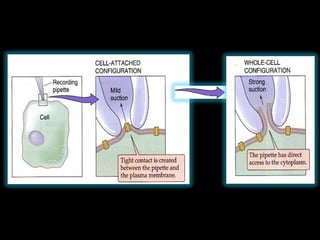
Configurations
Instrumentation
Applications
References
INTRODUCTION
 Patch – A very minute portion of the cell membrane.
 Clamp – To hold a certain physical quantity to a constant value.
 It is an electrophysiological technique in which we are able to
CLAMP the VOLTAGE of an isolated piece of cell membrane (or
whole-cell) & observe CURRENTS that flow through ION
CHANNELS.
 It is the current that the patch-clamp amplifier supplies to hold the
What is Patch Clamp?
(Neher & Sakmann, 1991)
 Previously researcher only studies ion channels in
neurons collectively.
 By 1970 the terms Na+
channel & K+
channel were used
frequently, although there was no direct evidences for the
existence of ion channels available from biological
preparations.
(Muley, et al., 2009)
1976 Erwin Neher and Bert Sakmann invented Patch Clamp.
1980 Serendipitous discovery of ‘Giga seal’.
1984 Noda et al. First time sequenced ion channels NAch and
Sodium channel.
1987 Tanabe et al. sequenced calcium channel.
1988 Kamb et al. sequenced Potassium channel.
1990 Fred Sigworth et al, and fertig et al. improved throughput by
introducing Planar Electrode Patch Clamp.
1991 Erwin Neher and Beert Sakmann earned The Nobel
Prize in Physiology or Medicine for patch clamp.
 1963 It was concluded Ohm’s law can be applied to biological
system,
(V=Change in potential ,I=Current ,R=Resistance of system)
Itotal = IC + Iionic [ where IC= Capacitive current,
Iionic = Ionic current. ]
When dV/dt=0,
Itotal = Iionic [As IC = C.(dV/dt)]
V=IR
PRINCIPLE
(Hille, 1970 & Neher, 1991)
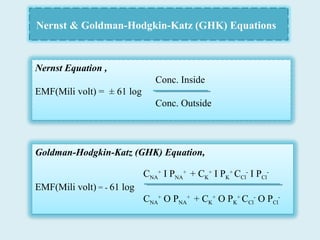
Nernst Equation ,
Conc. Inside
EMF(Mili volt) = ± 61 log
Conc. Outside
Nernst & Goldman-Hodgkin-Katz (GHK) Equations
Goldman-Hodgkin-Katz (GHK) Equation,
CNA
+
I PNA
+
+ CK
+
I PK
+
CCl
-
I PCl
-
EMF(Mili volt) = - 61 log
CNA
+
O PNA
+
+ CK
+
O PK
+
CCl
-
O PCl
-
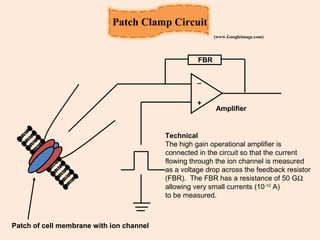
Patch Clamp Circuit
Patch of cell membrane with ion channel
FBR
_
+
Amplifier
Technical
The high gain operational amplifier is
connected in the circuit so that the current
flowing through the ion channel is measured
as a voltage drop across the feedback resistor
(FBR). The FBR has a resistance of 50 GΩ
allowing very small currents (10-12
A)
to be measured.
(www.Googleimage.com)
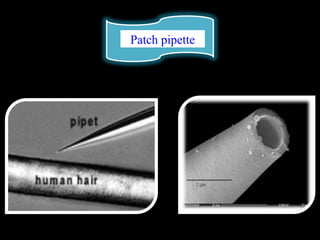
Patch pipette
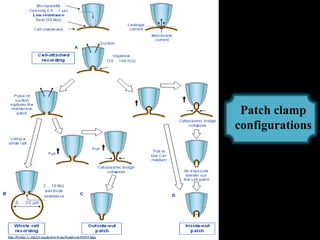
Patch clamp
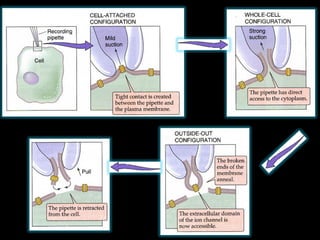
configurations
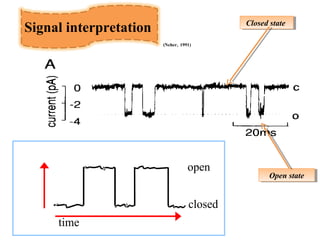
open
closed
current
time
Closed stateClosed state
Open stateOpen state
Signal interpretation
(Neher, 1991)
 How clean the surface of the cell is that is under investigation
 If the membrane surface is ‘clean’ then recordings can be made
from almost any cell.
 The most popular preparations are:
Cultured cells
Acutely isolated cells
Cells in thin slices of brain tissue
Cells that have been transfected with cloned ion channels
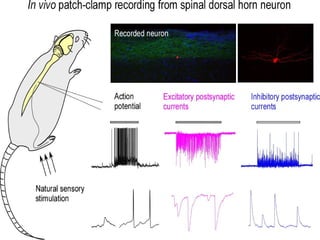
Recent reports have documented patch clamp recordings
in vivo
Preparations used
17
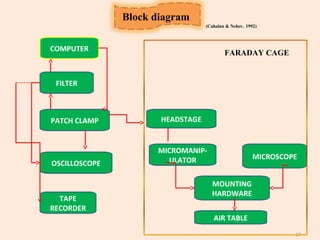
COMPUTER
PATCH CLAMP
TAPE
RECORDER
AIR TABLE
MOUNTING
HARDWARE
HEADSTAGE
OSCILLOSCOPE
MICROSCOPE
MICROMANIP-
ULATOR
FILTER
FARADAY CAGE
Block diagram
(Cahalan & Neher, 1992)
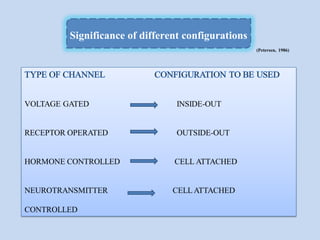
Significance of different configurations
(Petersen, 1986)
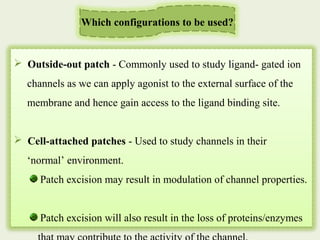
 Outside-out patch - Commonly used to study ligand- gated ion
channels as we can apply agonist to the external surface of the
membrane and hence gain access to the ligand binding site.
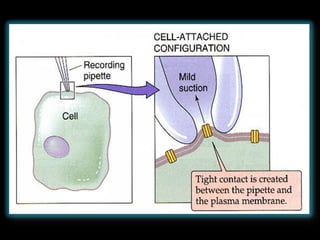
 Cell-attached patches - Used to study channels in their
‘normal’ environment.
Patch excision may result in modulation of channel properties.
Patch excision will also result in the loss of proteins/enzymes
Which configurations to be used?
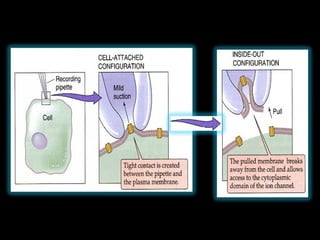
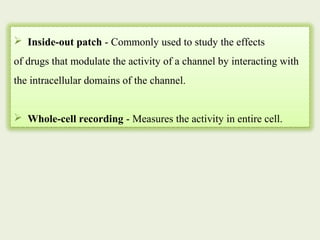
 Inside-out patch - Commonly used to study the effects
of drugs that modulate the activity of a channel by interacting with
the intracellular domains of the channel.
 Whole-cell recording - Measures the activity in entire cell.
Current Conventions
Positive and negative currents
Inward and outward currents
In whole cell and outside out
Current clamp
In cell attached and inside out
Conventional patch clamp
Planar patch clamp
Perforated patch clamp
Loose patch clamping
Techniques
(David, 2001)
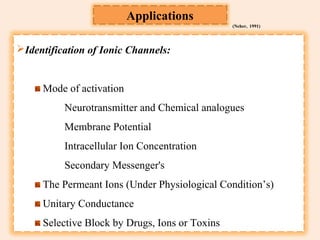
Identification of Ionic Channels:
Mode of activation
Neurotransmitter and Chemical analogues
Membrane Potential
Intracellular Ion Concentration
Secondary Messenger's
The Permeant Ions (Under Physiological Condition’s)
Unitary Conductance
Selective Block by Drugs, Ions or Toxins
Applications
(Neher, 1991)
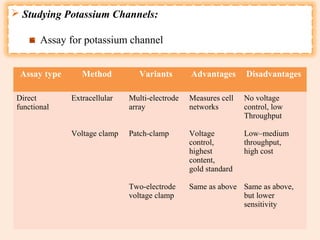
Assay type Method Variants Advantages Disadvantages
Direct
functional
Extracellular
Voltage clamp
Multi-electrode
array
Patch-clamp
Two-electrode
voltage clamp
Measures cell
networks
Voltage
control,
highest
content,
gold standard
Same as above
No voltage
control, low
Throughput
Low–medium
throughput,
high cost
Same as above,
but lower
sensitivity
 Studying Potassium Channels:
Assay for potassium channel
 Ion-channel assay technologies
 Multimodal Distribution of Granule Sizes in Rat Mast Cells
 Combined patch-clamp technique and calcium measurement
 Channel Recording
 Expanded Scope of Electrophysiology
 Capacitance measurement
 Cell Signaling
 Detection of Macromolecular Translocation Through
Nuclear pores
 Automated Electrophysiology Assays
Avi P, et al. (2007) Ionic Requirements for Membrane-Glass
Adhesion and Giga Seal Formation in Patch-Clamp
Recording. Biophysical Journal 92, 3893–3900.
Bert S (1991) Elementary Steps in synaptic transmission
revealed by currents through single ion channels. Noble
lecture, 31-59.
David O and Peter S. Patch clamp techniques for single
channel and whole-cell recording Chapter 4, 53-78.
REFERENCES
Frederick S and Feng Q (1993) Gated, Ion-selective Channels
Observed with Patch Pipettes in the Absence of Membranes:
Novel Properties of a Gigaseal. Biophysical Journal 65, 1101-
1107.
Hodgkin A.L. and Huxley A.F (1952) Currents carried by
sodium and potassium ions through the membrane of the giant
axons of loligo. J.Physiol 116, 449-472.
Huxley A.F (1963) The quantitative analysis of excitation and
conduction in nerve. NobelLecture, 52-69.
Jia Xu, et al. (2004) High-throughput technologies for studying
potassium channels progresses and challenges, 32-38.
Kim D (2008) Screening assays for ion channels, Ion Channels
in drug discovery-focus on biological assays, 24-27.
Muley N, et al. (2009) Historical Events in Electrophysiology.
Currents Research & Information on Pharmaceuticals Sciences
10(1).
Neher E (1991) Ionic channels for communication between and
within cells. Nobel Lecture,10-25.
Sakmann B (1992) Elementary steps in synaptic transmission
revealed by currents through single ion channels. Neuron 8,
613-629.
Sakmann B, et al. (1984) Patch clamp techniques for studying
ionic channels in excitable membranes. Annual Review of
Physiology 46, 455-472.
Wyllie DJA (2007) Single-channel recording. In Patch-Clamp
Analysis – Advanced Techniques 2nd
Ed, 69-129.
WEB SITES
www.nobelprize.org
www.bio.psu.edu
www.scholargoogle.com
www.sciencedirect.com
www.pubmed.com
patch clam technique

patch clam technique

  • 1.
  • 2.
  • 3.
    INTRODUCTION  Patch –A very minute portion of the cell membrane.  Clamp – To hold a certain physical quantity to a constant value.  It is an electrophysiological technique in which we are able to CLAMP the VOLTAGE of an isolated piece of cell membrane (or whole-cell) & observe CURRENTS that flow through ION CHANNELS.  It is the current that the patch-clamp amplifier supplies to hold the What is Patch Clamp? (Neher & Sakmann, 1991)
  • 4.
     Previously researcheronly studies ion channels in neurons collectively.  By 1970 the terms Na+ channel & K+ channel were used frequently, although there was no direct evidences for the existence of ion channels available from biological preparations. (Muley, et al., 2009)
  • 5.
    1976 Erwin Neherand Bert Sakmann invented Patch Clamp. 1980 Serendipitous discovery of ‘Giga seal’. 1984 Noda et al. First time sequenced ion channels NAch and Sodium channel. 1987 Tanabe et al. sequenced calcium channel. 1988 Kamb et al. sequenced Potassium channel. 1990 Fred Sigworth et al, and fertig et al. improved throughput by introducing Planar Electrode Patch Clamp. 1991 Erwin Neher and Beert Sakmann earned The Nobel Prize in Physiology or Medicine for patch clamp.
  • 6.
     1963 Itwas concluded Ohm’s law can be applied to biological system, (V=Change in potential ,I=Current ,R=Resistance of system) Itotal = IC + Iionic [ where IC= Capacitive current, Iionic = Ionic current. ] When dV/dt=0, Itotal = Iionic [As IC = C.(dV/dt)] V=IR PRINCIPLE (Hille, 1970 & Neher, 1991)
  • 7.
    Nernst Equation , Conc.Inside EMF(Mili volt) = ± 61 log Conc. Outside Nernst & Goldman-Hodgkin-Katz (GHK) Equations Goldman-Hodgkin-Katz (GHK) Equation, CNA + I PNA + + CK + I PK + CCl - I PCl - EMF(Mili volt) = - 61 log CNA + O PNA + + CK + O PK + CCl - O PCl -
  • 8.
    Patch Clamp Circuit Patchof cell membrane with ion channel FBR _ + Amplifier Technical The high gain operational amplifier is connected in the circuit so that the current flowing through the ion channel is measured as a voltage drop across the feedback resistor (FBR). The FBR has a resistance of 50 GΩ allowing very small currents (10-12 A) to be measured. (www.Googleimage.com)
  • 9.
  • 10.
  • 15.
    open closed current time Closed stateClosed state OpenstateOpen state Signal interpretation (Neher, 1991)
  • 16.
     How cleanthe surface of the cell is that is under investigation  If the membrane surface is ‘clean’ then recordings can be made from almost any cell.  The most popular preparations are: Cultured cells Acutely isolated cells Cells in thin slices of brain tissue Cells that have been transfected with cloned ion channels Recent reports have documented patch clamp recordings in vivo Preparations used
  • 17.
  • 18.
    Significance of differentconfigurations (Petersen, 1986)
  • 19.
     Outside-out patch- Commonly used to study ligand- gated ion channels as we can apply agonist to the external surface of the membrane and hence gain access to the ligand binding site.  Cell-attached patches - Used to study channels in their ‘normal’ environment. Patch excision may result in modulation of channel properties. Patch excision will also result in the loss of proteins/enzymes Which configurations to be used?
  • 20.
     Inside-out patch- Commonly used to study the effects of drugs that modulate the activity of a channel by interacting with the intracellular domains of the channel.  Whole-cell recording - Measures the activity in entire cell.
  • 21.
    Current Conventions Positive andnegative currents Inward and outward currents In whole cell and outside out Current clamp In cell attached and inside out
  • 22.
    Conventional patch clamp Planarpatch clamp Perforated patch clamp Loose patch clamping Techniques (David, 2001)
  • 23.
    Identification of IonicChannels: Mode of activation Neurotransmitter and Chemical analogues Membrane Potential Intracellular Ion Concentration Secondary Messenger's The Permeant Ions (Under Physiological Condition’s) Unitary Conductance Selective Block by Drugs, Ions or Toxins Applications (Neher, 1991)
  • 24.
    Assay type MethodVariants Advantages Disadvantages Direct functional Extracellular Voltage clamp Multi-electrode array Patch-clamp Two-electrode voltage clamp Measures cell networks Voltage control, highest content, gold standard Same as above No voltage control, low Throughput Low–medium throughput, high cost Same as above, but lower sensitivity  Studying Potassium Channels: Assay for potassium channel
  • 25.
     Ion-channel assaytechnologies  Multimodal Distribution of Granule Sizes in Rat Mast Cells  Combined patch-clamp technique and calcium measurement  Channel Recording  Expanded Scope of Electrophysiology
  • 26.
     Capacitance measurement Cell Signaling  Detection of Macromolecular Translocation Through Nuclear pores  Automated Electrophysiology Assays
  • 28.
    Avi P, etal. (2007) Ionic Requirements for Membrane-Glass Adhesion and Giga Seal Formation in Patch-Clamp Recording. Biophysical Journal 92, 3893–3900. Bert S (1991) Elementary Steps in synaptic transmission revealed by currents through single ion channels. Noble lecture, 31-59. David O and Peter S. Patch clamp techniques for single channel and whole-cell recording Chapter 4, 53-78. REFERENCES
  • 29.
    Frederick S andFeng Q (1993) Gated, Ion-selective Channels Observed with Patch Pipettes in the Absence of Membranes: Novel Properties of a Gigaseal. Biophysical Journal 65, 1101- 1107. Hodgkin A.L. and Huxley A.F (1952) Currents carried by sodium and potassium ions through the membrane of the giant axons of loligo. J.Physiol 116, 449-472. Huxley A.F (1963) The quantitative analysis of excitation and conduction in nerve. NobelLecture, 52-69. Jia Xu, et al. (2004) High-throughput technologies for studying potassium channels progresses and challenges, 32-38.
  • 30.
    Kim D (2008)Screening assays for ion channels, Ion Channels in drug discovery-focus on biological assays, 24-27. Muley N, et al. (2009) Historical Events in Electrophysiology. Currents Research & Information on Pharmaceuticals Sciences 10(1). Neher E (1991) Ionic channels for communication between and within cells. Nobel Lecture,10-25. Sakmann B (1992) Elementary steps in synaptic transmission revealed by currents through single ion channels. Neuron 8, 613-629.
  • 31.
    Sakmann B, etal. (1984) Patch clamp techniques for studying ionic channels in excitable membranes. Annual Review of Physiology 46, 455-472. Wyllie DJA (2007) Single-channel recording. In Patch-Clamp Analysis – Advanced Techniques 2nd Ed, 69-129. WEB SITES www.nobelprize.org www.bio.psu.edu www.scholargoogle.com www.sciencedirect.com www.pubmed.com