NEUROLEPTIC
ANESTHESIA, AGENTS
AND USES
DR. ARJUN
CHHETRI
ANTIPSYCHOTIC (neuroleptic)
DRUGS
 Diverse group of compounds (
phenothiazines, thioxanthenes,
butyrophenones).
 Useful in Rx schizophrenia, mania,
depression with psychotic.
 Also used in tourette syndrome and certain
movement disorder.
 Antiemetic.
 Phenothiazines and thioxanthenes have high
T.I accounts safety over wide dose range.
CONTD….
 Even large dose unlikely to cause life-
threatening depression of ventilation.
 Do not produce physical dependence.
 Although abrupt discontinuation results
skeletal muscle discomfort.
CHEMICAL STRUCTURE
 PHENOTHIAZINE
 THIOXANTHENE
CATEGORY AND DRUGS
PHENOTH
IAZINES
THIOXANT
HENES
DIBENZOD
IAZEPINES
BUTYROP
HENONES
BEZISOXA
ZOL
Chlorprom
azine
Chlorprothi
xene
CLOZAPIN
E
HALOPER
IDOL
RESPERID
ONE
Trifluproma
zine
Thiothixen
e
LOXAPINE DROPERI
DOL
Thioridazin
e
Fluphenazi
ne
Trifluopera
zine
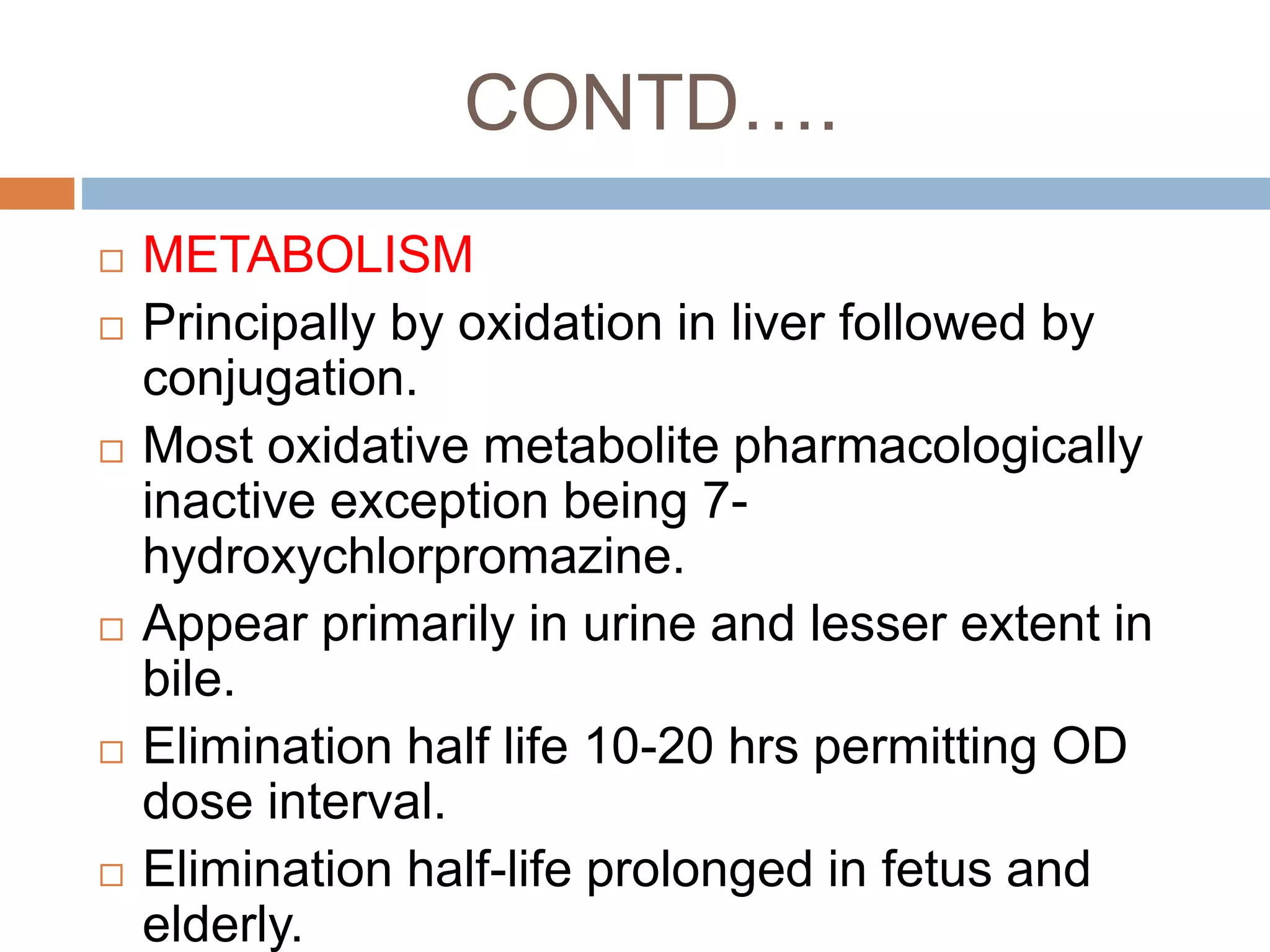
COMPARTIVE
PHARMAOLOGY
MECHANISM OF ACTION
 MOA due to blockade of dopamine receptor(D2
receptor) in the basal ganglia and limbic portion
of forebrain.
 Achieve max efficacy over a period of weeks.
 Interference with neurotransmitter function of
dopamine suggested by EPS.
 Blockade of dopamine receptor at CTZ of
medulla responsible for antiemetic effect.
PHARMACOKINETICS
 Phenothiazines & thioxanthenes display erratic
and unpredictable patterns of absorption after
PO.
 Highly lipid soluble and accumulate in well per
fused tissues.
 Passage across the placenta and
accumulation is possible.
 Avid protein binding in plasma and tissues
limits effectiveness of hemodialysis in
removing these drugs.
CONTD….
 METABOLISM
 Principally by oxidation in liver followed by
conjugation.
 Most oxidative metabolite pharmacologically
inactive exception being 7-
hydroxychlorpromazine.
 Appear primarily in urine and lesser extent in
bile.
 Elimination half life 10-20 hrs permitting OD
dose interval.
 Elimination half-life prolonged in fetus and
elderly.
SIDE EFFECTS
 Exception of clozapine, chronic use
of Phenothiazines & thioxanthenes
Complicated by serious side effects.
 Reflecting drug-induced blockade
Of dopamine receptors, especially in
Forebrain.
 Despite side effects , have large margin of
safety and overdoses are rarely fatal.
EXTRAPYRAMIDAL EFFECTS
 Tardive dyskinesia may occur 20% who
receive APD > 1years.
 Elderly and women of all age are more
sussceptible
 Manifestations include abnormal involuntary
movements i.e may effects tounge, facial and
neck muscles, upper & lower extremities,
truncal musculature.
 Occasionally skeletal muscle group involved in
breathing and swallowing.
EPS CONTD…
 TD rarely remits and there is no treatment.
 Compensatory dopamine increases in B.G may
responsible.
 Acute dystonic reactions
 Occur in approx 2% of treated patients with in first
72 hrs of therapy.
 Young men and in patients taking high-potency
drugs.
 Acute skeletal muscle rigidity & cramping may
develop
EPS CONTD….
 Musculature of the neck, tongue, face, and
back.
 Opisthotonos and oculogyric crises may occur.
 Sudden respiratory distress reflects laryngeal
dyskinesia (laryngospasm).
 Respond dramatically to diphenhydramine 25-
50 mg IV.
 Patient with antipsychotic- induced akathisia
often appears restless which may confused
with underlying psychotic disorder.
CARDIOVASCULAR EFFECTS
 IV administration of chlorpromazine causes
decrease in systemic BP resulting from
I. Depression of vasomotor reflexes mediated by
brainstem.
II. Peripheral alpha- adrenergic blockade.
III. Direct relaxant effects on vascular smooth
muscle.
IV. Direct cardiac depression.
 Risperidone associated with exaggerated
systemic hypotension during spinal anesthetic.
 Reflecting risperidone-induced alpha blockade.
CVS CONTD….
 Alpha- adrenergic blockade is sufficient to blunt or
prevent the pressor effects of epinephrine.
 Miosis occur also due to alpha-adrenergic
blockade.
 A cardiac antidysrhythmic effects of
chlorpromazine
may reflect potent LA activity of this drugs.
 Antipsychotic drugs prolong the QTc interval on
ECG thus predispose to the development of VT.
 Oral administration associated with less systemic
BP
NEUROLEPTIC MALINGNAT
SYNDROME
 Occur in 0.5%- 1%.
 Risk factor for development dehydration &
intercurrent illness.
 Typically develop over 24- 72 hrs in young men
and characterized by
i. Hyperthermia.
ii. Generalized hyper tonicity of skeletal muscle.
iii. Instability of ANS manifesting as alteration in
SBP, tachycardia, and cardiac dysrhythmias.
iv. Fluctuating levels of consciousness.
NMS CONTD….
 Increased skeletal muscle tone may decreased
chest wall expansion which required mechanical
support for ventilation.
 Skeletal muscle rigidity may severe enough cause
myonecrosis, leading to raised CPK level,
myoglobinuria, and renal failure.
 Liver transaminase enzyme may elevated.
 Mortality 20%- 30%.
 common cause of death being ventilatory failure,
cardiac failure/ dysrhythmias, renal failure and
thromboembolism.
NMS CONTD….
 Cause unknown
 As a result Rx is empirical and supportive
measure.
 Direct acting muscle relaxant DONTROLENE.
 Dopamine agonist BROMORIPTINE &
AMANTADINE.
 Malignant hyperthermia & central
anticholinergic syndrome may mimic NMS.
 Distinguished by NDMA produced flaccid
paralysis in NMS not in malignant
hyperthermia.
ENDOCRINE EFFECTS
 Prolactin level increased due to blockade of
dopamine receptors.
 Galactorrhea and gynecomasita.
 Amenorrhea possible but rare.
 Chlorpromazine may impair glucose tolerance
and release of insulin.
 Hypothalamic effects manifest as weight gain
and abnormal thermoregulation.
SEDATION
 Sedation due to antagonism of α1-adrenergic,
muscarinic, and H1 receptors.
 With chronic therapy tolerance develop to the
sedation effects.
ANTIEMITIC EFFECTS
 Antiemetic effects reflects interaction with
dopamine receptors in CTZ in medulla.
 Effecting in preventing opioid induced NOV.
 Perphenazine 5 mg IV as effective as
ondansetron 4 mg IV.
 Droperidol 1.25 mg IV prevent PONV after in
gynecologic surgery.
 Unlike others, Perphenazine not associated
with sedation and hypotension so useful as an
inexpensive prophylactic antiemetic.
OBSTRUCTIVE JAUNDICE
 OJ considered as an allergic reaction.
 Occur rarely 2 to 4 weeks after phenothiazines
or thioxanthenes administration.
 If jaundice not observed in first months of
therapy, unlikely to occur later.
HYPOTHERMIA
 Effects of chlorpromaizine on hypothalamus
responsible for poikilothermic effects.
 In past this effects used to facilitate the
production of surgical hypothermia.
DRUG INTRACTIONS
 Ventilatory depressant effects of opioids
exaggerated.
 Likewise, miotic and sedative effects of opioid
increased.
 Analgesic action likely to be potentiated.
 Interfere with exogenously administered
dopamine.
CLOZAPINE
 Belongs to DIBENZODIAZEPINES category.
 Only APD does not cause tardive dyskinesia
or EPS.
 Common side effects- sedation, NOV,
orthostatic hypotension.
 Low grade fever sometimes occurs in early
use.
 Safely combined with lithium and other APD.
 Excessive sedation if combined with
benzodiazepine.
CONTD….
 AGRANULOCYTOSIS is the serious side
effects.
 Occur in < 1%
 WBC weekly monitoring is required.
 High dose associated with incident of seizure
in 2% to 4%.
 Anticonvulsant is required.
 Valporic acid may be selected as it does not
alter clozapine metabolism.
BUTYROPHENONS
 DROPERIDOL and HALOPERIDOL
 Structurally and pharmacologic effects similar
to Phenothiazines and thioxanthenes.
 Decrease anxiety that accompanies psychosis
but less effective that accompanies
preoperative period
 Droperidol most often administered pre-op
period.
 Haloperidol has longer duration of action and
lack α-adrenergic antagonist effect thus
decreased SBP are unlikely.
CONTD….
 Principle use of haloperidol as long acting APD
and Rx of agitation and delirium in ICU.
 ZIPRASIDONE atypical APD use an
alternative in delirium.
 Like haloperidol it is also associated with EPS
and tardive dyskinesia and cause prolongation
of QTc interval on ECG.
 Not recommended in patient with
QTc>500msec, recent MI, uncompensated
CHF.
PHARMACOKINETICS
 Patient anesthetized with N2O-Fentanyl,
elimination half-time of Droperidol is 104 min.
 Clearance is 14.1mL/kg/min, Vd 2.04L/kg.
 Short elimination half-life is not consistent with
prolonged CNS effects which reflects slow
dissociation of the drug from receptors or
retention of Droperidol in brain.
 Metabolized in liver with maximal excretion of
metabolites occur during first 24 hrs.
SIDE EFFECTS
 Side effects is nearly as same as Phenothiazines and
thioxanthenes.
 CNS:
 As a dopamine antagonist, Droperidol evoke EPS in
abt 1% of patients.
 As a result should be avoided in Parkinson disease.
 Acute laryngeal dystonia is rare.
 Diphenhydramine IV is effective.
 Droperidol is a cerebral vasoconstrictors i.e cause in
CBF bur CBMO2 is not altered.
 Droperidol does not produce amnesia nor have
anticonvulsant action.
CONTD….
 CVS:
 SBP decrease due to its action on CNS and by
peripheral α-adrenergic blockade.
 Hypotension is minimal, occasionally patient may
experience marked hypotension.
 Myocardial contractility is not altered by
droperidol.
 Hypertension has been reported after droperidol
administration in a patients with
pheochromocytoma.
CONTD….
 Droperidol is a cardiac antidysrhythmic drug.
 Protect against epinephrine-induced
dysrhythmias.
 Mechanism is unknown but may reflects
blockade of α-adrenergic receptors in
myocardium, decreased in SBP i.e decrease the
likelihood of pressure dependent cardiac
dysrhythmias.
 Large dose 0.2 – 0.6 mg/kg decrease conduction of
cardiac impulses along accessory pathways
responsible for tachydysrhythmias i.e. occur in
patient with wolf Parkinson- white syndrome
CONTD…
 PROLONGED QTc INTERVAL:
 Malfunction of cardiac ion channels result in
impaired ventricular repolarization lead to
polymorphic ventricular tachycardia known as
torsades de points.
 Nondrug factors
Include female gender, advanced age,
electrolyte disturbance(hypokalemia,
hypomagnesaemia), CHF, bradycardia, MI,
and congential long QT syndromes.
CONTD…..
 Noncardiac drugs, droperidol, thiopental,
propofol, isoflurane, sevoflurane, SUX,
neostigmine, atropine, glycopy,
metoclopramide, macrolide.
 Produce dose dependent QTc prolongation on
ECG.
 Droperidol induced QTc prolongation effects
peak 2-3 min following IV , effects last for
several hours.
 Case of QTc prolongation occurred in patient
receiving at 1.25-2.5mg as well as 0.625-
CONTD….
 “BLACK BOX WARNING” has been added to the
package of droperidol.
 All patient should undergo 12 lead ECG prior to
given
 When Rx with droperidol is selected ,ECG
monitoring should been performed before and
continuous for 2-3 hrs.
 Caution to the patient who are at risk of
developing QTc prolongation(CHF,
BRADYCARDIA, HYPOKALEMIA, ELDERLY) .
 Sudden death during HALOPERIDOL reflects
drug induced prolongation of the QTc interval in
ECG.
NEUROLEPTANALGESIA
 Droperidol combined with fentanyl.
 Commercially available 50:1 combination of
droperidol with fentanyl known as INNOVAR.
 This fixed combination not associated
depression of ventilation as either drug alone.
 Droperidol does not enhance analgesia but
rather prolongs duration of action.
 Orthostatic hypotension and dysphoria are more
with innovar compared with fentanyl alone.
CONTD….
 Neuroleptanalgesia characterized by trance-like
immobility in a patient who is dissociated and
indifferent to the external surrounding.
 Analgesia is intense.
 Suitable in diagnostic and minor surigical
procedure
Like bronchoscopy and cystoscopy.
 Disadvantage like prolonged CNS depression and
failure to depress sympathetic NS.
CONTD…
 Mechanism is unknown but likely involves
inhibition of synaptic transmission by ligand-
gated ion channels.
 Evidence suggest that droperidol inhibits
activation of GABA and nACHRs receptors
that might results in anxiety, dysphoria, and
restlessness that limits its clinical usefulness
of high-dose droperidol anesthesia.
ANTIEMETIC
 Powerful antiemetic .
 Inhibit dopamine receptors in CTZ of the
medulla.
 Over three decades, Droperidol (0.625-1.25mg
IV) become widely accepted as a safe, cost
effective first line therapy for PONV.
 Motion sickness is not influneced by
droperidol.
THANK YOU

Neuroleptic anesthesia, agents and uses

  • 1.
  • 2.
    ANTIPSYCHOTIC (neuroleptic) DRUGS  Diversegroup of compounds ( phenothiazines, thioxanthenes, butyrophenones).  Useful in Rx schizophrenia, mania, depression with psychotic.  Also used in tourette syndrome and certain movement disorder.  Antiemetic.  Phenothiazines and thioxanthenes have high T.I accounts safety over wide dose range.
  • 3.
    CONTD….  Even largedose unlikely to cause life- threatening depression of ventilation.  Do not produce physical dependence.  Although abrupt discontinuation results skeletal muscle discomfort.
  • 4.
  • 5.
  • 6.
  • 7.
    MECHANISM OF ACTION MOA due to blockade of dopamine receptor(D2 receptor) in the basal ganglia and limbic portion of forebrain.  Achieve max efficacy over a period of weeks.  Interference with neurotransmitter function of dopamine suggested by EPS.  Blockade of dopamine receptor at CTZ of medulla responsible for antiemetic effect.
  • 8.
    PHARMACOKINETICS  Phenothiazines &thioxanthenes display erratic and unpredictable patterns of absorption after PO.  Highly lipid soluble and accumulate in well per fused tissues.  Passage across the placenta and accumulation is possible.  Avid protein binding in plasma and tissues limits effectiveness of hemodialysis in removing these drugs.
  • 9.
    CONTD….  METABOLISM  Principallyby oxidation in liver followed by conjugation.  Most oxidative metabolite pharmacologically inactive exception being 7- hydroxychlorpromazine.  Appear primarily in urine and lesser extent in bile.  Elimination half life 10-20 hrs permitting OD dose interval.  Elimination half-life prolonged in fetus and elderly.
  • 10.
    SIDE EFFECTS  Exceptionof clozapine, chronic use of Phenothiazines & thioxanthenes Complicated by serious side effects.  Reflecting drug-induced blockade Of dopamine receptors, especially in Forebrain.  Despite side effects , have large margin of safety and overdoses are rarely fatal.
  • 11.
    EXTRAPYRAMIDAL EFFECTS  Tardivedyskinesia may occur 20% who receive APD > 1years.  Elderly and women of all age are more sussceptible  Manifestations include abnormal involuntary movements i.e may effects tounge, facial and neck muscles, upper & lower extremities, truncal musculature.  Occasionally skeletal muscle group involved in breathing and swallowing.
  • 12.
    EPS CONTD…  TDrarely remits and there is no treatment.  Compensatory dopamine increases in B.G may responsible.  Acute dystonic reactions  Occur in approx 2% of treated patients with in first 72 hrs of therapy.  Young men and in patients taking high-potency drugs.  Acute skeletal muscle rigidity & cramping may develop
  • 13.
    EPS CONTD….  Musculatureof the neck, tongue, face, and back.  Opisthotonos and oculogyric crises may occur.  Sudden respiratory distress reflects laryngeal dyskinesia (laryngospasm).  Respond dramatically to diphenhydramine 25- 50 mg IV.  Patient with antipsychotic- induced akathisia often appears restless which may confused with underlying psychotic disorder.
  • 14.
    CARDIOVASCULAR EFFECTS  IVadministration of chlorpromazine causes decrease in systemic BP resulting from I. Depression of vasomotor reflexes mediated by brainstem. II. Peripheral alpha- adrenergic blockade. III. Direct relaxant effects on vascular smooth muscle. IV. Direct cardiac depression.  Risperidone associated with exaggerated systemic hypotension during spinal anesthetic.  Reflecting risperidone-induced alpha blockade.
  • 15.
    CVS CONTD….  Alpha-adrenergic blockade is sufficient to blunt or prevent the pressor effects of epinephrine.  Miosis occur also due to alpha-adrenergic blockade.  A cardiac antidysrhythmic effects of chlorpromazine may reflect potent LA activity of this drugs.  Antipsychotic drugs prolong the QTc interval on ECG thus predispose to the development of VT.  Oral administration associated with less systemic BP
  • 16.
    NEUROLEPTIC MALINGNAT SYNDROME  Occurin 0.5%- 1%.  Risk factor for development dehydration & intercurrent illness.  Typically develop over 24- 72 hrs in young men and characterized by i. Hyperthermia. ii. Generalized hyper tonicity of skeletal muscle. iii. Instability of ANS manifesting as alteration in SBP, tachycardia, and cardiac dysrhythmias. iv. Fluctuating levels of consciousness.
  • 17.
    NMS CONTD….  Increasedskeletal muscle tone may decreased chest wall expansion which required mechanical support for ventilation.  Skeletal muscle rigidity may severe enough cause myonecrosis, leading to raised CPK level, myoglobinuria, and renal failure.  Liver transaminase enzyme may elevated.  Mortality 20%- 30%.  common cause of death being ventilatory failure, cardiac failure/ dysrhythmias, renal failure and thromboembolism.
  • 18.
    NMS CONTD….  Causeunknown  As a result Rx is empirical and supportive measure.  Direct acting muscle relaxant DONTROLENE.  Dopamine agonist BROMORIPTINE & AMANTADINE.  Malignant hyperthermia & central anticholinergic syndrome may mimic NMS.  Distinguished by NDMA produced flaccid paralysis in NMS not in malignant hyperthermia.
  • 19.
    ENDOCRINE EFFECTS  Prolactinlevel increased due to blockade of dopamine receptors.  Galactorrhea and gynecomasita.  Amenorrhea possible but rare.  Chlorpromazine may impair glucose tolerance and release of insulin.  Hypothalamic effects manifest as weight gain and abnormal thermoregulation.
  • 20.
    SEDATION  Sedation dueto antagonism of α1-adrenergic, muscarinic, and H1 receptors.  With chronic therapy tolerance develop to the sedation effects.
  • 21.
    ANTIEMITIC EFFECTS  Antiemeticeffects reflects interaction with dopamine receptors in CTZ in medulla.  Effecting in preventing opioid induced NOV.  Perphenazine 5 mg IV as effective as ondansetron 4 mg IV.  Droperidol 1.25 mg IV prevent PONV after in gynecologic surgery.  Unlike others, Perphenazine not associated with sedation and hypotension so useful as an inexpensive prophylactic antiemetic.
  • 22.
    OBSTRUCTIVE JAUNDICE  OJconsidered as an allergic reaction.  Occur rarely 2 to 4 weeks after phenothiazines or thioxanthenes administration.  If jaundice not observed in first months of therapy, unlikely to occur later.
  • 23.
    HYPOTHERMIA  Effects ofchlorpromaizine on hypothalamus responsible for poikilothermic effects.  In past this effects used to facilitate the production of surgical hypothermia.
  • 24.
    DRUG INTRACTIONS  Ventilatorydepressant effects of opioids exaggerated.  Likewise, miotic and sedative effects of opioid increased.  Analgesic action likely to be potentiated.  Interfere with exogenously administered dopamine.
  • 25.
    CLOZAPINE  Belongs toDIBENZODIAZEPINES category.  Only APD does not cause tardive dyskinesia or EPS.  Common side effects- sedation, NOV, orthostatic hypotension.  Low grade fever sometimes occurs in early use.  Safely combined with lithium and other APD.  Excessive sedation if combined with benzodiazepine.
  • 26.
    CONTD….  AGRANULOCYTOSIS isthe serious side effects.  Occur in < 1%  WBC weekly monitoring is required.  High dose associated with incident of seizure in 2% to 4%.  Anticonvulsant is required.  Valporic acid may be selected as it does not alter clozapine metabolism.
  • 27.
    BUTYROPHENONS  DROPERIDOL andHALOPERIDOL  Structurally and pharmacologic effects similar to Phenothiazines and thioxanthenes.  Decrease anxiety that accompanies psychosis but less effective that accompanies preoperative period  Droperidol most often administered pre-op period.  Haloperidol has longer duration of action and lack α-adrenergic antagonist effect thus decreased SBP are unlikely.
  • 28.
    CONTD….  Principle useof haloperidol as long acting APD and Rx of agitation and delirium in ICU.  ZIPRASIDONE atypical APD use an alternative in delirium.  Like haloperidol it is also associated with EPS and tardive dyskinesia and cause prolongation of QTc interval on ECG.  Not recommended in patient with QTc>500msec, recent MI, uncompensated CHF.
  • 29.
    PHARMACOKINETICS  Patient anesthetizedwith N2O-Fentanyl, elimination half-time of Droperidol is 104 min.  Clearance is 14.1mL/kg/min, Vd 2.04L/kg.  Short elimination half-life is not consistent with prolonged CNS effects which reflects slow dissociation of the drug from receptors or retention of Droperidol in brain.  Metabolized in liver with maximal excretion of metabolites occur during first 24 hrs.
  • 30.
    SIDE EFFECTS  Sideeffects is nearly as same as Phenothiazines and thioxanthenes.  CNS:  As a dopamine antagonist, Droperidol evoke EPS in abt 1% of patients.  As a result should be avoided in Parkinson disease.  Acute laryngeal dystonia is rare.  Diphenhydramine IV is effective.  Droperidol is a cerebral vasoconstrictors i.e cause in CBF bur CBMO2 is not altered.  Droperidol does not produce amnesia nor have anticonvulsant action.
  • 31.
    CONTD….  CVS:  SBPdecrease due to its action on CNS and by peripheral α-adrenergic blockade.  Hypotension is minimal, occasionally patient may experience marked hypotension.  Myocardial contractility is not altered by droperidol.  Hypertension has been reported after droperidol administration in a patients with pheochromocytoma.
  • 32.
    CONTD….  Droperidol isa cardiac antidysrhythmic drug.  Protect against epinephrine-induced dysrhythmias.  Mechanism is unknown but may reflects blockade of α-adrenergic receptors in myocardium, decreased in SBP i.e decrease the likelihood of pressure dependent cardiac dysrhythmias.  Large dose 0.2 – 0.6 mg/kg decrease conduction of cardiac impulses along accessory pathways responsible for tachydysrhythmias i.e. occur in patient with wolf Parkinson- white syndrome
  • 33.
    CONTD…  PROLONGED QTcINTERVAL:  Malfunction of cardiac ion channels result in impaired ventricular repolarization lead to polymorphic ventricular tachycardia known as torsades de points.  Nondrug factors Include female gender, advanced age, electrolyte disturbance(hypokalemia, hypomagnesaemia), CHF, bradycardia, MI, and congential long QT syndromes.
  • 34.
    CONTD…..  Noncardiac drugs,droperidol, thiopental, propofol, isoflurane, sevoflurane, SUX, neostigmine, atropine, glycopy, metoclopramide, macrolide.  Produce dose dependent QTc prolongation on ECG.  Droperidol induced QTc prolongation effects peak 2-3 min following IV , effects last for several hours.  Case of QTc prolongation occurred in patient receiving at 1.25-2.5mg as well as 0.625-
  • 35.
    CONTD….  “BLACK BOXWARNING” has been added to the package of droperidol.  All patient should undergo 12 lead ECG prior to given  When Rx with droperidol is selected ,ECG monitoring should been performed before and continuous for 2-3 hrs.  Caution to the patient who are at risk of developing QTc prolongation(CHF, BRADYCARDIA, HYPOKALEMIA, ELDERLY) .  Sudden death during HALOPERIDOL reflects drug induced prolongation of the QTc interval in ECG.
  • 36.
    NEUROLEPTANALGESIA  Droperidol combinedwith fentanyl.  Commercially available 50:1 combination of droperidol with fentanyl known as INNOVAR.  This fixed combination not associated depression of ventilation as either drug alone.  Droperidol does not enhance analgesia but rather prolongs duration of action.  Orthostatic hypotension and dysphoria are more with innovar compared with fentanyl alone.
  • 37.
    CONTD….  Neuroleptanalgesia characterizedby trance-like immobility in a patient who is dissociated and indifferent to the external surrounding.  Analgesia is intense.  Suitable in diagnostic and minor surigical procedure Like bronchoscopy and cystoscopy.  Disadvantage like prolonged CNS depression and failure to depress sympathetic NS.
  • 38.
    CONTD…  Mechanism isunknown but likely involves inhibition of synaptic transmission by ligand- gated ion channels.  Evidence suggest that droperidol inhibits activation of GABA and nACHRs receptors that might results in anxiety, dysphoria, and restlessness that limits its clinical usefulness of high-dose droperidol anesthesia.
  • 39.
    ANTIEMETIC  Powerful antiemetic.  Inhibit dopamine receptors in CTZ of the medulla.  Over three decades, Droperidol (0.625-1.25mg IV) become widely accepted as a safe, cost effective first line therapy for PONV.  Motion sickness is not influneced by droperidol.
  • 40.

Editor's Notes

  • #3 Tourette syndrome (TS) is a neurological disorder characterized by repetitive, stereotyped, involuntary movements and vocalizations called tics. 
  • #37 CNS DEPRRESENT- RESPIRATION DEEP SALLOW NALOXANE DOSE –O,2M-.5 M FLUMAZINIL DOSE AS SAME AS NALOXANE… VENTIATION SOULD BE CONTINOUS