Sympathomimeti
Sympathomimeti
c Drugs
c Drugs
Wording
• Sympathomimetic drug
s
• Adrenomimetic drugs
• Adrenergic agonists
• Adrenoceptor agonists
Outline
A. Review of sympathetic activation
B. Introduction
C. Types and subtypes of adrenoceptors
D. Mechanism of action
E. Classification of sympathomimetic dru
gs
F. Mode of action
Outline
G. Chemistry, SAR and Pharmacokinetic
s
H. Organ system effects
I. Clinical application of sympathomimeti
cs
J. Adverse effects of sympathomimetics
K. Drug interactions
Objectives
1. List tissues that contain sig. No. of
alpha receptors of the  or 
type and  or  receptors.
2. Describe the major organ system
effects of a pure alpha agonist, a
pure beta agonist, and a mixed
alpha and beta agonist. Give
examples of each type of drug.
3. Describe a clinical situation in
which the effects of an indirect
sympathomimetic would differ
from those of a direct agonist.
4. List the major clinical
applications of the adrenoceptor
agonists.
Objectives
Suggested Reading
 Katzung BG. Basic & clinical pharmacology. 8t
h
ed., 2001.
 Katzung BG, Trevor AJ. Examination &board
review pharmacology. 5th
ed. 1998.
 Goodman&Gilman. Basic pharmacology. 9th
ed., 1996.
 Pharmacology, Lippincott’s Illustrated Review
s 1992.
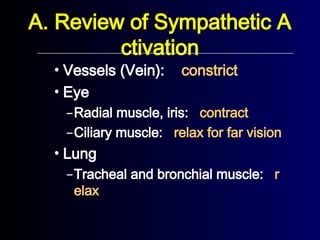
A. Review of Sympathetic A
ctivation
• ‘Fight’ or ‘Flight’ on Stress
• Heart
– HR, contractility, conduction veloc
ity
• Vessels (arterioles)
–Skin, cutaneous, visceral : constrict
–Skeletal muscle, coronary: dilate
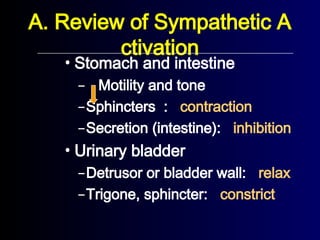
A. Review of Sympathetic A
ctivation
• Vessels (Vein): constrict
• Eye
–Radial muscle, iris: contract
–Ciliary muscle: relax for far vision
• Lung
–Tracheal and bronchial muscle: r
elax
• Stomach and intestine
– Motility and tone
–Sphincters : contraction
–Secretion (intestine): inhibition
• Urinary bladder
–Detrusor or bladder wall: relax
–Trigone, sphincter: constrict
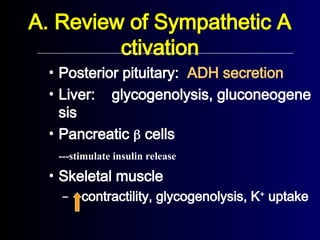
A. Review of Sympathetic A
ctivation
• Posterior pituitary: ADH secretion
• Liver: glycogenolysis, gluconeogene
sis
• Pancreatic  cells
---stimulate insulin release
• Skeletal muscle
– contractility, glycogenolysis, K+
uptake
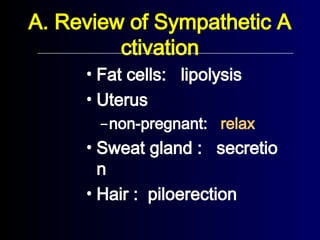
A. Review of Sympathetic A
ctivation
• Fat cells: lipolysis
• Uterus
–non-pregnant: relax
• Sweat gland : secretio
n
• Hair : piloerection
A. Review of Sympathetic A
ctivation
B. Introduction
• The effects of adrenomimetic drugs
are similar to sympathetic activation.
• But why each adrenomimetic drug c
an produce different responses?
• The differences in affinity to adreno
ceptor subtypes are responsible for
different responses.
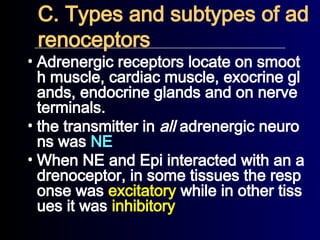
C. Types and subtypes of ad
renoceptors
• Adrenergic receptors locate on smoot
h muscle, cardiac muscle, exocrine gl
ands, endocrine glands and on nerve
terminals.
• the transmitter in all adrenergic neuro
ns was NE
• When NE and Epi interacted with an a
drenoceptor, in some tissues the resp
onse was excitatory while in other tiss
ues it was inhibitory
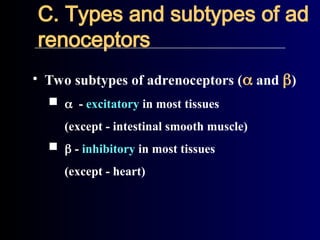
• Two subtypes of adrenoceptors ( and )
- excitatory in most tissues
(except - intestinal smooth muscle)
 - inhibitory in most tissues
(except - heart)
C. Types and subtypes of ad
renoceptors
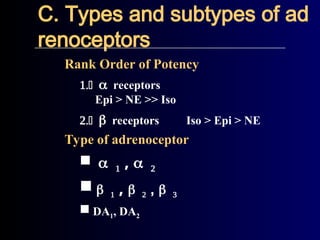
Rank Order of Potency
 receptors
Epi > NE >> Iso
 receptors Iso > Epi > NE
Type of adrenoceptor
 , 
  ,  , 
 DA1, DA2
C. Types and subtypes of ad
renoceptors
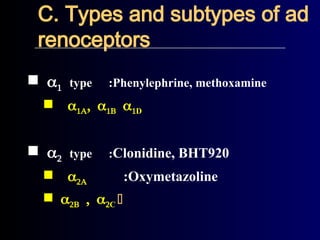
 type :Phenylephrine, methoxamine
D
 type :Clonidine, BHT920
 :Oxymetazoline
C 
C. Types and subtypes of ad
renoceptors
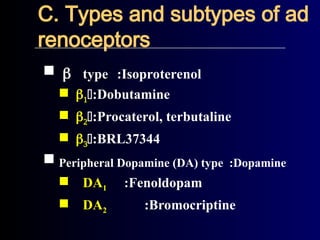
 type :Isoproterenol
:Dobutamine
:Procaterol, terbutaline
:BRL37344
 Peripheral Dopamine (DA) type :Dopamine
DA1 :Fenoldopam
DA2 :Bromocriptine
C. Types and subtypes of ad
renoceptors
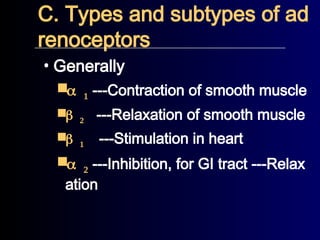
• Generally
 ---Contraction of smooth muscle
 ---Relaxation of smooth muscle
---Stimulation in heart
 ---Inhibition, for GI tract ---Relax
ation
C. Types and subtypes of ad
renoceptors
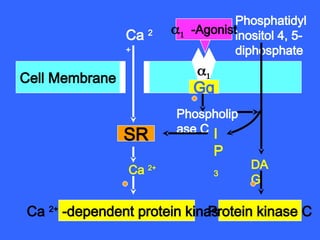
D. Mech. of action of Adren
omimetic drugs
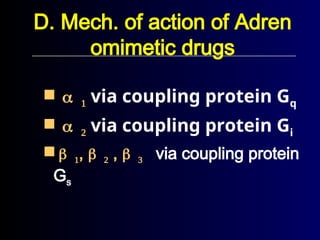
 via coupling protein Gq
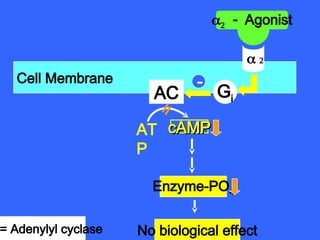
 via coupling protein Gi
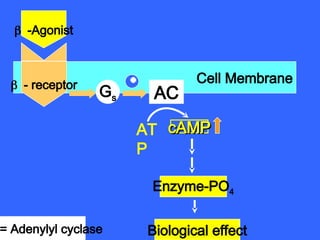
 ,  ,  via coupling protein
Gs
Cell Membrane
Ca 2
+
Ca 2+
Ca 2+
-dependent protein kinase
SR

Phospholip
ase C I
P
3
DA
G
Phosphatidyl
inositol 4, 5-
diphosphate
-Agonist
Protein kinase C
Gq
Cell Membrane
AC Gi
 
Agonist
AT
P
cAMP
cAMP
No biological effect
Enzyme-PO4
= Adenylyl cyclase
Cell Membrane
- receptor
-Agonist
AC
Gs
AT
P
cAMP
cAMP
Biological effect
Enzyme-PO4
= Adenylyl cyclase
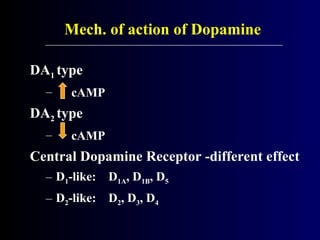
Mech. of action of Dopamine
DA1 type
– cAMP
DA2 type
– cAMP
Central Dopamine Receptor -different effect
– D1-like: D1A, D1B, D5
– D2-like: D2, D3, D4
Ca2+
chan
nels
Ca2+
(intracel
lular)
Ca
Ca2+
2+
-calmodulin
-calmodulin
complex
complex
Calmo
dulin
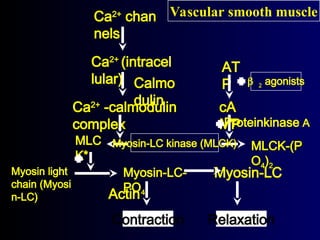
AT
P
cA
cA
MP
MP
MLC
MLC
K*
K*
MLCK-(P
MLCK-(P
O
O4
4)
)2
2
Myosin light
chain (Myosi
n-LC)
Myosin-LC-
PO4
Myosin-LC
Actin
Vascular smooth muscle
Contraction Relaxation
Myosin-LC kinase (MLCK)
agonists
Proteinkinase A
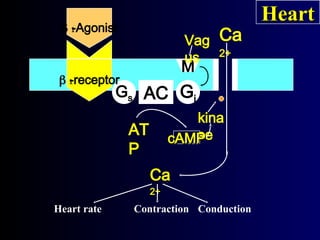
M
AC
Gs Gi
 
-receptor
 
-Agonist
kina
se
AT
P
Ca
2+
Ca
2+
Heart rate Conduction
Contraction
Vag
us
Heart
Heart
cAMP
cAMP
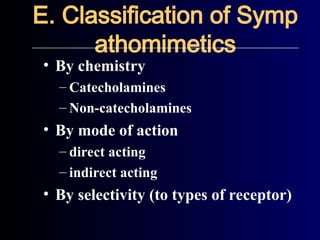
E. Classification of Symp
athomimetics
• By chemistry
– Catecholamines
– Non-catecholamines
• By mode of action
– direct acting
– indirect acting
• By selectivity (to types of receptor)
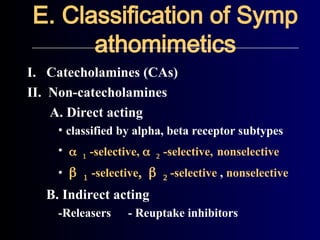
I. Catecholamines (CAs)
II. Non-catecholamines
A. Direct acting
• classified by alpha, beta receptor subtypes
• -selective, -selective, nonselective
• -selective -selective , nonselective
B. Indirect acting
-Releasers - Reuptake inhibitors
E. Classification of Symp
athomimetics
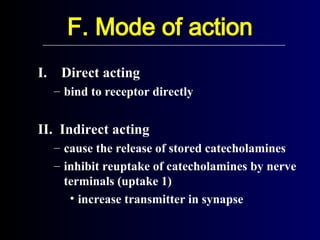
F. Mode of action
I. Direct acting
– bind to receptor directly
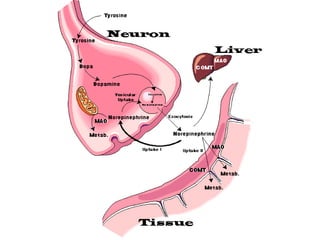
II. Indirect acting
– cause the release of stored catecholamines
– inhibit reuptake of catecholamines by nerve
terminals (uptake 1)
• increase transmitter in synapse
List of Adrenomimetic Dr
ugs
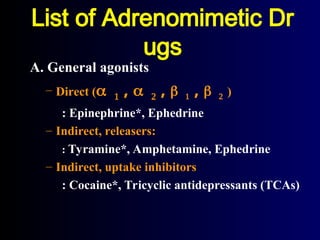
A. General agonists
– Direct ( ,  ,  ,  )
: Epinephrine*, Ephedrine
– Indirect, releasers:
: Tyramine*, Amphetamine, Ephedrine
– Indirect, uptake inhibitors
: Cocaine*, Tricyclic antidepressants (TCAs)
List of Adrenomimetic Dr
ugs
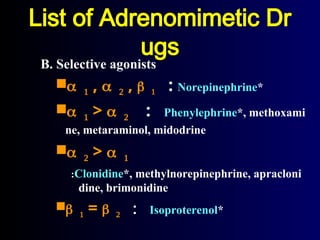
B. Selective agonists
 ,  ,  : Norepinephrine*
 >  : Phenylephrine*, methoxami
ne, metaraminol, midodrine
 > 
:Clonidine*, methylnorepinephrine, apracloni
dine, brimonidine
 =  : Isoproterenol*
List of Adrenomimetic Dr
ugs
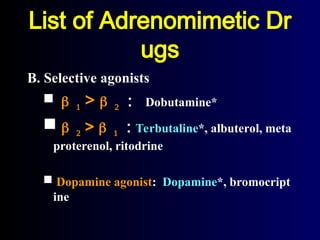
B. Selective agonists
 >  : Dobutamine*
  >  : Terbutaline*, albuterol, meta
proterenol, ritodrine
 Dopamine agonist: Dopamine*, bromocript
ine
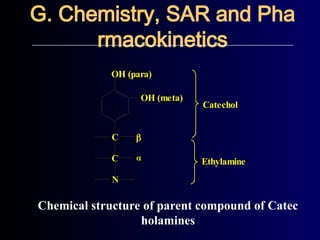
G. Chemistry, SAR and Pha
rmacokinetics
Chemical structure of parent compound of Catec
holamines
OH (para)
OH (meta)
C
C
N


Catechol
Ethylamine
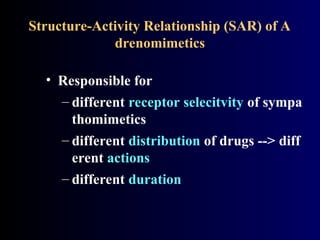
Structure-Activity Relationship (SAR) of A
drenomimetics
• Responsible for
– different receptor selecitvity of sympa
thomimetics
– different distribution of drugs --> diff
erent actions
– different duration
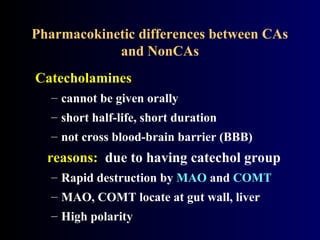
Pharmacokinetic differences between CAs
and NonCAs
Catecholamines
– cannot be given orally
– short half-life, short duration
– not cross blood-brain barrier (BBB)
reasons: due to having catechol group
– Rapid destruction by MAO and COMT
– MAO, COMT locate at gut wall, liver
– High polarity
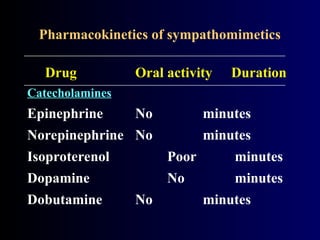
Pharmacokinetics of sympathomimetics
Drug Oral activity Duration
Catecholamines
Epinephrine No minutes
Norepinephrine No minutes
Isoproterenol Poor minutes
Dopamine No minutes
Dobutamine No minutes
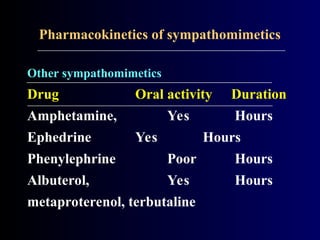
Other sympathomimetics
Drug Oral activity Duration
Amphetamine, Yes Hours
Ephedrine Yes Hours
Phenylephrine Poor Hours
Albuterol, Yes Hours
metaproterenol, terbutaline
Pharmacokinetics of sympathomimetics
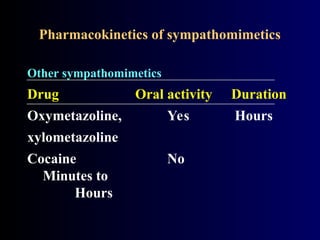
Other sympathomimetics
Drug Oral activity Duration
Oxymetazoline, Yes Hours
xylometazoline
Cocaine No
Minutes to
Hours
Pharmacokinetics of sympathomimetics
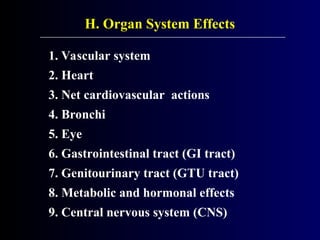
H. Organ System Effects
1. Vascular system
2. Heart
3. Net cardiovascular actions
4. Bronchi
5. Eye
6. Gastrointestinal tract (GI tract)
7. Genitourinary tract (GTU tract)
8. Metabolic and hormonal effects
9. Central nervous system (CNS)
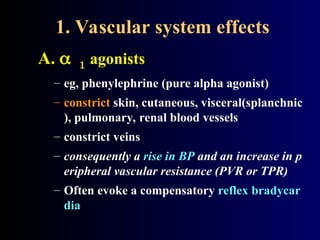
1. Vascular system effects
A.  agonists
– eg, phenylephrine (pure alpha agonist)
– constrict skin, cutaneous, visceral(splanchnic
), pulmonary, renal blood vessels
– constrict veins
– consequently a rise in BP and an increase in p
eripheral vascular resistance (PVR or TPR)
– Often evoke a compensatory reflex bradycar
dia
1. Vascular system effects
B.  agonists
– eg, terbutaline (pure beta agonist)
– dilate arterioles in skeletal muscle, coronary arteries
– consequently reduce PVR and BP.
– [Voluntary muscle ----> tremor ()]
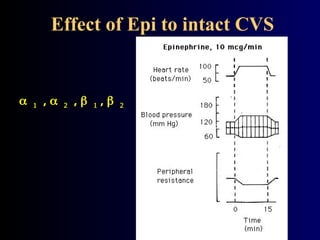
–Low dose of Epi: Beta2 activation is
dominant.
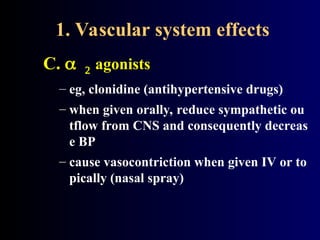
1. Vascular system effects
C.  agonists
– eg, clonidine (antihypertensive drugs)
– when given orally, reduce sympathetic ou
tflow from CNS and consequently decreas
e BP
– cause vasocontriction when given IV or to
pically (nasal spray)
1. Vascular system effects
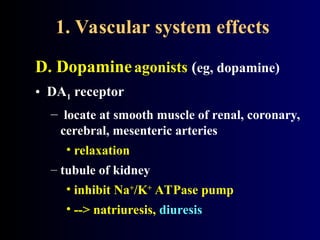
D. Dopamineagonists (eg, dopamine)
• DA1 receptor
– locate at smooth muscle of renal, coronary,
cerebral, mesenteric arteries
• relaxation
– tubule of kidney
• inhibit Na+
/K+
ATPase pump
• --> natriuresis, diuresis
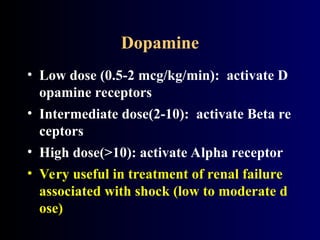
Dopamine
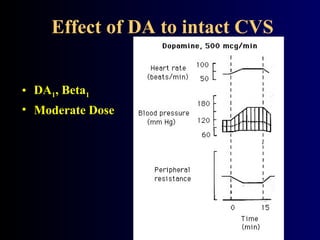
• Low dose (0.5-2 mcg/kg/min): activate D
opamine receptors
• Intermediate dose(2-10): activate Beta re
ceptors
• High dose(>10): activate Alpha receptor
• Very useful in treatment of renal failure
associated with shock (low to moderate d
ose)
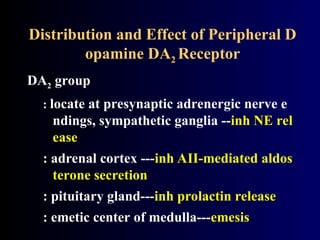
Distribution and Effect of Peripheral D
opamine DA2 Receptor
DA2 group
: locate at presynaptic adrenergic nerve e
ndings, sympathetic ganglia --inh NE rel
ease
: adrenal cortex ---inh AII-mediated aldos
terone secretion
: pituitary gland---inh prolactin release
: emetic center of medulla---emesis
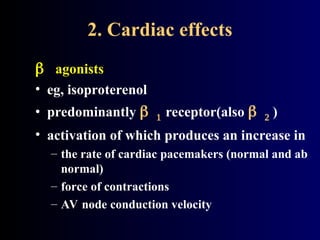
2. Cardiac effects
 agonists
• eg, isoproterenol
• predominantly receptor(also  )
• activation of which produces an increase in
– the rate of cardiac pacemakers (normal and ab
normal)
– force of contractions
– AV node conduction velocity
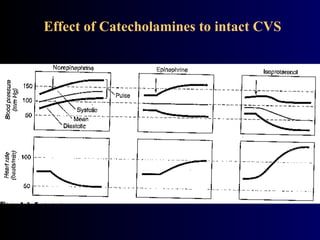
3. Net cardiovascular actions
and  agonists
– eg, norepinephrine
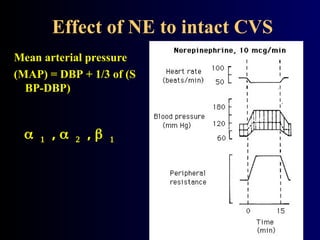
– may cause a reflex increase in vagal outf
low (due to BP increase) --> reflex brady
cardia
– This reflex often dominates any direct b
eta effects on the heart rate.
3. Net cardiovascular actions
and  agonists (cont’d)
• If reflex is blocked (eg, by ganglion blocke
rs), NE can cause tachycardia ( )
Pure alpha agonists
• eg, phenylephrine
• will routinely slow heart rate via the baror
eceptor reflex
3. Net cardiovascular actions
Pure beta agonists
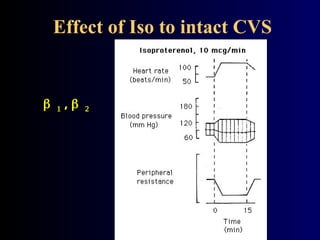
– eg, isoproterenol
– almost always increases the heart rate
Net effect on Blood Pressure
• Diastolic blood pressure (DBP) is affected
mainly by PVR and HR
• Alpha and  receptors have the greatest
effects on PVR
3. Net cardiovascular actions
Net effect on Blood Pressure (cont’d)
• Systolic blood pressure (SBP) = DBP + puls
e pressure (PP)
• Pulse pressure is determined mainly by stro
ke volume (SV), which is influenced by 
receptors (and venous return)
• Cardiac output (CO) = HR x SV
• So, alpha and beta selectivity determine SB
P, DBP and PP
Effect of NE to intact CVS
Mean arterial pressure
(MAP) = DBP + 1/3 of (S
BP-DBP)
 ,  , 
Effect of Epi to intact CVS
 ,  ,  , 
Effect of Iso to intact CVS
 , 
Effect of DA to intact CVS
• DA1, Beta1
• Moderate Dose
Effect of Catecholamines to intact CVS
4. Respiratory System
agonists
–eg, terbutaline
– produce relaxation of tracheal
and bronchial muscle
5. Eye
• Radial muscle, iris (pupillary dilator)
– contraction () --> mydriasis
– topical phenylephrine and similar alpha agonists
– accommodation is not significantly affected
– outflow of aqueous humor may be facilitated
--> reduce intraocular pressure (IOP)
• Ciliary muscle: relaxation for far vision ()
6. Gastrointestinal tract
• alpha and beta receptors locate on smooth muscle
and on neurons of enteric nervous system
• Stomach and intestine
– Motility and tone: (,)
– Sphincters : contraction ()
– Secretion (intestine): inhibition ()
: inhibit salt and water secretion
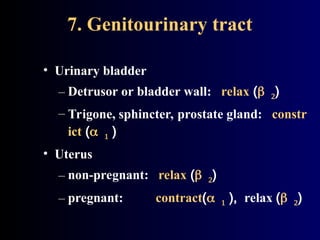
7. Genitourinary tract
• Urinary bladder
– Detrusor or bladder wall: relax ()
– Trigone, sphincter, prostate gland: constr
ict ()
• Uterus
– non-pregnant: relax ()
– pregnant: contract(), relax ()
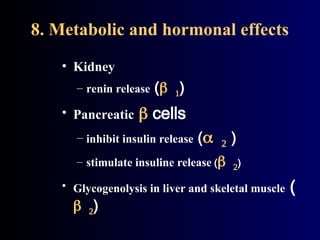
8. Metabolic and hormonal effects
• Kidney
– renin release ()
• Pancreatic  cells
– inhibit insulin release ()
– stimulate insuline release ()
• Glycogenolysis in liver and skeletal muscle (
)
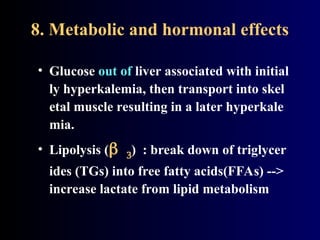
8. Metabolic and hormonal effects
• Glucose out of liver associated with initial
ly hyperkalemia, then transport into skel
etal muscle resulting in a later hyperkale
mia.
• Lipolysis () : break down of triglycer
ides (TGs) into free fatty acids(FFAs) -->
increase lactate from lipid metabolism
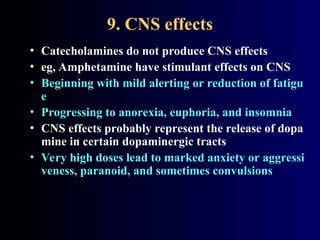
9. CNS effects
• Catecholamines do not produce CNS effects
• eg, Amphetamine have stimulant effects on CNS
• Beginning with mild alerting or reduction of fatigu
e
• Progressing to anorexia, euphoria, and insomnia
• CNS effects probably represent the release of dopa
mine in certain dopaminergic tracts
• Very high doses lead to marked anxiety or aggressi
veness, paranoid, and sometimes convulsions
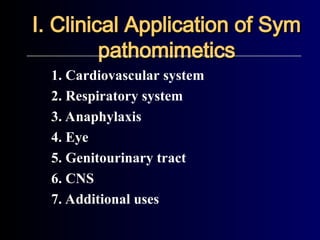
I. Clinical Application of Sym
pathomimetics
pathomimetics
1. Cardiovascular system
2. Respiratory system
3. Anaphylaxis
4. Eye
5. Genitourinary tract
6. CNS
7. Additional uses
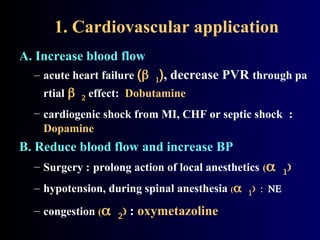
1. Cardiovascular application
A. Increase blood flow
– acute heart failure (), decrease PVR through pa
rtial  effect: Dobutamine
– cardiogenic shock from MI, CHF or septic shock :
Dopamine
B. Reduce blood flow and increase BP
– Surgery : prolong action of local anesthetics (
– hypotension, during spinal anesthesia (
– congestion ( : oxymetazoline
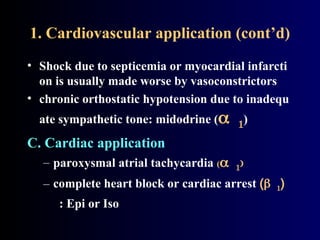
1. Cardiovascular application (cont’d)
• Shock due to septicemia or myocardial infarcti
on is usually made worse by vasoconstrictors
• chronic orthostatic hypotension due to inadequ
ate sympathetic tone: midodrine ()
C. Cardiac application
– paroxysmal atrial tachycardia (
– complete heart block or cardiac arrest ()
: Epi or Iso
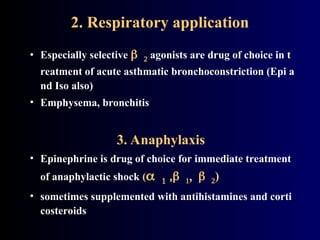
2. Respiratory application
• Especially selective  agonists are drug of choice in t
reatment of acute asthmatic bronchoconstriction (Epi a
nd Iso also)
• Emphysema, bronchitis
3. Anaphylaxis
• Epinephrine is drug of choice for immediate treatment
of anaphylactic shock ( ,)
• sometimes supplemented with antihistamines and corti
costeroids
4. Ophthalmic Application
• Alpha agonists, especially phenylephrine, often use
d topically to
– produce mydriasis, eg, ophthalmologic exam
– reduce the conjunctival itching and congestion c
aused by irritation or allergy
– do not cause cycloplegia (paralysis of accommod
ation)
• Epi and prodrug, dipivefrin, sometimes used for gl
aucoma. Phenylephrine also
5. Genitourinary Tract Application
• Beta2 agonists (ritodrine, terbutaline) used in p
remature labor, but cardiac stimulant effect m
ay be hazardous to both mother and fetus.
• Ephedrine (long-acting)
: sometimes used to improve urinary continen
ce in children with enuresis and in the elderl
y (contract trigone, prostate of bladder)
6. CNS Application
• Amphetamine: widely used and abused
• Legitimate indication: narcolepsy, attentio
n deficit hyperkinetic syndrome, weight re
duction
• Metabolism effect ( ) and anorexa
nt effect
• Misuse or abuse for deferring sleep, for mo
od-elevating, euphoria-producing action
7. Additional uses
Central  agonists
– hypertension
– menopausal hot flushes
– narcotics, alcohol, smoking withdrawal
J. ADRs of Sympathomimetics
Catecholamines
– little CNS toxicity
– high dose: excessive vasoconstriction, cardia
c arrhythmias, MI, pulmonary edema or he
morrhage, tissue necrosis.
Other sympathomimetics
• Phenylisopropylamines
– mild to severe CNS toxicity depending on do
sage
– small dose: nervousness, anorexia, insomnia
J. ADRs of Sympathomimetics
• Phenylpropylamines (PPA)
– higher dose: anxiety, aggressiveness, paranoid, c
onvulsion
• Peripherally acting agents: predictable toxicity
  agonists: hypertension, bradycardia (reflex)
–  agonists: palpitation, sinus tachycardia, seri
ous arrhythmias
–  agonists: skeletal muscle tremor
J. ADRs of Sympathomimetics
• No drug are perfectly selective; at high dose,
selectivity will decrease.
• Cocaine:
 special importance: drug of abuse
 cardiac arrhythmias or infarction and co
nvulsions
K. Drug interaction
Tyramine --MAO inhibitors
 tyramine not a drug, found in many foods
 tyramine is rapidly metabolized by MAO.
 MAO inhibitors increase the stores of catechol
amines in vesicles.
 Tyramine is a releaser of catecholamines
 may occur hypertensive crisis due to massive l
evels of NE
K. Drug interaction
Reuptake inhibitors -- Direct acting sympathomimetics
 eg, Cocaine vs NE
 when cocaine is given before NE -- intensify the e
ffects of NE
Epinephrine reversal
Beta blockers -- Sympathomimetics
 Can you predict the resulting effects ?
Thank you for your attention

adrenergic_agents (1)hhhhhhhhhhhhhhhhh.ppt

  • 1.
  • 2.
    Wording • Sympathomimetic drug s •Adrenomimetic drugs • Adrenergic agonists • Adrenoceptor agonists
  • 3.
    Outline A. Review ofsympathetic activation B. Introduction C. Types and subtypes of adrenoceptors D. Mechanism of action E. Classification of sympathomimetic dru gs F. Mode of action
  • 4.
    Outline G. Chemistry, SARand Pharmacokinetic s H. Organ system effects I. Clinical application of sympathomimeti cs J. Adverse effects of sympathomimetics K. Drug interactions
  • 5.
    Objectives 1. List tissuesthat contain sig. No. of alpha receptors of the  or  type and  or  receptors. 2. Describe the major organ system effects of a pure alpha agonist, a pure beta agonist, and a mixed alpha and beta agonist. Give examples of each type of drug.
  • 6.
    3. Describe aclinical situation in which the effects of an indirect sympathomimetic would differ from those of a direct agonist. 4. List the major clinical applications of the adrenoceptor agonists. Objectives
  • 7.
    Suggested Reading  KatzungBG. Basic & clinical pharmacology. 8t h ed., 2001.  Katzung BG, Trevor AJ. Examination &board review pharmacology. 5th ed. 1998.  Goodman&Gilman. Basic pharmacology. 9th ed., 1996.  Pharmacology, Lippincott’s Illustrated Review s 1992.
  • 8.
    A. Review ofSympathetic A ctivation • ‘Fight’ or ‘Flight’ on Stress • Heart – HR, contractility, conduction veloc ity • Vessels (arterioles) –Skin, cutaneous, visceral : constrict –Skeletal muscle, coronary: dilate
  • 9.
    A. Review ofSympathetic A ctivation • Vessels (Vein): constrict • Eye –Radial muscle, iris: contract –Ciliary muscle: relax for far vision • Lung –Tracheal and bronchial muscle: r elax
  • 10.
    • Stomach andintestine – Motility and tone –Sphincters : contraction –Secretion (intestine): inhibition • Urinary bladder –Detrusor or bladder wall: relax –Trigone, sphincter: constrict A. Review of Sympathetic A ctivation
  • 11.
    • Posterior pituitary:ADH secretion • Liver: glycogenolysis, gluconeogene sis • Pancreatic  cells ---stimulate insulin release • Skeletal muscle – contractility, glycogenolysis, K+ uptake A. Review of Sympathetic A ctivation
  • 12.
    • Fat cells:lipolysis • Uterus –non-pregnant: relax • Sweat gland : secretio n • Hair : piloerection A. Review of Sympathetic A ctivation
  • 13.
    B. Introduction • Theeffects of adrenomimetic drugs are similar to sympathetic activation. • But why each adrenomimetic drug c an produce different responses? • The differences in affinity to adreno ceptor subtypes are responsible for different responses.
  • 14.
    C. Types andsubtypes of ad renoceptors • Adrenergic receptors locate on smoot h muscle, cardiac muscle, exocrine gl ands, endocrine glands and on nerve terminals. • the transmitter in all adrenergic neuro ns was NE • When NE and Epi interacted with an a drenoceptor, in some tissues the resp onse was excitatory while in other tiss ues it was inhibitory
  • 15.
    • Two subtypesof adrenoceptors ( and ) - excitatory in most tissues (except - intestinal smooth muscle)  - inhibitory in most tissues (except - heart) C. Types and subtypes of ad renoceptors
  • 16.
    Rank Order ofPotency  receptors Epi > NE >> Iso  receptors Iso > Epi > NE Type of adrenoceptor  ,    ,  ,   DA1, DA2 C. Types and subtypes of ad renoceptors
  • 17.
     type :Phenylephrine,methoxamine D  type :Clonidine, BHT920  :Oxymetazoline C  C. Types and subtypes of ad renoceptors
  • 18.
     type :Isoproterenol :Dobutamine :Procaterol,terbutaline :BRL37344  Peripheral Dopamine (DA) type :Dopamine DA1 :Fenoldopam DA2 :Bromocriptine C. Types and subtypes of ad renoceptors
  • 19.
    • Generally  ---Contractionof smooth muscle  ---Relaxation of smooth muscle ---Stimulation in heart  ---Inhibition, for GI tract ---Relax ation C. Types and subtypes of ad renoceptors
  • 20.
    D. Mech. ofaction of Adren omimetic drugs  via coupling protein Gq  via coupling protein Gi  ,  ,  via coupling protein Gs
  • 21.
    Cell Membrane Ca 2 + Ca2+ Ca 2+ -dependent protein kinase SR  Phospholip ase C I P 3 DA G Phosphatidyl inositol 4, 5- diphosphate -Agonist Protein kinase C Gq
  • 22.
    Cell Membrane AC Gi  Agonist AT P cAMP cAMP No biological effect Enzyme-PO4 = Adenylyl cyclase
  • 23.
  • 24.
    Mech. of actionof Dopamine DA1 type – cAMP DA2 type – cAMP Central Dopamine Receptor -different effect – D1-like: D1A, D1B, D5 – D2-like: D2, D3, D4
  • 25.
  • 26.
    M AC Gs Gi   -receptor  -Agonist kina se AT P Ca 2+ Ca 2+ Heart rate Conduction Contraction Vag us Heart Heart cAMP cAMP
  • 27.
    E. Classification ofSymp athomimetics • By chemistry – Catecholamines – Non-catecholamines • By mode of action – direct acting – indirect acting • By selectivity (to types of receptor)
  • 28.
    I. Catecholamines (CAs) II.Non-catecholamines A. Direct acting • classified by alpha, beta receptor subtypes • -selective, -selective, nonselective • -selective -selective , nonselective B. Indirect acting -Releasers - Reuptake inhibitors E. Classification of Symp athomimetics
  • 29.
    F. Mode ofaction I. Direct acting – bind to receptor directly II. Indirect acting – cause the release of stored catecholamines – inhibit reuptake of catecholamines by nerve terminals (uptake 1) • increase transmitter in synapse
  • 31.
    List of AdrenomimeticDr ugs A. General agonists – Direct ( ,  ,  ,  ) : Epinephrine*, Ephedrine – Indirect, releasers: : Tyramine*, Amphetamine, Ephedrine – Indirect, uptake inhibitors : Cocaine*, Tricyclic antidepressants (TCAs)
  • 32.
    List of AdrenomimeticDr ugs B. Selective agonists  ,  ,  : Norepinephrine*  >  : Phenylephrine*, methoxami ne, metaraminol, midodrine  >  :Clonidine*, methylnorepinephrine, apracloni dine, brimonidine  =  : Isoproterenol*
  • 33.
    List of AdrenomimeticDr ugs B. Selective agonists  >  : Dobutamine*   >  : Terbutaline*, albuterol, meta proterenol, ritodrine  Dopamine agonist: Dopamine*, bromocript ine
  • 34.
    G. Chemistry, SARand Pha rmacokinetics Chemical structure of parent compound of Catec holamines OH (para) OH (meta) C C N   Catechol Ethylamine
  • 35.
    Structure-Activity Relationship (SAR)of A drenomimetics • Responsible for – different receptor selecitvity of sympa thomimetics – different distribution of drugs --> diff erent actions – different duration
  • 36.
    Pharmacokinetic differences betweenCAs and NonCAs Catecholamines – cannot be given orally – short half-life, short duration – not cross blood-brain barrier (BBB) reasons: due to having catechol group – Rapid destruction by MAO and COMT – MAO, COMT locate at gut wall, liver – High polarity
  • 37.
    Pharmacokinetics of sympathomimetics DrugOral activity Duration Catecholamines Epinephrine No minutes Norepinephrine No minutes Isoproterenol Poor minutes Dopamine No minutes Dobutamine No minutes
  • 38.
    Other sympathomimetics Drug Oralactivity Duration Amphetamine, Yes Hours Ephedrine Yes Hours Phenylephrine Poor Hours Albuterol, Yes Hours metaproterenol, terbutaline Pharmacokinetics of sympathomimetics
  • 39.
    Other sympathomimetics Drug Oralactivity Duration Oxymetazoline, Yes Hours xylometazoline Cocaine No Minutes to Hours Pharmacokinetics of sympathomimetics
  • 40.
    H. Organ SystemEffects 1. Vascular system 2. Heart 3. Net cardiovascular actions 4. Bronchi 5. Eye 6. Gastrointestinal tract (GI tract) 7. Genitourinary tract (GTU tract) 8. Metabolic and hormonal effects 9. Central nervous system (CNS)
  • 41.
    1. Vascular systemeffects A.  agonists – eg, phenylephrine (pure alpha agonist) – constrict skin, cutaneous, visceral(splanchnic ), pulmonary, renal blood vessels – constrict veins – consequently a rise in BP and an increase in p eripheral vascular resistance (PVR or TPR) – Often evoke a compensatory reflex bradycar dia
  • 42.
    1. Vascular systemeffects B.  agonists – eg, terbutaline (pure beta agonist) – dilate arterioles in skeletal muscle, coronary arteries – consequently reduce PVR and BP. – [Voluntary muscle ----> tremor ()] –Low dose of Epi: Beta2 activation is dominant.
  • 43.
    1. Vascular systemeffects C.  agonists – eg, clonidine (antihypertensive drugs) – when given orally, reduce sympathetic ou tflow from CNS and consequently decreas e BP – cause vasocontriction when given IV or to pically (nasal spray)
  • 44.
    1. Vascular systemeffects D. Dopamineagonists (eg, dopamine) • DA1 receptor – locate at smooth muscle of renal, coronary, cerebral, mesenteric arteries • relaxation – tubule of kidney • inhibit Na+ /K+ ATPase pump • --> natriuresis, diuresis
  • 45.
    Dopamine • Low dose(0.5-2 mcg/kg/min): activate D opamine receptors • Intermediate dose(2-10): activate Beta re ceptors • High dose(>10): activate Alpha receptor • Very useful in treatment of renal failure associated with shock (low to moderate d ose)
  • 46.
    Distribution and Effectof Peripheral D opamine DA2 Receptor DA2 group : locate at presynaptic adrenergic nerve e ndings, sympathetic ganglia --inh NE rel ease : adrenal cortex ---inh AII-mediated aldos terone secretion : pituitary gland---inh prolactin release : emetic center of medulla---emesis
  • 47.
    2. Cardiac effects agonists • eg, isoproterenol • predominantly receptor(also  ) • activation of which produces an increase in – the rate of cardiac pacemakers (normal and ab normal) – force of contractions – AV node conduction velocity
  • 48.
    3. Net cardiovascularactions and  agonists – eg, norepinephrine – may cause a reflex increase in vagal outf low (due to BP increase) --> reflex brady cardia – This reflex often dominates any direct b eta effects on the heart rate.
  • 49.
    3. Net cardiovascularactions and  agonists (cont’d) • If reflex is blocked (eg, by ganglion blocke rs), NE can cause tachycardia ( ) Pure alpha agonists • eg, phenylephrine • will routinely slow heart rate via the baror eceptor reflex
  • 50.
    3. Net cardiovascularactions Pure beta agonists – eg, isoproterenol – almost always increases the heart rate Net effect on Blood Pressure • Diastolic blood pressure (DBP) is affected mainly by PVR and HR • Alpha and  receptors have the greatest effects on PVR
  • 51.
    3. Net cardiovascularactions Net effect on Blood Pressure (cont’d) • Systolic blood pressure (SBP) = DBP + puls e pressure (PP) • Pulse pressure is determined mainly by stro ke volume (SV), which is influenced by  receptors (and venous return) • Cardiac output (CO) = HR x SV • So, alpha and beta selectivity determine SB P, DBP and PP
  • 52.
    Effect of NEto intact CVS Mean arterial pressure (MAP) = DBP + 1/3 of (S BP-DBP)  ,  , 
  • 53.
    Effect of Epito intact CVS  ,  ,  , 
  • 54.
    Effect of Isoto intact CVS  , 
  • 55.
    Effect of DAto intact CVS • DA1, Beta1 • Moderate Dose
  • 56.
  • 57.
    4. Respiratory System agonists –eg,terbutaline – produce relaxation of tracheal and bronchial muscle
  • 58.
    5. Eye • Radialmuscle, iris (pupillary dilator) – contraction () --> mydriasis – topical phenylephrine and similar alpha agonists – accommodation is not significantly affected – outflow of aqueous humor may be facilitated --> reduce intraocular pressure (IOP) • Ciliary muscle: relaxation for far vision ()
  • 59.
    6. Gastrointestinal tract •alpha and beta receptors locate on smooth muscle and on neurons of enteric nervous system • Stomach and intestine – Motility and tone: (,) – Sphincters : contraction () – Secretion (intestine): inhibition () : inhibit salt and water secretion
  • 60.
    7. Genitourinary tract •Urinary bladder – Detrusor or bladder wall: relax () – Trigone, sphincter, prostate gland: constr ict () • Uterus – non-pregnant: relax () – pregnant: contract(), relax ()
  • 61.
    8. Metabolic andhormonal effects • Kidney – renin release () • Pancreatic  cells – inhibit insulin release () – stimulate insuline release () • Glycogenolysis in liver and skeletal muscle ( )
  • 62.
    8. Metabolic andhormonal effects • Glucose out of liver associated with initial ly hyperkalemia, then transport into skel etal muscle resulting in a later hyperkale mia. • Lipolysis () : break down of triglycer ides (TGs) into free fatty acids(FFAs) --> increase lactate from lipid metabolism
  • 63.
    9. CNS effects •Catecholamines do not produce CNS effects • eg, Amphetamine have stimulant effects on CNS • Beginning with mild alerting or reduction of fatigu e • Progressing to anorexia, euphoria, and insomnia • CNS effects probably represent the release of dopa mine in certain dopaminergic tracts • Very high doses lead to marked anxiety or aggressi veness, paranoid, and sometimes convulsions
  • 64.
    I. Clinical Applicationof Sym I. Clinical Application of Sym pathomimetics pathomimetics 1. Cardiovascular system 2. Respiratory system 3. Anaphylaxis 4. Eye 5. Genitourinary tract 6. CNS 7. Additional uses
  • 65.
    1. Cardiovascular application A.Increase blood flow – acute heart failure (), decrease PVR through pa rtial  effect: Dobutamine – cardiogenic shock from MI, CHF or septic shock : Dopamine B. Reduce blood flow and increase BP – Surgery : prolong action of local anesthetics ( – hypotension, during spinal anesthesia ( – congestion ( : oxymetazoline
  • 66.
    1. Cardiovascular application(cont’d) • Shock due to septicemia or myocardial infarcti on is usually made worse by vasoconstrictors • chronic orthostatic hypotension due to inadequ ate sympathetic tone: midodrine () C. Cardiac application – paroxysmal atrial tachycardia ( – complete heart block or cardiac arrest () : Epi or Iso
  • 67.
    2. Respiratory application •Especially selective  agonists are drug of choice in t reatment of acute asthmatic bronchoconstriction (Epi a nd Iso also) • Emphysema, bronchitis 3. Anaphylaxis • Epinephrine is drug of choice for immediate treatment of anaphylactic shock ( ,) • sometimes supplemented with antihistamines and corti costeroids
  • 68.
    4. Ophthalmic Application •Alpha agonists, especially phenylephrine, often use d topically to – produce mydriasis, eg, ophthalmologic exam – reduce the conjunctival itching and congestion c aused by irritation or allergy – do not cause cycloplegia (paralysis of accommod ation) • Epi and prodrug, dipivefrin, sometimes used for gl aucoma. Phenylephrine also
  • 69.
    5. Genitourinary TractApplication • Beta2 agonists (ritodrine, terbutaline) used in p remature labor, but cardiac stimulant effect m ay be hazardous to both mother and fetus. • Ephedrine (long-acting) : sometimes used to improve urinary continen ce in children with enuresis and in the elderl y (contract trigone, prostate of bladder)
  • 70.
    6. CNS Application •Amphetamine: widely used and abused • Legitimate indication: narcolepsy, attentio n deficit hyperkinetic syndrome, weight re duction • Metabolism effect ( ) and anorexa nt effect • Misuse or abuse for deferring sleep, for mo od-elevating, euphoria-producing action
  • 71.
    7. Additional uses Central agonists – hypertension – menopausal hot flushes – narcotics, alcohol, smoking withdrawal
  • 72.
    J. ADRs ofSympathomimetics Catecholamines – little CNS toxicity – high dose: excessive vasoconstriction, cardia c arrhythmias, MI, pulmonary edema or he morrhage, tissue necrosis. Other sympathomimetics • Phenylisopropylamines – mild to severe CNS toxicity depending on do sage – small dose: nervousness, anorexia, insomnia
  • 73.
    J. ADRs ofSympathomimetics • Phenylpropylamines (PPA) – higher dose: anxiety, aggressiveness, paranoid, c onvulsion • Peripherally acting agents: predictable toxicity   agonists: hypertension, bradycardia (reflex) –  agonists: palpitation, sinus tachycardia, seri ous arrhythmias –  agonists: skeletal muscle tremor
  • 74.
    J. ADRs ofSympathomimetics • No drug are perfectly selective; at high dose, selectivity will decrease. • Cocaine:  special importance: drug of abuse  cardiac arrhythmias or infarction and co nvulsions
  • 75.
    K. Drug interaction Tyramine--MAO inhibitors  tyramine not a drug, found in many foods  tyramine is rapidly metabolized by MAO.  MAO inhibitors increase the stores of catechol amines in vesicles.  Tyramine is a releaser of catecholamines  may occur hypertensive crisis due to massive l evels of NE
  • 76.
    K. Drug interaction Reuptakeinhibitors -- Direct acting sympathomimetics  eg, Cocaine vs NE  when cocaine is given before NE -- intensify the e ffects of NE Epinephrine reversal Beta blockers -- Sympathomimetics  Can you predict the resulting effects ?
  • 77.
    Thank you foryour attention