
Amiodarone IV
Dr zikrullah
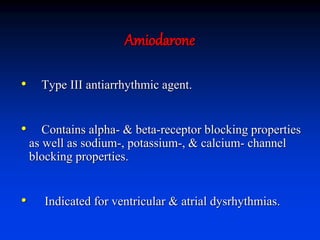
Amiodarone
• Type III antiarrhythmic agent.
• Contains alpha- & beta-receptor blocking properties
as well as sodium-, potassium-, & calcium- channel
blocking properties.
• Indicated for ventricular & atrial dysrhythmias.
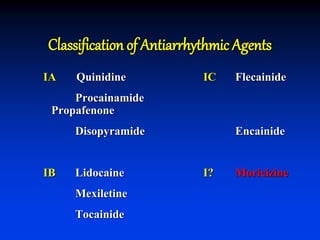
Classification of Antiarrhythmic Agents
IA Quinidine IC Flecainide
Procainamide
Propafenone
Disopyramide Encainide
IB Lidocaine I? Moricizine
Mexiletine
Tocainide
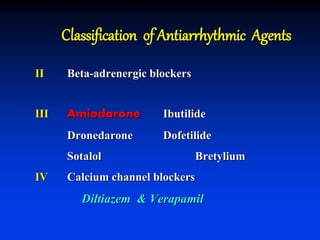
Classification of Antiarrhythmic Agents
II Beta-adrenergic blockers
III Amiodarone Ibutilide
Dronedarone Dofetilide
Sotalol Bretylium
IV Calcium channel blockers
Diltiazem & Verapamil
Amiodarone Historical Landmarks (1)
1962: Synthesized as an anti-anginal compound .
1968: Novel action with new biological profile.
1970: Unusual electrophysiology profile.
74/76: Unusual clinical potency as an
antiarrhythmic drug
Amiodarone Historical Landmarks (2)
1983: First US Symposium on Amiodarone .
1984: FDA Approval.
1993: Efficacy Unparalleled; Mode of Action
Unknown.
1995: Amiodarone IV approved
Unique Features of Amiodarone
as an Anti-arrhythmic Drug
• Long elimination half-life.
• Can be administered to anephric patients on dialysis.
• Well tolerated in advanced CHF.
• Manageable drug-drug interactions .
(ie, digoxin)
• Very low incidence of torsades de pointes even
with diuretic therapy.
Unique Features of Amiodarone
(Cont’d.)
• Has Class 1 properties without the associated
proarrhythmic actions or negative impact on
mortality.
• Has antisympathetic actions without beta-blocker
side effects.
• Increases LVEF and improves CHF.
• Antifibrillatory actions in the ventricles may be
augmented by addition of beta-blockade.
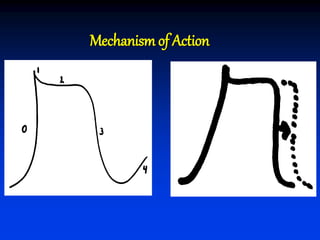
Mechanism of Action
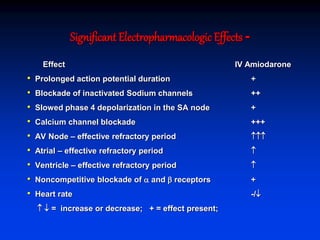
Significant Electropharmacologic Effects -
Effect IV Amiodarone
• Prolonged action potential duration +
• Blockade of inactivated Sodium channels ++
• Slowed phase 4 depolarization in the SA node +
• Calcium channel blockade +++
• AV Node – effective refractory period 
• Atrial – effective refractory period 
• Ventricle – effective refractory period 
• Noncompetitive blockade of  and  receptors +
• Heart rate -/
  = increase or decrease; + = effect present;
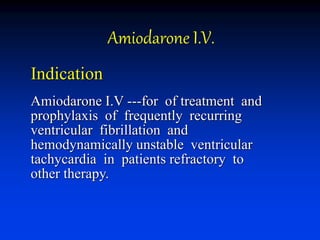
Amiodarone I.V.
Indication
Amiodarone I.V ---for of treatment and
prophylaxis of frequently recurring
ventricular fibrillation and
hemodynamically unstable ventricular
tachycardia in patients refractory to
other therapy.
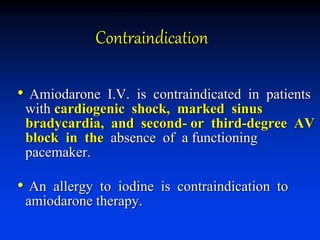
Contraindication
• Amiodarone I.V. is contraindicated in patients
with cardiogenic shock, marked sinus
bradycardia, and second- or third-degree AV
block in the absence of a functioning
pacemaker.
• An allergy to iodine is contraindication to
amiodarone therapy.
Pharmakokinetics
• Large volume of distribution.
• Half-life: 30 - 100 days.
• Metabolized primarily by CYP 3A4.
• Active metabolite : N- des-ethyl-amiodarone
- Half-life: ~60 days
Intravenous Amiodarone Pharmacokinetics
• Peak levels after single 5 mg/kg 15 min infusions
: 5-41 mg/L .
• After 10 min 150 mg load for VF/VT : 7-26
mg/L.
• Levels decline to 10 % of peak within 30-45 min
at the end of the infusion.
• After 48 hrs of continued infusions, levels 0.7 to 1.4
mg/L.
Pharmacokinetics of
Oral Amiodarone
•Absorption : Tmax: 2-12 h (lab 0.4-3 h).
• Extent of absorption : Poor and slow.
• Bioavailability : Variable (22-86%).
• Protein binding : 96.3 ± 0.6%.
• Volume of distribution : 1.3-65.8 L/kg.
• Negligible renal excretion
• Biotransformation : Hepatic and intestinal.
• Elimination half-life : 3 -20 h (acute),
15-50day (chronic).
Pharmacokinetics of
Oral Amiodarone
•Total body clearance : 0.10-0.77 l/min.
•Pattern of elimination : First order.
• Metabolites :
Major : mono N-des-ethyl-amiodarone,
Minor: bis-N-des-ethyl-amiodarone, deiodinated
•Therapeutic levels : 1.0-2.5 µg/mL range.
•Special factors : Slow onset & offset of action
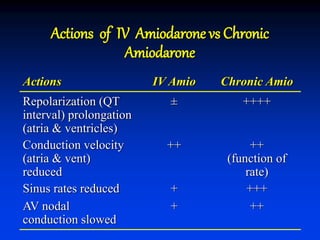
Actions of IV Amiodarone vs Chronic
Amiodarone
Actions IV Amio Chronic Amio
Repolarization (QT
interval) prolongation
(atria & ventricles)
± ++++
Conduction velocity
(atria & vent)
reduced
++ ++
(function of
rate)
Sinus rates reduced + +++
AV nodal
conduction slowed
+ ++
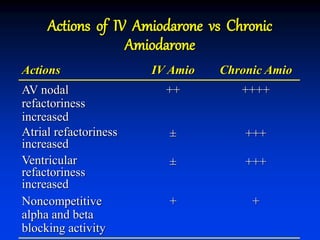
Actions of IV Amiodarone vs Chronic
Amiodarone
Actions IV Amio Chronic Amio
AV nodal
refactoriness
increased
++ ++++
Atrial refactoriness
increased
± +++
Ventricular
refactoriness
increased
± +++
Noncompetitive
alpha and beta
blocking activity
+ +
Pharmacokinetics of
IV Amiodarone
Summary : More rapid onset and
offset of action with IV versus oral
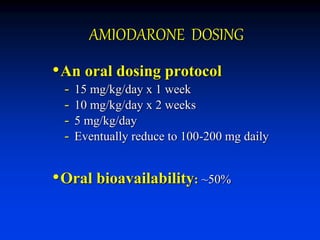
AMIODARONE DOSING
•An oral dosing protocol
- 15 mg/kg/day x 1 week
- 10 mg/kg/day x 2 weeks
- 5 mg/kg/day
- Eventually reduce to 100-200 mg daily
•Oral bioavailability: ~50%
•General IV load
- 150 mg over 10 minutes.
- 1 mg/min x 6 hours.
- 0.5 mg/min x 18 hours or longer.
Monitor heart rate & blood pressure
•Ventricular fibrillation
- 300 mg IV ; may repeat 150 mg IV.
•Ventricular tachycardia
- 150 mg over 10 min; repeat as needed to a total
of 2.2 gm in 24 hours.
Adverse Effect
• Hypotension is the most common adverse effect seen
with amiodarone I.V. and may be related to the rate
of infusion.
• Hypotension should be treated by slowing the infusion
or with standard therapy : vasopressor drugs, positive
inotropic agents, and volume expansion.
Other emergent adverse effects are;
• Hypotension (16%)
• Bradycardia (4.9%),
• Liver function test abnormalities (3.4%),
• Cardiac arrest (2.9%),
• Ventricular Tachycardia (2.4%),
• Chronic heart failure
• Cardiogenic shock (1.3%),
• AV block (0.5%).
Amiodarone
• Toxicities
CNS Liver Cornea deposits
GI Thyroid Optic neuropathy
Skin Bradycardia Photosensitivity
Pulmonary fibrosis
• Baseline labs
- Thyroid (recheck every 6 mths)
- Liver (recheck every 6 mths)
- Pulmonary (annual CXR)
Algorithm for Cardiac
Arrest
Utilizing amiodarone
I.V.
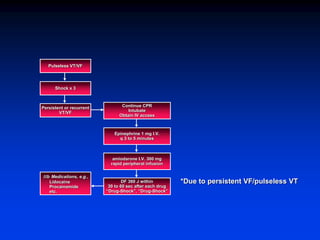
Pulseless VT/VF
Shock x 3
Persistent or recurrent
VT/VF
Continue CPR
Intubate
Obtain IV access
Epinephrine 1 mg I.V.
q 3 to 5 minutes
amiodarone I.V. 300 mg
rapid peripheral infusion
DF 360 J within
30 to 60 sec after each drug
“Drug-Shock”, “Drug-Shock”
IIb Medications, e.g.,
Lidocaine
Procainamide
etc.
*Due to persistent VF/pulseless VT
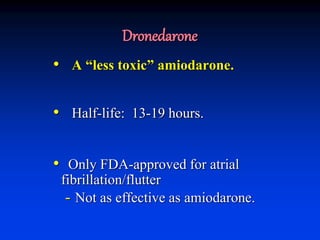
Dronedarone
• A “less toxic” amiodarone.
• Half-life: 13-19 hours.
• Only FDA-approved for atrial
fibrillation/flutter
- Not as effective as amiodarone.
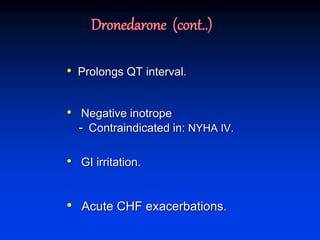
Dronedarone (cont..)
• Prolongs QT interval.
• Negative inotrope
- Contraindicated in: NYHA IV.
• GI irritation.
• Acute CHF exacerbations.
Dronedarone (cont..)
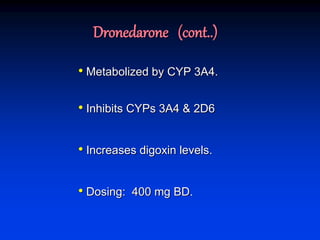
• Metabolized by CYP 3A4.
• Inhibits CYPs 3A4 & 2D6
• Increases digoxin levels.
• Dosing: 400 mg BD.
THANK YOU

Amiadrone

  • 1.
  • 2.
    Amiodarone • Type IIIantiarrhythmic agent. • Contains alpha- & beta-receptor blocking properties as well as sodium-, potassium-, & calcium- channel blocking properties. • Indicated for ventricular & atrial dysrhythmias.
  • 3.
    Classification of AntiarrhythmicAgents IA Quinidine IC Flecainide Procainamide Propafenone Disopyramide Encainide IB Lidocaine I? Moricizine Mexiletine Tocainide
  • 4.
    Classification of AntiarrhythmicAgents II Beta-adrenergic blockers III Amiodarone Ibutilide Dronedarone Dofetilide Sotalol Bretylium IV Calcium channel blockers Diltiazem & Verapamil
  • 5.
    Amiodarone Historical Landmarks(1) 1962: Synthesized as an anti-anginal compound . 1968: Novel action with new biological profile. 1970: Unusual electrophysiology profile. 74/76: Unusual clinical potency as an antiarrhythmic drug
  • 6.
    Amiodarone Historical Landmarks(2) 1983: First US Symposium on Amiodarone . 1984: FDA Approval. 1993: Efficacy Unparalleled; Mode of Action Unknown. 1995: Amiodarone IV approved
  • 7.
    Unique Features ofAmiodarone as an Anti-arrhythmic Drug • Long elimination half-life. • Can be administered to anephric patients on dialysis. • Well tolerated in advanced CHF. • Manageable drug-drug interactions . (ie, digoxin) • Very low incidence of torsades de pointes even with diuretic therapy.
  • 8.
    Unique Features ofAmiodarone (Cont’d.) • Has Class 1 properties without the associated proarrhythmic actions or negative impact on mortality. • Has antisympathetic actions without beta-blocker side effects. • Increases LVEF and improves CHF. • Antifibrillatory actions in the ventricles may be augmented by addition of beta-blockade.
  • 9.
  • 10.
    Significant Electropharmacologic Effects- Effect IV Amiodarone • Prolonged action potential duration + • Blockade of inactivated Sodium channels ++ • Slowed phase 4 depolarization in the SA node + • Calcium channel blockade +++ • AV Node – effective refractory period  • Atrial – effective refractory period  • Ventricle – effective refractory period  • Noncompetitive blockade of  and  receptors + • Heart rate -/   = increase or decrease; + = effect present;
  • 11.
    Amiodarone I.V. Indication Amiodarone I.V---for of treatment and prophylaxis of frequently recurring ventricular fibrillation and hemodynamically unstable ventricular tachycardia in patients refractory to other therapy.
  • 12.
    Contraindication • Amiodarone I.V.is contraindicated in patients with cardiogenic shock, marked sinus bradycardia, and second- or third-degree AV block in the absence of a functioning pacemaker. • An allergy to iodine is contraindication to amiodarone therapy.
  • 13.
    Pharmakokinetics • Large volumeof distribution. • Half-life: 30 - 100 days. • Metabolized primarily by CYP 3A4. • Active metabolite : N- des-ethyl-amiodarone - Half-life: ~60 days
  • 14.
    Intravenous Amiodarone Pharmacokinetics •Peak levels after single 5 mg/kg 15 min infusions : 5-41 mg/L . • After 10 min 150 mg load for VF/VT : 7-26 mg/L. • Levels decline to 10 % of peak within 30-45 min at the end of the infusion. • After 48 hrs of continued infusions, levels 0.7 to 1.4 mg/L.
  • 15.
    Pharmacokinetics of Oral Amiodarone •Absorption: Tmax: 2-12 h (lab 0.4-3 h). • Extent of absorption : Poor and slow. • Bioavailability : Variable (22-86%). • Protein binding : 96.3 ± 0.6%. • Volume of distribution : 1.3-65.8 L/kg. • Negligible renal excretion • Biotransformation : Hepatic and intestinal. • Elimination half-life : 3 -20 h (acute), 15-50day (chronic).
  • 16.
    Pharmacokinetics of Oral Amiodarone •Totalbody clearance : 0.10-0.77 l/min. •Pattern of elimination : First order. • Metabolites : Major : mono N-des-ethyl-amiodarone, Minor: bis-N-des-ethyl-amiodarone, deiodinated •Therapeutic levels : 1.0-2.5 µg/mL range. •Special factors : Slow onset & offset of action
  • 17.
    Actions of IVAmiodarone vs Chronic Amiodarone Actions IV Amio Chronic Amio Repolarization (QT interval) prolongation (atria & ventricles) ± ++++ Conduction velocity (atria & vent) reduced ++ ++ (function of rate) Sinus rates reduced + +++ AV nodal conduction slowed + ++
  • 18.
    Actions of IVAmiodarone vs Chronic Amiodarone Actions IV Amio Chronic Amio AV nodal refactoriness increased ++ ++++ Atrial refactoriness increased ± +++ Ventricular refactoriness increased ± +++ Noncompetitive alpha and beta blocking activity + +
  • 19.
    Pharmacokinetics of IV Amiodarone Summary: More rapid onset and offset of action with IV versus oral
  • 20.
    AMIODARONE DOSING •An oraldosing protocol - 15 mg/kg/day x 1 week - 10 mg/kg/day x 2 weeks - 5 mg/kg/day - Eventually reduce to 100-200 mg daily •Oral bioavailability: ~50%
  • 21.
    •General IV load -150 mg over 10 minutes. - 1 mg/min x 6 hours. - 0.5 mg/min x 18 hours or longer. Monitor heart rate & blood pressure •Ventricular fibrillation - 300 mg IV ; may repeat 150 mg IV. •Ventricular tachycardia - 150 mg over 10 min; repeat as needed to a total of 2.2 gm in 24 hours.
  • 22.
    Adverse Effect • Hypotensionis the most common adverse effect seen with amiodarone I.V. and may be related to the rate of infusion. • Hypotension should be treated by slowing the infusion or with standard therapy : vasopressor drugs, positive inotropic agents, and volume expansion.
  • 23.
    Other emergent adverseeffects are; • Hypotension (16%) • Bradycardia (4.9%), • Liver function test abnormalities (3.4%), • Cardiac arrest (2.9%), • Ventricular Tachycardia (2.4%), • Chronic heart failure • Cardiogenic shock (1.3%), • AV block (0.5%).
  • 24.
    Amiodarone • Toxicities CNS LiverCornea deposits GI Thyroid Optic neuropathy Skin Bradycardia Photosensitivity Pulmonary fibrosis • Baseline labs - Thyroid (recheck every 6 mths) - Liver (recheck every 6 mths) - Pulmonary (annual CXR)
  • 25.
  • 26.
    Pulseless VT/VF Shock x3 Persistent or recurrent VT/VF Continue CPR Intubate Obtain IV access Epinephrine 1 mg I.V. q 3 to 5 minutes amiodarone I.V. 300 mg rapid peripheral infusion DF 360 J within 30 to 60 sec after each drug “Drug-Shock”, “Drug-Shock” IIb Medications, e.g., Lidocaine Procainamide etc. *Due to persistent VF/pulseless VT
  • 27.
    Dronedarone • A “lesstoxic” amiodarone. • Half-life: 13-19 hours. • Only FDA-approved for atrial fibrillation/flutter - Not as effective as amiodarone.
  • 28.
    Dronedarone (cont..) • ProlongsQT interval. • Negative inotrope - Contraindicated in: NYHA IV. • GI irritation. • Acute CHF exacerbations.
  • 29.
    Dronedarone (cont..) • Metabolizedby CYP 3A4. • Inhibits CYPs 3A4 & 2D6 • Increases digoxin levels. • Dosing: 400 mg BD.
  • 30.

Editor's Notes