Inotropes
ATHULYA T P K
Inotropes
• Drugs that affect the strenght of contraction of
heart muscle(myocardial contractility).
• Positive inotropic agents increase strength of
muscular contraction.
• Negative inotropic agents weaken the force of
muscular contraction.
• Term "inotrope" generally used to describe positive
effect.
Positive inotropic agents
• Increase myocardial contractility.
• Used to support cardiac function in conditions such
as;
a)Decomponsated HF
b)Cardiogenic shock
c)Septic shock
d)MI
e)Cardiomyopathy
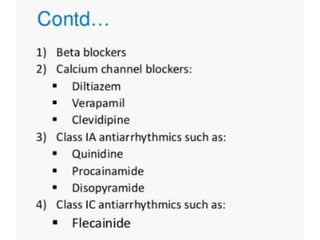
Negative inotropic agents
• Decrease myocardial contractility,and are used to
decrease cardiac workload in conditions such as
angina.
• While negative iontropism may precipitate or
exacerbate heart failure, certain beta
blockers(eg:carvedilol,metaprolol) have been
believed to reduce morbidity and mortality in
congestive heart failure.
Calcium channel blockers
• It dilate vascular smooth muscle and reduce heart
muscle contractility, and some agents block AV
nodal conduction.
• CCB are used to reduce peripheral vascular
resistance, decrease blood pressure, block coronary
spasm, and increase coronary blood flow.
• diltiazem, 30 to 60 mg orally, 10 mg IV
• verapamil, 120 mg orally, 2.5 to 5 mg IV
Catecholamines
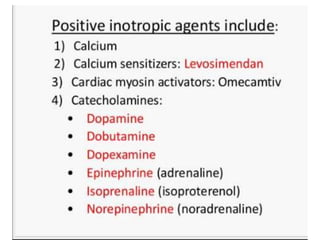
• Dopamine,epinephrine & norepinephrine are
endogenous.
• Dobutamine & isoproterenol are synthetic
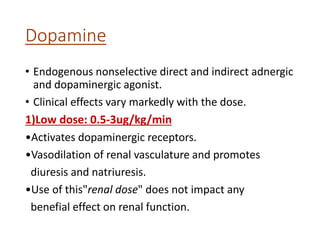
Dopamine
• Endogenous nonselective direct and indirect adnergic
and dopaminergic agonist.
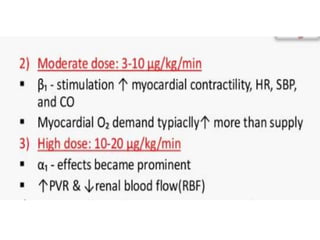
• Clinical effects vary markedly with the dose.
1)Low dose: 0.5-3ug/kg/min
•Activates dopaminergic receptors.
•Vasodilation of renal vasculature and promotes
diuresis and natriuresis.
•Use of this"renal dose" does not impact any
benefial effect on renal function.
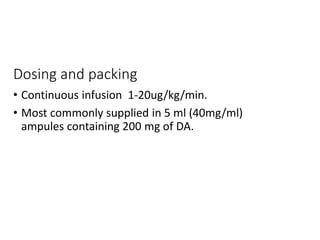
Dosing and packing
• Continuous infusion 1-20ug/kg/min.
• Most commonly supplied in 5 ml (40mg/ml)
ampules containing 200 mg of DA.
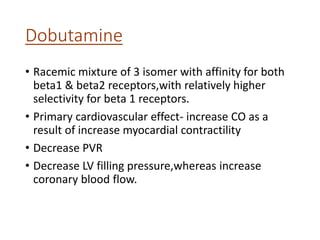
Dobutamine
• Racemic mixture of 3 isomer with affinity for both
beta1 & beta2 receptors,with relatively higher
selectivity for beta 1 receptors.
• Primary cardiovascular effect- increase CO as a
result of increase myocardial contractility
• Decrease PVR
• Decrease LV filling pressure,whereas increase
coronary blood flow.
• Dobutamine is a choice for patients with the
combination of CHF & CAD,particularly if PVR is
elevated.

• Used in low CO states and CHF
eg:myocarditis,cardiomyopathy,MI
•If BP adequate can be combined with afterload
reducer(nitroprusside or ACE inhibitor)
Dosing & packing
• Infusion @ 2-20 ug/kg/min
• Supplied in 5 ml (50mg/ml)ampules containing 250
mg.
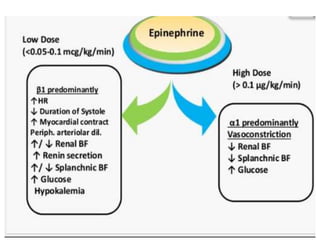
Epinephrine(adrenaline)
• Endogenous catecholamine synthesized in the
adrenal medulla.
• Direct stimulation of beta 1 receptors of the
myocardium cause increase in BP,CO & myocardial
O2 demand by increase contractility and HR.
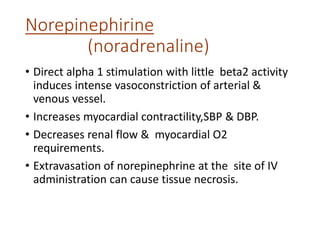
Norepinephirine
(noradrenaline)
• Direct alpha 1 stimulation with little beta2 activity
induces intense vasoconstriction of arterial &
venous vessel.
• Increases myocardial contractility,SBP & DBP.
• Decreases renal flow & myocardial O2
requirements.
• Extravasation of norepinephrine at the site of IV
administration can cause tissue necrosis.
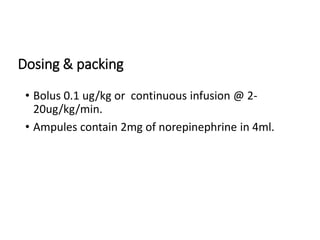
Dosing & packing
• Bolus 0.1 ug/kg or continuous infusion @ 2-
20ug/kg/min.
• Ampules contain 2mg of norepinephrine in 4ml.
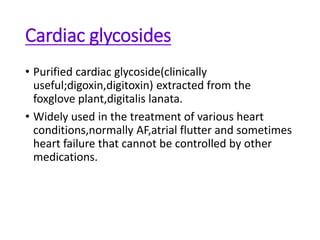
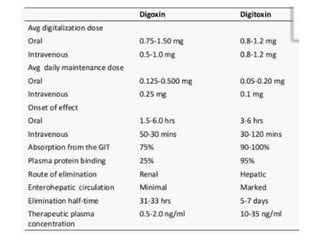
Cardiac glycosides
• Purified cardiac glycoside(clinically
useful;digoxin,digitoxin) extracted from the
foxglove plant,digitalis lanata.
• Widely used in the treatment of various heart
conditions,normally AF,atrial flutter and sometimes
heart failure that cannot be controlled by other
medications.
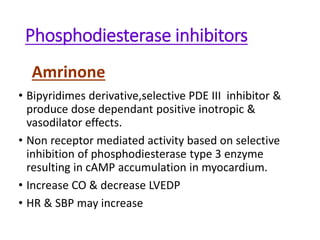
Phosphodiesterase inhibitors
• Bipyridimes derivative,selective PDE III inhibitor &
produce dose dependant positive inotropic &
vasodilator effects.
• Non receptor mediated activity based on selective
inhibition of phosphodiesterase type 3 enzyme
resulting in cAMP accumulation in myocardium.
• Increase CO & decrease LVEDP
• HR & SBP may increase
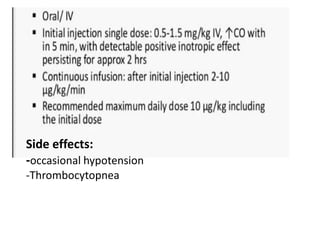
Amrinone
Side effects:
-occasional hypotension
-Thrombocytopnea
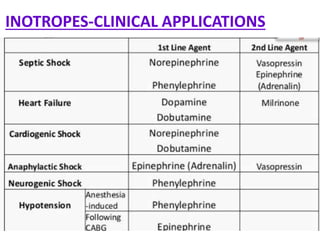
INOTROPES-CLINICAL APPLICATIONS
EMERGENCY DRUGS
Antiplatelate Agents
1)Cyclooxygenase inhibitors - (Asprin)
2)Platelet P2Y¹² ADP receptorantagonist-
(Ticlopidine,clopidogrel,prasugrel,ticagrelor)
3) Glycoprotein Gbll/llla inhibitors.
*Administration and combinations of
antiplatelet drugs is common weighing the
risk of bleeding against benefit of preventing
stent thrombosis.
• Asprin dosingof 75 -325 mg once daily...Clopidogrel
Dosing is commonly a load (300 or 600 mg)
followed by 75 mg daily.
• Prasugrel should not used when the patient with
previous stork or TIA due to exceeive
haemorrhage. Mean steady-state inhibition of
platelet aggregation was about 70% following 3 to
5 days of dosing at 10 mg daily after a 60 mg
loading dose.
• The loading dose is 180 mg PO
• Ticagrelor the loading dose is 180 mg PO(two 90
mg) and then 90mg PO twice daily.
Intravenous antiplatelet agents
• These are more most effective agents because they
inhibit platelet activation at a final common
receptor,the Gb llb/llla receptor.Because of the IV
only administration, these agents are limited to
intra-and post PCI procedure periods.
• Abciximab(reopro)
• Eptifibatide
• Tirofiban
Anticoagulation
HEPARIN
.For routine diagnostic procedure from the radial
approach some suggest 40 to 70 U/kg.
WARFARIN
.While warfarin is not given in catheterization
laboratory,the management of patient receiving
warfarin undergoing cardiac catheterization is a
common problem because of the increased risk of
procedural related bleeding.
.Cardiac catheterization should not proceed until the
INR is< 1.8
BIVALIRUDIN
• For patient at risk for heparin -induced
thrombocytopenia,bivalirudin preferred
anticoagulant.
• Dosing recommendations for ACS procedures:
Administer bolus 0.75 mg/kg with infusion of 1.75
mg/kg/hr.
Coronary vasodilators
• Nitroglycerin
• Nitroglycerin dilates both the coronary and peripheral arteries
as well as the venous beds.
• Intracoronary nitroglycerin in doses of 50, 100, and 200 mcg
modestly increases coronary blood flow without a marked
reduction in pressure.
• With doses of more than 250 mcg, hypotension without
further increases in coronary blood flow may be evident.
• Care should be used to avoid inducing hypotension when
administering nitroglycerin to patients with known or
suspected severe aortic stenosis, significant (LMCA) narrowing,
or HOCM
Adenosine
• Adenosine IV is used for SVT and is the drug of
choice for intracoronary induction of maximal
hyperemia for coronary vasodilator reserve.
• For SVT, doses of 6 to 12 mg IV bolus are commonly
used.
Nitroprusside
• Nitroprusside is a potent, short-acting IV arterial
vasodilator used to
• treat AS,MR,hypertensive crisis, and CHF. Doses
administered range from 10 to 100 ug/min and
must be monitored by direct arterial pressure
measurement.
• For coronary no-reflow or for induction of
intracoronary hyperemia when adenosine is not
available, a 50- to 100-g bolus of nitroprusside can
be used and repeated as needed.
Anticholinergic for vagal reactions
Atropine
.Atropine is used to block vagally induced slowing of
the heart rate and hypotension.
IV doses of 0.6 to 1.2 mg can be given immediately
and reverse bradycardia and hypotension with in 2
minuts.
Antiarrhythmic Drugs
•Lidocaine
•Amiodarone
Thankyou

Inotropics-1 new.pptx

  • 1.
  • 2.
    Inotropes • Drugs thataffect the strenght of contraction of heart muscle(myocardial contractility). • Positive inotropic agents increase strength of muscular contraction. • Negative inotropic agents weaken the force of muscular contraction. • Term "inotrope" generally used to describe positive effect.
  • 3.
    Positive inotropic agents •Increase myocardial contractility. • Used to support cardiac function in conditions such as; a)Decomponsated HF b)Cardiogenic shock c)Septic shock d)MI e)Cardiomyopathy
  • 5.
    Negative inotropic agents •Decrease myocardial contractility,and are used to decrease cardiac workload in conditions such as angina. • While negative iontropism may precipitate or exacerbate heart failure, certain beta blockers(eg:carvedilol,metaprolol) have been believed to reduce morbidity and mortality in congestive heart failure.
  • 7.
    Calcium channel blockers •It dilate vascular smooth muscle and reduce heart muscle contractility, and some agents block AV nodal conduction. • CCB are used to reduce peripheral vascular resistance, decrease blood pressure, block coronary spasm, and increase coronary blood flow. • diltiazem, 30 to 60 mg orally, 10 mg IV • verapamil, 120 mg orally, 2.5 to 5 mg IV
  • 8.
    Catecholamines • Dopamine,epinephrine &norepinephrine are endogenous. • Dobutamine & isoproterenol are synthetic
  • 9.
    Dopamine • Endogenous nonselectivedirect and indirect adnergic and dopaminergic agonist. • Clinical effects vary markedly with the dose. 1)Low dose: 0.5-3ug/kg/min •Activates dopaminergic receptors. •Vasodilation of renal vasculature and promotes diuresis and natriuresis. •Use of this"renal dose" does not impact any benefial effect on renal function.
  • 11.
    Dosing and packing •Continuous infusion 1-20ug/kg/min. • Most commonly supplied in 5 ml (40mg/ml) ampules containing 200 mg of DA.
  • 12.
    Dobutamine • Racemic mixtureof 3 isomer with affinity for both beta1 & beta2 receptors,with relatively higher selectivity for beta 1 receptors. • Primary cardiovascular effect- increase CO as a result of increase myocardial contractility • Decrease PVR • Decrease LV filling pressure,whereas increase coronary blood flow.
  • 13.
    • Dobutamine isa choice for patients with the combination of CHF & CAD,particularly if PVR is elevated. • Used in low CO states and CHF eg:myocarditis,cardiomyopathy,MI •If BP adequate can be combined with afterload reducer(nitroprusside or ACE inhibitor)
  • 14.
    Dosing & packing •Infusion @ 2-20 ug/kg/min • Supplied in 5 ml (50mg/ml)ampules containing 250 mg.
  • 15.
    Epinephrine(adrenaline) • Endogenous catecholaminesynthesized in the adrenal medulla. • Direct stimulation of beta 1 receptors of the myocardium cause increase in BP,CO & myocardial O2 demand by increase contractility and HR.
  • 17.
    Norepinephirine (noradrenaline) • Direct alpha1 stimulation with little beta2 activity induces intense vasoconstriction of arterial & venous vessel. • Increases myocardial contractility,SBP & DBP. • Decreases renal flow & myocardial O2 requirements. • Extravasation of norepinephrine at the site of IV administration can cause tissue necrosis.
  • 18.
    Dosing & packing •Bolus 0.1 ug/kg or continuous infusion @ 2- 20ug/kg/min. • Ampules contain 2mg of norepinephrine in 4ml.
  • 19.
    Cardiac glycosides • Purifiedcardiac glycoside(clinically useful;digoxin,digitoxin) extracted from the foxglove plant,digitalis lanata. • Widely used in the treatment of various heart conditions,normally AF,atrial flutter and sometimes heart failure that cannot be controlled by other medications.
  • 21.
    Phosphodiesterase inhibitors • Bipyridimesderivative,selective PDE III inhibitor & produce dose dependant positive inotropic & vasodilator effects. • Non receptor mediated activity based on selective inhibition of phosphodiesterase type 3 enzyme resulting in cAMP accumulation in myocardium. • Increase CO & decrease LVEDP • HR & SBP may increase Amrinone
  • 22.
  • 23.
  • 24.
  • 25.
    Antiplatelate Agents 1)Cyclooxygenase inhibitors- (Asprin) 2)Platelet P2Y¹² ADP receptorantagonist- (Ticlopidine,clopidogrel,prasugrel,ticagrelor) 3) Glycoprotein Gbll/llla inhibitors.
  • 26.
    *Administration and combinationsof antiplatelet drugs is common weighing the risk of bleeding against benefit of preventing stent thrombosis.
  • 27.
    • Asprin dosingof75 -325 mg once daily...Clopidogrel Dosing is commonly a load (300 or 600 mg) followed by 75 mg daily. • Prasugrel should not used when the patient with previous stork or TIA due to exceeive haemorrhage. Mean steady-state inhibition of platelet aggregation was about 70% following 3 to 5 days of dosing at 10 mg daily after a 60 mg loading dose. • The loading dose is 180 mg PO
  • 28.
    • Ticagrelor theloading dose is 180 mg PO(two 90 mg) and then 90mg PO twice daily.
  • 29.
    Intravenous antiplatelet agents •These are more most effective agents because they inhibit platelet activation at a final common receptor,the Gb llb/llla receptor.Because of the IV only administration, these agents are limited to intra-and post PCI procedure periods. • Abciximab(reopro) • Eptifibatide • Tirofiban
  • 30.
    Anticoagulation HEPARIN .For routine diagnosticprocedure from the radial approach some suggest 40 to 70 U/kg. WARFARIN .While warfarin is not given in catheterization laboratory,the management of patient receiving warfarin undergoing cardiac catheterization is a common problem because of the increased risk of procedural related bleeding. .Cardiac catheterization should not proceed until the INR is< 1.8
  • 31.
    BIVALIRUDIN • For patientat risk for heparin -induced thrombocytopenia,bivalirudin preferred anticoagulant. • Dosing recommendations for ACS procedures: Administer bolus 0.75 mg/kg with infusion of 1.75 mg/kg/hr.
  • 32.
    Coronary vasodilators • Nitroglycerin •Nitroglycerin dilates both the coronary and peripheral arteries as well as the venous beds. • Intracoronary nitroglycerin in doses of 50, 100, and 200 mcg modestly increases coronary blood flow without a marked reduction in pressure. • With doses of more than 250 mcg, hypotension without further increases in coronary blood flow may be evident. • Care should be used to avoid inducing hypotension when administering nitroglycerin to patients with known or suspected severe aortic stenosis, significant (LMCA) narrowing, or HOCM
  • 33.
    Adenosine • Adenosine IVis used for SVT and is the drug of choice for intracoronary induction of maximal hyperemia for coronary vasodilator reserve. • For SVT, doses of 6 to 12 mg IV bolus are commonly used.
  • 34.
    Nitroprusside • Nitroprusside isa potent, short-acting IV arterial vasodilator used to • treat AS,MR,hypertensive crisis, and CHF. Doses administered range from 10 to 100 ug/min and must be monitored by direct arterial pressure measurement. • For coronary no-reflow or for induction of intracoronary hyperemia when adenosine is not available, a 50- to 100-g bolus of nitroprusside can be used and repeated as needed.
  • 35.
    Anticholinergic for vagalreactions Atropine .Atropine is used to block vagally induced slowing of the heart rate and hypotension. IV doses of 0.6 to 1.2 mg can be given immediately and reverse bradycardia and hypotension with in 2 minuts.
  • 36.
  • 37.