Adaptation to climate Change
 The experiences of Practical Action/
               Sudan
         Darfur Program
        Kenya June 2010
Practical Action Vision
  Practical Action's Vision is of a sustainable world
  free of poverty and injustice in which technology is
               used for the benefit of all.

Practical Action Mission
“To use technology to challenge poverty by:
  • building the capabilities of poor people,
  • improving their access to technical options and
    knowledge, and
  • working with them to influence social, economic and
    institutional systems for innovation and the use of
    technology”.
Strategic fit
• Practical Action operates under four strategic
  objectives:
  – Vulnerability reduction :
     • Coping with the risk if natural and complex hazards,
       including climate change
     • Natural Resource Management
     • Food security
  – Markets and livelihoods
     • Actors, access, diversification of products/services,
  – Infrastructure services
     • WATSAN, energy, shelter, transport - livelihoods
  – New Technologies
Practical Action Climate Change Programme

• Run a programme of work that helps poor people to
  adapt and which helps us develop models of
  excellence in adaptation.
• Use our experience and knowledge to promote best
  practice seeking to influence other development
  practitioners, donors and decision-makers to ensure
  that all development work is „climate proofed‟.
• Persuade decision makers and donors to urgently
  adopt more ambitious targets for mitigation and give
  more support to help poor women and men to adapt.
• Reduce the carbon footprint of our own organization
  and its work.
Practical Action Climate Change Programme

1. Enhance our knowledge and understanding of the
   actual and likely effects of climate change upon the
   people we are working with, the impact upon their
   lives and livelihoods
2. Understanding of what our programme will contribute
   to enabling people to adapt to climate change
3. What our work will do to reduce greenhouse gas
   emissions
4. Identifying which issues Practical Action will engage
   on nationally and what will be contributed to the
   organisation‟s global policy agenda
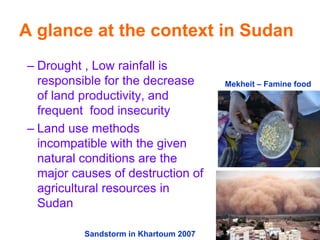
A glance at the context in Sudan
– Drought , Low rainfall is
  responsible for the decrease         Mekheit – Famine food
  of land productivity, and
  frequent food insecurity
– Land use methods
  incompatible with the given
  natural conditions are the
  major causes of destruction of
  agricultural resources in
  Sudan

          Sandstorm in Khartoum 2007
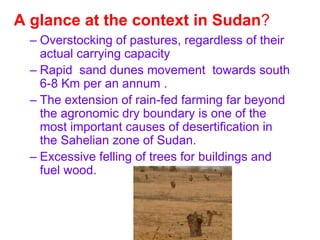
A glance at the context in Sudan?
  – Overstocking of pastures, regardless of their
    actual carrying capacity
  – Rapid sand dunes movement towards south
    6-8 Km per an annum .
  – The extension of rain-fed farming far beyond
    the agronomic dry boundary is one of the
    most important causes of desertification in
    the Sahelian zone of Sudan.
  – Excessive felling of trees for buildings and
    fuel wood.
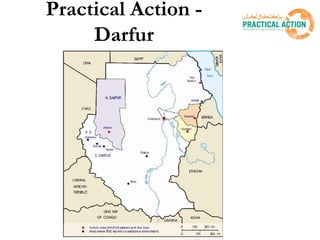
Practical Action -
     Darfur
N.Darfur Introduction
• Location: Western Sudan.
• Area:192,000 square km.
• General characterized: by remoteness,
  isolation lack of infrastructure and
  services, the state identified as one of
  the poorest among 26 states of Sudan.
• Population: 1,8 m (2009 census).
  Growth rate 4.9 %
• Climatically:lies on the Southern edges
  of the Sahara desert and fall within the
  arid of Sahara desert zone of Africa.
• Rainfall: not exceed 300mm annum.
Community Adaptation
   interventions
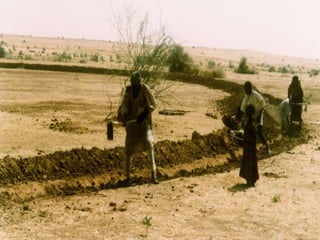
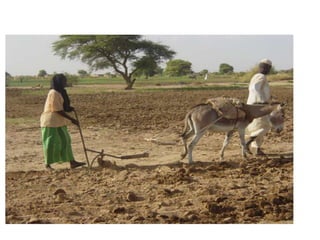
Terraces and animal traction

– To retain as much of the rain that does
  fall in the target area or upstream
– Communities are trained to decide on
  slopes and construct the terraces
  (VEAs)
– It generates helps farmers grow crops
  even if rains fall away from farm areas
  but drained by wadis from upstream
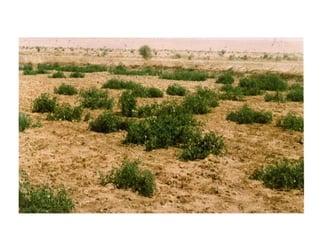
– It continue producing diversified crops
  for 6 months after the rainy season,
  plough and terraces seen every where
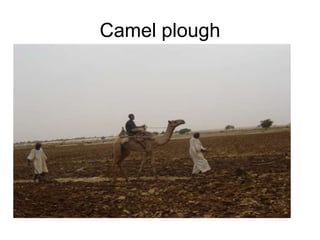
Camel plough
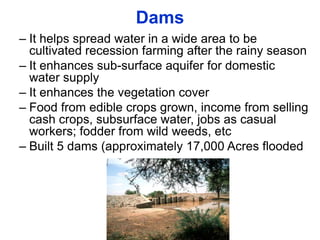
Dams
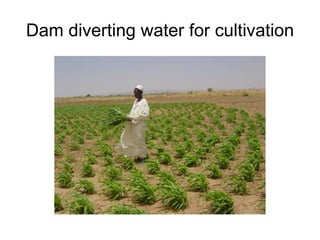
– It helps spread water in a wide area to be
  cultivated recession farming after the rainy season
– It enhances sub-surface aquifer for domestic
  water supply
– It enhances the vegetation cover
– Food from edible crops grown, income from selling
  cash crops, subsurface water, jobs as casual
  workers; fodder from wild weeds, etc
– Built 5 dams (approximately 17,000 Acres flooded
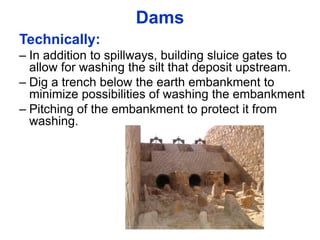
Dams
Technically:
– In addition to spillways, building sluice gates to
  allow for washing the silt that deposit upstream.
– Dig a trench below the earth embankment to
  minimize possibilities of washing the embankment
– Pitching of the embankment to protect it from
  washing.
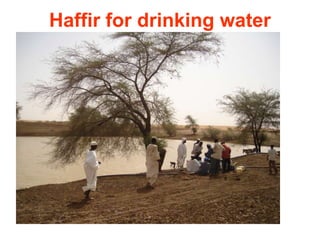
Haffir for drinking water
Dam diverting water for cultivation
Enhancing the vegetation cover

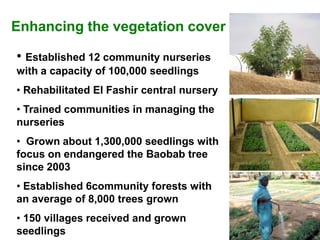
• Established 12 community nurseries
with a capacity of 100,000 seedlings
• Rehabilitated El Fashir central nursery
• Trained communities in managing the
nurseries
• Grown about 1,300,000 seedlings with
focus on endangered the Baobab tree
since 2003
• Established 6community forests with
an average of 8,000 trees grown
• 150 villages received and grown
seedlings
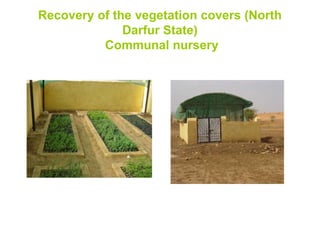
Recovery of the vegetation covers (North
              Darfur State)
          Communal nursery
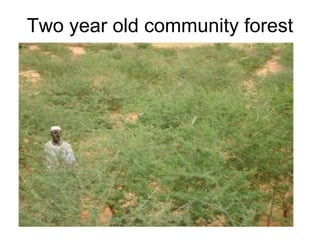
Two year old community forest
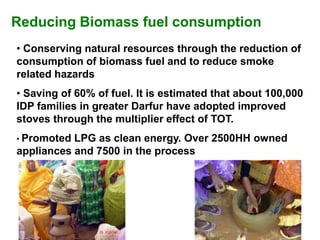
Reducing Biomass fuel consumption
• Conserving natural resources through the reduction of
consumption of biomass fuel and to reduce smoke
related hazards
• Saving of 60% of fuel. It is estimated that about 100,000
IDP families in greater Darfur have adopted improved
stoves through the multiplier effect of TOT.
• Promoted LPG as clean energy. Over 2500HH owned
appliances and 7500 in the process
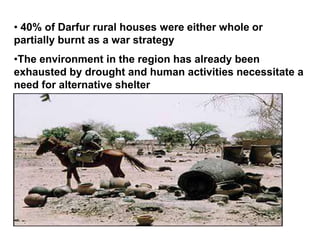
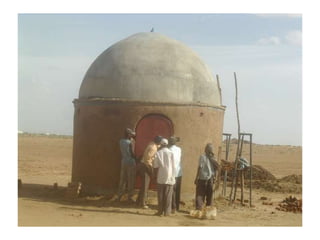
• 40% of Darfur rural houses were either whole or
partially burnt as a war strategy
•The environment in the region has already been
exhausted by drought and human activities necessitate a
need for alternative shelter
2010 plan
• Contribute to strengthening partners who are
  involved in adaptations initiatives (Capacity building)
• Build local communities capacities to contribute to
  collection of local metrological data (e.g. rain gages)
• Production of knowledge items (booklet, banners,
  video films & posters).
• Selected best community adaptation practices for
  documentation and disseminations
• Scale up successful adaptation practices through
  influencing partners and donors
• Use local media for environmental awareness
  message

Adaptation in sudan practical action - regional consultation

  • 1.
    Adaptation to climateChange The experiences of Practical Action/ Sudan Darfur Program Kenya June 2010
  • 2.
    Practical Action Vision Practical Action's Vision is of a sustainable world free of poverty and injustice in which technology is used for the benefit of all. Practical Action Mission “To use technology to challenge poverty by: • building the capabilities of poor people, • improving their access to technical options and knowledge, and • working with them to influence social, economic and institutional systems for innovation and the use of technology”.
  • 3.
    Strategic fit • PracticalAction operates under four strategic objectives: – Vulnerability reduction : • Coping with the risk if natural and complex hazards, including climate change • Natural Resource Management • Food security – Markets and livelihoods • Actors, access, diversification of products/services, – Infrastructure services • WATSAN, energy, shelter, transport - livelihoods – New Technologies
  • 4.
    Practical Action ClimateChange Programme • Run a programme of work that helps poor people to adapt and which helps us develop models of excellence in adaptation. • Use our experience and knowledge to promote best practice seeking to influence other development practitioners, donors and decision-makers to ensure that all development work is „climate proofed‟. • Persuade decision makers and donors to urgently adopt more ambitious targets for mitigation and give more support to help poor women and men to adapt. • Reduce the carbon footprint of our own organization and its work.
  • 5.
    Practical Action ClimateChange Programme 1. Enhance our knowledge and understanding of the actual and likely effects of climate change upon the people we are working with, the impact upon their lives and livelihoods 2. Understanding of what our programme will contribute to enabling people to adapt to climate change 3. What our work will do to reduce greenhouse gas emissions 4. Identifying which issues Practical Action will engage on nationally and what will be contributed to the organisation‟s global policy agenda
  • 6.
    A glance atthe context in Sudan – Drought , Low rainfall is responsible for the decrease Mekheit – Famine food of land productivity, and frequent food insecurity – Land use methods incompatible with the given natural conditions are the major causes of destruction of agricultural resources in Sudan Sandstorm in Khartoum 2007
  • 7.
    A glance atthe context in Sudan? – Overstocking of pastures, regardless of their actual carrying capacity – Rapid sand dunes movement towards south 6-8 Km per an annum . – The extension of rain-fed farming far beyond the agronomic dry boundary is one of the most important causes of desertification in the Sahelian zone of Sudan. – Excessive felling of trees for buildings and fuel wood.
  • 8.
  • 9.
    N.Darfur Introduction • Location:Western Sudan. • Area:192,000 square km. • General characterized: by remoteness, isolation lack of infrastructure and services, the state identified as one of the poorest among 26 states of Sudan. • Population: 1,8 m (2009 census). Growth rate 4.9 % • Climatically:lies on the Southern edges of the Sahara desert and fall within the arid of Sahara desert zone of Africa. • Rainfall: not exceed 300mm annum.
  • 10.
    Community Adaptation interventions
  • 11.
    Terraces and animaltraction – To retain as much of the rain that does fall in the target area or upstream – Communities are trained to decide on slopes and construct the terraces (VEAs) – It generates helps farmers grow crops even if rains fall away from farm areas but drained by wadis from upstream – It continue producing diversified crops for 6 months after the rainy season, plough and terraces seen every where
  • 15.
  • 16.
    Dams – It helpsspread water in a wide area to be cultivated recession farming after the rainy season – It enhances sub-surface aquifer for domestic water supply – It enhances the vegetation cover – Food from edible crops grown, income from selling cash crops, subsurface water, jobs as casual workers; fodder from wild weeds, etc – Built 5 dams (approximately 17,000 Acres flooded
  • 17.
    Dams Technically: – In additionto spillways, building sluice gates to allow for washing the silt that deposit upstream. – Dig a trench below the earth embankment to minimize possibilities of washing the embankment – Pitching of the embankment to protect it from washing.
  • 18.
  • 19.
    Dam diverting waterfor cultivation
  • 20.
    Enhancing the vegetationcover • Established 12 community nurseries with a capacity of 100,000 seedlings • Rehabilitated El Fashir central nursery • Trained communities in managing the nurseries • Grown about 1,300,000 seedlings with focus on endangered the Baobab tree since 2003 • Established 6community forests with an average of 8,000 trees grown • 150 villages received and grown seedlings
  • 21.
    Recovery of thevegetation covers (North Darfur State) Communal nursery
  • 22.
    Two year oldcommunity forest
  • 23.
    Reducing Biomass fuelconsumption • Conserving natural resources through the reduction of consumption of biomass fuel and to reduce smoke related hazards • Saving of 60% of fuel. It is estimated that about 100,000 IDP families in greater Darfur have adopted improved stoves through the multiplier effect of TOT. • Promoted LPG as clean energy. Over 2500HH owned appliances and 7500 in the process
  • 25.
    • 40% ofDarfur rural houses were either whole or partially burnt as a war strategy •The environment in the region has already been exhausted by drought and human activities necessitate a need for alternative shelter
  • 27.
    2010 plan • Contributeto strengthening partners who are involved in adaptations initiatives (Capacity building) • Build local communities capacities to contribute to collection of local metrological data (e.g. rain gages) • Production of knowledge items (booklet, banners, video films & posters). • Selected best community adaptation practices for documentation and disseminations • Scale up successful adaptation practices through influencing partners and donors • Use local media for environmental awareness message