Africa – Up in smoke?
      The second report from
the Working Group on Climate
    Change and Development
Contents


                             Foreword                                          1


                             Introduction, summary and recommendations         2


                             Food, farming and the environment                 6
Photo: Jim Loring/Tearfund


                             Water, drought and the changing rains            13


                             Health                                           18


                             Energy                                           20


                             Disasters                                        25


                             Gender                                           29


                             Migration                                        30


                             Conflict                                         32


                             Official development policy and climate change   34


                             Endnotes                                         37
Foreword

“The world’s wealthiest countries have emitted more than their fair share of greenhouse gases. Resultant floods, droughts
and other climate change impacts continue to fall disproportionately on the world's poorest people and countries, many
of which are in Africa.”


I am delighted that such a broad group of environment and development
organisations, many of which are faith based, have come together to speak with a
common voice, drawing attention to climate change in the African context. It is
well known that climate change will have particularly devastating effects on Africa.
Indeed, case studies in this report suggest that this is already happening. But this
report also shows the strength and creativity of African people in times of stress.
What is needed most now is that Africans are supported in their efforts to build
on these strengths.

The UK Prime Minister Tony Blair’s stated commitment to tackling climate change
and helping Africa is most welcome. It is important to understand that Africa and
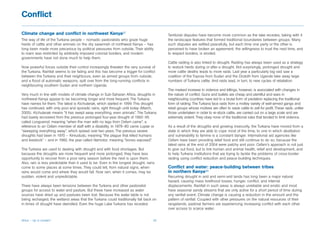
climate change are intrinsically linked, as climate change will affect the welfare of
Africans for years to come. Africans look forward to seeing some firm outcomes
from these commitments during Blair’s presidency of the G8 and the European
Union. Words will not be enough. The richest countries of the world, as
represented by the G8, have a responsibility to help the poorest. This is not just
charity, but a moral obligation. The world’s wealthiest countries have emitted more
than their fair share of greenhouse gases. Resultant floods, droughts and other
climate change impacts continue to fall disproportionately on the world's poorest
people and countries, many of which are in Africa.

Rich countries must therefore helper poorer countries in two ways. They must
reduce their greenhouse gas emissions so that the effects of climate change
suffered by Africa’s poor do not get worse. They also have an obligation to help
poor countries adapt to the negative impacts of climate change, which cannot be
avoided.

Archbishop Desmond Tutu


Africa – Up in smoke?                                                              1
Executive summary and recommendations

Africa – a special case for climate change                                                constitute an obstacle to a definitive break with certain degrees and patterns of
Global warming is already affecting Africa.1 The Intergovernmental Panel on               poverty. Therefore, measures aimed at managing these risks are of the utmost
Climate Change (IPCC) predicts that, “the effects of climate change are expected          importance.” More generally, the environment action plan of the New Partnership
to be greatest in developing countries in terms of loss of life and relative effects on   for Africa’s Development (NEPAD) observes, “Natural disasters… cause
investment and economy.” It describes Africa, the world’s poorest region, as “the         considerable human suffering and economic damage in the continent.” And quite
continent most vulnerable to the impacts of projected change because                      recently, governments agreed at the World Conference on Disaster Reduction in
widespread poverty limits adaptation capabilities”.2                                      January 2005 that, “Disasters in Africa pose a major obstacle to the African
                                                                                          continent’s efforts to achieve sustainable development.”5
Small-scale farming provides most of the food produced in Africa, as well as
employment for 70 per cent of working people.3 These simple facts, coupled with           Unfortunately, even this level of awareness is not the same as having a coherent
farming being overwhelmingly dependent on direct rainfall, mean that Africa is            and adequately funded approach to tackling the problem.
exceptionally vulnerable to the uncertainties and weather extremes of global
warming.                                                                                  Recently the role of developing new technology has been strongly emphasised. In
                                                                                          particular, governments have focused on how to improve weather forecasting in
But a vulnerable agricultural system is not the only problem. The continent is more       Africa. There is a consensus among development groups, however, that a greater
exposed to the impacts of climate change than many other regions in the world.4           and more urgent challenge is strengthening communities from the bottom-up, and
Its high sensitivity to climate is exacerbated by other factors such as widespread        building on their own coping strategies to live with global warming. The need to
poverty, recurrent droughts and floods, an immediate daily dependence on natural          give much more support to small-scale farming comes up again and again from
resources and biodiversity, a heavy disease burden, and the numerous conflicts            the field experience of development groups, along with the priority for access to
that have engulfed the continent. There are further complications introduced by an        energy from sustainable sources.
unjust international trade system and the burden of unpayable debt.
                                                                                          We believe it is not necessary to wait years for more research on climate change
All these factors call for a new model of development in which strategies to              before investing in disaster risk reduction. Governments have agreed on the need
increase human resilience in the face of climate change and the stability of              for action, and tools and methods for protecting communities from disasters are
ecosystems are central. It calls for a new test on every policy and project, in which     well developed. Now they need to be employed immediately in African countries
the key question will be, “Are you increasing or decreasing people’s vulnerability to     and communities on a much greater scale.
the climate?”
                                                                                          At the moment, spending priorities are perverse. For every $1 spent on preparing
Above all, the challenge calls for a new flexibility and not a one-size-fits-all, neo-    for disaster, a further $7 is saved in the cost of recovering from it. Yet, as in the
liberal-driven approach to development. As this Report observes, just as an               case of Mozambique, requests for resources to prepare for disasters before the
investment portfolio spreads risk by including a variety of stocks and shares, so an      great floods went seriously under-funded, leaving a huge disaster-relief bill to be
agricultural system geared to manage the risks of changing climate requires a rich        paid after the floods.
diversity of approaches in terms of what is grown, and how it is grown.
                                                                                          This Report finds that concerns about the effects of climate change on rural
But, even where the links to climate change are under-appreciated, Africa is a            African societies are more than justified. Climate change is happening, and it is
continent only too aware of the threat of ‘natural’ disasters and the obstacles they      affecting livelihoods that depend on the natural environment, which, in Africa,
pose to poverty reduction. Mozambique hit world headlines at the beginning of the         means nearly everyone. However, even without adequate support, far from being
new Millennium when it was hit by floods on a biblical scale. Now, its Action Plan        passive victims, people recognise even small changes in climate, and are taking
for the Reduction of Absolute Poverty 2001–2005 states: “Natural disasters…               steps to respond to them.


Africa – Up in smoke?                                                                2
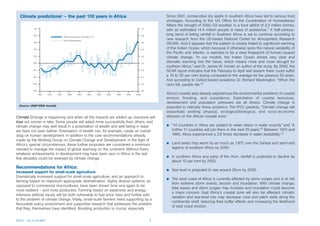
Climate predictions6 – the past 100 years in Africa                                     Since 2001, consecutive dry spells in southern Africa have led to serious food
                                                                                          shortages. According to the UN Office for the Coordination of Humanitarian
                                                                                          Affairs the drought of 2002–03 resulted, in a food deficit of 3.3 million tonnes,
                                                                                          with an estimated 14.4 million people in need of assistance.7 A half-century-
                                                                                          long trend of failing rainfall in Southern Africa is set to continue according to
                                                                                          new research from the US-based National Center for Atmospheric Research
                                                                                          (NCAR). And it appears that the pattern is closely linked to significant warming
                                                                                          of the Indian Ocean, which because it otherwise lacks the natural variability of
                                                                                          the Pacific and Atlantic, is reported to be a clear fingerprint of human-caused
                                                                                          climate change. “In our models, the Indian Ocean shows very clear and
                                                                                          dramatic warming into the future, which means more and more drought for
                                                                                          southern Africa,” said Dr. James W. Hurrell, an author of the study. By 2050, the
                                                                                          NCAR report indicates that the February-to-April wet season there could suffer
                                                                                          a 10 to 20 per cent drying compared to the average for the previous 50 years.
                                                                                          And according to Oxford-based academic Dr. Richard Washington, “When the
                                                                                          rains fail, people die.”8

                                                                                          Africa’s coastal area already experiences the environmental problems of coastal
                                                                                          erosion, flooding, and subsidence. Exploitation of coastal resources,
                                                                                          development and population pressures are all drivers. Climate change is
  (Source: UNEP/GRID Arendal)
                                                                                          expected to intensify these problems. The IPCC predicts, “Climate change will
                                                                                          exacerbate existing physical, ecological/biological, and socio-economic
Climate Change is happening and when all the impacts are added up, everyone will          stresses on the African coastal zone.”
lose out sooner or later. Some people will adapt more successfully than others, and
climate change may well result in a polarisation of wealth and well-being in ways         b   “14 countries in Africa are subject to water stress or water scarcity” and “A
we have not seen before. Polarisation of wealth can, for example, create an overall           further 11 countries will join them in the next 25 years.”9 Between 1970 and
drag on human development. In addition to the core recommendations already                    1995, Africa experienced a 2.8 times decrease in water availability.10
made by the Working Group on Climate Change and Development, in the light of
Africa’s special circumstances, these further proposals are considered a minimum          b   Land areas may warm by as much as 1.6ºC over the Sahara and semi-arid
needed to manage the impact of global warming on the continent. Without them,                 regions of southern Africa by 2050.
whatever achievements in development may have been won in Africa in the last
few decades could be reversed by climate change.                                          b   In southern Africa and parts of the Horn, rainfall is projected to decline by
                                                                                              about 10 per cent by 2050.
Recommendations for Africa:
                                                                                          b   Sea level is projected to rise around 25cm by 2050.
Increased support for small-scale agriculture:
Dramatically increased support for small-scale agriculture, and an approach to
                                                                                          b   The west coast of Africa is currently affected by storm surges and is at risk
farming based on maximum appropriate diversification. Highly diverse systems, as
                                                                                              from extreme storm events, erosion and inundation. With climate change,
opposed to commercial monocultures, have been shown time and again to be
                                                                                              tidal waves and storm surges may increase and inundation could become
more resilient – and more productive. Farming based on expensive and energy-
                                                                                              a major concern. East Africa’s coastal zone will also be affected: climatic
intensive artificial inputs will be both vulnerable to fuel price rises and further add
                                                                                              variation and sea-level rise may decrease coral and patch reefs along the
to the problem of climate change. Vitally, small-scale farmers need supporting by a
                                                                                              continental shelf, reducing their buffer effects and increasing the likelihood
favourable policy environment and supportive research that addresses the problem
                                                                                              of east coast erosion.
that they, themselves have identified. Boosting production is crucial, especially


Africa – Up in smoke?                                                                3
because of the enormous burden of HIV/AIDS, and doing so requires systems that           immediate benefits that stretch beyond just tackling climate-driven disasters. Later
combine new insights and technologies with the wisdom of tradition.                      on in this Report, we make several detailed recommendations on how to do this.
                                                                                         The integration of disaster risk reduction in relief, reconstruction, development
Cut rich country greenhouse gas emissions:                                               programming and poverty reduction plans should now be a priority. In our
Rich countries need to go far beyond their targets for reducing greenhouse gas           experience ‘good adaptation’ also makes ‘good development’.
emissions, set under the Kyoto Protocol. Instead they need to cut emissions to a
level commensurate with halting global warming and so that temperature rise is           Release aid quickly and set targets for local and regional procurement:
kept well below 2°C above pre-industrial levels. Commitments to cut emissions            More efficient systems are needed to ensure that aid is released quickly and that
should be progressively raised up until 2012 in a way that puts countries on track       humanitarian aid is well targeted when disasters strike. To ensure the long-term
to cuts of between 60 and 80 per cent by 2050. In this light, G8 countries should        development benefits of money spent on disasters, there should be targets for
establish a robust policy framework for long-term future action on climate change        local and regional procurement set for governments and agencies. This would help
post 2012. All G8 countries should commit to achieving caps on emissions at a            prevent the leakage of relief money from affected communities.
national level, that are compatible with a fair a global solution that is rooted in
human equality and capable of stopping dangerous climate change.                         Implement existing agreements on environment and development:
                                                                                         The international community specifically should implement the agreement made at
Focus on local needs first:                                                              the World Summit on Sustainable Development (WSSD) to help Africa prepare for,
Africa needs to be freed from a one-size-fits-all development approach. Effective        and mitigate disasters at both a community and national level. This should include, as
responses to climate change will differ everywhere depending on local                    agreed at the WSSD, promoting “…community-based disaster management planning
circumstances, so a new flexibility is needed. The greatest challenge is securing        by local authorities, including through training activities and raising public awareness”.
livelihoods at the local level.
                                                                                         Test whether initiatives are climate proof and climate friendly:
Map likely health impacts:                                                               All policies and programmes should face the test of whether they will leave people
Where health is concerned the challenge to the international community is to help        in Africa more or less vulnerable to the effects of global warming. The test will be:
map the complex impacts of global warming, and ensure that both the resources are        Is this climate friendly and climate proof? At the very latest, in line with the
available to tackle them, and that the development policy framework does not make        recommendation of the Commission for Africa, climate change should be
things worse. For example, as climate change puts stress on scarce water resources,      ‘mainstreamed’ within development policies, planning and activities by 2008.
a dogmatic approach to water privatisation could easily increase the vulnerability of
millions of people in Africa.                                                            New and additional funding:
                                                                                         All funding to help Africa adapt to global warming should be new and additional to
Help Africa leapfrog ‘dirty development’:                                                existing funds, and seen not as aid but as an obligation of the rich countries who
The exploitation of fossil fuels in Africa does little for the development or security   created the problem.
of its people. But the potential for sustainable and renewable energy on the
continent is enormous, and the market, especially in poor communities, is huge. To       The Up in Smoke Agenda
meet people’s need for energy, improve health at the household level, and to help        Up in Smoke?, the first report of the Working Group on Climate Change and
Africa leapfrog ‘dirty development’, international donors and financial institutions     Development, joined the environment and development communities in a united
should switch investment from fossil fuels into promoting access to renewable and        view on the minimum action necessary to deal with the threat of global warming
sustainable energy, remove obstacles to technology transfer, and adopt targets           to human development. This is what it called for in October 2004. If anything, the
and timetables to achieve those objectives.                                              proposals are even more pressing now than they were before.

Support community coping strategies:                                                     The environmental and development community, like the rest of humanity, is faced
Global warming presents a huge challenge to the coherence and coordination of            with three overarching challenges:
aid. For example, donors are focusing strongly on the role of technology. But our
                                                                                         1 How to stop and reverse further global warming.
experience tells us that promoting disaster reduction at the local level by
supporting community coping strategies, is far more effective and yields                 2 How to live with the degree of global warming that cannot be stopped.


Africa – Up in smoke?                                                               4
3 How to design a new model for human progress and development that is
  climate proof and climate friendly and gives everyone a fair share of the natural         Climate change vulnerability in Africa
  resources on which we all depend.

In that light, urgent priorities include:

b   A global risk assessment of the likely costs of adaptation to climate change in
    poor countries.
b   Commensurate new funds and other resources made available by
    industrialised countries for poor country adaptation, bearing in mind that rich
    country subsidies to their domestic, fossil-fuel industries stood at $73 billion
    per year in the late 1990s.
b   Effective and efficient arrangements to respond to the increasing burden of
    climate-related disaster relief.
b   Development models based on risk reduction, incorporating community-driven
    coping strategies in adaptation and disaster preparedness.
b   Disaster awareness campaigns with materials produced at community level
    and made available in local languages.
b   Co-ordinated plans, from local to international levels, for relocating threatened
    communities with appropriate political, legal, and financial resources.

In addition to these, as organisations striving to improve human well-being in the
face of enormous challenges, we will:

b   Work toward a collective understanding of the threat.
b   Share the best of our knowledge about how to build human and ecosystem
    resilience and live with the degree of global warming that is now unstoppable.
b   Do everything in our power to stop dangerous climate change and help bring
    about a global solution that is fair and rooted in human equality.


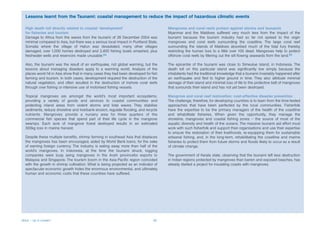
                                                                                            (Sources: UNEP/GRID Arendal/Anna Balance, 2002)


Africa – Up in smoke?                                                                   5
Food, farming and the environment – threats and building resilience

Environment – the foundation of livelihoods11                                             Mozambique: climate change, disruption and renewing rural livelihoods
Africa’s social and economic development is now even more in danger because               Despite civil war and major floods and drought, Mozambique has emerged in the
climate change threatens to undermine the integrity of the continent’s rich but fragile   21st century as a country of progress and possibilities, a flagship of renewal in
ecosystems.12 In Africa, these natural systems form the foundation of the economy         Africa. The Adaptive research project set out to investigate how rural people have
of most countries, from which the majority of the population derive their livelihood.13   adapted to these disturbances so that rural communities can be better supported
Africa contains about one-fifth of all known species of plants, mammals, and birds,       in the face of future changes, especially climate change.16
as well as one-sixth of amphibians and reptiles. Biodiversity in Africa, which
principally occurs outside formally conserved areas, is under threat from climate         Research focused on the community of Nwadjahane in Gaza Province in southern
change and other stresses. Savannahs, tropical forests, coral reef marine and             Mozambique. The village was established in the 1980s following displacement
freshwater habitats, wetlands and East Africa montane ecosystems are all at risk.         from surrounding areas during the civil war. Over the years, villagers have had to
                                                                                          live with political and economic instability, drought, and major flood and storm
Poor people, especially those living in marginal environments and in areas with           damage. Despite these difficult circumstances, villagers have developed creative
low agricultural productivity in Africa, depend directly on genetic, species and          and innovative ways of coping and adapting to this uncertainty and change.
ecosystem diversity to support their way of life. As a result of this dependency, any
impact that climate change has on natural systems will threaten the livelihoods,          Social networks are the links and connections that individuals and households
food intake and health of the population.                                                 have with family, neighbours and friends. Within Nwadjahane, these have evolved
                                                                                          and changed over the last 20 years. A fundamental shift is from paying people
With the extinction of plant species used in traditional medicines in Africa, it is       with cash in exchange for help with tasks on the farm, to ‘traditional’ forms of non-
expected that the change in climate will impact on people’s ability to tackle illness.    cash bartering, such as exchanging labour. Villagers explain that this is due to the
The World Health Organisation estimates that 80 per cent of the world’s population        combined drivers of less cash within the local economy (linked to wider economic
in developing countries rely on these plants for primary health care. In Mali,            processes) and the perceived increase in the number of weather-related
traditional medicines have declined because many medicinal plants have been               disturbances.
wiped out by constant drought.14
                                                                                          Increasingly frequent and severe droughts, floods, and storms have led to either
Livelihoods built for generations on particular patterns of farming may also become       less cash being available from crop sales, or simply the need for more labour to
quickly unviable. If not addressed, climate change is estimated to place an               replant or repair damaged crops or farm infrastructure. One of the recognised
additional 80–120 million people at risk of hunger; 70 to 80 per cent of these will       positive outcomes from this shift is an increased sense of solidarity with
be in Africa.15 With increasing temperatures and extreme weather events, climate          neighbours.
change will further erode the quality of the natural resource base, thereby
reinforcing conditions of poverty.                                                        Using the landscape to spread risk
                                                                                          Villagers in Nwadjahane farm both the fertile lowlands through irrigation and the
   “Drought is becoming more and more frequent leading to drying-out of soil              higher sandy dryland fields. Increasingly severe floods and droughts over the last
   and the disappearance of vegetation. The life of an entire population is on            two decades have increased demand from households for plots of land in both
   hold, waiting for clouds, which promise less and less rain and which finally           areas. While the lowland can produce good crops of rice, vegetables and
   destroy the hope that cattle breeders and their herds will enjoy healthy               potatoes, these can be destroyed during floods. Highland areas can produce good
   pastures. They also destroy people’s hope for a better tomorrow which                  crops of maize and cassava during flood years.
   would usher in an abundant harvest so passionately awaited by farmers
   and their creditors.”                                                                  However, during drought years the highlands are less productive and families rely
                                              Malian development group TNT                on lowland production. Households with land in just one area have started to
                                                                                          develop informal farming associations to lobby those responsible for land
Africa – Up in smoke?                                                                6
allocation. They’ve successfully managed to gain access to new areas to farm. This
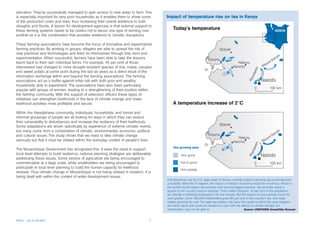
is especially important for very poor households as it enables them to share some         Impact of temperature rise on tea in Kenya
of the production costs and risks, thus increasing their overall resilience to both
droughts and floods. A lesson for development agencies is that external support to
these farming systems needs to be careful not to favour one type of farming over
another as it is the combination that provides resilience to climatic disruptions.

These farming associations have become the focus of innovative and experimental
farming practices. By working in groups, villagers are able to spread the risk of
new practices and technologies and learn for themselves through trial, error and
experimentation. When successful, farmers have been able to take the lessons
learnt back to their own individual farms. For example, 45 per cent of those
interviewed had changed to more drought-resistant species of rice, maize, cassava
and sweet potato at some point during the last six years as a direct result of the
information exchange within and beyond the farming associations. The farming
associations act as a buffer against initial risk with both poor and wealthy
households able to experiment. The associations have also been particularly
popular with groups of women, leading to a strengthening of their position within
the farming community. With the support of extension officers these types of
initiatives can strengthen livelihoods in the face of climate change and make
livelihood activities more profitable and secure.

Within the Nwadjahane community, individuals, households, and formal and
informal groupings of people are all looking for ways in which they can reduce
their vulnerability to disturbances and increase the resiliency of their livelihoods.
Some adaptations are driven specifically by experience of extreme climatic events,
but many come from a combination of climatic, environmental, economic, political
and cultural issues. The study shows that we need to take climate change
seriously but that it must be viewed within the everyday context of people’s lives.

The Mozambique Government has recognised this. It sees the need to support
local level attempts to build resilience; national planning strategies are deliberately
addressing these issues. Some sectors of agriculture are being encouraged to
commercialise at a large scale, while smallholders are being encouraged to
participate in local level planning to build the human capacity for livelihood
renewal. Thus climate change in Mozambique is not being viewed in isolation; it is
being dealt with within the context of wider development issues.
                                                                                          If temperatures rise by 2°C, large areas of Kenya currently suited to growing tea would become
                                                                                          unsuitable. Were this to happen, the impact on Kenya’s economy would be enormous. Kenya is
                                                                                          the world’s fourth-largest tea producer and second-biggest exporter. Tea provides nearly a
                                                                                          quarter of the country’s export earnings. Three million Kenyans, 10 per cent of the population,
                                                                                          are directly or indirectly employed in the tea industry. But the impact on poor people could be
                                                                                          even greater. Some 400,000 smallholders grow 60 per cent of the country’s tea, with large
                                                                                          estates growing the rest. The large tea estates may have the capital to afford the extra irrigation
                                                                                          and other inputs that would be needed to cope with the effects of climate change, but
                                                                                          smallholders may not be able to.                               Source: UNEP/GRID Arenal/Otto Simonet


Africa – Up in smoke?                                                                 7
Agro-ecology: the way forward for climate-resilient                                        Pooling resources in east Kenya18
food production17                                                                          A pioneer farmer and his neighbours in east Kenya pooled resources and
Agriculture in Africa suffers from a persistent lack of investment. It’s an issue both     decided to share information on farming technologies. They specifically wanted
at the national level, with African governments cutting back on farming support            to carry out soil and water conservation, together with the construction of an
services, and internationally, with funding from the EU, for example, going more to        earth pan to store floodwater. Using the water, he tried kitchen gardening using
‘governance’ and ‘infrastructure’.                                                         bucket-drip irrigation next to his homestead and was very successful. The
                                                                                           project depended on the availability of water and, with help, the group installed
Small-scale agriculture provides most of the food produced in Africa, and employs          a well and hand pump, sharing 50 per cent of the cost.
70 per cent of the workforce. But a lack of investment in drought-resistant farming
is in danger of creating serious problems for its ability to adapt in a warming world.     To reduce the damage from chafer grubs, which attack and damage the roots
Just as financial investors spread risk, it makes sense for farmers to do so as well       of maize seedlings, two methods were used which involved no chemicals:
in the face of global warming. A diversity of both approaches to cropping and to a
range of crops is the way to achieve that.                                                 b   Applying manure increases the tolerance of the maize plant to damage from
                                                                                               chafer grubs. The nutrients in the manure accelerate root growth and enable
This, in turn, means that farmers need access to seeds that are adapted to                     the seedlings to recover after attack.
drought or reduced rainfall during critical stages in the growing season. A variety of
forces have led to a reduced availability of local seeds, and increased dependence         b   Early land preparation exposes the grubs’ eggs to heat on the surface, which
on hybrid seeds and crops like maize that are not well adapted to these                        kills them, reducing the number of eggs that hatch.
conditions. Maize needs rain during the development of the cobs, and a gap in
rainfall at a crucial time leads to crop failure. Exactly this is happening in Zambia in   Together, these two methods reduce damage from 50 per cent to a mere 5–10
2005, despite plentiful rain earlier in the rainy season.                                  per cent without a biotechnologist in sight. The farmer and his wife also
                                                                                           attended a workshop on different uses of the neem tree and its products for
Another pressure comes from the concentration of ownership in the seed industry            pest control, animal and human health.
into a handful of large corporations. Ten companies now control one-third of the
global seed industry, further threatening agricultural biodiversity.                       Since sustainable agricultural techniques were adopted, crop yields have
                                                                                           increased four-fold. Livestock manure increases water retention and provides
A key aspect of an agro-ecological approach is how different developments can              nutrients to achieve higher yields. Using these local resources and skills, the
produce synergies, leading to win-win situations such as increased production              farmers have discarded the previous cut, burn, plant, and shift cropping system
without additional external resources. Diverse cropping systems yield much more            in favour of increasing yields from the same piece of land and leaving the rest
produce per unit of land than the mono-cropping favoured by ‘modern’ agricultural          for livestock pasture and environmental conservation. Currently all the farmer’s
systems. They are also much more suited to the harsh conditions in which most              cropping land is subject to rainwater conservation. He even harvests runoff
farmers in Sub-Saharan Africa operate.                                                     water from the roadside. If the water supply is maintained he intends to grow
                                                                                           more cash crops like watermelons and grafted yellow passion fruit. Both have
The example given from the semi-arid area in east Kenya illustrates the process.           a ready market. This will increase his income to see his son through university,
Sustainable agriculture is a method of farming based on human needs for food,              increase the food supply to the local community and hotel industry, and also
income, shelter, and fuelwood. It also builds an understanding of the long-term            increase productivity from his land.
effect of our activities on the environment. It integrates practices for plant and
animal production, with a focus on pest predator relationships, moisture and               However, the key to the wider adoption of sustainable agricultural techniques
plants, soil health and the chemical and physical relationship between plants and          depends on their promotion through official agricultural support, so called
animals on the farm.                                                                       ‘extension services’. In turn they need to be backed by a favourable policy
                                                                                           climate and supportive research that addresses problems identified by farmers.
Most sustainable agricultural initiatives seek to reduce soil erosion and to make
improvements to the soil’s physical structure through its organic matter content,


Africa – Up in smoke?                                                                 8
Senegal: the dangers of large-scale mono-cropping20
                                                                                        In comparison to the positive examples shown in Mozambique and Kenya,
                                                                                        Senegal’s experience of peanut farming leaves them more, not less, vulnerable
                                                                                        to climate change. Climatic phenomena, such as the drought cycles of the last
                                                                                        two decades, have worsened desertification. Vegetation cover has been
                                                                                        increasingly degraded and there has been overgrazing.

                                                                                        Beginning as long ago as the early 1880s, the French Administration, with the
                                                                                        help of armed troops, demanded that farmers grow peanuts for the French
                                                                                        vegetable oil industry. Peanut monoculture expanded rapidly after World Wars I
                                                                                        and II and boomed again during the 1950s. Peasants needed cash to pay taxes
                                                                                        imposed by the French and peanuts were the only source of francs. However,
                                                                                        the cash crop also brought unexpected catastrophe. Today, around 40 per cent
                                                                                        of Senegal’s arable land is used for growing peanuts. Economic dependence
                                                                                        on the export crop has led to excessive mono-cropping, soil degradation and
                                                                                        forest clear-cutting.

Gola forests chiefs at project meeting                                                  The environmental impact of the peanut farming has been comprehensive.
                                                                                        Small-scale farmers did not own animals, so manure was unavailable. A fallow
and water-holding capacity. Water is a clear constraint in many rains-fed systems.      period would have allowed nutrients to re-accumulate in the soil, but the people
When water is better harvested and conserved, it may be the key factor leading to       could not afford the time. Instead they grew peanuts till the soil was exhausted,
improved agricultural productivity. Provided the soil’s nutrient balance is             then moved to new lands. They chopped down trees, which held topsoil in
maintained, better water management means better cropping.                              place and helped absorb infrequent rains. Before the peanut take-over, the
                                                                                        roots and stalks of the millet crop used to be left in place, holding down the
Protecting the Gola Forests in Sierra Leone19                                           topsoil. But the peanut, on the other hand, is wrenched from the ground, the soil
Deforestation accounts for between 20 and 30 per cent of all greenhouse gas             loosened and clouds of earth swirled away with the dry-season winds.
emissions worldwide and has devastating effects on both biodiversity and local
communities. The Upper Guinea Forest, which once stretched from Guinea to
Ghana, now covers less than one-third of its original area and is highly fragmented
into comparatively small areas. Sierra Leone has only one-seventh of its original     Under a logging concession, the Government and local communities would expect
Upper Guinea Forest remaining, half of which is made up of the 750-square-            incomes from the concession holder through fees and royalties. This potential loss
kilometre Gola Forests in the southeast of the country.                               of income has to be compensated for by the new conservation agreement.
                                                                                      Income for the Government is fed directly into its Forestry Division to manage and
The RSPB and the Conservation Society of Sierra Leone (CSSL) developed one            develop the Gola Forests for conservation. Local communities will receive
example of an innovative approach to natural resource management that balances        royalties to put into conservation-friendly community development projects. The
peoples’ livelihoods with sustainability. They formed a long-term partnership with    agreement will also guarantee employment and engagement of communities in
the Sierra Leone Government and seven chiefdoms to protect the Gola Forests.          the management of the forests. A trust fund will meet these costs in perpetuity.

Following the recent conflict in Sierra Leone, there was a concern that commercial
logging would resume in the Gola Forests, bringing in much needed but short-
term money. Instead, the CSSL and the RSPB have concluded a ‘conservation
concession’ agreement with the Sierra Leone Government under which the forest
management rights will be used for conservation rather than logging.


Africa – Up in smoke?                                                            9
His farming system is heavily dependent on manure. In the event of a serious
Will climate change break the herder’s back?                                               drought or a series of below-average years, Hamidou may find it difficult to save his
                                                                                           animals as he has no obvious ‘refuge area’ and local pastures are increasingly rare
Niger and the story of Hamidou Oussemane21                                                 due to the pressure of cultivation. The locust plague of 2004 added an extra burden
Hamidou is a farmer from the village of Guidan Ali in the district of Birnin Konni.        on many farmers in Niger; aid agencies are warning that 2005 will be very difficult.
His extended family comprises 40 people.
                                                                                           The loss of the herd would undermine Hamidou’s farming system and livelihood.
Climate uncertainty is a way of life for Hamidou. As a young child he remembers            Livestock routes are blocked, the institutions managing access to resources are
the good times when the rains were abundant and more reliable than they are                ‘corrupted’, and there is increasing competition over local resources.
today. But since the drought years of the 1970s and 1980s, the rains have never
been consistent from one year to the next. Adapting to unpredictable and erratic           His plans now are to diversify into other areas of economic activity, which are less
conditions has not been easy, but over time Hamidou has developed a farming                dependent on the rains. Already two of his sons regularly go to Nigeria in the dry
system on which he has raised a family while managing to help others.                      season to earn money as labourers. His nephews too earn money in this way and
                                                                                           are planning to set up a small restaurant business in a nearby town. Hamidou is
The family’s livelihood is based on a mixture of farming, livestock keeping, and the       also thinking about buying land in a nearby irrigation scheme. He says he will wait
selling of fuelwood. The family farms 10 fields covering about 26 hectares located         to see what the future brings and whether God will answer his prayers for more
on different soil types (sandy dunes, and low-lying clay areas) and producing a            rain.
variety of food crops including millet, sorghum and rice, in order of importance. The
women cultivate smaller plots on which they grow sorrel and okra. In a good year,          Ethiopia and support for smallholder agriculture22
the family produces a surplus, which is stocked in the family’s granaries, although        Many of the approaches that constitute ‘good development’ also double as
a small amount of rice may be sold from time to time. The family also looks after          excellent techniques to adapt to the uncertainties of global warming. Smallholder
61 cattle of which 41 belong to them. The other animals belong to neighbours and           farming in Ethiopia is a case in point. Ethiopia is crippled by unfavourable
friends. Until 1982, the herd was taken in different seasons either north towards          international trade rules, lack of rural roads and market access, unemployment,
Tahoua, or south to northern Nigeria. But for a variety of reasons, including conflict     debt, and environmental degradation. Ten per cent of Ethiopia’s annual income still
and the rising costs of accessing pastures in the dry seasons, Hamidou’s sons              goes on debt repayments – twice what it spends on healthcare each year and
now look after the herd themselves in the vicinity of the village and it is used to        three million people have contracted the HIV virus. So, when the rains fail in
manure the family’s fields and those of other village members.                             Ethiopia there is nothing to fall back on.

Livestock, manure, plentiful household labour, and access to the relatively well-          The Ethiopian Orthodox Church, which works with the agency Christian Aid, is
watered clay soils at the base of the sandy hills have been the main ingredients           addressing these issues through its Rural Integrated Development Programme in
behind Hamidou’s success as a farmer. Although he has a large family to look               Bugna, in the Amhara region of northern Ethiopia. Project co-ordinator Deacon
after, he has a big farm by Sahelian standards with a broad mix of land types and          Abate Desale says, “The land is so degraded in this region that erosion causes
soils. In an average year he is able to harvest sufficient food to feed the whole          floods when the rains come and drought when it does not. Most Ethiopians are
family and put aside for future years. Since he doesn’t need to sell animals or milk       dependent on the land for their livelihoods so we must invest in it.” Techniques,
to buy grain, the herd is able to grow relatively fast. Hamidou’s system is an             such as terracing land on hillsides to stop erosion and collect water for irrigation,
example of the benefits of an integrated crop-livestock farming approach widely            replanting trees, and protecting areas of land for regeneration, are all effective
promoted by policy-makers in the Sahel.                                                    long-term measures to prevent drought leading to famine in the future.

However, it is a system that is highly vulnerable in the context of increasing climatic    The programme shows Ethiopia’s potential. In the middle of the dry, unproductive
uncertainty and greater rainfall fluctuations. Global warming introduces extra tension     landscape lies an oasis of lush, green vegetation and bird song. This ‘garden of
into an already stressed way of life that could make a critical and negative               Eden’ is designed to teach neighbouring farmers how to successfully grow
difference. Over the last 20–30 years, Hamidou has become more and more                    vegetables and trees with traditional organic methods, enabling them to earn an
‘sedentary’. He no longer takes his animals to more distant pastures and he has            income and have a more balanced diet. Vegetables, such as carrots, lettuces,
lost the contacts he used to have with families in other areas of Niger and Nigeria.       tomatoes and onions, rarely seen in rural Ethiopia, are intercropped with a variety


Africa – Up in smoke?                                                                 10
The Churches and climate change23

  “When I was a child, there was so much rain that we prayed for it to stop. Now we     common feature in Africa with some countries experiencing these impacts even
  pray for rain.” The Catholic archbishop of Bulawayo in Zimbabwe, Pius Ncube, says     twice a year.” She added: “At this faith-based groups’ meeting, we appeal to your
  that local people over 50 years of age have noticed much less rain in                 conscience to support the concept of Contraction and Convergence as it is not
  Matabeleland than there was 30 years ago. “There has been a big climate change        only ethical and moral, but it provides the avenue through which all countries can
  within living memory”, he reports “and the rainy season, which used to run from       participate in restoring the ecological and climate change imbalance in an
  October to April, now starts around mid-November and ends in February.” Yet, he       equitable manner. Africa has suffered enough in human history, from slavery to
  adds, “We have so many immediate crises in our country – starvation, poverty,         colonialism and now our people are at the mercy of the unbridled economic
  AIDS, human rights abuses – that environmental issues such as water shortages,        development of the North.”
  the random chopping of trees for fuel and the diminishing wildlife are not really
  being addressed.” In neighbouring Zambia, the Catholic bishops issued a letter in
  2004 deploring that, “We have not taken the best care for this environment on
  which we depend for our survival.” The letter identifies “massive deforestation” as
  a key problem and blames it on the ever-increasing need for fuel wood. The            of seedlings, such as coffee and fruit trees. Farmers learn about organic pest
  bishops say that lack of access to electricity in poor communities has encouraged     control, irrigation and water conservation and are provided with seeds and tree
  charcoal burning. In South Africa, the Church has begun awareness-raising work        seedlings to give them a head start.
  on the issue of energy, particularly encouraging the development of renewable
  energy such as solar and hydro. More than 70 per cent of total energy                 Carbate Bazarba is one of 400 farmers currently benefiting from this project. Like
                                                                                        most Ethiopian farmers, Carbate used to grow cereals only. “The greatest thing I
  consumption in South Africa comes from coal – a highly carbon-intensive fossil
                                                                                        have learnt from the demonstration site is how to plant new crops like fruits and
  fuel. Local ecumenical groups in South Africa, such as the Diakonia Council of
                                                                                        vegetables and how important these things are for our diet. Now my wife and
  Churches in Durban, are incorporating climate change into their bible study
                                                                                        children have a better diet and I earn money from selling vegetables. My only
  materials, which link scripture with the realities facing modern society.
                                                                                        problem now is that my children prefer guava and papaya and won’t eat their
                                                                                        injera!” Injera is an Ethiopian staple meal – a large flat pancake made from teff, the
  Two Protestant church leaders have warned of the dangers of climate change
                                                                                        Ethiopian grain.
  triggering disasters in Africa. In December 2004, Rev. Ishmael Noko, from
  Zimbabwe and head of the Lutheran World Federation, said the tsunami disaster
  that month was a warning of the vulnerability of low-lying coastal areas to rising
  sea levels caused by global warming. “It is a reminder that we would do well to
  heed, at a time when even the relatively inadequate efforts by the international
  community to address climate change continue to be subverted and undermined
  by some of those most responsible,” Noko said. His concerns were shared by Rev.
  Dr Sam Kobia, a Kenyan Methodist and the head of the World Council of
  Churches, who called on powerful nations that had not signed the Kyoto Protocol
  on greenhouse gas emissions, to do so. In October 2004, at the Coventry launch
  of Operation Noah, the British churches’ climate change campaign, a plea was
  read out from Africa asking for the help of faith-based groups in securing equity
  for Africa in the world’s response to climate change. In a letter to conference
  delegates, Grace Akumu, Co-ordinator of the Nairobi-based Climate Network
  Africa, reported that, “Frequent flooding and droughts leading to famines and
  deaths, destruction of infrastructure, economic and livelihood ruins, are now a


Africa – Up in smoke?                                                             11
Climate change and locust plague in the Sahel24
  During 2004, several West African countries fell victim to the largest locust           The key to reducing impact lies in the response of governments of countries of
  invasion in 15 years.25 Millions of hectares of crops and pasture were destroyed        neighbouring the Sahara. But that means securing financial support. Without
  by giant swarms of insects.26 Production, especially of food crops, decreased           money and the support of the International community it will be difficult to address
  drastically to reach 8,978,142 tonnes against a minimum need of 10,234,193              the problem.31 When poorer nations are using up to half of their revenues to pay
  tonnes in the Sahel.27 The locust plague that began in summer 2004 undermines           debts it does not leave much room for any poverty-reduction measures or for
  poor people’s livelihoods as 80 per cent of the population depends on seasonal          action to be taken to alleviate the catastrophic consequences of locust plague.
  staple-food production to feed themselves. West Africa is not the only region
  vulnerable to locust invasion. There are three main areas where locusts reproduce:      As for a technological solution to the plague problem, history has shown that it has
  in the Sahel and Maghreb; around the Red Sea; and along the Indian and                  never been possible to stop a plague of locusts using pesticides once the plague
  Pakistani border. The area covers about 16 million km2 and includes some 30             has developed. Natural forces always stop the plague, which means that dealing
  countries.                                                                              with a locust plague requires social, not technological, measures. Communities
                                                                                          need to be trained equipped and prepared at all levels for them to adapt to this
  Widespread and heavy locust infestations occur in periods of one or more years.         new situation.
  A plague can occur when favorable breeding conditions are present (which will be
  affected by climate change) and when control operations fail to stop a series of        Aid agencies are extremely concerned at a mounting food crisis in Mali and Niger
  local outbreaks from developing into an upsurge that cannot be contained, mostly        this year, with reports coming in of severe malnutrition among children in
  due to poor preparedness. There have been 6 major plagues of Desert Locusts in          pastoralist communities in both countries. The causes are partly to do with
  the 1900s, one of which lasted almost 13 years. These can cover an area of about        drought and partly with last year’s locust invasions. Major relief assistance is likely
  29 million km2, and can extend across 57 countries.                                     to be needed.

  Plagues occur in relation to locust biology.28 Vegetation, soil structure and habitat
  all affect their behaviour, all of which, in turn, are influenced by temperature and
  rainfall. Most climate change models predict an overall decline in rainfall, and
  within that, greater extremes of weather conditions, from droughts to inundations.
  Heavy rains create ideal conditions for locust reproduction. A combination of rain,
  vegetation and humidity leads to rapid breeding.29

  Over the past decades, Africa has experienced important changes in rainfall
  patterns due to sea surface temperature changes, inducing both desertification,
  and the higher temperatures that could influence locust plagues.30

  The Sahel has neither the means – in terms of equipment, products and logistics
  – nor the finances to avoid such disasters, much less stop the locust invasion from
  heading north towards the Maghreb. An invasion occurring during harvest will
  cause a major disaster that will lead to famine if the risk of residual eggs is not
  addressed. Economic impact can be reduced if farmers react quickly and save
  their crops before an invasion. But the ability to react quickly is not great so any
  damages will be huge.


Africa – Up in smoke?                                                               12
Water, drought and the changing rains

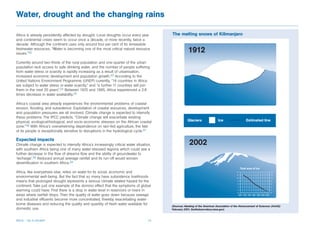
Africa is already persistently affected by drought. Local droughts occur every year       The melting snows of Kilimanjaro
and continental crises seem to occur once a decade, or more recently, twice a
decade. Although the continent uses only around four per cent of its renewable
freshwater resources, “Water is becoming one of the most critical natural resource
issues.”32

Currently around two-thirds of the rural population and one-quarter of the urban
population lack access to safe drinking water, and the number of people suffering
from water stress or scarcity is rapidly increasing as a result of urbanisation,
increased economic development and population growth.33 According to the
United Nations Environment Programme (UNEP) currently, “14 countries in Africa
are subject to water stress or water scarcity,” and “a further 11 countries will join
them in the next 25 years”.34 Between 1970 and 1995, Africa experienced a 2.8
times decrease in water availability.35

Africa’s coastal area already experiences the environmental problems of coastal
erosion, flooding, and subsidence. Exploitation of coastal resources, development
and population pressures are all involved. Climate change is expected to intensify
these problems. The IPCC predicts, “Climate change will exacerbate existing
physical, ecological/biological, and socio-economic stresses on the African coastal
zone.”36 With Africa’s overwhelming dependence on rain-fed agriculture, the fate
of its people is exceptionally sensitive to disruptions in the hydrological cycle.37

Expected impacts
Climate change is expected to intensify Africa’s increasingly critical water situation,
with southern Africa being one of many water-stressed regions which could see a
further decrease in the flow of streams flow and the ability of groundwater to
‘recharge’.38 Reduced annual average rainfall and its run-off would worsen
desertification in southern Africa.39

Africa, like everywhere else, relies on water for its social, economic and
environmental well-being. But the fact that so many have subsistence livelihoods
means that prolonged drought represents a serious climate related hazard for the
continent. Take just one example of the domino effect that the symptoms of global
warming could have. First there is a drop in water level in reservoirs or rivers in
areas where rainfall drops. Then the quality of water goes down because sewage
and industrial effluents become more concentrated, thereby exacerbating water-
borne diseases and reducing the quality and quantity of fresh water available for
                                                                                          (Sources: Meeting of the American Association of the Advancement of Sciences (AAAS)
domestic use.                                                                             February 2001; Earthobservatory.nasa.gov)


Africa – Up in smoke?                                                                13
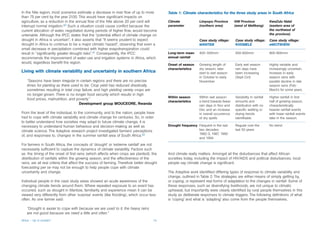
In the Nile region, most scenarios estimate a decrease in river flow of up to more          Table 1: Climate characteristics for the three study areas in South Africa
than 75 per cent by the year 2100. This would have significant impacts on
agriculture, as a reduction in the annual flow of the Nile above 20 per cent will           Climate            Limpopo Province        NW Province               KwaZulu Natal
interrupt normal irrigation.40 Such a situation could cause conflict because the            parameter          (northern area)         (west of Mafikeng)        (eastern area of
current allocation of water, negotiated during periods of higher flow, would become                                                                              the northwest of
untenable. Although the IPCC states that the “potential effect of climate change on                                                                              the province)
drought in Africa is uncertain”, it also asserts that “It seems prudent to expect                              Case study village:     Case study village:       Case study village:
drought in Africa to continue to be a major climatic hazard”, observing that even a                            MANTSIE                 KHOMELE                   eMCITSHENI
small decrease in precipitation combined with higher evapotranspiration could
result in “significantly greater drought risks”.41 Consequently, the IPCC                   Long-term mean     400–500mm               500-600mm                 800-900mm
recommends the improvement of water use and irrigation systems in Africa, which             annual rainfall
would, regardless benefit the region.
                                                                                            Onset of season    Growing length of       Early wet season          Highly variable and
                                                                                            characteristics    dry season, later       rain days have            increasingly uncertain.
Living with climate variability and uncertainty in southern Africa                                             start to wet season     been increasing           Increase in early
                                                                                                               in October to early     (Sept-Oct)                season rains with
   “Seasons have been irregular in certain regions and there are no precise                                    November                                          parallel decline in late
   times for planting as there used to be. Crop yield has reduced drastically,                                                                                   season rains (Feb-
   sometimes resulting in total crop failure, and high yielding variety crops are                                                                                March) for some years.
   no longer grown. There is no longer food security which results in high
                                                                                            Within season      Within wet season       Variability in rainfall   Higher rainfall in first
   food prices, malnutrition, and poverty.”
                                                                                            characteristics    a trend towards fewer   amounts and               half of growing season,
                                   Development group MOUCEORE, Rwanda                                          rain days in Nov and    distribution with no      characteristically
                                                                                                               Dec and an increase     specific wetting or       heavier rainfall events
From the level of the individual, to the community, and to the nation, people have                             in overall occurrence   drying trends             with lower rainfall events
had to cope with climate variability and climate change for centuries. So, in order                            of dry spells           identifiable              later in the season.
to better understand how societies may adapt to future climate change, it is
necessary to understand human behaviour and decision-making as well as                      Drought frequency Frequent in the last     Regular over the          No trend
climate science. The Adaptive research project investigated farmers’ perceptions                              two decades:             last 50 years
                                                                                                              1982-3, 1987, 1990
of, and responses to, changes in the summer rainfall area of South Africa.42
                                                                                                              and 1994
For farmers in South Africa, the concepts of ‘drought’ or ‘extreme rainfall’ are not
necessarily sufficient to capture the dynamics of climate variability. Factors such
as: the timing of the onset of first rains (which affects when crops are planted), the      And climate really matters. Amongst all the disturbances that affect African
distribution of rainfalls within the growing season, and the effectiveness of the           societies today, including the impact of HIV/AIDS and political disturbances, local
rains, are all real criteria that affect the success of farming. Therefore better drought   people say climate change is significant.
forecasting per se may not be enough to help people cope with climate
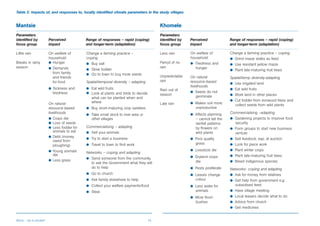
uncertainty and change.                                                                     The Adaptive work identified differing types of response to climate variability and
                                                                                            change, outlined in Table 2. The strategies are either means of simply getting by,
Individual people in the case study areas showed an acute awareness of the                  or coping, or represent real forms of adaptation to the changes in rainfall. Some of
changing climate trends around them. Where repeated exposure to an event has                these responses, such as diversifying livelihoods, are not unique to climatic
occurred, such as drought in Mantsie, familiarity and experience mean it can be             upheaval, but importantly were clearly identified by rural people themselves in this
viewed very differently from other ‘surprise’ events (like flooding), which occur less      study as deliberate responses to climate triggers. The following definitions of what
often. As one farmer said:                                                                  is ‘coping’ and what is ‘adapting’ also come from the people themselves.

   “Drought is easier to cope with because we are used to it, the heavy rains
   are not good because we need a little and often.”
Africa – Up in smoke?                                                                 14
Table 2: Impacts of, and responses to, locally identified climate parameters in the study villages


Mantsie                                                                                  Khomele
Parameters                                                                               Parameters
identified by           Perceived           Range of responses – rapid (coping)          identified by   Perceived              Range of responses – rapid (coping)
focus group             impact              and longer-term (adaptation)                 focus group     impact                 and longer-term (adaptation)

Little rain             On welfare of       Change a farming practice –                  Less rain       On welfare of          Change a farming practice – coping
                        household           coping                                                       household              b Grind maize stalks as feed
Breaks in rainy         b Hunger            b Buy salt                                   Period of no    b Tiredness and        b Use resistant yellow maize
season                  b Demands                                                        rain               hunger
                                            b Store fodder                                                                      b Plant late-maturing fruit trees
                          from family       b Go to town to buy more seeds
                          and friends                                                    Unpredictable   On natural             Spatial/temp diversity-adapting
                          for food          Spatial/temporal diversity – adapting        rain            resource-based         b Use irrigated land
                                                                                                         livelihoods
                        b Sickness and      b Eat wild fruits                            Rain out of                            b Eat wild fruits
                          tiredness         b Look at plants and birds to decide                         b Seeds do not
                                                                                         season                                 b Work land in other places
                                               what can be planted when and                                  germinate
                                               where                                                                            b Cut fodder from ironwood trees and
                        On natural                                                       Late rain       b Makes soil more
                                                                                                                                   collect seeds from wild plants
                        resource-based      b Buy short-maturing crop varieties                             unproductive
                        livelihoods                                                                      b Affects planning     Commercialising –adapting
                                            b Take small stock to river area or
                        b Crops die            other villages                                               – cannot tell the   b Gardening projects to improve food
                        b Loss of seeds                                                                     rainfall patterns     security
                        b Less fodder for   Commercialising – adapting                                      by flowers on       b Form groups to start new business
                           animals to eat   b Sell your animals                                             wild plants           venture
                        b Debt (money
                                            b Try to start a business                                    b Poor quality         b Sell livestock, esp. at auction
                           owed from
                                            b Travel to town to find work                                   grass               b Look for piece work
                           ploughing)
                        b Young animals                                                                  b Livestock die        b Plant winter crops
                                            Networks – coping and adapting
                           die                                                                                                  b Plant late-maturing fruit trees
                                            b Send someone from the community                            b Dryland crops
                        b Less grass                                                                        die                 b Breed indigenous species
                                               to ask the Government what they will
                                               do to help                                                b Pests proliferate    Networks- coping and adapting
                                            b Go to church                                               b Leaves change        b Ask for money from relatives
                                            b Ask family elsewhere to help                                  colour              b Get help from government e.g.
                                            b Collect your welfare payments/food                         b Less water for          subsidised feed
                                            b Steal                                                         animals             b Have village meeting
                                                                                                         b More thorn           b Local leasers decide what to do
                                                                                                            bushes              b Advice from church
                                                                                                                                b Get medicines


Africa – Up in smoke?                                                               15
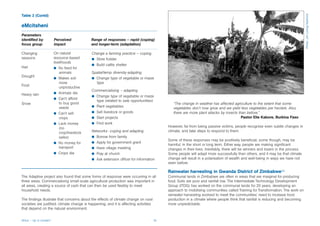
Table 2 (Contd)


                                                                                                                                                                                   Photo: Jim Loring/Tearfund
eMcitsheni
Parameters
identified by           Perceived            Range of responses – rapid (coping)
focus group             impact               and longer-term (adaptation)

Changing                On natural           Change a farming practice – coping
seasons                 resource-based       b Store fodder
                        livelihoods
                                             b Build cattle shelter
Hail                    b No feed for
                            animals          Spatial/temp diversity-adapting
Drought
                        b Makes soil         b Change type of vegetable or maize
                            more                type
Frost
                            unproductive
                                             Commercialising – adapting
Heavy rain              b Animals die
                                             b Change type of vegetable or maize
                        b Can’t afford
                                               type (related to sale opportunities)
Snow                        to buy good                                                        “The change in weather has affected agriculture to the extent that some
                            seeds            b Plant vegetables
                                                                                               vegetables don’t now grow and we yield less vegetables per hectare. Also,
                        b Can’t sell         b Sell livestock or goods                         there are more plant attacks by insects than before.”
                            crops            b Start projects                                                                            Pastor Elie Kabore, Burkina Faso
                        b Lack money         b Find work
                            (no                                                             However, far from being passive victims, people recognise even subtle changes in
                            crop/livestock   Networks- coping and adapting                  climate, and take steps to respond to them.
                            sales)           b Borrow from family
                                                                                            Some of these responses may be positively beneficial; some though, may be
                        b No money for       b Apply for government grant
                                                                                            harmful, in the short or long term. Either way, people are making significant
                            transport        b Have village meeting                         changes in their lives. Inevitably, there will be winners and losers in the process.
                        b Crops die          b Pray at church                               Some people will adapt more successfully than others, and it may be that climate
                                             b Ask extension officer for information        change will result in a polarisation of wealth and well-being in ways we have not
                                                                                            seen before.

                                                                                            Rainwater harvesting in Gwanda District of Zimbabwe43
The Adaptive project also found that some forms of response were occurring in all           Communal lands in Zimbabwe are often in areas that are marginal for producing
three areas. Commercialising small-scale agricultural production was important in           food. Soils are poor and rainfall low. The Intermediate Technology Development
all areas, creating a source of cash that can then be used flexibly to meet                 Group (ITDG) has worked on the communal lands for 20 years, developing an
household needs.                                                                            approach to mobilising communities called Training for Transformation. The work on
                                                                                            rainwater harvesting evolved to meet the communities’ need to increase food
The findings illustrate that concerns about the effects of climate change on rural          production in a climate where people think that rainfall is reducing and becoming
societies are justified: climate change is happening, and it is affecting activities        more unpredictable.
that depend on the natural environment.


Africa – Up in smoke?                                                                  16
able-bodied labour. So grandchildren took the place of elders. If an elderly
                                                                                           person had no younger relative, others would dig on their behalf. The
                                                                                           elderly can help, by praying, giving advice, and baby minding. We work
                                                                                           together as a social responsibility to elders.”

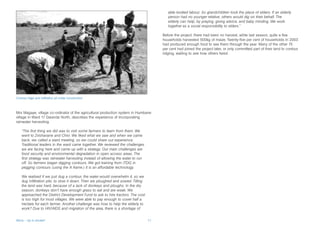
                                                                                        Before the project, there had been no harvest, while last season, quite a few
                                                                                        households harvested 500kg of maize. Twenty-five per cent of households in 2003
                                                                                        had produced enough food to see them through the year. Many of the other 75
                                                                                        per cent had joined the project later, or only committed part of their land to contour
                                                                                        ridging, waiting to see how others fared.


Contour ridge and infiltration pit under construction


Mrs Magaye, village co-ordinator of the agricultural production system in Humbane
village in Ward 17 Gwanda North, describes the experience of incorporating
rainwater harvesting.

    “The first thing we did was to visit some farmers to learn from them. We
    went to Zvishavane and Chivi. We liked what we saw and when we came
    back, we called a ward meeting, so we could share our experience.
    Traditional leaders in the ward came together. We reviewed the challenges
    we are facing here and came up with a strategy. Our main challenges are
    food security and environmental degradation in open access areas. The
    first strategy was rainwater harvesting instead of allowing the water to run
    off. So farmers began digging contours. We got training from ITDG in
    pegging contours (using the A frame.) It is an affordable technology.

    We realised if we just dug a contour, the water would overwhelm it, so we
    dug infiltration pits, to slow it down. Then we ploughed and sowed. Tilling
    the land was hard, because of a lack of donkeys and ploughs. In the dry
    season, donkeys don’t have enough grass to eat and are weak. We
    approached the District Development Fund to ask to hire tractors. The cost
    is too high for most villages. We were able to pay enough to cover half a
    hectare for each farmer. Another challenge was how to help the elderly to
    work? Due to HIV/AIDS and migration of the area, there is a shortage of


Africa – Up in smoke?                                                              17
Health

Health is often neglected in the assessment of vulnerability and adaptation                In its report, Climate change and human health, the WHO shows that changes in
to climate change. However, methods have been developed for assessing                      the patterns for the spread of infectious diseases are a likely major consequence
the impacts of climate variability and change on a range of health outcomes.44             of climate change.46 The report indicates likely increases in mosquito populations
                                                                                           which spread viral diseases such as dengue and yellow fever, and points to the
Systematic health assessments are needed to inform the management of                       positive correlation between the annual number of dengue epidemics in the South
everything from water, to food, housing and trade. Several developed and                   Pacific with the warm wet conditions of La Niña,47 and the seasonal variation in
developing countries have already conducted national assessments to determine              many diarrhoeal diseases suggesting sensitivity to climate.
their vulnerability to the impacts of climate change and evaluate the capacity of
their health infrastructures to adapt. In the summer of 2003, an estimated 11,435          The most recent IPCC report, Climate change 2001: impacts, adaptation, and
people above the seasonal average died in France when a record-breaking                    vulnerability, is unequivocal: climate change will have the biggest impact on the
heatwave struck in the first two weeks of August. Responding, Health Minister              communities least able to respond to it. “The impacts of climate change will fall
Jean-François Mattei, announced $748 million in extra funding for hospital                 disproportionately upon developing countries and the poor persons within all countries,
emergency services, a measure that would either be impossible or stretch to                thereby exacerbate inequities in health status and access to adequate food, clean
breaking point government budgets in much of Africa.45                                     water and other resources.”48 These communities are also the least responsible for
                                                                                           damage to the climate. Poor communities in Africa are likely to be the most vulnerable.
The range of potential problems sensitive to climate change is enormous:
                                                                                           Africa’s high vulnerability to the impacts of climate change is compounded by
b   Heat stress (the direct effect of the thermal environment on health).                  widespread poverty. Ongoing drought and floods, and a dependence on natural
                                                                                           resources for rural livelihoods, in turn, exacerbate the increased vulnerability.
b   Air pollution (outdoor air quality).
                                                                                           Also, Sub-Saharan Africa already supports a heavy disease burden including
b   Weather disasters (such as floods, windstorms).                                        HIV/AIDS and malaria, cholera, dengue fever, yellow fever, encephalitis and
                                                                                           haemorrhagic fever.49
b   Vector-borne diseases (such as malaria, dengue, schistosomiasis and tick-
    borne diseases).
                                                                                           Malaria – a special case
b   Water-borne and food-borne diseases (such as diarrhoeal diseases).
                                                                                              “Mosquitoes are spreading into highland areas that were historically free
b   Stratospheric ozone depletion (not a direct element of climate change, but a
                                                                                              from malaria. There is also an increase in water-borne diseases.”
    matter of concern).
                                                                                                                                                  Tadesse Dadi, Ethiopia
b   Food security.
                                                                                           Beyond its role in the continent’s already serious disease burden, malaria
b   Demographic changes that shift the balance of vulnerable populations
                                                                                           represents a particular and additional threat in Africa. There are between 300 and
    demanding different health services.
                                                                                           500 million cases of malaria annually in the world each year with a very high
                                                                                           proportion of those occurring in Africa – largely among the poor. Malaria causes
In spite of its relative neglect as an issue, since the first IPCC report in 1990, there   between 1.5 and 2.7 million deaths, of which more than 90 per cent are children
has been a steady improvement in the understanding of the impacts of climate               under 5 years of age. In addition, malaria slows economic growth in Africa by up to
change on health. The World Health Organisation (WHO) estimated that globally,             1.3 per cent each year.50
for the year 2000, there were 150,000 deaths and the loss of 5.5 million ‘disability-
adjusted life years’, (a standard WHO measure to compare disease burdens)                  Climate change is almost certain to make an already bad situation worse, and
caused by climate change.                                                                  may be already contributing to the problem. There is increasing evidence that


Africa – Up in smoke?                                                                18
Photo: Jim Loring/Tearfund
climate change plays a significant role. In one highland area of Rwanda, for                variability can introduce the disease to areas previously free of malaria. Populations
example, malaria incidence increased by 337 per cent in 1987, and 80 per cent of            within these areas lack immunity and increase the impact of the illness.53
the increase could be explained by changes in rainfall and temperature. It is
expected that small further changes in temperature and precipitation could trigger          Climate change will have a dramatic impact not just on the health of vulnerable
malaria epidemics at the current limits of the disease both in altitude and latitude.       communities in Africa, but also on the ability of those communities to respond to
                                                                                            the changing conditions. Any response to this crisis must include support for
Global warming will increase the incidence of floods, warming and drought all of            adaptation to the climate change that cannot be avoided, as well as investment in
which are factors in disease transmission. In South Africa, it is estimated that the        livelihoods and technologies that will both improve quality of life and mitigate
area suitable for malaria will double and that 7.2 million people will be at risk – an      further damage to the climate.
increase of 5.2 million.51
                                                                                            Rarely considered, though, is the knock-on effect of these impacts on poor and
In addition, flooding – which is likely to increase as the climate changes – could          vulnerable communities. What will be the impact of an increased disease burden
facilitate breeding of mosquitoes, and as a result spread malaria to otherwise dry          on an already-stressed healthcare infrastructure? What will be the impact of that
areas. The Sahel region, which has suffered from drought in the past 30 years, has          increasing disease burden on educational provision when both economic capacity
experienced a reduction in malaria transmission as a result. If flooding does occur,        and the pool of prospective teachers (and potential students) are diminished?
there is a renewed risk of a malaria epidemic.52                                            What will be the impact on the ability of people to work the land, or even rebuild
                                                                                            communities after climate driven disasters? Climate change will not only affect
Recent studies also show that it is not just an increase in average temperatures and        people’s health in all the ways described, but in doing so it will also hamper
rainfall that trigger epidemics in areas previously free of malaria, but greater climatic   people’s ability to adapt to a changing, uncertain climate.


Africa – Up in smoke?                                                                  19
Energy

Africa has enormous potential for renewable energy and energy-efficiency                 These considerations would apply to all the initiatives listed above, and the
technologies. Energy resources, such as biomass, geothermal and hydropower,              outcomes of Renewables 2004, the World Bank’s Extractive Industries Review
are abundant. On the other hand, the vast majority of African people have no             (EIR) and the G8 Renewables Task Force.
access to clean, modern energy. There is a huge market and human demand for
sustainable energy, especially in the poorer communities. These resources and            The G8 countries, at the very least, should work with African and other developing
technologies, however, remain largely unexploited due to financial, capacity,            countries to promote a meaningful follow-up process to the Renewables 2004
market and political barriers.                                                           conference to ensure that technology transfer and development approaches are
                                                                                         better co-ordinated, and that voluntary commitments made at the Bonn renewable
Almost half of Africa’s countries could profitably produce hydropower, but only a        energy conference are implemented. At present, the credibility of these programs
fraction of that potential has been reached to date because of poor infrastructure       in delivering meaningful outcomes is open to question.57 Worse than that, the face
and high costs of initial investments. The continent accounts for only 1.3 per cent of   of the fossil fuel industries in Africa is smeared with exploitation, pollution and bad
the world’s solar energy facilities, and only 4 of its 53 countries have started         development practice.
exploring underground heat sources.54 At the same time, a huge proportion of the
population is surviving without power or clean fuels. Over three-quarters of Sub-        African people want greater access to energy. The continent has abundant natural
Saharan Africans have no access to electricity, compared to fewer than 14 per cent       resources but these are often either under-used, badly exploited or exported to
of people living in Latin America and East Asia.55 Most of Sub-Saharan Africa            richer countries. Africa needs the means to develop local solutions using local
depends on biomass fuels taken from wood and agricultural waste. Families in rural       resources to meet local needs, and increased access to clean, sustainable energy
and semi-rural areas are left little choice but to increasingly exploit fragile          to support health and education services, households and enterprise.
ecosystems to meet their energy needs, ultimately undermining both the fuel source
upon which they depend and the rich diversity of plants and animals that live there.     Feeling the heat: gas flaring in Nigeria58
                                                                                         Nigeria is the world’s largest gas flarer and and Nigerian flaring has contributed
The challenge is how to create access to clean, affordable energy sources, which         more greenhouse gases than all other Sub-Saharan sources combined. And,
allow Africa to avoid the ‘dirty’ energy path that others have gone down, while          despite national and international condemnation, the practice of flaring gas in the
meeting real development needs. These energy options also offer employment               Niger Delta remains widespread. It has been carried out on a massive scale in
and economic development opportunities and help liberate countries from the              Nigeria for nearly 50 years, violating the rights of local populations, not least the
energy ball-and-chain of oil-dependency.                                                 right to health and the right to a healthy environment. Flames and fumes are
                                                                                         produced 24 hours a day, seven days a week, year after year, affecting people’s
Various initiatives have been established to support sustainable energy, including       health, polluting the local environment and destroying livelihoods. Nowhere else in
the Johannesburg Renewable Energy Coalition (JREC) and the Renewable Energy              the world are communities subjected to it on such a large scale.
and Energy Efficiency Partnership (REEEP). Two others are the European Union
Energy Initiative and the Global Village Energy Partnership and there is a current       In the mid-1990s, daily oil production in Nigeria amounted to approximately two
proposal to set up an EU Energy Facility for Africa worth €250 million. However, a       million barrels. In the region of 17 billion m3 of associated natural gas was
coherent strategy needs to be developed by leading industrialised countries to re-       estimated to be flared annually, generating an estimated 2,700 tons of particulates,
orient global investment away from fossil-fuel-intensive energy infrastructure and       160 tons of sulphur oxides, 5,400 tons of carbon monoxide, 12 million tons of
into low-carbon and carbon–neutral technologies, which can power poverty                 methane, and 3.5 million tons of carbon dioxide. Because of poor regulatory
reduction. As recently as 2003, fossil fuel projects represented 86 per cent of the      framework, Nigeria flares 75 per cent of the gas it produces. In absolute terms, this
World Bank’s spending on energy, compared to funding for renewables at just              is the highest amount in any OPEC member nation and accounts for about 19 per
14 per cent.56 It’s necessary now to ensure that sustainable energy initiatives          cent of the total amount flared globally. Information on the amount of associated
result in measurable commitments, be better integrated and far better resourced.         gas currently flared can be contradictory as well as difficult to obtain.


Africa – Up in smoke?                                                               20
The flares contain widely recognised toxins, such as benzene, and carcinogens,


                                                                                           Photo: Jim Loring/Tearfund
such as dioxin. Particles from the flares fill the air, covering everything with a fine
level of soot.

Exposed to this cocktail of toxins, local people, who live and work alongside the
flares with no protection, complain of respiratory problems, such as asthma and
bronchitis, and of the distress caused by the constant roaring noise and the
intense heat from the flares. Assessments made in the vicinity of Izombe Flow
station, one of the numerous oil installations in the Niger Delta, showed that gas
flaring had led to the complete destruction of crops within 200 meters from the
station. The loss was 45 per cent at 600 meters and even as far as 1Km from the
station, a 10 per cent loss in crop yields occurred. While a number of factors may
contribute to declining crop yields, many villagers across the delta region believe
that decreasing productivity is linked to the gas flaring, adding to their frustration
with the oil companies.

Acid rain caused by the flaring is also reported to corrode roofs and buildings in
the area. Neither the oil companies nor the Nigerian Government appear to have
investigated the psychological and physical impact of the gas flaring on local
communities. Nor have they provided local inhabitants with information on the
hazards to which they are exposed.

Few Nigerians have benefited from the wealth generated by Nigeria’s oil industry.
Many of the riverine communities of the Delta live in poverty, without access to
clean water, basic healthcare, electricity or education, due to a combination of
factors including environmental despoliation. In addition to constant flaring, oil
spills are common, frequently contaminating farmland, watercourses, and fish
supplies.

Gas flaring is visible and damaging. It is also a terrible and expensive waste of
resources costing Nigeria – where 70 per cent of people live on less than a dollar
a day and commonly cook on open fires – an estimated $2.5 billion annually in
lost potential income. It is also preventable. In Western Europe, about 99 per cent
of similar, so-called ‘associated’ gas is used or re-injected into the ground. The
double standard has led to accusations of environmental racism directed at the oil
companies.

The Nigerian Government’s commitment to end flaring (reportedly by 2008) is
ambiguous, reflected in otherwise lax environmental legislation and confusion over
the supposed end date, initially reported to be 2004, subsequently deferred to
2008 and sometimes reported to be 2010. The multinational oil company, Shell,
indicated in January 2005 that it might have difficulty in meeting the target
blaming a number of factors including insecurity.


Africa – Up in smoke?                                                                 21
Gas flaring not only affects the health and livelihoods of Delta inhabitants, it also    The World Bank continues to claim that the project is being implemented with
contributes to climate change, thus affecting communities all over world. Gas            community support and NGO input. In fact, Transparency International rated Chad
flaring emits carbon dioxide. Venting of the gas without burning, a practice also        the fourth, most corrupt country in the world in 2004, a fact that significantly
often referred to as flaring, releases methane, the second main greenhouse gas.          hampers participation in decision-making. The Chadian human rights situation is
Together these gases contribute about 80 per cent of global warming problem.             also highly problematic; the Chad Government has still not investigated the
                                                                                         massacres of hundreds of unarmed civilians that took place in 1997 and 1998 in
Livelihoods piped away – the Chad-Cameroon pipeline59                                    the country’s oil-producing region. It was revealed that the President of Chad used
The Chad-Cameroon pipeline project, worth $3.7 billion, is the biggest private           $4.5 million of the signing bonus paid by the oil consortium to buy weapons,
investment in Sub-Saharan Africa today, as well as one of the most controversial. It     rather than investing in public health, education and vital infrastructure.
involved the drilling of 300 oil wells in the Doba region in the south of Chad and
the construction of a 1070Km pipeline to transport the oil from Chad through             Since the official inauguration of the pipeline in October 2003, the situation in
Cameroon to an offshore loading facility on the Atlantic Coast. Along the way, the       Chad has deteriorated further. The authorities prohibited a peaceful demonstration
pipeline passes through rainforest, Pygmy territories and major food- and cotton-        planned by human rights groups, and the Government, in violation of the
producing areas.                                                                         constitution, closed the country’s only independent radio station. In both 2001 and
                                                                                         2002, local groups in Chad and Cameroon filed claims with the World Bank’s
Two of the companies originally involved, Shell and TotalFinalElf, dropped out of        Inspection Panel, charging that the Bank had violated its own policies in the
the consortium, reportedly partly due to local opposition and opposition from            implementation of the project. The Panel confirmed numerous trespasses of its
environmental groups. However, project leader ExxonMobil carried on with the             environmental assessment policy, and in the case of Chad, violations of its
project, and is supported by US-based Chevron and Malaysia’s Petronas. The               operational directives on poverty alleviation and economic evaluation. “The World
World Bank Group and European Investment Bank provided $200 million and                  Bank touts the Chad-Cameroon oil pipeline as a model project that will reduce
$120 million respectively for the project, presenting the project as an opportunity      poverty while compensating for environmental impacts. Practice has however
for Chad to come out of its acute poverty while generating much-needed revenue           demonstrated the failure of World Bank rhetoric to match reality,” said Samuel
for Cameroon.                                                                            Nguiffo of Friends of the Earth Cameroon. Now, instead of drawing lessons from
                                                                                         the experience, additional oil exploration and development is already taking place
But, by mid-2002 it was already clear that the project was piping great amounts of       in Chad.
misery and devastation into the area. The World Bank’s official project monitoring
bodies, the International Advisory Group and the External Compliance Monitoring          A recent report implied that UK Government support for the oil industry was driven
Group document many of the project’s serious problems in some detail.                    more by Foreign Office endeavours to secure energy demand than true
Thousands of people have had their lands expropriated, crops and other plants            sustainable development.61 The World Bank’s Extractive Industries Review
destroyed, and water sources polluted without adequate compensation. Some                concluded last year that the industry too often exacerbates poverty. But the key
victims have received no compensation whatsoever.                                        recommendation of the review to phase out funding of fossil fuel projects in a set
                                                                                         timeframe was brushed aside by the Bank. Now it is time for a radical rethink in
The pipeline cuts across sensitive and valuable ecosystems, particularly in              aid, development and energy.
Cameroon’s coastal rainforest. Project-related upgrading of existing seasonal roads
has led to logging and illegal poaching in otherwise inaccessible areas. The             Energy loss? The Commission for Africa’s approach62
pipeline traverses several major rivers, and construction has already caused oil         The approach of Prime Minister Tony Blair’s Commission for Africa to energy is
spills and polluted the water system.                                                    concentrated on funding “larger power projects” rather than local access to energy
                                                                                         or clean, renewable energy. The Commission supports hydro- and gas-powered
The influx of a migrant work force, the exponential growth of prostitution, and the      energy as potential drivers of growth. Hydro resources in some African countries,
poor sanitary conditions have led to the spread of communicable diseases,                notably the Democratic Republic of Congo, are noted to be huge, but largely
including HIV/AIDS. According to the World Health Organisation, “…it appeared            unexploited. Mozambique, it comments, has become a major exporter of electricity.
that in this project decisions were based largely on cost and profit considerations,     “Mega-projects” in the gas industry are planned in southern and West Africa. Work
giving only passing attention to environmental and social aspects, and little or no      is already underway on the development of the Grand Inga hydropower project,
decision-making power to the affected populations.”60                                    supported by the Commission, with a new development company. This project


Africa – Up in smoke?                                                               22
for local manufacture of technologies used in other parts of the developing world –
                                                                                                                         for example: micro-hydro, biogas, small-scale wind power, solar thermal water
                                                                                                                         heaters, and so on – to meet local needs now. Investment is needed in African
                                                                                                                         technology for African people. All of the Commission’s other priorities for Africa –
                                                                                                                         such as agriculture, promoting local enterprise, and access to water – require
                                                                                                                         appropriate clean energy services delivered in a way that is accessible and
                                                                                                                         appropriate. Implementation of the Commission’s energy strategy, therefore,
                                                                                                                         requires a bottom-up approach, built around people’s needs, rather than the
                                                                                                                         current top-down strategy. Without new thinking, a huge opportunity for
                                                                                                                         development could be lost.

                                                                                                                         Dilemmas and escape routes in the energy trap64
                                                                                                                         Demand for energy, coupled with the lack of livelihood options in many parts of
                                                                                                                         Africa, can force people in poverty to both destroy their own environment and
                                                                                                                         health, and miss finding a clean energy development path.

                                                                                                                         Along almost any stretch of road in rural Malawi you will find bulging sacks of
Photo: Jim Loring/Tearfund


                                                                                                                         charcoal and neat stacks of firewood for sale. It is a cottage industry that provides
                                                                                                                         one of the few opportunities for poor households to make a little money, but it is
                                                                                                                         also environmentally unsustainable, and in the long term impoverishes everyone.
                                                                                                                         “Charcoal production is a very serious issue, and is one of the major causes of
                                                                                                                         deforestation in Malawi,” the director of the Government’s forestry department,
                                                                                                                         Kenneth Nyasulu, said in January 2005. “The damage to trees is causing soil
                                                                                                                         erosion, which in turn causes food insecurity because the fertile soil is lost.”
                                                                                                                         Acknowledging the growing problem of deforestation, President Bingu wa
                                                                                                                         Mutharika inaugurated a national tree-planting month in January 2005. Sustainable
                             alone would absorb several billion dollars of investment and development funds.             forest management will secure livelihoods in the long term. Until a major supply of
                             More than $4 billion is earmarked for the first phase, the building of Inga-3 and           renewables is widely available to poor communities, cleaner fossil fuels such as
                             transmission lines to southern Africa. To develop the full potential of Inga, 40,000        LPG, offers an affordable fuel for many people in Africa that removes pressure on
                             megawatts, would cost £50 billion,63 focused on one high risk and highly                    the forests and reduces GHG emissions. Also, 96 per cent of Malawi’s 12 million
                             contentious project.                                                                        population has no access to electricity – restricting what they can do at home or
                                                                                                                         work – while alternative sources of income are needed for rural people.
                             But mega hydro- and gas-power schemes, together with grid expansion, puts all
                             the energy eggs in one basket, soaking up the available aid and investment,                 Fuel efficient small stoves in Mozambique
                             leaving little to deliver access to energy services for the poorest. Large power            In neighbouring Mozambique, around 91 per cent of energy use depends on
                             projects also tend to rely on international technologies, consultants and                   fuelwood and charcoal. When biomass – including firewood and charcoal – is
                             contractors, meaning that the funds invested will leak out of Africa and very little        used inefficiently, it produces high levels of smoke, which damage health within
                             capacity building will take place where the projects are built. Even so, the report         households and the environment. Efficient combustion can reduce the amount of
                             itself states that it should “should avoid funding prestige projects that have so           wood needed and with improved ventilation reduce smoke emissions, both when
                             often turned into white elephants in the past”.                                             the charcoal is produced and also when it gets used for fuel, in improved stoves.

                             The Commission’s approach to clean energy is to hope that rich countries will               An improved-efficiency stove, can produce a dramatic reduction in women’s
                             develop new markets that eventually open to Africa. It misses, as a result, the             workload in fetching fuelwood. Some designs, such as the rocket stove, can also
                             huge potential for indigenous technology development. Yet there is great potential          dramatically reduce emissions.


                             Africa – Up in smoke?                                                                  23
Mozambique is rich in renewable energy resources. Some of Africa’s great rivers
flow through the country. In the mountains in the northern and eastern provinces,
there are many sites suitable for micro-hydro, which is free of carbon or any other
pollutants and can be community managed. Currently large hydropower in
Mozambique is transmitted over great distances to South Africa, with little gain to
the local people where the power is generated.

There is abundant sunshine. Solar energy powers photovoltaic cells for
electrification. Solar stoves for cooking have potential for those households for
whom the technology is appropriate.65

Energy which doesn’t cost the Earth66
Demand for indigenous tree species from Kenya’s Kakamega Forest for timber,
firewood, carving wood, charcoal production, and poles is so great that up to
100,000 m3 of timber and charcoal may be illegally extracted every year. To
preserve the forest, the Kakamega Integrated Conservation Project, in partnership
with ITDG, has introduced firewood-saving stoves, which are acceptable and
affordable to local communities. The people are made aware of the energy-saving          The Five Star Group, from the informal settlement of Epworth, on the fringes of Harare, with the
                                                                                         stabilised soil blocks they have made (around 7,000 bricks).
opportunities through discussions, participatory technical training and
demonstrations, exchange visits, and information. Local community entrepreneurs
have also been trained to commercialise the energy stoves.
                                                                                         Low-energy building materials: soil stabilised blocks
By the end of 2001, communities adjacent to the forest had installed nearly 4,000        There are many examples of African solutions to the energy crisis that need
fuelwood energy-saving stoves. A production unit for the stoves is in operation,         support. In Kenya and Zimbabwe low-cost and low-energy building blocks are
managed by the local community. Ten fuelwood energy-saving stoves have been              being made from stabilised soil.68 Sun-dried, they can be made on or close to the
installed in schools, institutions, hotels and hospitals around Kakamega Forest. The     building site, so no energy is used in transport. The other advantage is that the
Upesi stove is made of clay and fired in a kiln. The design allows it to burn            people engaged in production gain a livelihood, and can afford to build decent
agricultural residues, such as waste from sugar cane, as well as wood. It can halve      homes and community buildings. The technology is simple. Soil dug on-site, if
the amount of fuelwood needed by a household, which reduces drudgery and                 suitable, is mixed with a small amount of cement. People are trained in soil-testing
improves the sustainability of fuelwood resources. It provides employment and            techniques to determine the best mix. Water is added and the mixture is placed in
reduces smoke and carbon emissions. ITDG also introduced a new design of kiln,           block press. The bricks require cement, which often has to be imported, so there is
which substantially reduced the fuel needed to make the stoves.                          an external energy input cost. However, the bricks offer an alternative to locally
                                                                                         made baked-earth bricks, which are fired over 2–3 days in kilns burning fuelwood;
But these issues need comprehensive and systematic support. For example,                 this local industry has contributed to deforestation and is inefficient in energy use.
International Financial Institutions could immediately target 20 per cent of energy      The approach has helped to provide legal affordable housing in low-income
sector lending and support towards renewable energy development and energy               neighbourhoods because the stabilised soil blocks compete favourably on cost
efficiency programmes. The international community could also call for one billion       with commercially made clay bricks. The technology uses little water, and
people to be provided with improved, clean stoves by 2015.67                             produces no waste.

                                                                                         African people want greater access to energy. The continent has abundant natural
                                                                                         resources but these are often either under-used, badly exploited or exported to
                                                                                         richer countries. Africa needs the means to develop local solutions using local
                                                                                         resources to meet local needs, and increase access to clean, sustainable energy
                                                                                         to support health and education services, households and enterprise.


Africa – Up in smoke?                                                               24
Disasters

   “Poverty… plays a big role in keeping people vulnerable to disasters. And
   in the same fashion, disasters keep the poor in poverty by consistently              Living on the floodplain of the River Incomati
   wiping out the few resources they have.”                                              “I was first alerted to the danger by my son who had heard an urgent warning
                                                            World Bank, 2000            over the local radio station. But I refused to move, saying “Why should I go? I
                                                                                        have been living here since 1937. This is the place where I was born. I’m not
Development wasted: the great Mozambique flood disaster69                               leaving!” So when the waters came in the middle of that night I was forced to
As rescue helicopters flew them to the safety of high ground, survivors of              flee my house and take refuge in a tree, where I was stranded with nothing to
Mozambique’s devastating floods of February 2000 looked out over the huge               eat for four days. There were also many poisonous snakes in the tree as they
inland sea which covered once-prime farming land. Villages lay covered by silt and      had also climbed to escape the water. I saw many dead animals floating past.
vegetation, a train track disappeared either side of an elevated bridge, and cattle     Eventually I was saved by helicopter and taken to a rescue centre.”
waded knee-deep in water or huddled on tiny islands. After landing in Chibuto, a
slightly elevated town spared the worst of the floods, the displaced people were        “There was no food; we tried to make platforms in the trees for the children to
taken to camps run by aid agencies. There, a fuel shortage in the town meant that       sit on. Some people died, and some of the children fell into the water, only to
two large water tanks at the main camp sat unfilled and just two toilets served         be swept away. The adults could not swim after them – they had to sit and watch
3,500 people. But longer-term problems loomed large.                                    them float away.” 72

A third of the country’s crops had been destroyed; in some areas the loss was
total. Roads and railway lines were wiped out, entire villages had disappeared, and
hundreds of thousands of people were made homeless. But perhaps, more than             Disaster risk reduction
damage to infrastructure, it was the long-term damage to livelihoods that was          “Extreme climate events such as floods, strong winds, droughts and tidal waves”
most devastating. Estimates put the figure close to 350,000 lost jobs, undermining,    are the main threats to Africa from climate change according to the IPCC. Many
through the impact on households, the livelihoods of up to 1.5 million people.70       African communities are already suffering from the effects of drought and
                                                                                       increasingly unpredictable weather patterns.73
Years of development work in Mozambique, a country still recovering from years of
war, were washed away by these floods. The worst in living memory, they followed       Enabling vulnerable communities to reduce the risks from climate-related disasters
unusually heavy rains over southern Africa and tropical storms that accompanied        is crucial to positive development, a point not lost to African countries.
cyclones Connie and Eline. The Mozambique Government estimated that £65.5              Mozambique’s Action Plan for the Reduction of Absolute Poverty 2001–2005
million would be needed for reconstruction, including for water and sanitation, food   states: “Natural disasters… constitute an obstacle to a definitive break with certain
aid, medicine and healthcare, shelter and housing, seeds and tools.                    degrees and patterns of poverty. Therefore, measures aimed at managing these
                                                                                       risks are of the utmost importance.” The environment action plan of the New
In Britain, other European nations and the US, millions of pounds are invested in      Partnership for Africa’s Development (NEPAD) observes, “Natural disasters…cause
reducing the risks associated with floods, earthquakes and droughts. Yet very little   considerable human suffering and economic damage in the continent.” And,
of international aid budgets gets spent on helping poor communities to do the          governments agreed at the World Conference on Disaster Reduction in January
same. To illustrate this, six months before the Mozambique flood disaster, the         2005 that “Disasters in Africa pose a major obstacle to the African continent’s
Government appealed to the international community for US$2.7 million to prepare       efforts to achieve sustainable development.”74
for the impending crisis. It received less than half this amount. After the floods
came, Mozambique received US$100 million in emergency assistance and a                 Reducing vulnerability to today’s climate through disaster risk reduction is an
further US$450 million was pledged for rehabilitation.71                               excellent method of building adaptive capacity for the future uncertainties of global
                                                                                       warming.


Africa – Up in smoke?                                                             25
The ecology of disaster reduction                                                         Plugging the leaks
The 2001 World Disasters Report identified four themes key to helping countries
recover from disasters:75                                                                 Ensuring that post-disaster resources re-circulate within the local economy,
                                                                                          rather than leaking out of it.
1   Investing in sustainable livelihoods increases the speed of recovery and
    reduces vulnerability of the poor to disasters. People’s livelihoods are as
    important as physical defences.

2   Plugging the spending leaks by maximising local procurement ensures that
    post-disaster resources re-circulate within the local economy, rather than                           ‘Leaks’                                        ‘Plugs’
    leaking out of it, and helps boost longer-term recovery.                                      from the local                                        to stop the
                                                                                                      economy                                           leaks
3   Diversified local economies are best that maximise employment and respect
    economic, social and environmental priorities, and are more disaster resilient               Aid staff use foreign-owned hotels       Ensure staff localise spending on
    than agricultural or industrial monocultures.                                                                       and services      services
                                                                                                   Payments to foreign consultants        Support local NGOs and
4   The impacts of globalisation, in terms of trade and financial flows, as well as                                and contractors        businesses
    climate change, are draining the resources needed to deal with disasters from                Purchase of foreign reconstruction       Localise purchase of recovery
    the least developed countries.                                                               materials and agricultural/medical       materials and inputs
                                                                                                                             inputs
A lot can be learnt from the experience of places highly vulnerable to climate-
                                                                                                          Crop and business losses        Introduce disaster insurance against
driven disasters such as low-lying, small, island states. Understanding of how to
                                                                                                                                          crop and business losses
reduce the impact of disasters is particularly advanced in the South Pacific
region.76 Research identified several factors as enhancing community ability to                           Profiteering and corruption     Work with governments, NGOs and
recover from ‘natural’ disasters. They include strong, extended family structures,                                                        communities to stop corruption
strong local government, and building on traditional approaches to housing and               Economic markets lost to competitors         Provide small enterprises with flexible
farming. Economic diversity and financial mechanisms to spread losses were also                        during economic recovery           credit during recovery period
vital (for example, insurance, disaster funds, community trust funds). A dynamic                        Long-term development aid         Ensure fresh funds for disaster
civil society is important along with good transport, communications, sanitation,                    redirected to disaster response      recovery
good education and health services, coupled with disaster preparedness and
emergency services.                                                                            Long-term commodity-price decline          Commodity-price support for primary
                                                                                                                                          commodity-dependent regions
Conversely the loss of such social and economic fabric hampers post-disaster                   Higher risk-related returns expected       Ensure ‘investment measures’ are not
recovery. A narrow economic base, over exploitation of natural resources, and loss                                    on investment       undermined
of diversity provide the weakest foundations for recovery.77                                            Post-disaster flight of capital   Introduce controls in high-risk areas
                                                                                                                                          to prevent destabilising capital flight
In Africa, particular risk-reduction measures would include participatory vulnerability
                                                                                                   Costs of flying aid in rather than     Establish targets for local
assessment, rainwater harvesting, grain banks, designing and improving                                              procuring locally     procurement
evacuation routes and sites, famine and flood early warning systems, protecting
community buildings in flood-prone areas, and community disaster preparedness                      Local initiative and ownership of      Rebuild social economy through
training. Such measures prove highly effective in saving lives and livelihoods in                          recovery undermined by         community-designed reconstruction
                                                                                                                     donor-driven aid
vulnerable regions around the world. Importantly, many risk-reduction measures
are low cost and are relatively simple to implement.                                      (Source: World Disasters Report 2001)


Africa – Up in smoke?                                                                26
The best approach to reducing disaster risks in Africa is a systematic one, which
becomes mainstreamed into relief and development planning. This protects                  Low-cost ways to reduce vulnerability:
programmes from being undermined by future hazards, and ensures that projects             disaster-resistant housing83
do not inadvertently increase vulnerability. As the UK’s Department for International
                                                                                          Floods are a normal part of life in much of Bangladesh, and typhoons in the
Development (DFID) observes: “Effective integration of disaster risk reduction into
                                                                                          Philippines. Various traditional housing techniques have been formulated to
development will help transform ‘vicious spirals’ of failed development, risk
                                                                                          cope with this situation. ITDG worked with communities regularly affected by
accumulation and disaster losses into ‘virtuous spirals’ of development, risk
                                                                                          monsoon floods to develop a design for a flood-resistant house. It used
reduction and effective disaster response. Gains include a wide range of positive
                                                                                          available low-cost materials and local skills, and built on local skills and
impacts on progress towards MDG.”78
                                                                                          knowledge. The approach could readily be applied in other countries affected
                                                                                          by floods and storms, like Mozambique.
Yet despite the clear rationale, donor organisations tend to approach disaster risk
reduction on an ad-hoc basis, normally as a reaction to a major disaster, rather          Success depends on collaboration between local masons and carpenters and
than systematically integrating it into their development planning and                    any outside experts. In Bangladesh, an improved attic to be used as living and
programming. This was the conclusion of extensive research on donor policy                storage space during times of floods resulted from contributions from the
towards risk reduction.79 Much progress needs to be made in donor organisations           community on how to improve the housing design.
in terms of understanding, owning and prioritising risk reduction as an integral
component of all activities within Africa.                                                Poorer people cannot afford more water-resistant materials like corrugated
                                                                                          metal, and have to suffice with thatched roofs, walls of woven grass or palm and
The finding was confirmed by DFID in its recently commissioned study on the links         bamboo. But, innovative methods can be applied, building on local traditional
between risk reduction, poverty and development.80 “Disaster risk reduction has           methods. Weaving, and joining bamboo and timber to form joists, results in a
not so far received serious attention as a facet of development, despite the              building that can withstand typhoon-force winds through its very flexibility,
increasing seriousness of disaster impact.” A core recommendation of DFID’s study         better than a rigid building of modern materials. Where the floodwater level is
is that donors should “…establish and implement time-bound strategies for                 not normally too far above normal water level, houses can be built on raised
incorporating the reduction of risk from disasters as a central concern of                earthen platforms.
development policy and programming as well as of humanitarian work, and for
promoting and supporting a risk reduction agenda amongst their various                    Planting water-resistant plants and trees such as bamboo and banana next to
development partners globally”.81                                                         homesteads helps to protect the houses from erosion. Food, household items
                                                                                          and crops are stored on a platform in the main living room. An added benefit is
Thousands of lives could be saved each year and economic losses prevented in              that the structure using woven walls can be designed to be dismantled in the
Africa if more emphasis was placed on this issue. For example, in Mozambique a            event of a severe flood forecast, and moved for re-erection on a new site or
well co-ordinated community-based early warning system was put in place after             restoration after floodwaters subside.
the devastating floods in 2000. When another flood occurred a year later, the
impact was significantly reduced. Disaster risk reduction can also be highly cost-
effective. It has been estimated that for every $1 spent on preparing for disaster, a
further $7 is saved in the cost of recovering from it.                                  It is not necessary to wait years for more research on climate change before
                                                                                        investing in disaster risk reduction. Governments have agreed on the need for
There is a now a clear political mandate to invest in disaster risk reduction in        action, and tools and methods for protecting communities from disasters are well
Africa. At the World Summit on Sustainable Development (WSSD) in 2002, all              developed. Now they need to be employed immediately in African countries and
governments agreed to “Provide financial and technical assistance to strengthen         communities on a much greater scale.
the capacities of African countries… including at the local level, for effective
disaster management, including observation and early warning systems,
assessments, prevention, preparedness, response and recovery.”82


Africa – Up in smoke?                                                              27
Lessons learnt from the Tsunami: coastal management to reduce the impact of hazardous climatic events

  High death toll directly related to coastal ‘development’                           Mangroves and coral reefs protect against storms and tsunamis
  for fisheries and tourism                                                           Myanmar and the Maldives suffered very much less from the impact of the
  Damage to Africa from the waves from the tsunami of 26 December 2004 was            tsunami because the tourism industry had so far not spread to the virgin
  minimal compared to Asia, but there was a serious local impact in Puntland State,   mangroves and coral reefs surrounding the coastline. The large coral reef
  Somalia where the village of Hafun was devastated, many other villages              surrounding the islands of Maldives absorbed much of the tidal fury thereby
  damaged, over 1,000 homes destroyed and 2,400 fishing boats smashed, plus           restricting the human loss to a little over 100 dead. Mangroves help to protect
  freshwater wells and reservoirs made unusable.84                                    offshore coral reefs by filtering out the silt flowing seawards from the land.85

  Also, the tsunami was the result of an earthquake, not global warming, but the      The epicentre of the tsunami was close to Simeulue Island, in Indonesia. The
  lessons about managing disasters apply to a warming world. Analysis of the          death toll on this particular island was significantly low simply because the
  places worst hit in Asia show that in many cases they had been developed for fish   inhabitants had the traditional knowledge that a tsunami invariably happened after
  farming and tourism. In both cases, development required the destruction of the     an earthquake and fled to higher ground in time. They also attribute minimal
  natural vegetation, and often resulted in the destruction of inshore coral reefs    damage of their island and minimal loss of life to the protective belt of mangroves
  through over fishing or intensive use of motorised fishing vessels.                 that surrounds their island and has not yet been destroyed.

  Tropical mangroves are amongst the world’s most important ecosystems,               Mangrove and coral reef restoration: cost-effective disaster prevention
  providing a variety of goods and services to coastal communities and                The challenge, therefore, for developing countries is to learn from the time-tested
  protecting inland areas from violent storms and tidal waves. They stabilise         approaches that have been perfected by the local communities. Fisherfolk
  sediments, reduce shoreline and riverbank erosion, regulate flooding, and recycle   have the expertise to be the primary managers of the health of the coastline
  nutrients. Mangroves provide a nursery area for three quarters of the               and rehabilitate fisheries. When given the opportunity, they manage the
  commercial fish species that spend part of their life cycle in the mangrove         shoreline, mangroves and coastal fishing zones – the source of most of the
  swamps. Each acre of mangrove forest destroyed results in an estimated              aquatic diversity and health of the oceans. The massive tsunami aid effort must
  300kg loss in marine harvest.                                                       work with such fisherfolk and support their organisations and use their expertise
                                                                                      to ensure the restoration of their livelihoods, re-equipping them for sustainable
  Despite these multiple benefits, shrimp farming in southeast Asia that displaces    artisanal fishing, and, in the long-term, rehabilitating the coastline and marine
  the mangroves has been encouraged, aided by World Bank loans, for the sake          fisheries to protect them from future storms and floods likely to occur as a result
  of earning foreign currency. The industry is eating away more than half of the      of climate change.
  world’s mangroves. In Indonesia, at the time the tsunami struck, logging
  companies were busy axing mangroves in the Aceh provincefor exports to              The government of Kerala state, observing that the tsunami left less destruction
  Malaysia and Singapore. The tourism boom in the Asia-Pacific region coincided       in Indian regions protected by mangroves than barren and exposed beaches, has
  with the growth in shrimp cultivation. What is being projected as an indicator of   already started a project for insulating coasts with mangroves.
  spectacular economic growth hides the enormous environmental, and ultimately
  human and economic costs that these countries have suffered.


Africa – Up in smoke?                                                           28
Gender
Bypassing Africa’s women in tackling climate change86
                                                                                            Country case studies throughout Africa – and emerging macroeconomic analysis
When she received the Nobel Peace Prize in Oslo on 10 December 2004,                        – consistently show that gender-based inequality acts as a constraint to poverty
Wangari Maathai described Africa’s women as “the primary caretakers, holding                reduction and sustainable development. These differences are too important to
significant responsibility for tilling the land and feeding their families”. As a result,   ignore, and their impacts too severe, especially given Africa’s chronic food
she said, they are often the first to become aware of environmental damage –                insecurity and environmental vulnerability.
including climactic instability – as resources become scarce, and have problems
sustaining their families. The founder of Kenya’s Green Belt Movement pointed out
that women involved in the movement have planted 20–30 million trees in Africa
to counter forest loss and slow the spread of the deserts. She suggested that, “an
holistic approach to development, as exemplified by the Green Belt Movement,
could be embraced and replicated in more parts of Africa and beyond”. Maathai
urged African governments, led mostly by men, to do more about climate change.
She has also urged them to have more respect for traditional knowledge and for
women’s experience while addressing this and other problems.

Yet, the reality is that women in Africa have limited access to productive assets,
including land, and to other things necessary for production like credit and
education. Women’s work, even in food production, is undervalued. In Sub-
Saharan Africa, women produce 80 per cent of the crops, but own only one per
cent of the land. When a woman does own land, her holdings tend to be smaller
and less fertile than those of men. Land reform schemes have often displaced
complex systems of land use and tenure in which women had certain rights in
common law and local practice, if not in legislation. New land titles are usually
registered in the name of a male household head, regardless of women’s
economic contribution to the household, their customary rights, or the increasing
number of female-headed households.

African women receive less than ten per cent of the credit to small farmers and
one per cent of the total credit to agriculture. Their work of processing food –
including such tasks as threshing, drying, winnowing, peeling, grating, sieving and
pounding – and domestic tasks, such as fetching water and firewood, are largely
invisible because little data are assembled. Men can also influence the uptake of
new energy technologies in the women’s domain of the kitchen. In one case in
Zimbabwe, men are reported to have rejected the use of solar cookers by their
wives, since technology and its development are seen traditionally as a male
preserve. But steps could be taken to improve the situation. Ensuring that
women’s knowledge is preserved, for example, by documenting this knowledge
and women’s survival strategies in dryland areas and their expertise in integrated
water management.


Africa – Up in smoke?                                                                  29
Migration

Numbers of refugees could be about to increase dramatically over coming years             for example, when the national level is under water. At least five small island states
as a direct result of the way that the rich global elite lead their lives. Global         are at risk of ceasing to exist due to predicted sea level rises. In Africa it is the
warming, more than war or political upheaval, stands to displace many millions of         impact on farming that could force people to leave their homelands. Although
people. And climate change is being driven by the fossil-fuel-intensive lifestyles        Africa’s farmers have proved skilled at adapting to changing rainfall patterns over
that we enjoy so much.                                                                    decades, global warming threatens to stretch coping mechanisms beyond
                                                                                          breaking point. Large-scale population movements already occur due to droughts
Environmental refugees are already with us. They are people who have been                 and floods; as these worsen more people are set to become both internally
forced to flee their homes and even cross borders primarily because of                    displaced and to flee across borders.
environmental factors such as extreme weather events, drought, and
desertification. There are probably more of them already than their ‘political’           Sea-level rise in the range expected by the IPCC would devastate the Maldives.
counterparts – 25 million environmental refugees in the mid-1990s, according to           Up to 10 million people could be displaced in the Philippines, millions more in
Oxford academic Norman Myers, compared to around 22 million conventional                  Cambodia, Thailand, Egypt, China, and across Latin America. If the flow of the Nile
refugees at the same time. By 2050, mostly due to the likely effects of global            reduces (and sea levels rise), the most densely populated part of Africa will be
warming, there could be over 150 million.                                                 hugely disrupted – affecting an estimated 66 million people (2002) projected to
                                                                                          rise to nearly 90 million by 2015, nearly all living along the banks of the Nile.
The effects of this scale of population movements will be highly destabilising to
the global community unless they are carefully managed. Without action, the               Creating new legal obligations for states to accept environmental refugees would
countries least responsible for creating the problem – poor developing nations            be one way to ensure that industrialised countries accept the unintended
who already are the major recipients of refugee flows – stand to carry the largest        consequences of their fossil-fuel-intensive lifestyle choices.
share of additional costs associated with environmental refugees. For example, as
a consequence of global warming, Bangladesh, one of the poorest countries in              Just as the 1951 Geneva Refugee Convention provides protection for people
the world, expects to have around 20 million such environmental refugees in the           fleeing persecution, a new international treaty could address the current gap in the
coming years.                                                                             international legal system by conferring special status and rights on environmental
                                                                                          refugees, forced to flee their country where it cannot meet their needs due to the
People can claim refugee status where persecutory action by states leads to the           scale of climate change impacts.
oppression of individuals. And the environment can be used as a tool to harm, as
is the case when communities are the victims of deliberately flooded valleys, of          Numerous poor countries already cannot afford to meet the basic needs of their
relocation to marginal unproductive land or of the destruction of livelihoods through     people. Without status, environmental refugees could be condemned by a global
deforestation. Policies that either fail to abate, or worsen, global warming could fall   problem to a national economic and geographical lottery, and to the patchwork
into the category of ‘environmental persecution’. It might, therefore, be possible to     availability of resources and the application of immigration policies. There is a wide
protect environmental refugees under a reinterpretation of existing international law.    acceptance that current national policies would not be remotely capable of
                                                                                          handling the scale of the problem. Environmental refugees need recognising, and
Although they do not confer any legal status, the UN’s Guiding Principles on              the problem needs managing before it manages us.
Internal Displacement are a widely used tool that consolidates existing principles
of human rights and international humanitarian and refugee law. It then applies
these principles to the needs of people forced to leave their homes but remaining
within their countries of origin – including as a result of natural or human-made
disasters such as climate change. But, in certain circumstances, however, the
suggestion that the solution must lie purely at the national level could be absurd,


Africa – Up in smoke?                                                               30
Africa – Up in smoke?
31


                        Photo: Jim Loring/Tearfund
Conflict

Climate change and conflict in northwest Kenya87                                         Territorial disputes have become more common as the lake recedes, taking with it
The way of life of the Turkana people – nomadic pastoralists who graze huge              the landscape features that formed traditional boundaries between groups. Many
herds of cattle and other animals on the dry savannah of northwest Kenya – has           such disputes are settled peacefully, but each time one party or the other is
long been made more precarious by political pressures from outside. Their ability        perceived to have broken an agreement, the willingness to trust the next time, and
to roam was restricted by arbitrarily imposed colonial borders, and modern               to respect borders, is eroded.
governments have not done much to help them.
                                                                                         Cattle raiding is also linked to drought. Raiding has always been used as a strategy
Now powerful forces outside their control increasingly threaten the very survival of     to restock herds during or after a drought. Not surprisingly, prolonged drought and
the Turkana. Rainfall seems to be failing and this has become a trigger for conflict     more cattle deaths leads to more raids. Last year a particularly big raid saw a
between the Turkana and their neighbours, even as armed groups from outside,             coalition of the Toposa from Sudan and the Dodoth from Uganda take away large
and a flood of automatic weapons, spill over from the long-running conflicts in          numbers of Turkana cattle. And raids lead, in turn, to new cycles of retaliation.
neighbouring southern Sudan and northern Uganda.
                                                                                         The marked increase in violence and killings, however, is associated with changes in
Very much in line with models of climate change in Sub-Saharan Africa, droughts in       the nature of conflict. Guns and bullets are cheap and plentiful and wars in
northwest Kenya appear to be becoming longer and more frequent. The Turkana              neighbouring countries have led to a brutal form of predation replacing the traditional
have names for them. The latest is Kichutanak, which started in 1999. This drought       form of raiding. The Turkana face raids from a motley variety of well-armed gangs and
has continued, with only poor and sporadic rains, right through until today (March,      rebel groups whose motives are often to seize cattle to sell for profit. These raids, unlike
2005). Kichutanak means “it has swept away everything, even animals”. The Turkana        those undertaken in order to re-stock cattle, are carried out on a large scale and are
had barely recovered from the previous prolonged four-year drought of 1992–95            extremely violent. They obey none of the traditional rules that tended to limit violence.
called Longuensil, meaning “when the man with no legs from Oxfam came”, a
reference to an Oxfam member of staff with a disability. In 1979–80 came Lopiar or       As a result of the droughts and growing insecurity, the Turkana have moved from a
“sweeping everything away”, which spread over two years. The previous severe             state in which they are able to cope most of the time, to one in which destitution
droughts had been in 1970 – Kimududu, meaning “the plague that killed humans             and vulnerability to famine is a constant danger. International aid agencies like
and livestock” – and in 1960, the year called Namotor, meaning “bones exposed”.          Oxfam have been providing relief food and still continue to do so, because the
                                                                                         latest rains at the end of 2004 were patchy and poor. Oxfam’s approach is not just
The Turkana are used to dealing with drought and with food shortages. But                to give out food, but to link human and animal health, relief and development, and
because the droughts are more frequent and more prolonged, they have less                to help Turkana institutions that are trying to tackle the problems of cross-border
opportunity to recover from a poor rainy season before the next is upon them.            raiding using conflict reduction and peace-building techniques.
Also, rain is less predictable than it used to be. Even in the longest drought, rains
come to some places at some times. They could tell, from natural signs, when             Conflict and water: peace-building between tribes
rains would come and where they would fall. Now rain, when it comes, may be              in northern Kenya88
sudden, violent and unpredictable.                                                       Recurring drought in arid and semi-arid lands has long been a major natural
                                                                                         hazard, causing mass livelihood losses, hunger, conflict, and internal
There have always been tensions between the Turkana and other pastoralist                displacements. Rainfall in such areas is always unreliable and erratic and most
groups for access to water and pasture. But these have increased as water                have seasonal sandy streams that are only active for a short period of time during
sources have dried up and pastures been lost. Because the water table is not             any rainfall event. Climate change is causing a reduction in the amount and the
being recharged, the wetland areas that the Turkana could traditionally fall back on     pattern of rainfall. Coupled with other pressures on the natural resources of their
in times of drought have dwindled. Even the huge Lake Turkana has receded.               rangelands, pastoral farmers are experiencing increasing conflict with each other
                                                                                         over access to scarce water.


Africa – Up in smoke?                                                               32
Teams of Samburu and Turkana women and men working together on constructing a sand dam        The completed dam after the rains


During the dry periods they get water for themselves and their livestock by                   which helped informal interaction and renewed recognition between the tribes of
scooping into the sand beds of the dry streams. Water in such sites is usually                common problems.
clean for drinking but finite and quickly depleted. Sand dams are an artificial
enhancement of this traditional practice that puts extra water into the sand beds to          The improvement of shallow wells and the desilting of water pans reduced the
recharge and store water for use. They’re made by building a concrete wall across             deaths of both people and livestock. The construction of water troughs at the wells
the channel at specific sites to trap and hold back the sand during flooding; this            has allowed more animals to be watered, at the same thereby reducing
creates an additional sub-surface water bank for harvesting.                                  congestion and conflicts from water users. These improvements to existing water
                                                                                              resources, coupled with better management, opened up underused rangelands
With careful siting, the total amount of water available in the sand dams can be              and lead to environmental protection and rising livestock productivity, despite poor
considerable, over 6000m3. Sand dam technology has been used successfully in                  rainfall.
Kenya in Kitui, Machakos and Samburu districts. Other countries with similar dry
environments such as Ethiopia and Namibia have also used sand dams.
Compared to other water-harvesting techniques, the benefits include provision of
clean water for households, control of erosion, and improved water infiltration. Sand
dam sites witness plants regrowing which attracts other biological resources and
ecosystems threatened by drought. The project is costly in terms of getting people
involved and it is labour intensive. But it is also culturally acceptable and has the
potential to alleviate the region’s water shortages and benefit livelihoods.

Constructing sand dams gave ITDG the opportunity to help build peace between
tribes in conflict over scarce resources. Teams of Samburu and Turkana men and
women working together built the dams. A condition of the project was that equal
numbers of each tribal group and of men and women, should work together,


Africa – Up in smoke?                                                                    33
Official development policy and climate change

   “Since the United Nations Conference on Environment and Development,                3 Donors should work to improve the climate observation network through the
   sustainable development has remained elusive for many African countries.              Global Climate Observation System, bilateral support.
   Poverty remains a major challenge and most countries on the continent
   have not benefited fully from the opportunities of globalisation, further           4 Rich countries were encouraged to set targets to use cleaner energy
   exacerbating the continent’s marginalisation.”                                        technologies in order to stimulate the global market, and to encourage their
                                      Johannesburg Plan of Implementation,               use in developing countries.
                          2002, World Summit on Sustainable Development.
                                                                                       5 Giving one actual target, it also called on donors to make climate variability and
The challenge of global warming is arriving late on many official agendas. When a        climate change risk factors an integral part of their project planning and
much-heralded report from the UK Government about climate change and Africa              assessment by 2008. They were also called on to meet their commitments on
was finally made public, the fact that the only issue considered in any detail was       funding, which currently amount to only $0.41 billion per year spread across all
the need to improve weather forecasting, led to widespread disappointment.89             developing countries, to help African countries adapt to the risks and impacts
                                                                                         of climate change.
Although more scientific capacity is needed to help Africa cope with global
warming, such research will only be effective if it results in strengthening the       The wider focus of the Commission’s report was welcome, as was recognising the
people’s ability to cope who live in the places most affected by climate change.       need to consider risk factors in development planning, and funding for adaptation.
Resources are always limited and the danger is that a focus on increasing              But considering the fact that these are recommendations from an independent
scientific capacity will happen at the expense of investment in adaptation at the      commission, free of the need to work within the strict parameters of existing
community level. Many already have no choice but to adapt to change, and need          government policy, they are weak in a number of regards. They fail to capture the
additional support to strengthen their resilience now. This report has outlined what   urgency and comprehensiveness of the threat posed by climate change. They fail
several of those approaches could be. Building scientific expertise, on the other      to call for a proper assessment of the new resource needs that Africa will face. The
hand, may take years. However, the report’s recommendation that awareness of           complex new obstacle that global warming puts in the path of achieving the
climate change must be ‘mainstreamed’ within development policies, planning and        Millennium Development Goals is inadequately appreciated. Finally, and crucially
activities is welcome.                                                                 in the context of glacially slow and often vague international negotiations, the
                                                                                       recommendations are almost completely empty of concrete targets and
More high profile and broader ranging was the independent Commission for Africa        timetables.
report initiated by the UK Government. It contained five broad recommendations,
which governments are not obliged to implement, touching on environmental and          Firmer promises were made much earlier in 2002 at the tenth anniversary of the
climate change issues.                                                                 Earth Summit in Johannesburg. There, governments agreed to take action to assist
                                                                                       African countries adapt to climate change. In the Johannesburg Plan of
1 It supported the Environment Initiative of the African Union’s NEPAD                 Implementation all governments pledged to:
  programme, suggesting that donors should strengthen environmental
  considerations in their programmes.                                                  b   “Combat desertification and mitigate the effects of drought and
                                                                                           floods…including through the provision of adequate and predictable financial
2 Donor governments and institutions, such as the World Bank, UNEP and UNDP,               resources to implement the United Nations Convention to Combat
  were asked to encourage African governments to include sustainable                       Desertification in Those Countries Experiencing Serious Drought and/or
  development in their poverty reduction strategies, and to monitor their                  Desertification, particularly in Africa, as one of the tools for poverty
  environmental performance.                                                               eradication.” {paragraph.6(l)}


Africa – Up in smoke?                                                            34
b   “Assist African countries in mobilizing adequate resources for their adaptation        (LDCs) and the Small Island Developing States (SIDS), to adapt to the impacts of
    needs relating to the adverse effects of climate change, extreme weather               climate change.90
    events, sea-level rise and climate variability, and assist in developing national
    climate change strategies and mitigation programmes…” {paragraph.56(k)}                At the seventh Conference of Parties (COP7) of the Convention, held in Marrakech,
                                                                                           Morocco in 2001, a special fund to assist the LDCs – the LDC Fund – was set up
b   “Provide financial and technical assistance to strengthen the capacities of            with voluntary contributions from the rich countries to assist the LDCs adapt to the
    African countries, including institutional and human capacity, including at the        potential impacts of climate change. The LDCs comprise nearly fifty of the poorest
    local level, for effective disaster management, including observation and early        countries in the world, the majority being located in Sub-Saharan Africa, the others
    warning systems, assessments, prevention, preparedness, response and                   being in the Asia-Pacific region. Under the arrangement each country has been
    recovery.” {paragraph.59(a)}                                                           provided with just around $200,000 to carry out a National Adaptation Programme
                                                                                           of Action (NAPA).
b   “….in cases of most acute water scarcity, support efforts for developing non-
    conventional water resources…” {paragraph.60(d)}                                       However, the contributions to the LDC Fund up to April 2005 amounted to only
                                                                                           about $33 million of which $12 million is to be used by the LDCs to carry out the
b   “Achieve significantly improved sustainable agricultural productivity and food         NAPAs, and only $21 million will be available for implementing adaptation
    security…” {paragraph.61}                                                              measures identified through the NAPAs. To put that into context, to protect of the
                                                                                           vulnerable portion of the coastline of Dar es Salaam against sea level rises over
But three years on, African communities are still struggling to cope with climate          the course of the century, would cost US$380 million.91
variability and extreme weather events, and the agreements made in
Johannesburg remain largely unfulfilled. When it comes to rich, high-polluting             Out of these contributions, the amount from the G8 countries has been $6.5 million
countries fulfilling their obligations, the difference between rhetoric and reality gets   from Canada, $3.7 million from Germany, $0.3 million from France and $1 million
wider the deeper you go.                                                                   from Italy. Yet, as mentioned above, France announced $748 million in extra funding
                                                                                           for its own hospital emergency services in the summer of 2003, after an estimated
The United Nation Framework Convention on Climate Change (UNFCCC) requires                 11,435 people died during a record-breaking heatwave.92 Notably, several of the
all signatory countries, and especially the developed countries, to assist the             richest countries of the G8 such as the US, the UK and Japan, who are all major
poorest and most vulnerable countries, namely the Least Developed Countries                greenhouse gases emitters, have yet to donate a single penny to the fund.93


    The Make Poverty History Coalition
    Members of the Make Poverty History Coalition recognise climate change is
    already affecting the poor, and that the essential policy changes we demand
    on trade justice, debt and aid will be seriously undermined unless climate
    change is also tackled. Make Poverty History therefore welcomes the fact that
    climate change is high on the political agenda this year. Make Poverty History
    has prioritised trade justice, debt and aid for the focus of our campaigning in
    2005. We are supportive of the work of other coalitions working on climate
    change and, recognising the importance of coordination, seek to work with
    them where possible. Make Poverty History also welcomes the support for our
    demands from the environmental movement and coalitions campaigning on
    climate change.
                                                                       March 2005


Africa – Up in smoke?                                                                35
Africa – Up in smoke?   36
Endnotes
1    Hulme, M, et al (2001): ‘African Climate Change: 1900-2100’, Climate Research, 17:145-168.           23   Source: Columban Faith and Justice.
2    IPCC (2001) Third Assessment Report, Summary for Policymakers.                                       24   Source: ActionAid.
3    Maxwell, S (2001) ‘WDR 2001: Is there a “new poverty agenda”?’ Development Policy Review 19               References
     (1): 143–149.
                                                                                                               UN (2004) The Eighth Plague, West Africa’s Locust Invasion, (UN Office for the Coordination of
4    McCarthy, J et al, eds, (2001) Climate Change 2001: Impacts, Adaptation and Vulnerability, IPCC           Humanitarian Affairs, New York). Available on http://www.irinnews.org/webspecials/Locust/Locust-
     Working Group II, Third Assessment Report. (Cambridge University Press, Cambridge).                       webspecial.PDF (accessed 1 June 2005).
5    Hyogo Framework for Action 2005–2015.                                                                     General conclusions of the permanent interstates committee for drought control in the Sahel
                                                                                                               (CILSS), Niamey/Niger du 14 au 16 décembre 2004.
6    IPCC (1997), IPCC Special Report The Regional Impacts of Climate Change: An Assessment of
     Vulnerability – Summary for Policymakers, online at www.ipcc.ch.                                          Symmons, P and Cressman, K (2001) Desert Locust Guidelines, Biology and behaviour, Second
                                                                                                               edition – 2001, (Food and Agriculture Organization of the United Nations, Rome).
7    Rising Indian Ocean temperatures will bring escalating drought, 25 May 2005 (IRIN)
     Johannesburg, UN Office for the Coordination of Humanitarian Affairs.                                     Desanker, P and Justice, C (2001) ‘Africa and global climate change: critical issues and
                                                                                                               suggestions for further research and integrated assessment modelling’ Climate Research Vol. 17,
8    ‘Ocean Warmth Tied to African Drought’, New York Times, 24 May 2005.
                                                                                                               No. 2 (Global Environmental Change Program—Africa, Department of Environmental Science,
9    Ibid.                                                                                                     University of Virginia Clark Hall, Clim Res Charlottesville, Virginia 22903, USA).

10   Shiklomanov (1996) cited in Nyong, A (2005), ‘Impacts of climate change in the tropics: the               Nicholson, S (2001) ‘Climatic and environmental change in Africa during the last two centuries’,
     African experience’, keynote presentation at ‘Avoiding dangerous climate change: a scientific             Climate Research Vol. 17: pp123–144, (Clim Res Department of Meteorology, Florida State
     symposium on stabilization of greenhouse gases,Met Office, Exeter, United Kingdom, February               University, Tallahassee, Florida 32306, USA).
     2005. Available on http://www.stabilisation2005.com/Tony_Nyong.pdf (accessed 1 June 2005).
                                                                                                               Hulme, M et al (2001) ‘African climate change: 1900–2100’, Climate Research Vol. 17,
11   Source: Dr. Anthony Nyong, Centre for Environmental Resources and Hazards Research,                       pp 145–168.
     Department of Geography and Planning, Faculty of Environmental Sciences, University of Jos,
                                                                                                          25   The Sahel is the region of Africa between the Sahara to the north and the savannas to the south,
     Nigeria; Nicola Saltman, Climate Change Policy Advisor WWF-UK.
                                                                                                               extending from Senegal, on the west, through Mauritania, Mali, Burkina Faso, Niger, N Nigeria,
12   Huq, S et al (2003) Mainstreaming adaptation to climate change in less developed countries                Sudan, to Ethiopia on the east.
     (LDCs) (IIED Climate Programme, London).
                                                                                                          26   Locusts are members of the grasshopper family Acrididae, which includes most of the short-
13   Desanker, P (2003) Impact of Climate Change on Life in Africa, WWF. Available on                          horned grasshoppers.
     http://www.wwf.org.uk/filelibrary/pdf/africa_climate.pdf (accessed 1 June 2005).
                                                                                                          27   Conclusions of the Technical meeting held by the CILSS and attended by FAO, Fews Net and the
14   Tearfund project partner, TNT, Mali.                                                                      WFP in Banjul Gambia 1–4 November 2004.

15   McCarthy et al, op. cit.                                                                             28   Symmons and Cressman, op. cit.

16   The ADAPTIVE project is based at the Universities of Oxford and Sheffield, UK co-ordinated by        29   Note: Eggs are rarely laid in dry or nearly dry soil. If eggs were laid in a dry soil, they would
     Prof. David Thomas and Dr Chasca Twyman. In Southern Africa it works with the Climate System              desiccate (dry out) unless rain fell soon after laying. The rate of development is therefore
     Analysis Group at the University of Cape Town.                                                            exclusively a function of the soil temperature at pod depth. There is a reasonably good
                                                                                                               relationship between soil temperature and screen (air) temperature so rates of egg development
17   Source: ITDG.                                                                                             can be predicted satisfactorily from air temperatures and even from long-term mean values since
18   Source: ITDG.                                                                                             temperatures do not vary greatly between years for a given place and time of year in most of the
                                                                                                               breeding areas. However, there can be exceptions to this, notably during the winter when the
19   Source: RSPB.                                                                                             weather may be unusually warm, allowing development to continue.
20   Source: Columban Faith and Justice.                                                                  30   Nicholson, op.cit.
21   Source: Interview conducted by Ced Hesse of the IIED drylands programme.                             31   Note: The fact that the OCLALAV regional structure has been dismantled in favour of micro-
                                                                                                               national initiatives has undermined an effective response the locust plague.
22   Source: Christian Aid.
                                                                                                          32   UNEP (1999), Global Environmental Outlook 2000, p.127 (Earthscan Publications Ltd).


Africa – Up in smoke?                                                                                37
33   Ibid.                                                                                                 56   Simms, A et al (2004) Up in Smoke p14 (nef, London).
34   Ibid.                                                                                                 57   Source: WWF.
35   Shiklamanov, op. cit.                                                                                 58   Source: Friends of the Earth, RSPB.
36   Facts and figures on water from Tearfund/IPCC.                                                        59   Source: Friends of the Earth.
37   Ibid.                                                                                                 60   Jobin, W (2003) Health and Equity Impacts of a Large Oil Project in Africa, Bulletin of the World
                                                                                                                Health Organization (WHO, Geneva).
38   UNEP (1999), op. cit.
                                                                                                           61   (2005) ‘Pumping Poverty: Britain’s Department for International Development and the oil Industry’,
39   Ibid.
                                                                                                                March 2005, PLATFORM, Friends of the Earth & PlanB.
40   Dixon, R, Smith, J, Guill, S (2003). ‘Life on the edge: vulnerability and adaptation of African
                                                                                                           62   Source: ITDG.
     ecosystems to global climate change’. Mitigation and Adaptation Strategies for Global Change,
     8(2):93–113 cited in Nyong, A. (2005), ‘Impacts of climate change in the tropics: the African         63   ‘US$50-billion plan to tame the Congo River’, The Guardian, 25 February 2005.
     experience’, keynote presentation at ‘Avoiding dangerous climate change: a scientific symposium
                                                                                                           64   Source: ITDG.
     on stabilization of greenhouse gases, Met Office, Exeter, United Kingdom, February 2005.
     Available on http://www.stabilisation2005.com/Tony_Nyong.pdf (accessed 1 June 2005).                  65   Solar stoves work for those women whose house is near their farmland, and who can be at home
                                                                                                                midday to prepare the meal for the evening and leave it to cook. For these people it can be a
41   IPCC (2001), Climate change 2001: impacts, adaptation, and vulnerability, contribution of Working
                                                                                                                clean and affordable technology.
     Group II to the third assessment report of the IPCC (Cambridge University Press. Cambridge).
                                                                                                           66   Source: ITDG.
42   Oxfam/Adaptive research project. The Adaptive project is based at the Universities of Oxford and
     Sheffield, UK. The project is funded by the Tyndall Centre for Climate Change and has received        67   (2002) Sustainable Energy for Poverty Reduction: an Action Plan, ITDG and Greenpeace.
     support from Oxfam and Save the Children and others. In Southern Africa it works with the
     Climate System Analysis Group at the University of Cape Town.                                         68   Source: ITDG.

43   Source: ITDG.                                                                                         69   Columban Faith and Justice.

44   Methods of assessing human health vulnerability and public health adaptation to climate change,       70   International Federation of Red Cross and Red Crescent Societies (2001) World Disasters Report
     World Health Organization, Health Canada, the United Nations Environment Programme, and the                Focus on Recovery, Chapter 2 ‘The ecology of disaster recovery (IFRC, Geneva).
     World Meteorological Organization.                                                                    71   Source: Tearfund.
45   Bulletin of the World Health Organisation 2003, 81 (10).                                              72   From interviews conducted by ActionAid-Mozambique after the ‘great floods’ of 2000.
46   McMichael, A.J. et al, eds. (2003), Climate change and human health – risks and responses:                 Respondents used to live in the floodplain of the River Incomati.
     Summary, (WHO, Geneva) available on                                                                   73   Source: Tearfund.
     http://www.who.int/globalchange/publications/cchhsummary/en/ (accessed 1 June 2005).
                                                                                                           74   Hyogo Framework for Action 2005–2015.
47   Hales S, et al (1996) ‘Dengue Fever Epidemics in the South Pacific Region: Driven by El Niño
     Southern Oscillation?’ The Lancet 348: 1664–1665.                                                     75   World Disasters Report 2001, Focus on Recovery, Chapter 2 ‘The ecology of disaster recovery,’
                                                                                                                International Red Cross and Red Crescent Societies.
48   IPCC (2001), op. cit.
                                                                                                           76   Ibid.
49   McMichael et al, op. cit.; Nyong, op. cit.
                                                                                                           77   This section drawn from the World Disasters Report 2001.
50   UNEP (2005) Africa environment outlook: Past, present and future perspectives. Impacts of the
     state of the environment.                                                                             78   DFID (2005) Disaster Risk Reduction: a development concern (DFID, London). Available at
                                                                                                                http://www.dfid.gov.uk/pubs/files/disaster-risk-reduction.pdf (accessed 1 June 2005).
51   Source: WWF UK.
                                                                                                           79   Tearfund (2003), Natural Disaster Risk Reduction: the policy and practice of selected institutional
52   IPPC (2001), op. cit.                                                                                      donors, (Tearfund, London).
53   Guofa Zhou,et al (2003). ‘Association between climate variability and malaria epidemics in the        80   DFID (2005), op. cit.
     East African highlands’, PNAS 101: 2375-2380; published online before print as
     10.1073/pnas.0308714100 (viewed 18 March 2005).                                                       81   Ibid.

54   OECD (2004). ‘Exploiting Africa’s huge potential as weapon against poverty’. Available at             82   Johannesburg Plan of Implementation.
     http://www.oecd.org/dataoecd/43/45/32285615.PDF (accessed 1 June 2005).
                                                                                                           83   Source: ITDG.
55   Ibid.

Africa – Up in smoke?                                                                                 38
84   Source: Oxfam.
85   In addition the mangroves absorb significant quantities of carbon dioxide, a critical factor in global
     warming.
86   Source: Columban Faith and Justice.
87   Source: Oxfam.
88   Source: ITDG.
89   Washington R et al (2004) African Climate Report: a report commissioned by the UK
     Government to review African climate science, policy and options for action (DEFRA, London).
     Available on http://www.defra.gov.uk/environment/climatechange/ccafrica-study/pdf/africa-
     climate.pdf (accessed 1 June 2005).
90   Under Article 4.8 and 4.9 of the UNFCCC.
91   US Country Studies Programme, Chapter 3. p 78 (GCRIO) available on
     http://www.gcrio.org/CSP/pdf/chap3.pdf (accessed 1 June 2005).
92   Simms, A et al (2004) Cast adrift: How the rich are leaving the poor to sink in a warming world
     (2004), (nef and Greenpeace International, London).
93   Status report on the Least Developed Countries Fund for Climate Change and the Special
     Climate Change Fund, Paper for the GEF Council June 3–10, 2005, Agenda Item 8, April 29,
     2005 Global Environment Facility.


Africa – Up in smoke?                                                                                  39
Photo: Jim Loring/Tearfund


Africa – Up in smoke?   40
Supporting organisations (The Working Group on Climate Change and Development)


Written and compiled by Andrew Simms, policy director of   new economics foundation, 3 Jonathan Street, London SE11 5NH, United Kingdom
                                                           Telephone: +44 (0)20 7820 6300 Facsimile: +44 (0)20 7820 6301
nef (the new economics foundation), with support from
                                                           E-mail: info@neweconomics.org Website: www.neweconomics.org
Hannah Reid (IIED) and based on material supplied by the
members of the Working Group on Climate Change and         International Institute for Environment and Development
Development.                                               3 Endsleigh Street, London WC1H 0DD, United Kingdom
                                                           Tel: +44 (0)20 7388 2117 Fax: +44 (0)20 7388 2826 E-mail: info@iied.org Website: www.iied.org
Edited by: Mary Murphy
Design: the Argument by Design – www.tabd.co.uk            Published by nef, June 2005    Registered charity number 1055254   ISBN 1 904882 00 5

Africa - Up in Smoke - Global Warming Vulnerability

  • 1.
    Africa – Upin smoke? The second report from the Working Group on Climate Change and Development
  • 2.
    Contents Foreword 1 Introduction, summary and recommendations 2 Food, farming and the environment 6 Photo: Jim Loring/Tearfund Water, drought and the changing rains 13 Health 18 Energy 20 Disasters 25 Gender 29 Migration 30 Conflict 32 Official development policy and climate change 34 Endnotes 37
  • 3.
    Foreword “The world’s wealthiestcountries have emitted more than their fair share of greenhouse gases. Resultant floods, droughts and other climate change impacts continue to fall disproportionately on the world's poorest people and countries, many of which are in Africa.” I am delighted that such a broad group of environment and development organisations, many of which are faith based, have come together to speak with a common voice, drawing attention to climate change in the African context. It is well known that climate change will have particularly devastating effects on Africa. Indeed, case studies in this report suggest that this is already happening. But this report also shows the strength and creativity of African people in times of stress. What is needed most now is that Africans are supported in their efforts to build on these strengths. The UK Prime Minister Tony Blair’s stated commitment to tackling climate change and helping Africa is most welcome. It is important to understand that Africa and climate change are intrinsically linked, as climate change will affect the welfare of Africans for years to come. Africans look forward to seeing some firm outcomes from these commitments during Blair’s presidency of the G8 and the European Union. Words will not be enough. The richest countries of the world, as represented by the G8, have a responsibility to help the poorest. This is not just charity, but a moral obligation. The world’s wealthiest countries have emitted more than their fair share of greenhouse gases. Resultant floods, droughts and other climate change impacts continue to fall disproportionately on the world's poorest people and countries, many of which are in Africa. Rich countries must therefore helper poorer countries in two ways. They must reduce their greenhouse gas emissions so that the effects of climate change suffered by Africa’s poor do not get worse. They also have an obligation to help poor countries adapt to the negative impacts of climate change, which cannot be avoided. Archbishop Desmond Tutu Africa – Up in smoke? 1
  • 4.
    Executive summary andrecommendations Africa – a special case for climate change constitute an obstacle to a definitive break with certain degrees and patterns of Global warming is already affecting Africa.1 The Intergovernmental Panel on poverty. Therefore, measures aimed at managing these risks are of the utmost Climate Change (IPCC) predicts that, “the effects of climate change are expected importance.” More generally, the environment action plan of the New Partnership to be greatest in developing countries in terms of loss of life and relative effects on for Africa’s Development (NEPAD) observes, “Natural disasters… cause investment and economy.” It describes Africa, the world’s poorest region, as “the considerable human suffering and economic damage in the continent.” And quite continent most vulnerable to the impacts of projected change because recently, governments agreed at the World Conference on Disaster Reduction in widespread poverty limits adaptation capabilities”.2 January 2005 that, “Disasters in Africa pose a major obstacle to the African continent’s efforts to achieve sustainable development.”5 Small-scale farming provides most of the food produced in Africa, as well as employment for 70 per cent of working people.3 These simple facts, coupled with Unfortunately, even this level of awareness is not the same as having a coherent farming being overwhelmingly dependent on direct rainfall, mean that Africa is and adequately funded approach to tackling the problem. exceptionally vulnerable to the uncertainties and weather extremes of global warming. Recently the role of developing new technology has been strongly emphasised. In particular, governments have focused on how to improve weather forecasting in But a vulnerable agricultural system is not the only problem. The continent is more Africa. There is a consensus among development groups, however, that a greater exposed to the impacts of climate change than many other regions in the world.4 and more urgent challenge is strengthening communities from the bottom-up, and Its high sensitivity to climate is exacerbated by other factors such as widespread building on their own coping strategies to live with global warming. The need to poverty, recurrent droughts and floods, an immediate daily dependence on natural give much more support to small-scale farming comes up again and again from resources and biodiversity, a heavy disease burden, and the numerous conflicts the field experience of development groups, along with the priority for access to that have engulfed the continent. There are further complications introduced by an energy from sustainable sources. unjust international trade system and the burden of unpayable debt. We believe it is not necessary to wait years for more research on climate change All these factors call for a new model of development in which strategies to before investing in disaster risk reduction. Governments have agreed on the need increase human resilience in the face of climate change and the stability of for action, and tools and methods for protecting communities from disasters are ecosystems are central. It calls for a new test on every policy and project, in which well developed. Now they need to be employed immediately in African countries the key question will be, “Are you increasing or decreasing people’s vulnerability to and communities on a much greater scale. the climate?” At the moment, spending priorities are perverse. For every $1 spent on preparing Above all, the challenge calls for a new flexibility and not a one-size-fits-all, neo- for disaster, a further $7 is saved in the cost of recovering from it. Yet, as in the liberal-driven approach to development. As this Report observes, just as an case of Mozambique, requests for resources to prepare for disasters before the investment portfolio spreads risk by including a variety of stocks and shares, so an great floods went seriously under-funded, leaving a huge disaster-relief bill to be agricultural system geared to manage the risks of changing climate requires a rich paid after the floods. diversity of approaches in terms of what is grown, and how it is grown. This Report finds that concerns about the effects of climate change on rural But, even where the links to climate change are under-appreciated, Africa is a African societies are more than justified. Climate change is happening, and it is continent only too aware of the threat of ‘natural’ disasters and the obstacles they affecting livelihoods that depend on the natural environment, which, in Africa, pose to poverty reduction. Mozambique hit world headlines at the beginning of the means nearly everyone. However, even without adequate support, far from being new Millennium when it was hit by floods on a biblical scale. Now, its Action Plan passive victims, people recognise even small changes in climate, and are taking for the Reduction of Absolute Poverty 2001–2005 states: “Natural disasters… steps to respond to them. Africa – Up in smoke? 2
  • 5.
    Climate predictions6 –the past 100 years in Africa Since 2001, consecutive dry spells in southern Africa have led to serious food shortages. According to the UN Office for the Coordination of Humanitarian Affairs the drought of 2002–03 resulted, in a food deficit of 3.3 million tonnes, with an estimated 14.4 million people in need of assistance.7 A half-century- long trend of failing rainfall in Southern Africa is set to continue according to new research from the US-based National Center for Atmospheric Research (NCAR). And it appears that the pattern is closely linked to significant warming of the Indian Ocean, which because it otherwise lacks the natural variability of the Pacific and Atlantic, is reported to be a clear fingerprint of human-caused climate change. “In our models, the Indian Ocean shows very clear and dramatic warming into the future, which means more and more drought for southern Africa,” said Dr. James W. Hurrell, an author of the study. By 2050, the NCAR report indicates that the February-to-April wet season there could suffer a 10 to 20 per cent drying compared to the average for the previous 50 years. And according to Oxford-based academic Dr. Richard Washington, “When the rains fail, people die.”8 Africa’s coastal area already experiences the environmental problems of coastal erosion, flooding, and subsidence. Exploitation of coastal resources, development and population pressures are all drivers. Climate change is (Source: UNEP/GRID Arendal) expected to intensify these problems. The IPCC predicts, “Climate change will exacerbate existing physical, ecological/biological, and socio-economic Climate Change is happening and when all the impacts are added up, everyone will stresses on the African coastal zone.” lose out sooner or later. Some people will adapt more successfully than others, and climate change may well result in a polarisation of wealth and well-being in ways b “14 countries in Africa are subject to water stress or water scarcity” and “A we have not seen before. Polarisation of wealth can, for example, create an overall further 11 countries will join them in the next 25 years.”9 Between 1970 and drag on human development. In addition to the core recommendations already 1995, Africa experienced a 2.8 times decrease in water availability.10 made by the Working Group on Climate Change and Development, in the light of Africa’s special circumstances, these further proposals are considered a minimum b Land areas may warm by as much as 1.6ºC over the Sahara and semi-arid needed to manage the impact of global warming on the continent. Without them, regions of southern Africa by 2050. whatever achievements in development may have been won in Africa in the last few decades could be reversed by climate change. b In southern Africa and parts of the Horn, rainfall is projected to decline by about 10 per cent by 2050. Recommendations for Africa: b Sea level is projected to rise around 25cm by 2050. Increased support for small-scale agriculture: Dramatically increased support for small-scale agriculture, and an approach to b The west coast of Africa is currently affected by storm surges and is at risk farming based on maximum appropriate diversification. Highly diverse systems, as from extreme storm events, erosion and inundation. With climate change, opposed to commercial monocultures, have been shown time and again to be tidal waves and storm surges may increase and inundation could become more resilient – and more productive. Farming based on expensive and energy- a major concern. East Africa’s coastal zone will also be affected: climatic intensive artificial inputs will be both vulnerable to fuel price rises and further add variation and sea-level rise may decrease coral and patch reefs along the to the problem of climate change. Vitally, small-scale farmers need supporting by a continental shelf, reducing their buffer effects and increasing the likelihood favourable policy environment and supportive research that addresses the problem of east coast erosion. that they, themselves have identified. Boosting production is crucial, especially Africa – Up in smoke? 3
  • 6.
    because of theenormous burden of HIV/AIDS, and doing so requires systems that immediate benefits that stretch beyond just tackling climate-driven disasters. Later combine new insights and technologies with the wisdom of tradition. on in this Report, we make several detailed recommendations on how to do this. The integration of disaster risk reduction in relief, reconstruction, development Cut rich country greenhouse gas emissions: programming and poverty reduction plans should now be a priority. In our Rich countries need to go far beyond their targets for reducing greenhouse gas experience ‘good adaptation’ also makes ‘good development’. emissions, set under the Kyoto Protocol. Instead they need to cut emissions to a level commensurate with halting global warming and so that temperature rise is Release aid quickly and set targets for local and regional procurement: kept well below 2°C above pre-industrial levels. Commitments to cut emissions More efficient systems are needed to ensure that aid is released quickly and that should be progressively raised up until 2012 in a way that puts countries on track humanitarian aid is well targeted when disasters strike. To ensure the long-term to cuts of between 60 and 80 per cent by 2050. In this light, G8 countries should development benefits of money spent on disasters, there should be targets for establish a robust policy framework for long-term future action on climate change local and regional procurement set for governments and agencies. This would help post 2012. All G8 countries should commit to achieving caps on emissions at a prevent the leakage of relief money from affected communities. national level, that are compatible with a fair a global solution that is rooted in human equality and capable of stopping dangerous climate change. Implement existing agreements on environment and development: The international community specifically should implement the agreement made at Focus on local needs first: the World Summit on Sustainable Development (WSSD) to help Africa prepare for, Africa needs to be freed from a one-size-fits-all development approach. Effective and mitigate disasters at both a community and national level. This should include, as responses to climate change will differ everywhere depending on local agreed at the WSSD, promoting “…community-based disaster management planning circumstances, so a new flexibility is needed. The greatest challenge is securing by local authorities, including through training activities and raising public awareness”. livelihoods at the local level. Test whether initiatives are climate proof and climate friendly: Map likely health impacts: All policies and programmes should face the test of whether they will leave people Where health is concerned the challenge to the international community is to help in Africa more or less vulnerable to the effects of global warming. The test will be: map the complex impacts of global warming, and ensure that both the resources are Is this climate friendly and climate proof? At the very latest, in line with the available to tackle them, and that the development policy framework does not make recommendation of the Commission for Africa, climate change should be things worse. For example, as climate change puts stress on scarce water resources, ‘mainstreamed’ within development policies, planning and activities by 2008. a dogmatic approach to water privatisation could easily increase the vulnerability of millions of people in Africa. New and additional funding: All funding to help Africa adapt to global warming should be new and additional to Help Africa leapfrog ‘dirty development’: existing funds, and seen not as aid but as an obligation of the rich countries who The exploitation of fossil fuels in Africa does little for the development or security created the problem. of its people. But the potential for sustainable and renewable energy on the continent is enormous, and the market, especially in poor communities, is huge. To The Up in Smoke Agenda meet people’s need for energy, improve health at the household level, and to help Up in Smoke?, the first report of the Working Group on Climate Change and Africa leapfrog ‘dirty development’, international donors and financial institutions Development, joined the environment and development communities in a united should switch investment from fossil fuels into promoting access to renewable and view on the minimum action necessary to deal with the threat of global warming sustainable energy, remove obstacles to technology transfer, and adopt targets to human development. This is what it called for in October 2004. If anything, the and timetables to achieve those objectives. proposals are even more pressing now than they were before. Support community coping strategies: The environmental and development community, like the rest of humanity, is faced Global warming presents a huge challenge to the coherence and coordination of with three overarching challenges: aid. For example, donors are focusing strongly on the role of technology. But our 1 How to stop and reverse further global warming. experience tells us that promoting disaster reduction at the local level by supporting community coping strategies, is far more effective and yields 2 How to live with the degree of global warming that cannot be stopped. Africa – Up in smoke? 4
  • 7.
    3 How todesign a new model for human progress and development that is climate proof and climate friendly and gives everyone a fair share of the natural Climate change vulnerability in Africa resources on which we all depend. In that light, urgent priorities include: b A global risk assessment of the likely costs of adaptation to climate change in poor countries. b Commensurate new funds and other resources made available by industrialised countries for poor country adaptation, bearing in mind that rich country subsidies to their domestic, fossil-fuel industries stood at $73 billion per year in the late 1990s. b Effective and efficient arrangements to respond to the increasing burden of climate-related disaster relief. b Development models based on risk reduction, incorporating community-driven coping strategies in adaptation and disaster preparedness. b Disaster awareness campaigns with materials produced at community level and made available in local languages. b Co-ordinated plans, from local to international levels, for relocating threatened communities with appropriate political, legal, and financial resources. In addition to these, as organisations striving to improve human well-being in the face of enormous challenges, we will: b Work toward a collective understanding of the threat. b Share the best of our knowledge about how to build human and ecosystem resilience and live with the degree of global warming that is now unstoppable. b Do everything in our power to stop dangerous climate change and help bring about a global solution that is fair and rooted in human equality. (Sources: UNEP/GRID Arendal/Anna Balance, 2002) Africa – Up in smoke? 5
  • 8.
    Food, farming andthe environment – threats and building resilience Environment – the foundation of livelihoods11 Mozambique: climate change, disruption and renewing rural livelihoods Africa’s social and economic development is now even more in danger because Despite civil war and major floods and drought, Mozambique has emerged in the climate change threatens to undermine the integrity of the continent’s rich but fragile 21st century as a country of progress and possibilities, a flagship of renewal in ecosystems.12 In Africa, these natural systems form the foundation of the economy Africa. The Adaptive research project set out to investigate how rural people have of most countries, from which the majority of the population derive their livelihood.13 adapted to these disturbances so that rural communities can be better supported Africa contains about one-fifth of all known species of plants, mammals, and birds, in the face of future changes, especially climate change.16 as well as one-sixth of amphibians and reptiles. Biodiversity in Africa, which principally occurs outside formally conserved areas, is under threat from climate Research focused on the community of Nwadjahane in Gaza Province in southern change and other stresses. Savannahs, tropical forests, coral reef marine and Mozambique. The village was established in the 1980s following displacement freshwater habitats, wetlands and East Africa montane ecosystems are all at risk. from surrounding areas during the civil war. Over the years, villagers have had to live with political and economic instability, drought, and major flood and storm Poor people, especially those living in marginal environments and in areas with damage. Despite these difficult circumstances, villagers have developed creative low agricultural productivity in Africa, depend directly on genetic, species and and innovative ways of coping and adapting to this uncertainty and change. ecosystem diversity to support their way of life. As a result of this dependency, any impact that climate change has on natural systems will threaten the livelihoods, Social networks are the links and connections that individuals and households food intake and health of the population. have with family, neighbours and friends. Within Nwadjahane, these have evolved and changed over the last 20 years. A fundamental shift is from paying people With the extinction of plant species used in traditional medicines in Africa, it is with cash in exchange for help with tasks on the farm, to ‘traditional’ forms of non- expected that the change in climate will impact on people’s ability to tackle illness. cash bartering, such as exchanging labour. Villagers explain that this is due to the The World Health Organisation estimates that 80 per cent of the world’s population combined drivers of less cash within the local economy (linked to wider economic in developing countries rely on these plants for primary health care. In Mali, processes) and the perceived increase in the number of weather-related traditional medicines have declined because many medicinal plants have been disturbances. wiped out by constant drought.14 Increasingly frequent and severe droughts, floods, and storms have led to either Livelihoods built for generations on particular patterns of farming may also become less cash being available from crop sales, or simply the need for more labour to quickly unviable. If not addressed, climate change is estimated to place an replant or repair damaged crops or farm infrastructure. One of the recognised additional 80–120 million people at risk of hunger; 70 to 80 per cent of these will positive outcomes from this shift is an increased sense of solidarity with be in Africa.15 With increasing temperatures and extreme weather events, climate neighbours. change will further erode the quality of the natural resource base, thereby reinforcing conditions of poverty. Using the landscape to spread risk Villagers in Nwadjahane farm both the fertile lowlands through irrigation and the “Drought is becoming more and more frequent leading to drying-out of soil higher sandy dryland fields. Increasingly severe floods and droughts over the last and the disappearance of vegetation. The life of an entire population is on two decades have increased demand from households for plots of land in both hold, waiting for clouds, which promise less and less rain and which finally areas. While the lowland can produce good crops of rice, vegetables and destroy the hope that cattle breeders and their herds will enjoy healthy potatoes, these can be destroyed during floods. Highland areas can produce good pastures. They also destroy people’s hope for a better tomorrow which crops of maize and cassava during flood years. would usher in an abundant harvest so passionately awaited by farmers and their creditors.” However, during drought years the highlands are less productive and families rely Malian development group TNT on lowland production. Households with land in just one area have started to develop informal farming associations to lobby those responsible for land Africa – Up in smoke? 6
  • 9.
    allocation. They’ve successfullymanaged to gain access to new areas to farm. This is especially important for very poor households as it enables them to share some Impact of temperature rise on tea in Kenya of the production costs and risks, thus increasing their overall resilience to both droughts and floods. A lesson for development agencies is that external support to these farming systems needs to be careful not to favour one type of farming over another as it is the combination that provides resilience to climatic disruptions. These farming associations have become the focus of innovative and experimental farming practices. By working in groups, villagers are able to spread the risk of new practices and technologies and learn for themselves through trial, error and experimentation. When successful, farmers have been able to take the lessons learnt back to their own individual farms. For example, 45 per cent of those interviewed had changed to more drought-resistant species of rice, maize, cassava and sweet potato at some point during the last six years as a direct result of the information exchange within and beyond the farming associations. The farming associations act as a buffer against initial risk with both poor and wealthy households able to experiment. The associations have also been particularly popular with groups of women, leading to a strengthening of their position within the farming community. With the support of extension officers these types of initiatives can strengthen livelihoods in the face of climate change and make livelihood activities more profitable and secure. Within the Nwadjahane community, individuals, households, and formal and informal groupings of people are all looking for ways in which they can reduce their vulnerability to disturbances and increase the resiliency of their livelihoods. Some adaptations are driven specifically by experience of extreme climatic events, but many come from a combination of climatic, environmental, economic, political and cultural issues. The study shows that we need to take climate change seriously but that it must be viewed within the everyday context of people’s lives. The Mozambique Government has recognised this. It sees the need to support local level attempts to build resilience; national planning strategies are deliberately addressing these issues. Some sectors of agriculture are being encouraged to commercialise at a large scale, while smallholders are being encouraged to participate in local level planning to build the human capacity for livelihood renewal. Thus climate change in Mozambique is not being viewed in isolation; it is being dealt with within the context of wider development issues. If temperatures rise by 2°C, large areas of Kenya currently suited to growing tea would become unsuitable. Were this to happen, the impact on Kenya’s economy would be enormous. Kenya is the world’s fourth-largest tea producer and second-biggest exporter. Tea provides nearly a quarter of the country’s export earnings. Three million Kenyans, 10 per cent of the population, are directly or indirectly employed in the tea industry. But the impact on poor people could be even greater. Some 400,000 smallholders grow 60 per cent of the country’s tea, with large estates growing the rest. The large tea estates may have the capital to afford the extra irrigation and other inputs that would be needed to cope with the effects of climate change, but smallholders may not be able to. Source: UNEP/GRID Arenal/Otto Simonet Africa – Up in smoke? 7
  • 10.
    Agro-ecology: the wayforward for climate-resilient Pooling resources in east Kenya18 food production17 A pioneer farmer and his neighbours in east Kenya pooled resources and Agriculture in Africa suffers from a persistent lack of investment. It’s an issue both decided to share information on farming technologies. They specifically wanted at the national level, with African governments cutting back on farming support to carry out soil and water conservation, together with the construction of an services, and internationally, with funding from the EU, for example, going more to earth pan to store floodwater. Using the water, he tried kitchen gardening using ‘governance’ and ‘infrastructure’. bucket-drip irrigation next to his homestead and was very successful. The project depended on the availability of water and, with help, the group installed Small-scale agriculture provides most of the food produced in Africa, and employs a well and hand pump, sharing 50 per cent of the cost. 70 per cent of the workforce. But a lack of investment in drought-resistant farming is in danger of creating serious problems for its ability to adapt in a warming world. To reduce the damage from chafer grubs, which attack and damage the roots Just as financial investors spread risk, it makes sense for farmers to do so as well of maize seedlings, two methods were used which involved no chemicals: in the face of global warming. A diversity of both approaches to cropping and to a range of crops is the way to achieve that. b Applying manure increases the tolerance of the maize plant to damage from chafer grubs. The nutrients in the manure accelerate root growth and enable This, in turn, means that farmers need access to seeds that are adapted to the seedlings to recover after attack. drought or reduced rainfall during critical stages in the growing season. A variety of forces have led to a reduced availability of local seeds, and increased dependence b Early land preparation exposes the grubs’ eggs to heat on the surface, which on hybrid seeds and crops like maize that are not well adapted to these kills them, reducing the number of eggs that hatch. conditions. Maize needs rain during the development of the cobs, and a gap in rainfall at a crucial time leads to crop failure. Exactly this is happening in Zambia in Together, these two methods reduce damage from 50 per cent to a mere 5–10 2005, despite plentiful rain earlier in the rainy season. per cent without a biotechnologist in sight. The farmer and his wife also attended a workshop on different uses of the neem tree and its products for Another pressure comes from the concentration of ownership in the seed industry pest control, animal and human health. into a handful of large corporations. Ten companies now control one-third of the global seed industry, further threatening agricultural biodiversity. Since sustainable agricultural techniques were adopted, crop yields have increased four-fold. Livestock manure increases water retention and provides A key aspect of an agro-ecological approach is how different developments can nutrients to achieve higher yields. Using these local resources and skills, the produce synergies, leading to win-win situations such as increased production farmers have discarded the previous cut, burn, plant, and shift cropping system without additional external resources. Diverse cropping systems yield much more in favour of increasing yields from the same piece of land and leaving the rest produce per unit of land than the mono-cropping favoured by ‘modern’ agricultural for livestock pasture and environmental conservation. Currently all the farmer’s systems. They are also much more suited to the harsh conditions in which most cropping land is subject to rainwater conservation. He even harvests runoff farmers in Sub-Saharan Africa operate. water from the roadside. If the water supply is maintained he intends to grow more cash crops like watermelons and grafted yellow passion fruit. Both have The example given from the semi-arid area in east Kenya illustrates the process. a ready market. This will increase his income to see his son through university, Sustainable agriculture is a method of farming based on human needs for food, increase the food supply to the local community and hotel industry, and also income, shelter, and fuelwood. It also builds an understanding of the long-term increase productivity from his land. effect of our activities on the environment. It integrates practices for plant and animal production, with a focus on pest predator relationships, moisture and However, the key to the wider adoption of sustainable agricultural techniques plants, soil health and the chemical and physical relationship between plants and depends on their promotion through official agricultural support, so called animals on the farm. ‘extension services’. In turn they need to be backed by a favourable policy climate and supportive research that addresses problems identified by farmers. Most sustainable agricultural initiatives seek to reduce soil erosion and to make improvements to the soil’s physical structure through its organic matter content, Africa – Up in smoke? 8
  • 11.
    Senegal: the dangersof large-scale mono-cropping20 In comparison to the positive examples shown in Mozambique and Kenya, Senegal’s experience of peanut farming leaves them more, not less, vulnerable to climate change. Climatic phenomena, such as the drought cycles of the last two decades, have worsened desertification. Vegetation cover has been increasingly degraded and there has been overgrazing. Beginning as long ago as the early 1880s, the French Administration, with the help of armed troops, demanded that farmers grow peanuts for the French vegetable oil industry. Peanut monoculture expanded rapidly after World Wars I and II and boomed again during the 1950s. Peasants needed cash to pay taxes imposed by the French and peanuts were the only source of francs. However, the cash crop also brought unexpected catastrophe. Today, around 40 per cent of Senegal’s arable land is used for growing peanuts. Economic dependence on the export crop has led to excessive mono-cropping, soil degradation and forest clear-cutting. Gola forests chiefs at project meeting The environmental impact of the peanut farming has been comprehensive. Small-scale farmers did not own animals, so manure was unavailable. A fallow and water-holding capacity. Water is a clear constraint in many rains-fed systems. period would have allowed nutrients to re-accumulate in the soil, but the people When water is better harvested and conserved, it may be the key factor leading to could not afford the time. Instead they grew peanuts till the soil was exhausted, improved agricultural productivity. Provided the soil’s nutrient balance is then moved to new lands. They chopped down trees, which held topsoil in maintained, better water management means better cropping. place and helped absorb infrequent rains. Before the peanut take-over, the roots and stalks of the millet crop used to be left in place, holding down the Protecting the Gola Forests in Sierra Leone19 topsoil. But the peanut, on the other hand, is wrenched from the ground, the soil Deforestation accounts for between 20 and 30 per cent of all greenhouse gas loosened and clouds of earth swirled away with the dry-season winds. emissions worldwide and has devastating effects on both biodiversity and local communities. The Upper Guinea Forest, which once stretched from Guinea to Ghana, now covers less than one-third of its original area and is highly fragmented into comparatively small areas. Sierra Leone has only one-seventh of its original Under a logging concession, the Government and local communities would expect Upper Guinea Forest remaining, half of which is made up of the 750-square- incomes from the concession holder through fees and royalties. This potential loss kilometre Gola Forests in the southeast of the country. of income has to be compensated for by the new conservation agreement. Income for the Government is fed directly into its Forestry Division to manage and The RSPB and the Conservation Society of Sierra Leone (CSSL) developed one develop the Gola Forests for conservation. Local communities will receive example of an innovative approach to natural resource management that balances royalties to put into conservation-friendly community development projects. The peoples’ livelihoods with sustainability. They formed a long-term partnership with agreement will also guarantee employment and engagement of communities in the Sierra Leone Government and seven chiefdoms to protect the Gola Forests. the management of the forests. A trust fund will meet these costs in perpetuity. Following the recent conflict in Sierra Leone, there was a concern that commercial logging would resume in the Gola Forests, bringing in much needed but short- term money. Instead, the CSSL and the RSPB have concluded a ‘conservation concession’ agreement with the Sierra Leone Government under which the forest management rights will be used for conservation rather than logging. Africa – Up in smoke? 9
  • 12.
    His farming systemis heavily dependent on manure. In the event of a serious Will climate change break the herder’s back? drought or a series of below-average years, Hamidou may find it difficult to save his animals as he has no obvious ‘refuge area’ and local pastures are increasingly rare Niger and the story of Hamidou Oussemane21 due to the pressure of cultivation. The locust plague of 2004 added an extra burden Hamidou is a farmer from the village of Guidan Ali in the district of Birnin Konni. on many farmers in Niger; aid agencies are warning that 2005 will be very difficult. His extended family comprises 40 people. The loss of the herd would undermine Hamidou’s farming system and livelihood. Climate uncertainty is a way of life for Hamidou. As a young child he remembers Livestock routes are blocked, the institutions managing access to resources are the good times when the rains were abundant and more reliable than they are ‘corrupted’, and there is increasing competition over local resources. today. But since the drought years of the 1970s and 1980s, the rains have never been consistent from one year to the next. Adapting to unpredictable and erratic His plans now are to diversify into other areas of economic activity, which are less conditions has not been easy, but over time Hamidou has developed a farming dependent on the rains. Already two of his sons regularly go to Nigeria in the dry system on which he has raised a family while managing to help others. season to earn money as labourers. His nephews too earn money in this way and are planning to set up a small restaurant business in a nearby town. Hamidou is The family’s livelihood is based on a mixture of farming, livestock keeping, and the also thinking about buying land in a nearby irrigation scheme. He says he will wait selling of fuelwood. The family farms 10 fields covering about 26 hectares located to see what the future brings and whether God will answer his prayers for more on different soil types (sandy dunes, and low-lying clay areas) and producing a rain. variety of food crops including millet, sorghum and rice, in order of importance. The women cultivate smaller plots on which they grow sorrel and okra. In a good year, Ethiopia and support for smallholder agriculture22 the family produces a surplus, which is stocked in the family’s granaries, although Many of the approaches that constitute ‘good development’ also double as a small amount of rice may be sold from time to time. The family also looks after excellent techniques to adapt to the uncertainties of global warming. Smallholder 61 cattle of which 41 belong to them. The other animals belong to neighbours and farming in Ethiopia is a case in point. Ethiopia is crippled by unfavourable friends. Until 1982, the herd was taken in different seasons either north towards international trade rules, lack of rural roads and market access, unemployment, Tahoua, or south to northern Nigeria. But for a variety of reasons, including conflict debt, and environmental degradation. Ten per cent of Ethiopia’s annual income still and the rising costs of accessing pastures in the dry seasons, Hamidou’s sons goes on debt repayments – twice what it spends on healthcare each year and now look after the herd themselves in the vicinity of the village and it is used to three million people have contracted the HIV virus. So, when the rains fail in manure the family’s fields and those of other village members. Ethiopia there is nothing to fall back on. Livestock, manure, plentiful household labour, and access to the relatively well- The Ethiopian Orthodox Church, which works with the agency Christian Aid, is watered clay soils at the base of the sandy hills have been the main ingredients addressing these issues through its Rural Integrated Development Programme in behind Hamidou’s success as a farmer. Although he has a large family to look Bugna, in the Amhara region of northern Ethiopia. Project co-ordinator Deacon after, he has a big farm by Sahelian standards with a broad mix of land types and Abate Desale says, “The land is so degraded in this region that erosion causes soils. In an average year he is able to harvest sufficient food to feed the whole floods when the rains come and drought when it does not. Most Ethiopians are family and put aside for future years. Since he doesn’t need to sell animals or milk dependent on the land for their livelihoods so we must invest in it.” Techniques, to buy grain, the herd is able to grow relatively fast. Hamidou’s system is an such as terracing land on hillsides to stop erosion and collect water for irrigation, example of the benefits of an integrated crop-livestock farming approach widely replanting trees, and protecting areas of land for regeneration, are all effective promoted by policy-makers in the Sahel. long-term measures to prevent drought leading to famine in the future. However, it is a system that is highly vulnerable in the context of increasing climatic The programme shows Ethiopia’s potential. In the middle of the dry, unproductive uncertainty and greater rainfall fluctuations. Global warming introduces extra tension landscape lies an oasis of lush, green vegetation and bird song. This ‘garden of into an already stressed way of life that could make a critical and negative Eden’ is designed to teach neighbouring farmers how to successfully grow difference. Over the last 20–30 years, Hamidou has become more and more vegetables and trees with traditional organic methods, enabling them to earn an ‘sedentary’. He no longer takes his animals to more distant pastures and he has income and have a more balanced diet. Vegetables, such as carrots, lettuces, lost the contacts he used to have with families in other areas of Niger and Nigeria. tomatoes and onions, rarely seen in rural Ethiopia, are intercropped with a variety Africa – Up in smoke? 10
  • 13.
    The Churches andclimate change23 “When I was a child, there was so much rain that we prayed for it to stop. Now we common feature in Africa with some countries experiencing these impacts even pray for rain.” The Catholic archbishop of Bulawayo in Zimbabwe, Pius Ncube, says twice a year.” She added: “At this faith-based groups’ meeting, we appeal to your that local people over 50 years of age have noticed much less rain in conscience to support the concept of Contraction and Convergence as it is not Matabeleland than there was 30 years ago. “There has been a big climate change only ethical and moral, but it provides the avenue through which all countries can within living memory”, he reports “and the rainy season, which used to run from participate in restoring the ecological and climate change imbalance in an October to April, now starts around mid-November and ends in February.” Yet, he equitable manner. Africa has suffered enough in human history, from slavery to adds, “We have so many immediate crises in our country – starvation, poverty, colonialism and now our people are at the mercy of the unbridled economic AIDS, human rights abuses – that environmental issues such as water shortages, development of the North.” the random chopping of trees for fuel and the diminishing wildlife are not really being addressed.” In neighbouring Zambia, the Catholic bishops issued a letter in 2004 deploring that, “We have not taken the best care for this environment on which we depend for our survival.” The letter identifies “massive deforestation” as a key problem and blames it on the ever-increasing need for fuel wood. The of seedlings, such as coffee and fruit trees. Farmers learn about organic pest bishops say that lack of access to electricity in poor communities has encouraged control, irrigation and water conservation and are provided with seeds and tree charcoal burning. In South Africa, the Church has begun awareness-raising work seedlings to give them a head start. on the issue of energy, particularly encouraging the development of renewable energy such as solar and hydro. More than 70 per cent of total energy Carbate Bazarba is one of 400 farmers currently benefiting from this project. Like most Ethiopian farmers, Carbate used to grow cereals only. “The greatest thing I consumption in South Africa comes from coal – a highly carbon-intensive fossil have learnt from the demonstration site is how to plant new crops like fruits and fuel. Local ecumenical groups in South Africa, such as the Diakonia Council of vegetables and how important these things are for our diet. Now my wife and Churches in Durban, are incorporating climate change into their bible study children have a better diet and I earn money from selling vegetables. My only materials, which link scripture with the realities facing modern society. problem now is that my children prefer guava and papaya and won’t eat their injera!” Injera is an Ethiopian staple meal – a large flat pancake made from teff, the Two Protestant church leaders have warned of the dangers of climate change Ethiopian grain. triggering disasters in Africa. In December 2004, Rev. Ishmael Noko, from Zimbabwe and head of the Lutheran World Federation, said the tsunami disaster that month was a warning of the vulnerability of low-lying coastal areas to rising sea levels caused by global warming. “It is a reminder that we would do well to heed, at a time when even the relatively inadequate efforts by the international community to address climate change continue to be subverted and undermined by some of those most responsible,” Noko said. His concerns were shared by Rev. Dr Sam Kobia, a Kenyan Methodist and the head of the World Council of Churches, who called on powerful nations that had not signed the Kyoto Protocol on greenhouse gas emissions, to do so. In October 2004, at the Coventry launch of Operation Noah, the British churches’ climate change campaign, a plea was read out from Africa asking for the help of faith-based groups in securing equity for Africa in the world’s response to climate change. In a letter to conference delegates, Grace Akumu, Co-ordinator of the Nairobi-based Climate Network Africa, reported that, “Frequent flooding and droughts leading to famines and deaths, destruction of infrastructure, economic and livelihood ruins, are now a Africa – Up in smoke? 11
  • 14.
    Climate change andlocust plague in the Sahel24 During 2004, several West African countries fell victim to the largest locust The key to reducing impact lies in the response of governments of countries of invasion in 15 years.25 Millions of hectares of crops and pasture were destroyed neighbouring the Sahara. But that means securing financial support. Without by giant swarms of insects.26 Production, especially of food crops, decreased money and the support of the International community it will be difficult to address drastically to reach 8,978,142 tonnes against a minimum need of 10,234,193 the problem.31 When poorer nations are using up to half of their revenues to pay tonnes in the Sahel.27 The locust plague that began in summer 2004 undermines debts it does not leave much room for any poverty-reduction measures or for poor people’s livelihoods as 80 per cent of the population depends on seasonal action to be taken to alleviate the catastrophic consequences of locust plague. staple-food production to feed themselves. West Africa is not the only region vulnerable to locust invasion. There are three main areas where locusts reproduce: As for a technological solution to the plague problem, history has shown that it has in the Sahel and Maghreb; around the Red Sea; and along the Indian and never been possible to stop a plague of locusts using pesticides once the plague Pakistani border. The area covers about 16 million km2 and includes some 30 has developed. Natural forces always stop the plague, which means that dealing countries. with a locust plague requires social, not technological, measures. Communities need to be trained equipped and prepared at all levels for them to adapt to this Widespread and heavy locust infestations occur in periods of one or more years. new situation. A plague can occur when favorable breeding conditions are present (which will be affected by climate change) and when control operations fail to stop a series of Aid agencies are extremely concerned at a mounting food crisis in Mali and Niger local outbreaks from developing into an upsurge that cannot be contained, mostly this year, with reports coming in of severe malnutrition among children in due to poor preparedness. There have been 6 major plagues of Desert Locusts in pastoralist communities in both countries. The causes are partly to do with the 1900s, one of which lasted almost 13 years. These can cover an area of about drought and partly with last year’s locust invasions. Major relief assistance is likely 29 million km2, and can extend across 57 countries. to be needed. Plagues occur in relation to locust biology.28 Vegetation, soil structure and habitat all affect their behaviour, all of which, in turn, are influenced by temperature and rainfall. Most climate change models predict an overall decline in rainfall, and within that, greater extremes of weather conditions, from droughts to inundations. Heavy rains create ideal conditions for locust reproduction. A combination of rain, vegetation and humidity leads to rapid breeding.29 Over the past decades, Africa has experienced important changes in rainfall patterns due to sea surface temperature changes, inducing both desertification, and the higher temperatures that could influence locust plagues.30 The Sahel has neither the means – in terms of equipment, products and logistics – nor the finances to avoid such disasters, much less stop the locust invasion from heading north towards the Maghreb. An invasion occurring during harvest will cause a major disaster that will lead to famine if the risk of residual eggs is not addressed. Economic impact can be reduced if farmers react quickly and save their crops before an invasion. But the ability to react quickly is not great so any damages will be huge. Africa – Up in smoke? 12
  • 15.
    Water, drought andthe changing rains Africa is already persistently affected by drought. Local droughts occur every year The melting snows of Kilimanjaro and continental crises seem to occur once a decade, or more recently, twice a decade. Although the continent uses only around four per cent of its renewable freshwater resources, “Water is becoming one of the most critical natural resource issues.”32 Currently around two-thirds of the rural population and one-quarter of the urban population lack access to safe drinking water, and the number of people suffering from water stress or scarcity is rapidly increasing as a result of urbanisation, increased economic development and population growth.33 According to the United Nations Environment Programme (UNEP) currently, “14 countries in Africa are subject to water stress or water scarcity,” and “a further 11 countries will join them in the next 25 years”.34 Between 1970 and 1995, Africa experienced a 2.8 times decrease in water availability.35 Africa’s coastal area already experiences the environmental problems of coastal erosion, flooding, and subsidence. Exploitation of coastal resources, development and population pressures are all involved. Climate change is expected to intensify these problems. The IPCC predicts, “Climate change will exacerbate existing physical, ecological/biological, and socio-economic stresses on the African coastal zone.”36 With Africa’s overwhelming dependence on rain-fed agriculture, the fate of its people is exceptionally sensitive to disruptions in the hydrological cycle.37 Expected impacts Climate change is expected to intensify Africa’s increasingly critical water situation, with southern Africa being one of many water-stressed regions which could see a further decrease in the flow of streams flow and the ability of groundwater to ‘recharge’.38 Reduced annual average rainfall and its run-off would worsen desertification in southern Africa.39 Africa, like everywhere else, relies on water for its social, economic and environmental well-being. But the fact that so many have subsistence livelihoods means that prolonged drought represents a serious climate related hazard for the continent. Take just one example of the domino effect that the symptoms of global warming could have. First there is a drop in water level in reservoirs or rivers in areas where rainfall drops. Then the quality of water goes down because sewage and industrial effluents become more concentrated, thereby exacerbating water- borne diseases and reducing the quality and quantity of fresh water available for (Sources: Meeting of the American Association of the Advancement of Sciences (AAAS) domestic use. February 2001; Earthobservatory.nasa.gov) Africa – Up in smoke? 13
  • 16.
    In the Nileregion, most scenarios estimate a decrease in river flow of up to more Table 1: Climate characteristics for the three study areas in South Africa than 75 per cent by the year 2100. This would have significant impacts on agriculture, as a reduction in the annual flow of the Nile above 20 per cent will Climate Limpopo Province NW Province KwaZulu Natal interrupt normal irrigation.40 Such a situation could cause conflict because the parameter (northern area) (west of Mafikeng) (eastern area of current allocation of water, negotiated during periods of higher flow, would become the northwest of untenable. Although the IPCC states that the “potential effect of climate change on the province) drought in Africa is uncertain”, it also asserts that “It seems prudent to expect Case study village: Case study village: Case study village: drought in Africa to continue to be a major climatic hazard”, observing that even a MANTSIE KHOMELE eMCITSHENI small decrease in precipitation combined with higher evapotranspiration could result in “significantly greater drought risks”.41 Consequently, the IPCC Long-term mean 400–500mm 500-600mm 800-900mm recommends the improvement of water use and irrigation systems in Africa, which annual rainfall would, regardless benefit the region. Onset of season Growing length of Early wet season Highly variable and characteristics dry season, later rain days have increasingly uncertain. Living with climate variability and uncertainty in southern Africa start to wet season been increasing Increase in early in October to early (Sept-Oct) season rains with “Seasons have been irregular in certain regions and there are no precise November parallel decline in late times for planting as there used to be. Crop yield has reduced drastically, season rains (Feb- sometimes resulting in total crop failure, and high yielding variety crops are March) for some years. no longer grown. There is no longer food security which results in high Within season Within wet season Variability in rainfall Higher rainfall in first food prices, malnutrition, and poverty.” characteristics a trend towards fewer amounts and half of growing season, Development group MOUCEORE, Rwanda rain days in Nov and distribution with no characteristically Dec and an increase specific wetting or heavier rainfall events From the level of the individual, to the community, and to the nation, people have in overall occurrence drying trends with lower rainfall events had to cope with climate variability and climate change for centuries. So, in order of dry spells identifiable later in the season. to better understand how societies may adapt to future climate change, it is necessary to understand human behaviour and decision-making as well as Drought frequency Frequent in the last Regular over the No trend climate science. The Adaptive research project investigated farmers’ perceptions two decades: last 50 years 1982-3, 1987, 1990 of, and responses to, changes in the summer rainfall area of South Africa.42 and 1994 For farmers in South Africa, the concepts of ‘drought’ or ‘extreme rainfall’ are not necessarily sufficient to capture the dynamics of climate variability. Factors such as: the timing of the onset of first rains (which affects when crops are planted), the And climate really matters. Amongst all the disturbances that affect African distribution of rainfalls within the growing season, and the effectiveness of the societies today, including the impact of HIV/AIDS and political disturbances, local rains, are all real criteria that affect the success of farming. Therefore better drought people say climate change is significant. forecasting per se may not be enough to help people cope with climate uncertainty and change. The Adaptive work identified differing types of response to climate variability and change, outlined in Table 2. The strategies are either means of simply getting by, Individual people in the case study areas showed an acute awareness of the or coping, or represent real forms of adaptation to the changes in rainfall. Some of changing climate trends around them. Where repeated exposure to an event has these responses, such as diversifying livelihoods, are not unique to climatic occurred, such as drought in Mantsie, familiarity and experience mean it can be upheaval, but importantly were clearly identified by rural people themselves in this viewed very differently from other ‘surprise’ events (like flooding), which occur less study as deliberate responses to climate triggers. The following definitions of what often. As one farmer said: is ‘coping’ and what is ‘adapting’ also come from the people themselves. “Drought is easier to cope with because we are used to it, the heavy rains are not good because we need a little and often.” Africa – Up in smoke? 14
  • 17.
    Table 2: Impactsof, and responses to, locally identified climate parameters in the study villages Mantsie Khomele Parameters Parameters identified by Perceived Range of responses – rapid (coping) identified by Perceived Range of responses – rapid (coping) focus group impact and longer-term (adaptation) focus group impact and longer-term (adaptation) Little rain On welfare of Change a farming practice – Less rain On welfare of Change a farming practice – coping household coping household b Grind maize stalks as feed Breaks in rainy b Hunger b Buy salt Period of no b Tiredness and b Use resistant yellow maize season b Demands rain hunger b Store fodder b Plant late-maturing fruit trees from family b Go to town to buy more seeds and friends Unpredictable On natural Spatial/temp diversity-adapting for food Spatial/temporal diversity – adapting rain resource-based b Use irrigated land livelihoods b Sickness and b Eat wild fruits Rain out of b Eat wild fruits tiredness b Look at plants and birds to decide b Seeds do not season b Work land in other places what can be planted when and germinate where b Cut fodder from ironwood trees and On natural Late rain b Makes soil more collect seeds from wild plants resource-based b Buy short-maturing crop varieties unproductive livelihoods b Affects planning Commercialising –adapting b Take small stock to river area or b Crops die other villages – cannot tell the b Gardening projects to improve food b Loss of seeds rainfall patterns security b Less fodder for Commercialising – adapting by flowers on b Form groups to start new business animals to eat b Sell your animals wild plants venture b Debt (money b Try to start a business b Poor quality b Sell livestock, esp. at auction owed from b Travel to town to find work grass b Look for piece work ploughing) b Young animals b Livestock die b Plant winter crops Networks – coping and adapting die b Plant late-maturing fruit trees b Send someone from the community b Dryland crops b Less grass die b Breed indigenous species to ask the Government what they will do to help b Pests proliferate Networks- coping and adapting b Go to church b Leaves change b Ask for money from relatives b Ask family elsewhere to help colour b Get help from government e.g. b Collect your welfare payments/food b Less water for subsidised feed b Steal animals b Have village meeting b More thorn b Local leasers decide what to do bushes b Advice from church b Get medicines Africa – Up in smoke? 15
  • 18.
    Table 2 (Contd) Photo: Jim Loring/Tearfund eMcitsheni Parameters identified by Perceived Range of responses – rapid (coping) focus group impact and longer-term (adaptation) Changing On natural Change a farming practice – coping seasons resource-based b Store fodder livelihoods b Build cattle shelter Hail b No feed for animals Spatial/temp diversity-adapting Drought b Makes soil b Change type of vegetable or maize more type Frost unproductive Commercialising – adapting Heavy rain b Animals die b Change type of vegetable or maize b Can’t afford type (related to sale opportunities) Snow to buy good “The change in weather has affected agriculture to the extent that some seeds b Plant vegetables vegetables don’t now grow and we yield less vegetables per hectare. Also, b Can’t sell b Sell livestock or goods there are more plant attacks by insects than before.” crops b Start projects Pastor Elie Kabore, Burkina Faso b Lack money b Find work (no However, far from being passive victims, people recognise even subtle changes in crop/livestock Networks- coping and adapting climate, and take steps to respond to them. sales) b Borrow from family Some of these responses may be positively beneficial; some though, may be b No money for b Apply for government grant harmful, in the short or long term. Either way, people are making significant transport b Have village meeting changes in their lives. Inevitably, there will be winners and losers in the process. b Crops die b Pray at church Some people will adapt more successfully than others, and it may be that climate b Ask extension officer for information change will result in a polarisation of wealth and well-being in ways we have not seen before. Rainwater harvesting in Gwanda District of Zimbabwe43 The Adaptive project also found that some forms of response were occurring in all Communal lands in Zimbabwe are often in areas that are marginal for producing three areas. Commercialising small-scale agricultural production was important in food. Soils are poor and rainfall low. The Intermediate Technology Development all areas, creating a source of cash that can then be used flexibly to meet Group (ITDG) has worked on the communal lands for 20 years, developing an household needs. approach to mobilising communities called Training for Transformation. The work on rainwater harvesting evolved to meet the communities’ need to increase food The findings illustrate that concerns about the effects of climate change on rural production in a climate where people think that rainfall is reducing and becoming societies are justified: climate change is happening, and it is affecting activities more unpredictable. that depend on the natural environment. Africa – Up in smoke? 16
  • 19.
    able-bodied labour. Sograndchildren took the place of elders. If an elderly person had no younger relative, others would dig on their behalf. The elderly can help, by praying, giving advice, and baby minding. We work together as a social responsibility to elders.” Before the project, there had been no harvest, while last season, quite a few households harvested 500kg of maize. Twenty-five per cent of households in 2003 had produced enough food to see them through the year. Many of the other 75 per cent had joined the project later, or only committed part of their land to contour ridging, waiting to see how others fared. Contour ridge and infiltration pit under construction Mrs Magaye, village co-ordinator of the agricultural production system in Humbane village in Ward 17 Gwanda North, describes the experience of incorporating rainwater harvesting. “The first thing we did was to visit some farmers to learn from them. We went to Zvishavane and Chivi. We liked what we saw and when we came back, we called a ward meeting, so we could share our experience. Traditional leaders in the ward came together. We reviewed the challenges we are facing here and came up with a strategy. Our main challenges are food security and environmental degradation in open access areas. The first strategy was rainwater harvesting instead of allowing the water to run off. So farmers began digging contours. We got training from ITDG in pegging contours (using the A frame.) It is an affordable technology. We realised if we just dug a contour, the water would overwhelm it, so we dug infiltration pits, to slow it down. Then we ploughed and sowed. Tilling the land was hard, because of a lack of donkeys and ploughs. In the dry season, donkeys don’t have enough grass to eat and are weak. We approached the District Development Fund to ask to hire tractors. The cost is too high for most villages. We were able to pay enough to cover half a hectare for each farmer. Another challenge was how to help the elderly to work? Due to HIV/AIDS and migration of the area, there is a shortage of Africa – Up in smoke? 17
  • 20.
    Health Health is oftenneglected in the assessment of vulnerability and adaptation In its report, Climate change and human health, the WHO shows that changes in to climate change. However, methods have been developed for assessing the patterns for the spread of infectious diseases are a likely major consequence the impacts of climate variability and change on a range of health outcomes.44 of climate change.46 The report indicates likely increases in mosquito populations which spread viral diseases such as dengue and yellow fever, and points to the Systematic health assessments are needed to inform the management of positive correlation between the annual number of dengue epidemics in the South everything from water, to food, housing and trade. Several developed and Pacific with the warm wet conditions of La Niña,47 and the seasonal variation in developing countries have already conducted national assessments to determine many diarrhoeal diseases suggesting sensitivity to climate. their vulnerability to the impacts of climate change and evaluate the capacity of their health infrastructures to adapt. In the summer of 2003, an estimated 11,435 The most recent IPCC report, Climate change 2001: impacts, adaptation, and people above the seasonal average died in France when a record-breaking vulnerability, is unequivocal: climate change will have the biggest impact on the heatwave struck in the first two weeks of August. Responding, Health Minister communities least able to respond to it. “The impacts of climate change will fall Jean-François Mattei, announced $748 million in extra funding for hospital disproportionately upon developing countries and the poor persons within all countries, emergency services, a measure that would either be impossible or stretch to thereby exacerbate inequities in health status and access to adequate food, clean breaking point government budgets in much of Africa.45 water and other resources.”48 These communities are also the least responsible for damage to the climate. Poor communities in Africa are likely to be the most vulnerable. The range of potential problems sensitive to climate change is enormous: Africa’s high vulnerability to the impacts of climate change is compounded by b Heat stress (the direct effect of the thermal environment on health). widespread poverty. Ongoing drought and floods, and a dependence on natural resources for rural livelihoods, in turn, exacerbate the increased vulnerability. b Air pollution (outdoor air quality). Also, Sub-Saharan Africa already supports a heavy disease burden including b Weather disasters (such as floods, windstorms). HIV/AIDS and malaria, cholera, dengue fever, yellow fever, encephalitis and haemorrhagic fever.49 b Vector-borne diseases (such as malaria, dengue, schistosomiasis and tick- borne diseases). Malaria – a special case b Water-borne and food-borne diseases (such as diarrhoeal diseases). “Mosquitoes are spreading into highland areas that were historically free b Stratospheric ozone depletion (not a direct element of climate change, but a from malaria. There is also an increase in water-borne diseases.” matter of concern). Tadesse Dadi, Ethiopia b Food security. Beyond its role in the continent’s already serious disease burden, malaria b Demographic changes that shift the balance of vulnerable populations represents a particular and additional threat in Africa. There are between 300 and demanding different health services. 500 million cases of malaria annually in the world each year with a very high proportion of those occurring in Africa – largely among the poor. Malaria causes In spite of its relative neglect as an issue, since the first IPCC report in 1990, there between 1.5 and 2.7 million deaths, of which more than 90 per cent are children has been a steady improvement in the understanding of the impacts of climate under 5 years of age. In addition, malaria slows economic growth in Africa by up to change on health. The World Health Organisation (WHO) estimated that globally, 1.3 per cent each year.50 for the year 2000, there were 150,000 deaths and the loss of 5.5 million ‘disability- adjusted life years’, (a standard WHO measure to compare disease burdens) Climate change is almost certain to make an already bad situation worse, and caused by climate change. may be already contributing to the problem. There is increasing evidence that Africa – Up in smoke? 18
  • 21.
    Photo: Jim Loring/Tearfund climatechange plays a significant role. In one highland area of Rwanda, for variability can introduce the disease to areas previously free of malaria. Populations example, malaria incidence increased by 337 per cent in 1987, and 80 per cent of within these areas lack immunity and increase the impact of the illness.53 the increase could be explained by changes in rainfall and temperature. It is expected that small further changes in temperature and precipitation could trigger Climate change will have a dramatic impact not just on the health of vulnerable malaria epidemics at the current limits of the disease both in altitude and latitude. communities in Africa, but also on the ability of those communities to respond to the changing conditions. Any response to this crisis must include support for Global warming will increase the incidence of floods, warming and drought all of adaptation to the climate change that cannot be avoided, as well as investment in which are factors in disease transmission. In South Africa, it is estimated that the livelihoods and technologies that will both improve quality of life and mitigate area suitable for malaria will double and that 7.2 million people will be at risk – an further damage to the climate. increase of 5.2 million.51 Rarely considered, though, is the knock-on effect of these impacts on poor and In addition, flooding – which is likely to increase as the climate changes – could vulnerable communities. What will be the impact of an increased disease burden facilitate breeding of mosquitoes, and as a result spread malaria to otherwise dry on an already-stressed healthcare infrastructure? What will be the impact of that areas. The Sahel region, which has suffered from drought in the past 30 years, has increasing disease burden on educational provision when both economic capacity experienced a reduction in malaria transmission as a result. If flooding does occur, and the pool of prospective teachers (and potential students) are diminished? there is a renewed risk of a malaria epidemic.52 What will be the impact on the ability of people to work the land, or even rebuild communities after climate driven disasters? Climate change will not only affect Recent studies also show that it is not just an increase in average temperatures and people’s health in all the ways described, but in doing so it will also hamper rainfall that trigger epidemics in areas previously free of malaria, but greater climatic people’s ability to adapt to a changing, uncertain climate. Africa – Up in smoke? 19
  • 22.
    Energy Africa has enormouspotential for renewable energy and energy-efficiency These considerations would apply to all the initiatives listed above, and the technologies. Energy resources, such as biomass, geothermal and hydropower, outcomes of Renewables 2004, the World Bank’s Extractive Industries Review are abundant. On the other hand, the vast majority of African people have no (EIR) and the G8 Renewables Task Force. access to clean, modern energy. There is a huge market and human demand for sustainable energy, especially in the poorer communities. These resources and The G8 countries, at the very least, should work with African and other developing technologies, however, remain largely unexploited due to financial, capacity, countries to promote a meaningful follow-up process to the Renewables 2004 market and political barriers. conference to ensure that technology transfer and development approaches are better co-ordinated, and that voluntary commitments made at the Bonn renewable Almost half of Africa’s countries could profitably produce hydropower, but only a energy conference are implemented. At present, the credibility of these programs fraction of that potential has been reached to date because of poor infrastructure in delivering meaningful outcomes is open to question.57 Worse than that, the face and high costs of initial investments. The continent accounts for only 1.3 per cent of of the fossil fuel industries in Africa is smeared with exploitation, pollution and bad the world’s solar energy facilities, and only 4 of its 53 countries have started development practice. exploring underground heat sources.54 At the same time, a huge proportion of the population is surviving without power or clean fuels. Over three-quarters of Sub- African people want greater access to energy. The continent has abundant natural Saharan Africans have no access to electricity, compared to fewer than 14 per cent resources but these are often either under-used, badly exploited or exported to of people living in Latin America and East Asia.55 Most of Sub-Saharan Africa richer countries. Africa needs the means to develop local solutions using local depends on biomass fuels taken from wood and agricultural waste. Families in rural resources to meet local needs, and increased access to clean, sustainable energy and semi-rural areas are left little choice but to increasingly exploit fragile to support health and education services, households and enterprise. ecosystems to meet their energy needs, ultimately undermining both the fuel source upon which they depend and the rich diversity of plants and animals that live there. Feeling the heat: gas flaring in Nigeria58 Nigeria is the world’s largest gas flarer and and Nigerian flaring has contributed The challenge is how to create access to clean, affordable energy sources, which more greenhouse gases than all other Sub-Saharan sources combined. And, allow Africa to avoid the ‘dirty’ energy path that others have gone down, while despite national and international condemnation, the practice of flaring gas in the meeting real development needs. These energy options also offer employment Niger Delta remains widespread. It has been carried out on a massive scale in and economic development opportunities and help liberate countries from the Nigeria for nearly 50 years, violating the rights of local populations, not least the energy ball-and-chain of oil-dependency. right to health and the right to a healthy environment. Flames and fumes are produced 24 hours a day, seven days a week, year after year, affecting people’s Various initiatives have been established to support sustainable energy, including health, polluting the local environment and destroying livelihoods. Nowhere else in the Johannesburg Renewable Energy Coalition (JREC) and the Renewable Energy the world are communities subjected to it on such a large scale. and Energy Efficiency Partnership (REEEP). Two others are the European Union Energy Initiative and the Global Village Energy Partnership and there is a current In the mid-1990s, daily oil production in Nigeria amounted to approximately two proposal to set up an EU Energy Facility for Africa worth €250 million. However, a million barrels. In the region of 17 billion m3 of associated natural gas was coherent strategy needs to be developed by leading industrialised countries to re- estimated to be flared annually, generating an estimated 2,700 tons of particulates, orient global investment away from fossil-fuel-intensive energy infrastructure and 160 tons of sulphur oxides, 5,400 tons of carbon monoxide, 12 million tons of into low-carbon and carbon–neutral technologies, which can power poverty methane, and 3.5 million tons of carbon dioxide. Because of poor regulatory reduction. As recently as 2003, fossil fuel projects represented 86 per cent of the framework, Nigeria flares 75 per cent of the gas it produces. In absolute terms, this World Bank’s spending on energy, compared to funding for renewables at just is the highest amount in any OPEC member nation and accounts for about 19 per 14 per cent.56 It’s necessary now to ensure that sustainable energy initiatives cent of the total amount flared globally. Information on the amount of associated result in measurable commitments, be better integrated and far better resourced. gas currently flared can be contradictory as well as difficult to obtain. Africa – Up in smoke? 20
  • 23.
    The flares containwidely recognised toxins, such as benzene, and carcinogens, Photo: Jim Loring/Tearfund such as dioxin. Particles from the flares fill the air, covering everything with a fine level of soot. Exposed to this cocktail of toxins, local people, who live and work alongside the flares with no protection, complain of respiratory problems, such as asthma and bronchitis, and of the distress caused by the constant roaring noise and the intense heat from the flares. Assessments made in the vicinity of Izombe Flow station, one of the numerous oil installations in the Niger Delta, showed that gas flaring had led to the complete destruction of crops within 200 meters from the station. The loss was 45 per cent at 600 meters and even as far as 1Km from the station, a 10 per cent loss in crop yields occurred. While a number of factors may contribute to declining crop yields, many villagers across the delta region believe that decreasing productivity is linked to the gas flaring, adding to their frustration with the oil companies. Acid rain caused by the flaring is also reported to corrode roofs and buildings in the area. Neither the oil companies nor the Nigerian Government appear to have investigated the psychological and physical impact of the gas flaring on local communities. Nor have they provided local inhabitants with information on the hazards to which they are exposed. Few Nigerians have benefited from the wealth generated by Nigeria’s oil industry. Many of the riverine communities of the Delta live in poverty, without access to clean water, basic healthcare, electricity or education, due to a combination of factors including environmental despoliation. In addition to constant flaring, oil spills are common, frequently contaminating farmland, watercourses, and fish supplies. Gas flaring is visible and damaging. It is also a terrible and expensive waste of resources costing Nigeria – where 70 per cent of people live on less than a dollar a day and commonly cook on open fires – an estimated $2.5 billion annually in lost potential income. It is also preventable. In Western Europe, about 99 per cent of similar, so-called ‘associated’ gas is used or re-injected into the ground. The double standard has led to accusations of environmental racism directed at the oil companies. The Nigerian Government’s commitment to end flaring (reportedly by 2008) is ambiguous, reflected in otherwise lax environmental legislation and confusion over the supposed end date, initially reported to be 2004, subsequently deferred to 2008 and sometimes reported to be 2010. The multinational oil company, Shell, indicated in January 2005 that it might have difficulty in meeting the target blaming a number of factors including insecurity. Africa – Up in smoke? 21
  • 24.
    Gas flaring notonly affects the health and livelihoods of Delta inhabitants, it also The World Bank continues to claim that the project is being implemented with contributes to climate change, thus affecting communities all over world. Gas community support and NGO input. In fact, Transparency International rated Chad flaring emits carbon dioxide. Venting of the gas without burning, a practice also the fourth, most corrupt country in the world in 2004, a fact that significantly often referred to as flaring, releases methane, the second main greenhouse gas. hampers participation in decision-making. The Chadian human rights situation is Together these gases contribute about 80 per cent of global warming problem. also highly problematic; the Chad Government has still not investigated the massacres of hundreds of unarmed civilians that took place in 1997 and 1998 in Livelihoods piped away – the Chad-Cameroon pipeline59 the country’s oil-producing region. It was revealed that the President of Chad used The Chad-Cameroon pipeline project, worth $3.7 billion, is the biggest private $4.5 million of the signing bonus paid by the oil consortium to buy weapons, investment in Sub-Saharan Africa today, as well as one of the most controversial. It rather than investing in public health, education and vital infrastructure. involved the drilling of 300 oil wells in the Doba region in the south of Chad and the construction of a 1070Km pipeline to transport the oil from Chad through Since the official inauguration of the pipeline in October 2003, the situation in Cameroon to an offshore loading facility on the Atlantic Coast. Along the way, the Chad has deteriorated further. The authorities prohibited a peaceful demonstration pipeline passes through rainforest, Pygmy territories and major food- and cotton- planned by human rights groups, and the Government, in violation of the producing areas. constitution, closed the country’s only independent radio station. In both 2001 and 2002, local groups in Chad and Cameroon filed claims with the World Bank’s Two of the companies originally involved, Shell and TotalFinalElf, dropped out of Inspection Panel, charging that the Bank had violated its own policies in the the consortium, reportedly partly due to local opposition and opposition from implementation of the project. The Panel confirmed numerous trespasses of its environmental groups. However, project leader ExxonMobil carried on with the environmental assessment policy, and in the case of Chad, violations of its project, and is supported by US-based Chevron and Malaysia’s Petronas. The operational directives on poverty alleviation and economic evaluation. “The World World Bank Group and European Investment Bank provided $200 million and Bank touts the Chad-Cameroon oil pipeline as a model project that will reduce $120 million respectively for the project, presenting the project as an opportunity poverty while compensating for environmental impacts. Practice has however for Chad to come out of its acute poverty while generating much-needed revenue demonstrated the failure of World Bank rhetoric to match reality,” said Samuel for Cameroon. Nguiffo of Friends of the Earth Cameroon. Now, instead of drawing lessons from the experience, additional oil exploration and development is already taking place But, by mid-2002 it was already clear that the project was piping great amounts of in Chad. misery and devastation into the area. The World Bank’s official project monitoring bodies, the International Advisory Group and the External Compliance Monitoring A recent report implied that UK Government support for the oil industry was driven Group document many of the project’s serious problems in some detail. more by Foreign Office endeavours to secure energy demand than true Thousands of people have had their lands expropriated, crops and other plants sustainable development.61 The World Bank’s Extractive Industries Review destroyed, and water sources polluted without adequate compensation. Some concluded last year that the industry too often exacerbates poverty. But the key victims have received no compensation whatsoever. recommendation of the review to phase out funding of fossil fuel projects in a set timeframe was brushed aside by the Bank. Now it is time for a radical rethink in The pipeline cuts across sensitive and valuable ecosystems, particularly in aid, development and energy. Cameroon’s coastal rainforest. Project-related upgrading of existing seasonal roads has led to logging and illegal poaching in otherwise inaccessible areas. The Energy loss? The Commission for Africa’s approach62 pipeline traverses several major rivers, and construction has already caused oil The approach of Prime Minister Tony Blair’s Commission for Africa to energy is spills and polluted the water system. concentrated on funding “larger power projects” rather than local access to energy or clean, renewable energy. The Commission supports hydro- and gas-powered The influx of a migrant work force, the exponential growth of prostitution, and the energy as potential drivers of growth. Hydro resources in some African countries, poor sanitary conditions have led to the spread of communicable diseases, notably the Democratic Republic of Congo, are noted to be huge, but largely including HIV/AIDS. According to the World Health Organisation, “…it appeared unexploited. Mozambique, it comments, has become a major exporter of electricity. that in this project decisions were based largely on cost and profit considerations, “Mega-projects” in the gas industry are planned in southern and West Africa. Work giving only passing attention to environmental and social aspects, and little or no is already underway on the development of the Grand Inga hydropower project, decision-making power to the affected populations.”60 supported by the Commission, with a new development company. This project Africa – Up in smoke? 22
  • 25.
    for local manufactureof technologies used in other parts of the developing world – for example: micro-hydro, biogas, small-scale wind power, solar thermal water heaters, and so on – to meet local needs now. Investment is needed in African technology for African people. All of the Commission’s other priorities for Africa – such as agriculture, promoting local enterprise, and access to water – require appropriate clean energy services delivered in a way that is accessible and appropriate. Implementation of the Commission’s energy strategy, therefore, requires a bottom-up approach, built around people’s needs, rather than the current top-down strategy. Without new thinking, a huge opportunity for development could be lost. Dilemmas and escape routes in the energy trap64 Demand for energy, coupled with the lack of livelihood options in many parts of Africa, can force people in poverty to both destroy their own environment and health, and miss finding a clean energy development path. Along almost any stretch of road in rural Malawi you will find bulging sacks of Photo: Jim Loring/Tearfund charcoal and neat stacks of firewood for sale. It is a cottage industry that provides one of the few opportunities for poor households to make a little money, but it is also environmentally unsustainable, and in the long term impoverishes everyone. “Charcoal production is a very serious issue, and is one of the major causes of deforestation in Malawi,” the director of the Government’s forestry department, Kenneth Nyasulu, said in January 2005. “The damage to trees is causing soil erosion, which in turn causes food insecurity because the fertile soil is lost.” Acknowledging the growing problem of deforestation, President Bingu wa Mutharika inaugurated a national tree-planting month in January 2005. Sustainable alone would absorb several billion dollars of investment and development funds. forest management will secure livelihoods in the long term. Until a major supply of More than $4 billion is earmarked for the first phase, the building of Inga-3 and renewables is widely available to poor communities, cleaner fossil fuels such as transmission lines to southern Africa. To develop the full potential of Inga, 40,000 LPG, offers an affordable fuel for many people in Africa that removes pressure on megawatts, would cost £50 billion,63 focused on one high risk and highly the forests and reduces GHG emissions. Also, 96 per cent of Malawi’s 12 million contentious project. population has no access to electricity – restricting what they can do at home or work – while alternative sources of income are needed for rural people. But mega hydro- and gas-power schemes, together with grid expansion, puts all the energy eggs in one basket, soaking up the available aid and investment, Fuel efficient small stoves in Mozambique leaving little to deliver access to energy services for the poorest. Large power In neighbouring Mozambique, around 91 per cent of energy use depends on projects also tend to rely on international technologies, consultants and fuelwood and charcoal. When biomass – including firewood and charcoal – is contractors, meaning that the funds invested will leak out of Africa and very little used inefficiently, it produces high levels of smoke, which damage health within capacity building will take place where the projects are built. Even so, the report households and the environment. Efficient combustion can reduce the amount of itself states that it should “should avoid funding prestige projects that have so wood needed and with improved ventilation reduce smoke emissions, both when often turned into white elephants in the past”. the charcoal is produced and also when it gets used for fuel, in improved stoves. The Commission’s approach to clean energy is to hope that rich countries will An improved-efficiency stove, can produce a dramatic reduction in women’s develop new markets that eventually open to Africa. It misses, as a result, the workload in fetching fuelwood. Some designs, such as the rocket stove, can also huge potential for indigenous technology development. Yet there is great potential dramatically reduce emissions. Africa – Up in smoke? 23
  • 26.
    Mozambique is richin renewable energy resources. Some of Africa’s great rivers flow through the country. In the mountains in the northern and eastern provinces, there are many sites suitable for micro-hydro, which is free of carbon or any other pollutants and can be community managed. Currently large hydropower in Mozambique is transmitted over great distances to South Africa, with little gain to the local people where the power is generated. There is abundant sunshine. Solar energy powers photovoltaic cells for electrification. Solar stoves for cooking have potential for those households for whom the technology is appropriate.65 Energy which doesn’t cost the Earth66 Demand for indigenous tree species from Kenya’s Kakamega Forest for timber, firewood, carving wood, charcoal production, and poles is so great that up to 100,000 m3 of timber and charcoal may be illegally extracted every year. To preserve the forest, the Kakamega Integrated Conservation Project, in partnership with ITDG, has introduced firewood-saving stoves, which are acceptable and affordable to local communities. The people are made aware of the energy-saving The Five Star Group, from the informal settlement of Epworth, on the fringes of Harare, with the stabilised soil blocks they have made (around 7,000 bricks). opportunities through discussions, participatory technical training and demonstrations, exchange visits, and information. Local community entrepreneurs have also been trained to commercialise the energy stoves. Low-energy building materials: soil stabilised blocks By the end of 2001, communities adjacent to the forest had installed nearly 4,000 There are many examples of African solutions to the energy crisis that need fuelwood energy-saving stoves. A production unit for the stoves is in operation, support. In Kenya and Zimbabwe low-cost and low-energy building blocks are managed by the local community. Ten fuelwood energy-saving stoves have been being made from stabilised soil.68 Sun-dried, they can be made on or close to the installed in schools, institutions, hotels and hospitals around Kakamega Forest. The building site, so no energy is used in transport. The other advantage is that the Upesi stove is made of clay and fired in a kiln. The design allows it to burn people engaged in production gain a livelihood, and can afford to build decent agricultural residues, such as waste from sugar cane, as well as wood. It can halve homes and community buildings. The technology is simple. Soil dug on-site, if the amount of fuelwood needed by a household, which reduces drudgery and suitable, is mixed with a small amount of cement. People are trained in soil-testing improves the sustainability of fuelwood resources. It provides employment and techniques to determine the best mix. Water is added and the mixture is placed in reduces smoke and carbon emissions. ITDG also introduced a new design of kiln, block press. The bricks require cement, which often has to be imported, so there is which substantially reduced the fuel needed to make the stoves. an external energy input cost. However, the bricks offer an alternative to locally made baked-earth bricks, which are fired over 2–3 days in kilns burning fuelwood; But these issues need comprehensive and systematic support. For example, this local industry has contributed to deforestation and is inefficient in energy use. International Financial Institutions could immediately target 20 per cent of energy The approach has helped to provide legal affordable housing in low-income sector lending and support towards renewable energy development and energy neighbourhoods because the stabilised soil blocks compete favourably on cost efficiency programmes. The international community could also call for one billion with commercially made clay bricks. The technology uses little water, and people to be provided with improved, clean stoves by 2015.67 produces no waste. African people want greater access to energy. The continent has abundant natural resources but these are often either under-used, badly exploited or exported to richer countries. Africa needs the means to develop local solutions using local resources to meet local needs, and increase access to clean, sustainable energy to support health and education services, households and enterprise. Africa – Up in smoke? 24
  • 27.
    Disasters “Poverty… plays a big role in keeping people vulnerable to disasters. And in the same fashion, disasters keep the poor in poverty by consistently Living on the floodplain of the River Incomati wiping out the few resources they have.” “I was first alerted to the danger by my son who had heard an urgent warning World Bank, 2000 over the local radio station. But I refused to move, saying “Why should I go? I have been living here since 1937. This is the place where I was born. I’m not Development wasted: the great Mozambique flood disaster69 leaving!” So when the waters came in the middle of that night I was forced to As rescue helicopters flew them to the safety of high ground, survivors of flee my house and take refuge in a tree, where I was stranded with nothing to Mozambique’s devastating floods of February 2000 looked out over the huge eat for four days. There were also many poisonous snakes in the tree as they inland sea which covered once-prime farming land. Villages lay covered by silt and had also climbed to escape the water. I saw many dead animals floating past. vegetation, a train track disappeared either side of an elevated bridge, and cattle Eventually I was saved by helicopter and taken to a rescue centre.” waded knee-deep in water or huddled on tiny islands. After landing in Chibuto, a slightly elevated town spared the worst of the floods, the displaced people were “There was no food; we tried to make platforms in the trees for the children to taken to camps run by aid agencies. There, a fuel shortage in the town meant that sit on. Some people died, and some of the children fell into the water, only to two large water tanks at the main camp sat unfilled and just two toilets served be swept away. The adults could not swim after them – they had to sit and watch 3,500 people. But longer-term problems loomed large. them float away.” 72 A third of the country’s crops had been destroyed; in some areas the loss was total. Roads and railway lines were wiped out, entire villages had disappeared, and hundreds of thousands of people were made homeless. But perhaps, more than Disaster risk reduction damage to infrastructure, it was the long-term damage to livelihoods that was “Extreme climate events such as floods, strong winds, droughts and tidal waves” most devastating. Estimates put the figure close to 350,000 lost jobs, undermining, are the main threats to Africa from climate change according to the IPCC. Many through the impact on households, the livelihoods of up to 1.5 million people.70 African communities are already suffering from the effects of drought and increasingly unpredictable weather patterns.73 Years of development work in Mozambique, a country still recovering from years of war, were washed away by these floods. The worst in living memory, they followed Enabling vulnerable communities to reduce the risks from climate-related disasters unusually heavy rains over southern Africa and tropical storms that accompanied is crucial to positive development, a point not lost to African countries. cyclones Connie and Eline. The Mozambique Government estimated that £65.5 Mozambique’s Action Plan for the Reduction of Absolute Poverty 2001–2005 million would be needed for reconstruction, including for water and sanitation, food states: “Natural disasters… constitute an obstacle to a definitive break with certain aid, medicine and healthcare, shelter and housing, seeds and tools. degrees and patterns of poverty. Therefore, measures aimed at managing these risks are of the utmost importance.” The environment action plan of the New In Britain, other European nations and the US, millions of pounds are invested in Partnership for Africa’s Development (NEPAD) observes, “Natural disasters…cause reducing the risks associated with floods, earthquakes and droughts. Yet very little considerable human suffering and economic damage in the continent.” And, of international aid budgets gets spent on helping poor communities to do the governments agreed at the World Conference on Disaster Reduction in January same. To illustrate this, six months before the Mozambique flood disaster, the 2005 that “Disasters in Africa pose a major obstacle to the African continent’s Government appealed to the international community for US$2.7 million to prepare efforts to achieve sustainable development.”74 for the impending crisis. It received less than half this amount. After the floods came, Mozambique received US$100 million in emergency assistance and a Reducing vulnerability to today’s climate through disaster risk reduction is an further US$450 million was pledged for rehabilitation.71 excellent method of building adaptive capacity for the future uncertainties of global warming. Africa – Up in smoke? 25
  • 28.
    The ecology ofdisaster reduction Plugging the leaks The 2001 World Disasters Report identified four themes key to helping countries recover from disasters:75 Ensuring that post-disaster resources re-circulate within the local economy, rather than leaking out of it. 1 Investing in sustainable livelihoods increases the speed of recovery and reduces vulnerability of the poor to disasters. People’s livelihoods are as important as physical defences. 2 Plugging the spending leaks by maximising local procurement ensures that post-disaster resources re-circulate within the local economy, rather than ‘Leaks’ ‘Plugs’ leaking out of it, and helps boost longer-term recovery. from the local to stop the economy leaks 3 Diversified local economies are best that maximise employment and respect economic, social and environmental priorities, and are more disaster resilient Aid staff use foreign-owned hotels Ensure staff localise spending on than agricultural or industrial monocultures. and services services Payments to foreign consultants Support local NGOs and 4 The impacts of globalisation, in terms of trade and financial flows, as well as and contractors businesses climate change, are draining the resources needed to deal with disasters from Purchase of foreign reconstruction Localise purchase of recovery the least developed countries. materials and agricultural/medical materials and inputs inputs A lot can be learnt from the experience of places highly vulnerable to climate- Crop and business losses Introduce disaster insurance against driven disasters such as low-lying, small, island states. Understanding of how to crop and business losses reduce the impact of disasters is particularly advanced in the South Pacific region.76 Research identified several factors as enhancing community ability to Profiteering and corruption Work with governments, NGOs and recover from ‘natural’ disasters. They include strong, extended family structures, communities to stop corruption strong local government, and building on traditional approaches to housing and Economic markets lost to competitors Provide small enterprises with flexible farming. Economic diversity and financial mechanisms to spread losses were also during economic recovery credit during recovery period vital (for example, insurance, disaster funds, community trust funds). A dynamic Long-term development aid Ensure fresh funds for disaster civil society is important along with good transport, communications, sanitation, redirected to disaster response recovery good education and health services, coupled with disaster preparedness and emergency services. Long-term commodity-price decline Commodity-price support for primary commodity-dependent regions Conversely the loss of such social and economic fabric hampers post-disaster Higher risk-related returns expected Ensure ‘investment measures’ are not recovery. A narrow economic base, over exploitation of natural resources, and loss on investment undermined of diversity provide the weakest foundations for recovery.77 Post-disaster flight of capital Introduce controls in high-risk areas to prevent destabilising capital flight In Africa, particular risk-reduction measures would include participatory vulnerability Costs of flying aid in rather than Establish targets for local assessment, rainwater harvesting, grain banks, designing and improving procuring locally procurement evacuation routes and sites, famine and flood early warning systems, protecting community buildings in flood-prone areas, and community disaster preparedness Local initiative and ownership of Rebuild social economy through training. Such measures prove highly effective in saving lives and livelihoods in recovery undermined by community-designed reconstruction donor-driven aid vulnerable regions around the world. Importantly, many risk-reduction measures are low cost and are relatively simple to implement. (Source: World Disasters Report 2001) Africa – Up in smoke? 26
  • 29.
    The best approachto reducing disaster risks in Africa is a systematic one, which becomes mainstreamed into relief and development planning. This protects Low-cost ways to reduce vulnerability: programmes from being undermined by future hazards, and ensures that projects disaster-resistant housing83 do not inadvertently increase vulnerability. As the UK’s Department for International Floods are a normal part of life in much of Bangladesh, and typhoons in the Development (DFID) observes: “Effective integration of disaster risk reduction into Philippines. Various traditional housing techniques have been formulated to development will help transform ‘vicious spirals’ of failed development, risk cope with this situation. ITDG worked with communities regularly affected by accumulation and disaster losses into ‘virtuous spirals’ of development, risk monsoon floods to develop a design for a flood-resistant house. It used reduction and effective disaster response. Gains include a wide range of positive available low-cost materials and local skills, and built on local skills and impacts on progress towards MDG.”78 knowledge. The approach could readily be applied in other countries affected by floods and storms, like Mozambique. Yet despite the clear rationale, donor organisations tend to approach disaster risk reduction on an ad-hoc basis, normally as a reaction to a major disaster, rather Success depends on collaboration between local masons and carpenters and than systematically integrating it into their development planning and any outside experts. In Bangladesh, an improved attic to be used as living and programming. This was the conclusion of extensive research on donor policy storage space during times of floods resulted from contributions from the towards risk reduction.79 Much progress needs to be made in donor organisations community on how to improve the housing design. in terms of understanding, owning and prioritising risk reduction as an integral component of all activities within Africa. Poorer people cannot afford more water-resistant materials like corrugated metal, and have to suffice with thatched roofs, walls of woven grass or palm and The finding was confirmed by DFID in its recently commissioned study on the links bamboo. But, innovative methods can be applied, building on local traditional between risk reduction, poverty and development.80 “Disaster risk reduction has methods. Weaving, and joining bamboo and timber to form joists, results in a not so far received serious attention as a facet of development, despite the building that can withstand typhoon-force winds through its very flexibility, increasing seriousness of disaster impact.” A core recommendation of DFID’s study better than a rigid building of modern materials. Where the floodwater level is is that donors should “…establish and implement time-bound strategies for not normally too far above normal water level, houses can be built on raised incorporating the reduction of risk from disasters as a central concern of earthen platforms. development policy and programming as well as of humanitarian work, and for promoting and supporting a risk reduction agenda amongst their various Planting water-resistant plants and trees such as bamboo and banana next to development partners globally”.81 homesteads helps to protect the houses from erosion. Food, household items and crops are stored on a platform in the main living room. An added benefit is Thousands of lives could be saved each year and economic losses prevented in that the structure using woven walls can be designed to be dismantled in the Africa if more emphasis was placed on this issue. For example, in Mozambique a event of a severe flood forecast, and moved for re-erection on a new site or well co-ordinated community-based early warning system was put in place after restoration after floodwaters subside. the devastating floods in 2000. When another flood occurred a year later, the impact was significantly reduced. Disaster risk reduction can also be highly cost- effective. It has been estimated that for every $1 spent on preparing for disaster, a further $7 is saved in the cost of recovering from it. It is not necessary to wait years for more research on climate change before investing in disaster risk reduction. Governments have agreed on the need for There is a now a clear political mandate to invest in disaster risk reduction in action, and tools and methods for protecting communities from disasters are well Africa. At the World Summit on Sustainable Development (WSSD) in 2002, all developed. Now they need to be employed immediately in African countries and governments agreed to “Provide financial and technical assistance to strengthen communities on a much greater scale. the capacities of African countries… including at the local level, for effective disaster management, including observation and early warning systems, assessments, prevention, preparedness, response and recovery.”82 Africa – Up in smoke? 27
  • 30.
    Lessons learnt fromthe Tsunami: coastal management to reduce the impact of hazardous climatic events High death toll directly related to coastal ‘development’ Mangroves and coral reefs protect against storms and tsunamis for fisheries and tourism Myanmar and the Maldives suffered very much less from the impact of the Damage to Africa from the waves from the tsunami of 26 December 2004 was tsunami because the tourism industry had so far not spread to the virgin minimal compared to Asia, but there was a serious local impact in Puntland State, mangroves and coral reefs surrounding the coastline. The large coral reef Somalia where the village of Hafun was devastated, many other villages surrounding the islands of Maldives absorbed much of the tidal fury thereby damaged, over 1,000 homes destroyed and 2,400 fishing boats smashed, plus restricting the human loss to a little over 100 dead. Mangroves help to protect freshwater wells and reservoirs made unusable.84 offshore coral reefs by filtering out the silt flowing seawards from the land.85 Also, the tsunami was the result of an earthquake, not global warming, but the The epicentre of the tsunami was close to Simeulue Island, in Indonesia. The lessons about managing disasters apply to a warming world. Analysis of the death toll on this particular island was significantly low simply because the places worst hit in Asia show that in many cases they had been developed for fish inhabitants had the traditional knowledge that a tsunami invariably happened after farming and tourism. In both cases, development required the destruction of the an earthquake and fled to higher ground in time. They also attribute minimal natural vegetation, and often resulted in the destruction of inshore coral reefs damage of their island and minimal loss of life to the protective belt of mangroves through over fishing or intensive use of motorised fishing vessels. that surrounds their island and has not yet been destroyed. Tropical mangroves are amongst the world’s most important ecosystems, Mangrove and coral reef restoration: cost-effective disaster prevention providing a variety of goods and services to coastal communities and The challenge, therefore, for developing countries is to learn from the time-tested protecting inland areas from violent storms and tidal waves. They stabilise approaches that have been perfected by the local communities. Fisherfolk sediments, reduce shoreline and riverbank erosion, regulate flooding, and recycle have the expertise to be the primary managers of the health of the coastline nutrients. Mangroves provide a nursery area for three quarters of the and rehabilitate fisheries. When given the opportunity, they manage the commercial fish species that spend part of their life cycle in the mangrove shoreline, mangroves and coastal fishing zones – the source of most of the swamps. Each acre of mangrove forest destroyed results in an estimated aquatic diversity and health of the oceans. The massive tsunami aid effort must 300kg loss in marine harvest. work with such fisherfolk and support their organisations and use their expertise to ensure the restoration of their livelihoods, re-equipping them for sustainable Despite these multiple benefits, shrimp farming in southeast Asia that displaces artisanal fishing, and, in the long-term, rehabilitating the coastline and marine the mangroves has been encouraged, aided by World Bank loans, for the sake fisheries to protect them from future storms and floods likely to occur as a result of earning foreign currency. The industry is eating away more than half of the of climate change. world’s mangroves. In Indonesia, at the time the tsunami struck, logging companies were busy axing mangroves in the Aceh provincefor exports to The government of Kerala state, observing that the tsunami left less destruction Malaysia and Singapore. The tourism boom in the Asia-Pacific region coincided in Indian regions protected by mangroves than barren and exposed beaches, has with the growth in shrimp cultivation. What is being projected as an indicator of already started a project for insulating coasts with mangroves. spectacular economic growth hides the enormous environmental, and ultimately human and economic costs that these countries have suffered. Africa – Up in smoke? 28
  • 31.
    Gender Bypassing Africa’s womenin tackling climate change86 Country case studies throughout Africa – and emerging macroeconomic analysis When she received the Nobel Peace Prize in Oslo on 10 December 2004, – consistently show that gender-based inequality acts as a constraint to poverty Wangari Maathai described Africa’s women as “the primary caretakers, holding reduction and sustainable development. These differences are too important to significant responsibility for tilling the land and feeding their families”. As a result, ignore, and their impacts too severe, especially given Africa’s chronic food she said, they are often the first to become aware of environmental damage – insecurity and environmental vulnerability. including climactic instability – as resources become scarce, and have problems sustaining their families. The founder of Kenya’s Green Belt Movement pointed out that women involved in the movement have planted 20–30 million trees in Africa to counter forest loss and slow the spread of the deserts. She suggested that, “an holistic approach to development, as exemplified by the Green Belt Movement, could be embraced and replicated in more parts of Africa and beyond”. Maathai urged African governments, led mostly by men, to do more about climate change. She has also urged them to have more respect for traditional knowledge and for women’s experience while addressing this and other problems. Yet, the reality is that women in Africa have limited access to productive assets, including land, and to other things necessary for production like credit and education. Women’s work, even in food production, is undervalued. In Sub- Saharan Africa, women produce 80 per cent of the crops, but own only one per cent of the land. When a woman does own land, her holdings tend to be smaller and less fertile than those of men. Land reform schemes have often displaced complex systems of land use and tenure in which women had certain rights in common law and local practice, if not in legislation. New land titles are usually registered in the name of a male household head, regardless of women’s economic contribution to the household, their customary rights, or the increasing number of female-headed households. African women receive less than ten per cent of the credit to small farmers and one per cent of the total credit to agriculture. Their work of processing food – including such tasks as threshing, drying, winnowing, peeling, grating, sieving and pounding – and domestic tasks, such as fetching water and firewood, are largely invisible because little data are assembled. Men can also influence the uptake of new energy technologies in the women’s domain of the kitchen. In one case in Zimbabwe, men are reported to have rejected the use of solar cookers by their wives, since technology and its development are seen traditionally as a male preserve. But steps could be taken to improve the situation. Ensuring that women’s knowledge is preserved, for example, by documenting this knowledge and women’s survival strategies in dryland areas and their expertise in integrated water management. Africa – Up in smoke? 29
  • 32.
    Migration Numbers of refugeescould be about to increase dramatically over coming years for example, when the national level is under water. At least five small island states as a direct result of the way that the rich global elite lead their lives. Global are at risk of ceasing to exist due to predicted sea level rises. In Africa it is the warming, more than war or political upheaval, stands to displace many millions of impact on farming that could force people to leave their homelands. Although people. And climate change is being driven by the fossil-fuel-intensive lifestyles Africa’s farmers have proved skilled at adapting to changing rainfall patterns over that we enjoy so much. decades, global warming threatens to stretch coping mechanisms beyond breaking point. Large-scale population movements already occur due to droughts Environmental refugees are already with us. They are people who have been and floods; as these worsen more people are set to become both internally forced to flee their homes and even cross borders primarily because of displaced and to flee across borders. environmental factors such as extreme weather events, drought, and desertification. There are probably more of them already than their ‘political’ Sea-level rise in the range expected by the IPCC would devastate the Maldives. counterparts – 25 million environmental refugees in the mid-1990s, according to Up to 10 million people could be displaced in the Philippines, millions more in Oxford academic Norman Myers, compared to around 22 million conventional Cambodia, Thailand, Egypt, China, and across Latin America. If the flow of the Nile refugees at the same time. By 2050, mostly due to the likely effects of global reduces (and sea levels rise), the most densely populated part of Africa will be warming, there could be over 150 million. hugely disrupted – affecting an estimated 66 million people (2002) projected to rise to nearly 90 million by 2015, nearly all living along the banks of the Nile. The effects of this scale of population movements will be highly destabilising to the global community unless they are carefully managed. Without action, the Creating new legal obligations for states to accept environmental refugees would countries least responsible for creating the problem – poor developing nations be one way to ensure that industrialised countries accept the unintended who already are the major recipients of refugee flows – stand to carry the largest consequences of their fossil-fuel-intensive lifestyle choices. share of additional costs associated with environmental refugees. For example, as a consequence of global warming, Bangladesh, one of the poorest countries in Just as the 1951 Geneva Refugee Convention provides protection for people the world, expects to have around 20 million such environmental refugees in the fleeing persecution, a new international treaty could address the current gap in the coming years. international legal system by conferring special status and rights on environmental refugees, forced to flee their country where it cannot meet their needs due to the People can claim refugee status where persecutory action by states leads to the scale of climate change impacts. oppression of individuals. And the environment can be used as a tool to harm, as is the case when communities are the victims of deliberately flooded valleys, of Numerous poor countries already cannot afford to meet the basic needs of their relocation to marginal unproductive land or of the destruction of livelihoods through people. Without status, environmental refugees could be condemned by a global deforestation. Policies that either fail to abate, or worsen, global warming could fall problem to a national economic and geographical lottery, and to the patchwork into the category of ‘environmental persecution’. It might, therefore, be possible to availability of resources and the application of immigration policies. There is a wide protect environmental refugees under a reinterpretation of existing international law. acceptance that current national policies would not be remotely capable of handling the scale of the problem. Environmental refugees need recognising, and Although they do not confer any legal status, the UN’s Guiding Principles on the problem needs managing before it manages us. Internal Displacement are a widely used tool that consolidates existing principles of human rights and international humanitarian and refugee law. It then applies these principles to the needs of people forced to leave their homes but remaining within their countries of origin – including as a result of natural or human-made disasters such as climate change. But, in certain circumstances, however, the suggestion that the solution must lie purely at the national level could be absurd, Africa – Up in smoke? 30
  • 33.
    Africa – Upin smoke? 31 Photo: Jim Loring/Tearfund
  • 34.
    Conflict Climate change andconflict in northwest Kenya87 Territorial disputes have become more common as the lake recedes, taking with it The way of life of the Turkana people – nomadic pastoralists who graze huge the landscape features that formed traditional boundaries between groups. Many herds of cattle and other animals on the dry savannah of northwest Kenya – has such disputes are settled peacefully, but each time one party or the other is long been made more precarious by political pressures from outside. Their ability perceived to have broken an agreement, the willingness to trust the next time, and to roam was restricted by arbitrarily imposed colonial borders, and modern to respect borders, is eroded. governments have not done much to help them. Cattle raiding is also linked to drought. Raiding has always been used as a strategy Now powerful forces outside their control increasingly threaten the very survival of to restock herds during or after a drought. Not surprisingly, prolonged drought and the Turkana. Rainfall seems to be failing and this has become a trigger for conflict more cattle deaths leads to more raids. Last year a particularly big raid saw a between the Turkana and their neighbours, even as armed groups from outside, coalition of the Toposa from Sudan and the Dodoth from Uganda take away large and a flood of automatic weapons, spill over from the long-running conflicts in numbers of Turkana cattle. And raids lead, in turn, to new cycles of retaliation. neighbouring southern Sudan and northern Uganda. The marked increase in violence and killings, however, is associated with changes in Very much in line with models of climate change in Sub-Saharan Africa, droughts in the nature of conflict. Guns and bullets are cheap and plentiful and wars in northwest Kenya appear to be becoming longer and more frequent. The Turkana neighbouring countries have led to a brutal form of predation replacing the traditional have names for them. The latest is Kichutanak, which started in 1999. This drought form of raiding. The Turkana face raids from a motley variety of well-armed gangs and has continued, with only poor and sporadic rains, right through until today (March, rebel groups whose motives are often to seize cattle to sell for profit. These raids, unlike 2005). Kichutanak means “it has swept away everything, even animals”. The Turkana those undertaken in order to re-stock cattle, are carried out on a large scale and are had barely recovered from the previous prolonged four-year drought of 1992–95 extremely violent. They obey none of the traditional rules that tended to limit violence. called Longuensil, meaning “when the man with no legs from Oxfam came”, a reference to an Oxfam member of staff with a disability. In 1979–80 came Lopiar or As a result of the droughts and growing insecurity, the Turkana have moved from a “sweeping everything away”, which spread over two years. The previous severe state in which they are able to cope most of the time, to one in which destitution droughts had been in 1970 – Kimududu, meaning “the plague that killed humans and vulnerability to famine is a constant danger. International aid agencies like and livestock” – and in 1960, the year called Namotor, meaning “bones exposed”. Oxfam have been providing relief food and still continue to do so, because the latest rains at the end of 2004 were patchy and poor. Oxfam’s approach is not just The Turkana are used to dealing with drought and with food shortages. But to give out food, but to link human and animal health, relief and development, and because the droughts are more frequent and more prolonged, they have less to help Turkana institutions that are trying to tackle the problems of cross-border opportunity to recover from a poor rainy season before the next is upon them. raiding using conflict reduction and peace-building techniques. Also, rain is less predictable than it used to be. Even in the longest drought, rains come to some places at some times. They could tell, from natural signs, when Conflict and water: peace-building between tribes rains would come and where they would fall. Now rain, when it comes, may be in northern Kenya88 sudden, violent and unpredictable. Recurring drought in arid and semi-arid lands has long been a major natural hazard, causing mass livelihood losses, hunger, conflict, and internal There have always been tensions between the Turkana and other pastoralist displacements. Rainfall in such areas is always unreliable and erratic and most groups for access to water and pasture. But these have increased as water have seasonal sandy streams that are only active for a short period of time during sources have dried up and pastures been lost. Because the water table is not any rainfall event. Climate change is causing a reduction in the amount and the being recharged, the wetland areas that the Turkana could traditionally fall back on pattern of rainfall. Coupled with other pressures on the natural resources of their in times of drought have dwindled. Even the huge Lake Turkana has receded. rangelands, pastoral farmers are experiencing increasing conflict with each other over access to scarce water. Africa – Up in smoke? 32
  • 35.
    Teams of Samburuand Turkana women and men working together on constructing a sand dam The completed dam after the rains During the dry periods they get water for themselves and their livestock by which helped informal interaction and renewed recognition between the tribes of scooping into the sand beds of the dry streams. Water in such sites is usually common problems. clean for drinking but finite and quickly depleted. Sand dams are an artificial enhancement of this traditional practice that puts extra water into the sand beds to The improvement of shallow wells and the desilting of water pans reduced the recharge and store water for use. They’re made by building a concrete wall across deaths of both people and livestock. The construction of water troughs at the wells the channel at specific sites to trap and hold back the sand during flooding; this has allowed more animals to be watered, at the same thereby reducing creates an additional sub-surface water bank for harvesting. congestion and conflicts from water users. These improvements to existing water resources, coupled with better management, opened up underused rangelands With careful siting, the total amount of water available in the sand dams can be and lead to environmental protection and rising livestock productivity, despite poor considerable, over 6000m3. Sand dam technology has been used successfully in rainfall. Kenya in Kitui, Machakos and Samburu districts. Other countries with similar dry environments such as Ethiopia and Namibia have also used sand dams. Compared to other water-harvesting techniques, the benefits include provision of clean water for households, control of erosion, and improved water infiltration. Sand dam sites witness plants regrowing which attracts other biological resources and ecosystems threatened by drought. The project is costly in terms of getting people involved and it is labour intensive. But it is also culturally acceptable and has the potential to alleviate the region’s water shortages and benefit livelihoods. Constructing sand dams gave ITDG the opportunity to help build peace between tribes in conflict over scarce resources. Teams of Samburu and Turkana men and women working together built the dams. A condition of the project was that equal numbers of each tribal group and of men and women, should work together, Africa – Up in smoke? 33
  • 36.
    Official development policyand climate change “Since the United Nations Conference on Environment and Development, 3 Donors should work to improve the climate observation network through the sustainable development has remained elusive for many African countries. Global Climate Observation System, bilateral support. Poverty remains a major challenge and most countries on the continent have not benefited fully from the opportunities of globalisation, further 4 Rich countries were encouraged to set targets to use cleaner energy exacerbating the continent’s marginalisation.” technologies in order to stimulate the global market, and to encourage their Johannesburg Plan of Implementation, use in developing countries. 2002, World Summit on Sustainable Development. 5 Giving one actual target, it also called on donors to make climate variability and The challenge of global warming is arriving late on many official agendas. When a climate change risk factors an integral part of their project planning and much-heralded report from the UK Government about climate change and Africa assessment by 2008. They were also called on to meet their commitments on was finally made public, the fact that the only issue considered in any detail was funding, which currently amount to only $0.41 billion per year spread across all the need to improve weather forecasting, led to widespread disappointment.89 developing countries, to help African countries adapt to the risks and impacts of climate change. Although more scientific capacity is needed to help Africa cope with global warming, such research will only be effective if it results in strengthening the The wider focus of the Commission’s report was welcome, as was recognising the people’s ability to cope who live in the places most affected by climate change. need to consider risk factors in development planning, and funding for adaptation. Resources are always limited and the danger is that a focus on increasing But considering the fact that these are recommendations from an independent scientific capacity will happen at the expense of investment in adaptation at the commission, free of the need to work within the strict parameters of existing community level. Many already have no choice but to adapt to change, and need government policy, they are weak in a number of regards. They fail to capture the additional support to strengthen their resilience now. This report has outlined what urgency and comprehensiveness of the threat posed by climate change. They fail several of those approaches could be. Building scientific expertise, on the other to call for a proper assessment of the new resource needs that Africa will face. The hand, may take years. However, the report’s recommendation that awareness of complex new obstacle that global warming puts in the path of achieving the climate change must be ‘mainstreamed’ within development policies, planning and Millennium Development Goals is inadequately appreciated. Finally, and crucially activities is welcome. in the context of glacially slow and often vague international negotiations, the recommendations are almost completely empty of concrete targets and More high profile and broader ranging was the independent Commission for Africa timetables. report initiated by the UK Government. It contained five broad recommendations, which governments are not obliged to implement, touching on environmental and Firmer promises were made much earlier in 2002 at the tenth anniversary of the climate change issues. Earth Summit in Johannesburg. There, governments agreed to take action to assist African countries adapt to climate change. In the Johannesburg Plan of 1 It supported the Environment Initiative of the African Union’s NEPAD Implementation all governments pledged to: programme, suggesting that donors should strengthen environmental considerations in their programmes. b “Combat desertification and mitigate the effects of drought and floods…including through the provision of adequate and predictable financial 2 Donor governments and institutions, such as the World Bank, UNEP and UNDP, resources to implement the United Nations Convention to Combat were asked to encourage African governments to include sustainable Desertification in Those Countries Experiencing Serious Drought and/or development in their poverty reduction strategies, and to monitor their Desertification, particularly in Africa, as one of the tools for poverty environmental performance. eradication.” {paragraph.6(l)} Africa – Up in smoke? 34
  • 37.
    b “Assist African countries in mobilizing adequate resources for their adaptation (LDCs) and the Small Island Developing States (SIDS), to adapt to the impacts of needs relating to the adverse effects of climate change, extreme weather climate change.90 events, sea-level rise and climate variability, and assist in developing national climate change strategies and mitigation programmes…” {paragraph.56(k)} At the seventh Conference of Parties (COP7) of the Convention, held in Marrakech, Morocco in 2001, a special fund to assist the LDCs – the LDC Fund – was set up b “Provide financial and technical assistance to strengthen the capacities of with voluntary contributions from the rich countries to assist the LDCs adapt to the African countries, including institutional and human capacity, including at the potential impacts of climate change. The LDCs comprise nearly fifty of the poorest local level, for effective disaster management, including observation and early countries in the world, the majority being located in Sub-Saharan Africa, the others warning systems, assessments, prevention, preparedness, response and being in the Asia-Pacific region. Under the arrangement each country has been recovery.” {paragraph.59(a)} provided with just around $200,000 to carry out a National Adaptation Programme of Action (NAPA). b “….in cases of most acute water scarcity, support efforts for developing non- conventional water resources…” {paragraph.60(d)} However, the contributions to the LDC Fund up to April 2005 amounted to only about $33 million of which $12 million is to be used by the LDCs to carry out the b “Achieve significantly improved sustainable agricultural productivity and food NAPAs, and only $21 million will be available for implementing adaptation security…” {paragraph.61} measures identified through the NAPAs. To put that into context, to protect of the vulnerable portion of the coastline of Dar es Salaam against sea level rises over But three years on, African communities are still struggling to cope with climate the course of the century, would cost US$380 million.91 variability and extreme weather events, and the agreements made in Johannesburg remain largely unfulfilled. When it comes to rich, high-polluting Out of these contributions, the amount from the G8 countries has been $6.5 million countries fulfilling their obligations, the difference between rhetoric and reality gets from Canada, $3.7 million from Germany, $0.3 million from France and $1 million wider the deeper you go. from Italy. Yet, as mentioned above, France announced $748 million in extra funding for its own hospital emergency services in the summer of 2003, after an estimated The United Nation Framework Convention on Climate Change (UNFCCC) requires 11,435 people died during a record-breaking heatwave.92 Notably, several of the all signatory countries, and especially the developed countries, to assist the richest countries of the G8 such as the US, the UK and Japan, who are all major poorest and most vulnerable countries, namely the Least Developed Countries greenhouse gases emitters, have yet to donate a single penny to the fund.93 The Make Poverty History Coalition Members of the Make Poverty History Coalition recognise climate change is already affecting the poor, and that the essential policy changes we demand on trade justice, debt and aid will be seriously undermined unless climate change is also tackled. Make Poverty History therefore welcomes the fact that climate change is high on the political agenda this year. Make Poverty History has prioritised trade justice, debt and aid for the focus of our campaigning in 2005. We are supportive of the work of other coalitions working on climate change and, recognising the importance of coordination, seek to work with them where possible. Make Poverty History also welcomes the support for our demands from the environmental movement and coalitions campaigning on climate change. March 2005 Africa – Up in smoke? 35
  • 38.
    Africa – Upin smoke? 36
  • 39.
    Endnotes 1 Hulme, M, et al (2001): ‘African Climate Change: 1900-2100’, Climate Research, 17:145-168. 23 Source: Columban Faith and Justice. 2 IPCC (2001) Third Assessment Report, Summary for Policymakers. 24 Source: ActionAid. 3 Maxwell, S (2001) ‘WDR 2001: Is there a “new poverty agenda”?’ Development Policy Review 19 References (1): 143–149. UN (2004) The Eighth Plague, West Africa’s Locust Invasion, (UN Office for the Coordination of 4 McCarthy, J et al, eds, (2001) Climate Change 2001: Impacts, Adaptation and Vulnerability, IPCC Humanitarian Affairs, New York). Available on http://www.irinnews.org/webspecials/Locust/Locust- Working Group II, Third Assessment Report. (Cambridge University Press, Cambridge). webspecial.PDF (accessed 1 June 2005). 5 Hyogo Framework for Action 2005–2015. General conclusions of the permanent interstates committee for drought control in the Sahel (CILSS), Niamey/Niger du 14 au 16 décembre 2004. 6 IPCC (1997), IPCC Special Report The Regional Impacts of Climate Change: An Assessment of Vulnerability – Summary for Policymakers, online at www.ipcc.ch. Symmons, P and Cressman, K (2001) Desert Locust Guidelines, Biology and behaviour, Second edition – 2001, (Food and Agriculture Organization of the United Nations, Rome). 7 Rising Indian Ocean temperatures will bring escalating drought, 25 May 2005 (IRIN) Johannesburg, UN Office for the Coordination of Humanitarian Affairs. Desanker, P and Justice, C (2001) ‘Africa and global climate change: critical issues and suggestions for further research and integrated assessment modelling’ Climate Research Vol. 17, 8 ‘Ocean Warmth Tied to African Drought’, New York Times, 24 May 2005. No. 2 (Global Environmental Change Program—Africa, Department of Environmental Science, 9 Ibid. University of Virginia Clark Hall, Clim Res Charlottesville, Virginia 22903, USA). 10 Shiklomanov (1996) cited in Nyong, A (2005), ‘Impacts of climate change in the tropics: the Nicholson, S (2001) ‘Climatic and environmental change in Africa during the last two centuries’, African experience’, keynote presentation at ‘Avoiding dangerous climate change: a scientific Climate Research Vol. 17: pp123–144, (Clim Res Department of Meteorology, Florida State symposium on stabilization of greenhouse gases,Met Office, Exeter, United Kingdom, February University, Tallahassee, Florida 32306, USA). 2005. Available on http://www.stabilisation2005.com/Tony_Nyong.pdf (accessed 1 June 2005). Hulme, M et al (2001) ‘African climate change: 1900–2100’, Climate Research Vol. 17, 11 Source: Dr. Anthony Nyong, Centre for Environmental Resources and Hazards Research, pp 145–168. Department of Geography and Planning, Faculty of Environmental Sciences, University of Jos, 25 The Sahel is the region of Africa between the Sahara to the north and the savannas to the south, Nigeria; Nicola Saltman, Climate Change Policy Advisor WWF-UK. extending from Senegal, on the west, through Mauritania, Mali, Burkina Faso, Niger, N Nigeria, 12 Huq, S et al (2003) Mainstreaming adaptation to climate change in less developed countries Sudan, to Ethiopia on the east. (LDCs) (IIED Climate Programme, London). 26 Locusts are members of the grasshopper family Acrididae, which includes most of the short- 13 Desanker, P (2003) Impact of Climate Change on Life in Africa, WWF. Available on horned grasshoppers. http://www.wwf.org.uk/filelibrary/pdf/africa_climate.pdf (accessed 1 June 2005). 27 Conclusions of the Technical meeting held by the CILSS and attended by FAO, Fews Net and the 14 Tearfund project partner, TNT, Mali. WFP in Banjul Gambia 1–4 November 2004. 15 McCarthy et al, op. cit. 28 Symmons and Cressman, op. cit. 16 The ADAPTIVE project is based at the Universities of Oxford and Sheffield, UK co-ordinated by 29 Note: Eggs are rarely laid in dry or nearly dry soil. If eggs were laid in a dry soil, they would Prof. David Thomas and Dr Chasca Twyman. In Southern Africa it works with the Climate System desiccate (dry out) unless rain fell soon after laying. The rate of development is therefore Analysis Group at the University of Cape Town. exclusively a function of the soil temperature at pod depth. There is a reasonably good relationship between soil temperature and screen (air) temperature so rates of egg development 17 Source: ITDG. can be predicted satisfactorily from air temperatures and even from long-term mean values since 18 Source: ITDG. temperatures do not vary greatly between years for a given place and time of year in most of the breeding areas. However, there can be exceptions to this, notably during the winter when the 19 Source: RSPB. weather may be unusually warm, allowing development to continue. 20 Source: Columban Faith and Justice. 30 Nicholson, op.cit. 21 Source: Interview conducted by Ced Hesse of the IIED drylands programme. 31 Note: The fact that the OCLALAV regional structure has been dismantled in favour of micro- national initiatives has undermined an effective response the locust plague. 22 Source: Christian Aid. 32 UNEP (1999), Global Environmental Outlook 2000, p.127 (Earthscan Publications Ltd). Africa – Up in smoke? 37
  • 40.
    33 Ibid. 56 Simms, A et al (2004) Up in Smoke p14 (nef, London). 34 Ibid. 57 Source: WWF. 35 Shiklamanov, op. cit. 58 Source: Friends of the Earth, RSPB. 36 Facts and figures on water from Tearfund/IPCC. 59 Source: Friends of the Earth. 37 Ibid. 60 Jobin, W (2003) Health and Equity Impacts of a Large Oil Project in Africa, Bulletin of the World Health Organization (WHO, Geneva). 38 UNEP (1999), op. cit. 61 (2005) ‘Pumping Poverty: Britain’s Department for International Development and the oil Industry’, 39 Ibid. March 2005, PLATFORM, Friends of the Earth & PlanB. 40 Dixon, R, Smith, J, Guill, S (2003). ‘Life on the edge: vulnerability and adaptation of African 62 Source: ITDG. ecosystems to global climate change’. Mitigation and Adaptation Strategies for Global Change, 8(2):93–113 cited in Nyong, A. (2005), ‘Impacts of climate change in the tropics: the African 63 ‘US$50-billion plan to tame the Congo River’, The Guardian, 25 February 2005. experience’, keynote presentation at ‘Avoiding dangerous climate change: a scientific symposium 64 Source: ITDG. on stabilization of greenhouse gases, Met Office, Exeter, United Kingdom, February 2005. Available on http://www.stabilisation2005.com/Tony_Nyong.pdf (accessed 1 June 2005). 65 Solar stoves work for those women whose house is near their farmland, and who can be at home midday to prepare the meal for the evening and leave it to cook. For these people it can be a 41 IPCC (2001), Climate change 2001: impacts, adaptation, and vulnerability, contribution of Working clean and affordable technology. Group II to the third assessment report of the IPCC (Cambridge University Press. Cambridge). 66 Source: ITDG. 42 Oxfam/Adaptive research project. The Adaptive project is based at the Universities of Oxford and Sheffield, UK. The project is funded by the Tyndall Centre for Climate Change and has received 67 (2002) Sustainable Energy for Poverty Reduction: an Action Plan, ITDG and Greenpeace. support from Oxfam and Save the Children and others. In Southern Africa it works with the Climate System Analysis Group at the University of Cape Town. 68 Source: ITDG. 43 Source: ITDG. 69 Columban Faith and Justice. 44 Methods of assessing human health vulnerability and public health adaptation to climate change, 70 International Federation of Red Cross and Red Crescent Societies (2001) World Disasters Report World Health Organization, Health Canada, the United Nations Environment Programme, and the Focus on Recovery, Chapter 2 ‘The ecology of disaster recovery (IFRC, Geneva). World Meteorological Organization. 71 Source: Tearfund. 45 Bulletin of the World Health Organisation 2003, 81 (10). 72 From interviews conducted by ActionAid-Mozambique after the ‘great floods’ of 2000. 46 McMichael, A.J. et al, eds. (2003), Climate change and human health – risks and responses: Respondents used to live in the floodplain of the River Incomati. Summary, (WHO, Geneva) available on 73 Source: Tearfund. http://www.who.int/globalchange/publications/cchhsummary/en/ (accessed 1 June 2005). 74 Hyogo Framework for Action 2005–2015. 47 Hales S, et al (1996) ‘Dengue Fever Epidemics in the South Pacific Region: Driven by El Niño Southern Oscillation?’ The Lancet 348: 1664–1665. 75 World Disasters Report 2001, Focus on Recovery, Chapter 2 ‘The ecology of disaster recovery,’ International Red Cross and Red Crescent Societies. 48 IPCC (2001), op. cit. 76 Ibid. 49 McMichael et al, op. cit.; Nyong, op. cit. 77 This section drawn from the World Disasters Report 2001. 50 UNEP (2005) Africa environment outlook: Past, present and future perspectives. Impacts of the state of the environment. 78 DFID (2005) Disaster Risk Reduction: a development concern (DFID, London). Available at http://www.dfid.gov.uk/pubs/files/disaster-risk-reduction.pdf (accessed 1 June 2005). 51 Source: WWF UK. 79 Tearfund (2003), Natural Disaster Risk Reduction: the policy and practice of selected institutional 52 IPPC (2001), op. cit. donors, (Tearfund, London). 53 Guofa Zhou,et al (2003). ‘Association between climate variability and malaria epidemics in the 80 DFID (2005), op. cit. East African highlands’, PNAS 101: 2375-2380; published online before print as 10.1073/pnas.0308714100 (viewed 18 March 2005). 81 Ibid. 54 OECD (2004). ‘Exploiting Africa’s huge potential as weapon against poverty’. Available at 82 Johannesburg Plan of Implementation. http://www.oecd.org/dataoecd/43/45/32285615.PDF (accessed 1 June 2005). 83 Source: ITDG. 55 Ibid. Africa – Up in smoke? 38
  • 41.
    84 Source: Oxfam. 85 In addition the mangroves absorb significant quantities of carbon dioxide, a critical factor in global warming. 86 Source: Columban Faith and Justice. 87 Source: Oxfam. 88 Source: ITDG. 89 Washington R et al (2004) African Climate Report: a report commissioned by the UK Government to review African climate science, policy and options for action (DEFRA, London). Available on http://www.defra.gov.uk/environment/climatechange/ccafrica-study/pdf/africa- climate.pdf (accessed 1 June 2005). 90 Under Article 4.8 and 4.9 of the UNFCCC. 91 US Country Studies Programme, Chapter 3. p 78 (GCRIO) available on http://www.gcrio.org/CSP/pdf/chap3.pdf (accessed 1 June 2005). 92 Simms, A et al (2004) Cast adrift: How the rich are leaving the poor to sink in a warming world (2004), (nef and Greenpeace International, London). 93 Status report on the Least Developed Countries Fund for Climate Change and the Special Climate Change Fund, Paper for the GEF Council June 3–10, 2005, Agenda Item 8, April 29, 2005 Global Environment Facility. Africa – Up in smoke? 39
  • 42.
  • 44.
    Supporting organisations (TheWorking Group on Climate Change and Development) Written and compiled by Andrew Simms, policy director of new economics foundation, 3 Jonathan Street, London SE11 5NH, United Kingdom Telephone: +44 (0)20 7820 6300 Facsimile: +44 (0)20 7820 6301 nef (the new economics foundation), with support from E-mail: info@neweconomics.org Website: www.neweconomics.org Hannah Reid (IIED) and based on material supplied by the members of the Working Group on Climate Change and International Institute for Environment and Development Development. 3 Endsleigh Street, London WC1H 0DD, United Kingdom Tel: +44 (0)20 7388 2117 Fax: +44 (0)20 7388 2826 E-mail: info@iied.org Website: www.iied.org Edited by: Mary Murphy Design: the Argument by Design – www.tabd.co.uk Published by nef, June 2005 Registered charity number 1055254 ISBN 1 904882 00 5